
Executive Overview
In the theater of modern military deployments, the psychological toll on service members is often measured in isolation, vigilance, and the enduring strain of operating thousands of miles from home. For Second Lieutenant Aaron Harring-Spoerl of the Wisconsin Army National Guard, a grueling 367-day deployment across Kuwait, Jordan, Syria, and Iraq tested these limits. Yet, amid the tactical uncertainty and demanding environment of a diplomatic mission in Baghdad, a small, unassuming orange stray cat altered the trajectory of his service—and his life.
This report chronicles an extraordinary journey of resilience, cross-continental rescue, and an unlikely bond forged in a conflict zone. What began as a series of fleeting encounters outside a recreation facility at the Baghdad Diplomatic Support Center evolved into a profound mutual lifeline. When military operational cycles forced the unit to relocate, the separation proved temporary due to a remarkable series of coincidences, grassroots animal welfare intervention, and the tireless efforts of organizations like SPCA International and the Baghdad Embassy Cat Coalition (affectionately known as the "Kitty Committee").
Today, the feline—appropriately named Sully after the compound where he was rediscovered—resides safely in Wisconsin, transitioning from a survivalist street cat in a war-torn capital to a cherished family pet. This in-depth feature examines the logistics of international animal rescue during wartime, the critical role of morale-boosting animal companionship for deployed troops, and the enduring human-animal bond that transcends geopolitical divides.
Detailed Chronology
The Oasis Encounters: Finding Solace in Baghdad
Second Lieutenant Aaron Harring-Spoerl’s deployment was characterized by perpetual movement and high-stakes responsibility. Stationed across multiple volatile regions, his duties eventually brought him to the Baghdad Diplomatic Support Center in Iraq. Life on the compound was routine-driven, stark, and defined by the constant undercurrent of operational tension.
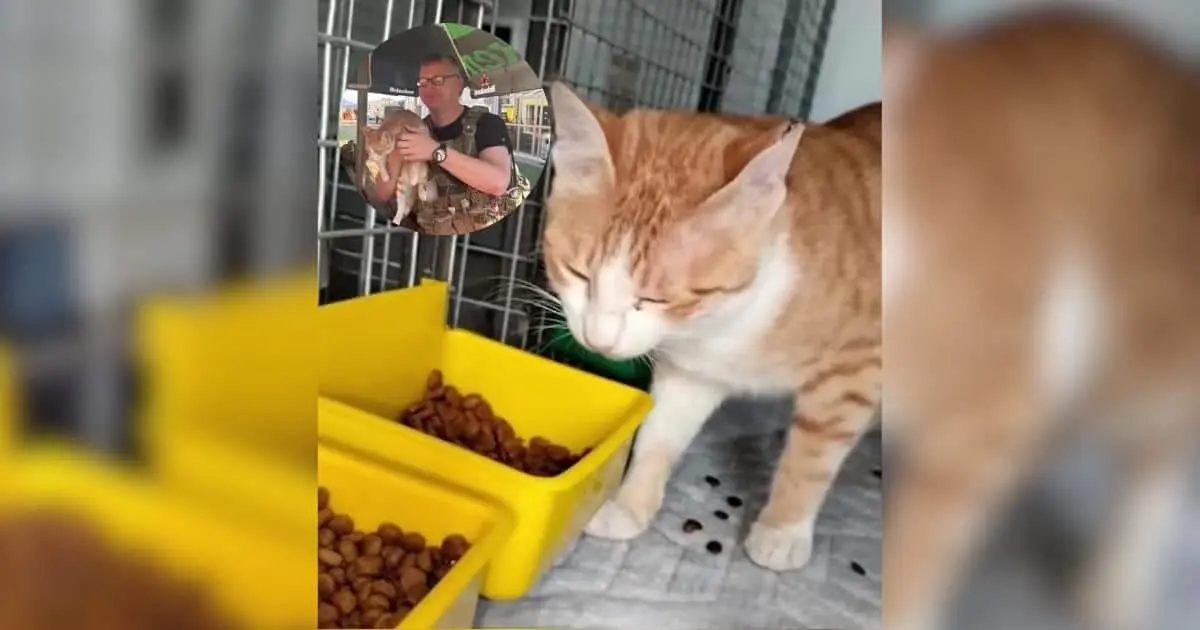
It was outside a recreation facility known locally as "the Oasis" that Harring-Spoerl first encountered the small, hungry orange stray. Visibly undernourished and braving an unforgiving urban environment, the cat showed a striking lack of wariness, stepping forward to solicit attention and sustenance from the troops.
"He was right outside begging for food. He was a lot smaller than he is now," Harring-Spoerl recalled.
Recognizing a kindred spirit in an environment devoid of familiar comforts, Harring-Spoerl and his fellow soldiers began setting aside portions of their rations for the visitor. What started as an act of charity quickly transformed into a daily ritual. The cat’s presence offered a vital psychological anchor. In a landscape where interactions were heavily guarded and structured around risk mitigation, offering and receiving affection from an animal restored a semblance of normalcy.
The emotional exchange was reciprocal. As Harring-Spoerl noted, the cat provided mental fortification during months of separation from family and civilian life, succinctly summarizing the dynamic: "Because he helped my morale as much as I helped him."

The Separation and an Improbable Reunion
As is the nature of military deployments, operational requirements eventually demanded that Harring-Spoerl’s unit pack up and move out of the area. The parting was fraught with anxiety. Leaving a dependent animal behind in a hostile theater of operations carried heavy emotional weight.
"I knew there wouldn’t be a lot to care for him, and I was worried that the wild Iraqi dogs would get to him," Harring-Spoerl explained. For weeks, the fate of the little orange cat remained entirely unknown.
However, the cat’s survival instincts—honed on the streets of Baghdad—led to an extraordinary stroke of fate. While an explosive ordnance disposal (EOD) technician was clearing a route near Baghdad’s international airport, the orange cat materialized from the surroundings. Demonstrating absolute fearlessness, the animal approached the technician, weaving between his legs and dangerously close to unexploded ordnance.
Recognizing the hazard, the EOD specialist scooped the cat up, placed him safely inside a vehicle, and initiated contact with the Baghdad Embassy Cat Coalition. Composed of embassy personnel, international contractors, and stationed service members, the informal rescue network—fondly dubbed the "Kitty Committee"—routinely provides triage, feeding stations, and veterinary coordination for the stray animal population inhabiting diplomatic compounds. Given a temporary home and medical evaluation, the cat was christened "Sully," named in honor of the nearby Sully Compound.
Weeks later, Harring-Spoerl began volunteering his off-duty hours with the exact same coalition. When organizers asked if he had considered adoption and introduced him to candidates currently under their care, he stopped in his tracks. Among them was Sully.
"They were showing me available cats and I recognized Sully," Harring-Spoerl said. "And I’m like, this is the cat. I had him!"
A quick consultation of digital photographs stored on his mobile phone confirmed the physical markings and unique features. The cat he thought he had lost forever had miraculously crossed paths with him a second time.
The Epic Logistics of the Journey Home
Reuniting with Sully in Baghdad was only the first hurdle; transporting a feline from an active conflict zone to the American Midwest presented an administrative and logistical labyrinth.

Harring-Spoerl rotated back to the United States on June 3, returning to his hometown roots near Stoughton, Wisconsin, while Sully remained overseas awaiting proper clearance. The rescue effort was spearheaded by SPCA International through its specialized "Patriot Pets" program, an initiative dedicated to navigating the complex barriers of military-zone animal repatriation.
The path to relocation was fraught with delays. Escalating regional tensions, restricted airspace, and fluid commercial and military flight availability caused an intended July transport to fall through. For Harring-Spoerl, monitoring news reports of conflict and instability in Iraq from the safety of Wisconsin was agonizing.
"It was nerve-wracking," he admitted. "It became rather worrying because it’s like, that’s my cat. I want him to be cared for."
Despite the obstacles—including crowded cargo manifests, sudden flight cancellations, and the low priority traditionally afforded to animal transport during geopolitical crises—SPCA International persevered. Eventually, a viable route opened. Sully was loaded onto a dedicated cargo flight departing Iraq for New York.
Upon clearing U.S. Customs, a relay network of dedicated animal transporters ferried the cat westward. The final handoff occurred in Wauwatosa, Wisconsin, marking the end of a separation that had stretched across months and oceans.
Integration and Adaptation in Wisconsin
The transition from the streets of Baghdad to a quiet Wisconsin household required patience. Following a grueling 16-hour flight, Sully was understandably skittish inside his carrier. Harring-Spoerl climbed into the back seat of the transport vehicle, using familiar tones and treats to coax his long-lost companion into the open.
The adjustment period was remarkably brief. Within days of arriving at the Harring-Spoerl family home near Stoughton, Sully had transitioned seamlessly into domestic life. The cat that once navigated military checkpoints and evaded regional hazards was now spending his days napping beside family members, welcoming affection, and enjoying indoor comforts.
Notably, Sully was not an isolated case within Harring-Spoerl’s unit. The deep bonds formed between soldiers and local fauna earned the group the affectionate designation of the "cat platoon," with Harring-Spoerl’s platoon sergeant ultimately adopting another feline through the same deployment-rescue pipeline.

Supporting Context & Metrics
The psychological challenges faced by deployed service members are well-documented by military health researchers. According to data from the Department of Defense, long-term deployments outside the continental United States consistently correlate with elevated risks of operational fatigue, anxiety, and homesickness. While institutional mental health resources remain the primary mechanism for support, non-traditional interventions—such as interaction with animals—have gained formal recognition among behavioral health specialists.
| Metric / Factor | Contextual Details |
|---|---|
| Deployment Duration | 367 days total operational deployment across Kuwait, Jordan, Syria, and Iraq. |
| Geographic Span | Multiple tactical environments, culminating in diplomatic support operations in Baghdad. |
| Transit Distance | Over 6,000 miles bridging Baghdad, Iraq, and Stoughton, Wisconsin. |
| Key Organizations Involved | SPCA International (Patriot Pets Program), Baghdad Embassy Cat Coalition ("Kitty Committee"), Wisconsin Army National Guard. |
Official Statements and Expert Perspectives
The psychological mechanics behind military-animal bonds are profound, serving as a vital counterweight to the depersonalized nature of contemporary conflict zones.
Lori Kalef, Director of Programs for SPCA International, emphasizes the critical stabilizing influence that animals provide in high-stress environments. According to Kalef, dogs and cats encountered during deployments offer a unique form of therapeutic grounding:
"These relationships can become particularly important for service members deployed in conflict regions. Dogs and cats can provide companionship and a sense of unconditional affection in circumstances where both may be difficult to find."
For Harring-Spoerl, the motivation to bring Sully across the globe was rooted in a sense of moral reciprocity and deep empathy forged under shared duress. Reflecting on the finality of bringing his companion home to Wisconsin, Harring-Spoerl shared:
"He helped me out a lot mentally over there. He helped my soldiers out a lot mentally. I wanted to do the best that I can to care for him because no cat deserves to be in a war."
Future Outlook
The successful repatriation of Sully highlights the vital, ongoing mission of animal welfare organizations operating in tandem with military personnel. Programs like SPCA International’s Patriot Pets continue to serve as a bridge between active-duty service members and the animals who share their hardships abroad.
As geopolitical friction persists in various global hotspots, military units will inevitably encounter stray and feral animal populations. The story of Second Lieutenant Aaron Harring-Spoerl and Sully demonstrates that beneath the austere logistics of defense and deployment, human compassion remains resilient. Sully’s journey from an endangered street cat outside the Oasis recreation facility to a secure, beloved family member in Wisconsin stands as an enduring testament to the healing power of the human-animal bond—proving that love, once sparked, can successfully navigate the vastest of distances.