
Executive Overview
For decades, the journey of a potato from the fertile soils of a farm to the processing plants of consumer packaged goods (CPG) giants has been fraught with invisible, yet staggering, financial losses. Potatoes are notoriously delicate crops. Their high water content and susceptibility to pressure mean that even the slightest mishandling during harvest can result in bruising. This seemingly minor physical damage triggers enzymatic discoloration, rendering millions of dollars’ worth of produce unmarketable each year. The agricultural industry has long accepted these losses as an inevitable cost of doing business, rooted in the complexities of mechanized harvesting.
However, a groundbreaking cross-industry collaboration is upending this status quo. PepsiCo, one of the world’s largest food and beverage corporations, has joined forces with Grimme, a premier global agricultural machinery manufacturer, and immersive learning technology provider Altoura. Together, they are tackling the supply chain crisis at its most fundamental, yet chronically overlooked, source: the operator. By leveraging cutting-edge digital twin technology and virtual reality (VR), the partners have engineered a training ecosystem that allows farmers and machinery operators to master the intricacies of heavy-duty harvesting equipment long before they ever step foot in a tractor.
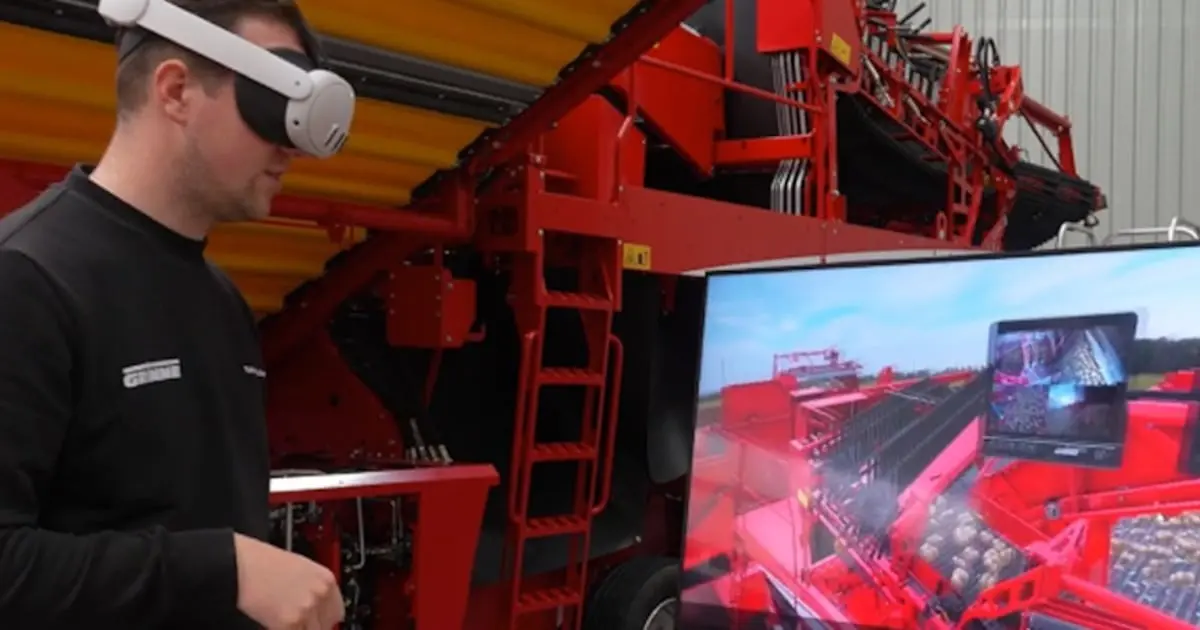
The initiative centers on the creation of high-fidelity virtual replicas of Grimme’s flagship EVO and SE series potato harvesters. Through immersive simulations, operators can virtually inspect machine components, remove panels, troubleshoot mechanical adjustments, and practice optimal harvesting techniques in a risk-free digital environment. Designed primarily for VR headsets—yet fully accessible via everyday desktops, tablets, and smartphones—the platform is engineered for the realities of modern agriculture, functioning seamlessly offline without the need for Wi-Fi or mobile service once downloaded.
The initial results of this initiative are nothing short of transformative. Pilot programs executed across international markets have demonstrated an astonishing 87% increase in bruise-free potato yields, alongside a 1.7-fold reduction in severe crop bruising. As agriculture faces mounting pressures from labor shortages, climate volatility, and the imperative for sustainable resource management, this initiative offers a compelling blueprint for the future of farming. By democratizing access to expert-level machinery training across borders, languages, and seasonal labor pools, PepsiCo and Grimme are proving that the next agricultural revolution will not just be built on physical machinery, but on the digital mastery of it.
Detailed Chronology: From Concept to Global Implementation
The genesis of this transformative agricultural training program did not happen overnight. It is the result of a calculated, multi-year evolution in how multinational corporations approach supply chain resilience, technology transfer, and workforce development.
Phase 1: Intra-Company Innovation and Cross-Sector Inspiration
The conceptual foundation of the potato harvester digital twin was laid outside of traditional agronomy. Earlier in the industrial cycle, PepsiCo leadership began exploring advanced technologies to optimize its manufacturing and supply chain operations. This momentum was crystallized when the CPG giant announced a landmark artificial intelligence and digital twin collaboration with industrial tech leaders Siemens and Nvidia, deploying sophisticated simulation tools to revolutionize factory-floor manufacturing.
Observing the profound efficiencies gained through these industrial digital twins, agricultural leadership at PepsiCo posed a critical question: If virtual replicas could optimize complex manufacturing plants, could they not also optimize the agricultural machinery operating at the very beginning of the supply chain?
The hypothesis was simple yet radical. Farming operations, particularly specialized harvesting, rely heavily on seasonal, highly mobile, and geographically dispersed labor. Ensuring uniform operating standards across thousands of independent growers and hired hands is notoriously difficult. Translating the manufacturing digital twin framework into an agricultural context offered a way to bridge this gap, taking the tribal knowledge of veteran agronomists and packaging it into an interactive, scalable digital format.
Phase 2: Engineering the Digital Twin
To bring the vision to life, PepsiCo partnered with Grimme—a titan in potato harvesting technology—and Altoura, a specialist in immersive learning software. The objective was to build hyper-accurate digital replicas of Grimme’s EVO and SE series harvesters.
Unlike standard video tutorials or static user manuals, these digital twins function as fully interactive, physics-based simulations. Every mechanical adjustment—from web speeds and roller pressures to share depths and separator configurations—reacts in the virtual space exactly as it would in the physical world. Operators can walk around the virtual machine, open maintenance panels, remove internal components, and witness firsthand how altering machine parameters affects crop flow and bruising potential.
Recognizing the infrastructure limitations common in rural agricultural communities, the development team prioritized offline functionality. Once the Altoura-powered application is downloaded onto a device, operators require no active Wi-Fi or mobile data connection to run the training modules. This design choice ensured that farmers in remote fields could access high-end simulation technology just as easily as those in urban-adjacent agricultural hubs.
Phase 3: International Pilot Testing (Brazil, Mexico, Poland, and Romania)
With the technology built, the coalition initiated a rigorous global field-testing phase. Last year, PepsiCo and Grimme launched pilot deployments in key agricultural markets across Latin America, specifically targeting Brazil and Mexico. These regions provided diverse soil conditions, varying climate dynamics, and distinct operator demographics, making them ideal testing grounds for the platform’s adaptability.
Following the success of the Latin American trials, the program expanded into Eastern Europe, rolling out pilot evaluations in Poland and Romania. During these trials, the companies measured not only the mechanical proficiency of the operators but, more importantly, the tangible impact on crop quality. The metrics recorded during these international deployments exceeded expectations, laying the groundwork for broader commercial validation.
Phase 4: Global Showcase and Commercial Scaling
Building on the momentum of the European trials, PepsiCo showcased the Grimme digital twin training platform at its prestigious Global Agro University in Germany. This event served as a major inflection point, introducing the technology to international agronomy leaders, supply chain partners, and independent growers.
Concurrently, the partners adopted a measured, region-specific rollout strategy. Rather than deploying a monolithic, one-size-fits-all training program, PepsiCo and Grimme worked closely with local agronomists to tailor the software to regional farming practices, linguistic nuances, and regulatory environments. This deliberate localization strategy has become the bedrock of the program’s ongoing expansion, ensuring high adoption rates among diverse farming communities worldwide.
Supporting Context & Metrics: The Economics of Potato Bruising
To fully appreciate the significance of the PepsiCo-Grimme collaboration, one must understand the profound economic and operational realities of potato farming. The potato is a foundational crop for the global food industry, serving as the primary input for chips, fries, and a myriad of consumer packaged goods. However, the path from soil to processing plant is fraught with physical hazards.
The Anatomy of Potato Bruising
Potato bruising is generally categorized into three types: blackspot, internal pressure bruising, and shatter bruising.
- Blackspot bruising occurs when the tissue beneath the skin is damaged by impact, causing enzymes to react with phenolic compounds and turn the flesh dark gray or black. This damage often remains invisible until the potato is peeled or processed, leading to massive rejections at processing facilities.
- Shatter bruising involves immediate cracking or splitting of the tuber skin, making the potato instantly susceptible to moisture loss and fungal rot during storage.
- Internal bruising develops during long-term storage due to excessive compressive forces and poor handling practices.
Globally, these forms of damage result in millions of dollars in lost revenue annually. For independent growers contracted by major CPG companies, bruised crops translate into rejected shipments, downgraded grades, and severely compressed profit margins. For PepsiCo, inconsistent raw material quality disrupts manufacturing efficiency, increases waste, and threatens sustainability targets.
Quantifying Success: The 87% Solution
The financial and operational stakes make the metrics emerging from the PepsiCo-Grimme pilot program all the more compelling. According to data released by PepsiCo, the implementation of the digital twin training platform yielded extraordinary operational improvements:
- 87% Increase in Bruise-Free Potatoes: Farms utilizing the VR training platform saw an almost nine-fold increase in the harvest of pristine, unblemished tubers compared to control groups relying on traditional, informal training methods.
- 1.7x Reduction in Severe Bruising: Catastrophic crop damage—the kind that renders entire batches unusable for high-grade processing—was nearly halved, dramatically preserving the economic value of the harvest.
Solving the Agricultural Labor Crisis
Beyond crop preservation, the digital twin initiative directly addresses one of the most persistent structural crises in modern agriculture: the severe shortage of skilled labor.
Agriculture has long suffered from chronic labor deficits, exacerbated by an aging rural workforce, difficulties in attracting younger generations to farming, and an increasing reliance on seasonal workers. Training temporary or seasonal staff on multimillion-dollar agricultural machinery has traditionally been a high-risk, ad-hoc endeavor. Novice operators learning "on the fly" in the field often make costly mechanical errors, resulting in equipment wear-and-tear, excessive downtime, and ruined crops.
The Altoura-powered VR platform democratizes expert-level knowledge. By shifting the learning curve from the physical field to the virtual world, farms can onboard seasonal workers rapidly and safely. Operators can repeat complex maintenance procedures or harvester adjustments virtually as many times as necessary to build muscle memory and cognitive confidence, completely eliminating the risk of operational errors during actual harvest execution.
Official Industry Perspectives & Strategic Insights
The success of the digital twin initiative is deeply rooted in a philosophy of collaborative innovation and empathetic technology adoption. Industry leaders driving the partnership have offered profound insights into the strategic thinking behind the platform.
Adapting to Local Realities: The Vision of Rob Meyers
Rob Meyers, Vice President of Global Agriculture at PepsiCo, has been instrumental in spearheading the integration of advanced digital tools into the company’s agricultural supply chain. In interviews with agricultural technology analysts, Meyers emphasized that the true genius of the platform lies not merely in the sophistication of the VR headsets, but in its meticulous adaptation to human and regional realities.
"Adapting to local realities is often more important to driving adoption at scale," Meyers explained. "As we expand into new markets, we’re continuing to refine the experience, including language support and training content. The goal isn’t to introduce complexity. It’s to make proven expertise available to more operators, in more places, before they enter the field."
Meyers noted that the inspiration to bring virtual reality to the farm came from observing internal successes within PepsiCo’s manufacturing divisions. When leadership witnessed how industrial digital twins transformed operator training in factory settings, applying the same logic to agricultural field operations felt like a natural, albeit pioneering, evolution.
Addressing Scalability and Cost Barriers
A central theme in agricultural technology discourse is the barrier of cost versus return on investment (ROI). Advanced technologies often fail to achieve widespread adoption among independent growers due to prohibitive upfront expenditures. Meyers addressed this concern directly, framing the VR training platform as a high-yield risk-mitigation tool.
"One of agriculture’s biggest challenges is delivering consistent, high-quality training to operators who may be seasonal, geographically dispersed, or working in different languages and markets," Meyers stated. "The opportunity with digital tools is their ability to make expert training more accessible and scalable. Of course, cost is always an important consideration for the adoption of any technology. The loss of revenue for a farmer due to bruising can be very high, and the VR technology costs are only a fraction of this risk."
By framing the cost of VR hardware and software licenses against the catastrophic financial losses of crop bruising—which can easily run into tens of thousands of dollars per farm annually—PepsiCo and Grimme have positioned the technology not as an expensive luxury, but as an essential, high-ROI investment in farm profitability.
Future Outlook: The Next Frontier in Smart Agriculture
As the PepsiCo, Grimme, and Altoura partnership transitions from pilot validation to global commercial scaling, the broader implications for the agricultural sector are profound. The success of the potato harvester digital twin signals a paradigm shift in how machinery manufacturers, CPG corporations, and independent growers will collaborate in the decades to come.
Expansion Beyond Potatoes and Harvesters
The foundational architecture of the digital twin training platform is inherently modular. While the initial focus has been laser-focused on Grimme EVO and SE series potato harvesters to solve an acute supply chain bottleneck, the underlying methodology can be readily expanded.
Industry analysts predict that similar immersive learning frameworks will soon be developed for other delicate root and specialty crops—such as sugar beets, carrots, and certain fruits—where mechanical bruising and mishandling similarly drain billions from the global agricultural economy. Furthermore, the scope of the machinery is expanding; future iterations may encompass planters, cultivators, and advanced sorting systems, creating a comprehensive digital training ecosystem across the entire crop lifecycle.
The Convergence of VR, AI, and IoT in Agronomy
Looking ahead, the integration of immersive learning is expected to converge with other emerging agricultural technologies, particularly the Internet of Things (IoT) and artificial intelligence. Imagine a future where an operator trains on a digital twin of a specific Grimme harvester, and that same digital twin is subsequently fed real-time telematics data from the physical machine operating in the field.
Through this continuous feedback loop, machine learning algorithms could identify specific operational habits—such as driving speed during turns or header height adjustments over varying terrain contours—that correlate with minor bruising events. The training platform could then automatically generate customized, targeted virtual retraining modules for that specific operator, creating a hyper-personalized, self-improving agricultural workforce.
Empowering the Next Generation of Farmers
Perhaps the most enduring impact of the digital-first training revolution is cultural. Agriculture faces a generational transition, as aging farmers retire and tech-native younger generations inherit or enter the farming profession. Traditional agricultural education has often struggled to bridge the gap between heavy mechanical grit and modern digital fluency.
By introducing immersive VR environments, interactive 3D modeling, and gamified learning mechanics into agricultural training, companies like PepsiCo and Grimme are transforming the perception of farming. They are bridging the generational divide, making agricultural machinery operation appealing to tech-savvy youth while simultaneously empowering traditional farmhands with world-class technical expertise.
Conclusion
The collaboration between PepsiCo, Grimme, and Altoura is much more than a successful corporate pilot program; it is a visionary glimpse into the future of sustainable, efficient agriculture. By confronting a seemingly mundane and accepted agricultural problem—potato bruising—with state-of-the-art immersive technology, the partners have unlocked unprecedented economic value and operational resilience.
With an 87% increase in bruise-free yields and a scalable framework for global workforce upskilling, this initiative proves that the most powerful tool in modern farming is not just the horsepower of the tractor, but the knowledge of the human operating it. As the technology continues to scale across international borders, it establishes a powerful gold standard for how global supply chains can innovate from the ground up, ensuring that the food of tomorrow is cultivated with unprecedented care, precision, and efficiency.