
Executive Overview
For over a quarter of a century, German agricultural machinery giant Claas has maintained an active industrial footprint in North America. What began as a strategic manufacturing partnership with Caterpillar has matured into an independent, deeply localized operational network. Today, the Omaha, Nebraska facility stands as the nerve center of this long-term strategy. In an era marked by shifting trade dynamics, volatile tariff policies, and evolving farm economies, original equipment manufacturers (OEMs) face immense pressure to balance global efficiencies with hyper-local responsiveness.
Claas is leaning into this challenge head-on. The company recently inaugurated a state-of-the-art, 44,800-square-foot Research and Development (R&D) center at its Omaha campus. Designed to serve as the critical bridge between North American agricultural realities and German engineering prowess, this facility represents a multi-million-dollar commitment to regional innovation.
Simultaneously, Claas has had to deftly maneuver through choppy geopolitical waters. Navigating complex tariff structures, managing import-export flows from European headquarters, and establishing an internal tariff task force to monitor shifting U.S.-Canada trade policies have all become standard operating procedure. Despite these macro-level headwinds, the manufacturer is pressing forward with aggressive localization initiatives—such as sourcing an estimated 40% of its Lexion combine components domestically and rolling out high-horsepower tractor lines designed explicitly for North American growers.
This deep-dive report examines the technological milestones behind the new Omaha R&D hub, explores how trade dynamics are reshaping the OEM landscape, and analyzes why Claas executives remain steadfast in their assertion that the company is "here to stay" and positioned for long-term growth.
Detailed Chronology: From Caterpillar Partnership to the Omaha R&D Hub
To understand the weight of Claas’s latest infrastructural investment, one must look back at the trajectory of the brand’s presence in North America.
- The Late 1990s: Claas established its foundational manufacturing presence in North America through a high-profile original equipment manufacturing and distribution partnership with Caterpillar. This alliance allowed the German firm to leverage Caterpillar’s extensive dealer network while introducing its advanced harvesting technology to American soil.
- 2002: Building upon the success of the initial partnership, Claas transitioned to independent operations in North America, cementing its brand identity and establishing direct control over its manufacturing, distribution, and customer support networks.
- August 2024: Signaling a major evolution in its regional strategy, Claas officially broke ground on a massive 44,800-square-foot R&D facility integrated into its existing Omaha, Nebraska manufacturing footprint. The project was envisioned not merely as an extension of the factory floor, but as a crucial node in the company’s global innovation network—joining existing engineering and development powerhouses in Germany, China, France, and Hungary.
- Late Summer 2025: Amid broader macroeconomic shifts, trade negotiations, and fluctuating supply chain pressures, Claas briefly adjusted portions of its combine production lines back to its German headquarters. Demonstrating a strong commitment to its local workforce, the company collaborated closely with Omaha community leaders and municipal businesses to safeguard jobs during the temporary transition, successfully recalling and reintegrating workers as production volumes ramped back up.
- August 29, 2025: Claas officially published formal structural details regarding the completion of the R&D center, highlighting its dual-floor office layout and advanced physical and digital intellectual property (IP) protection measures.
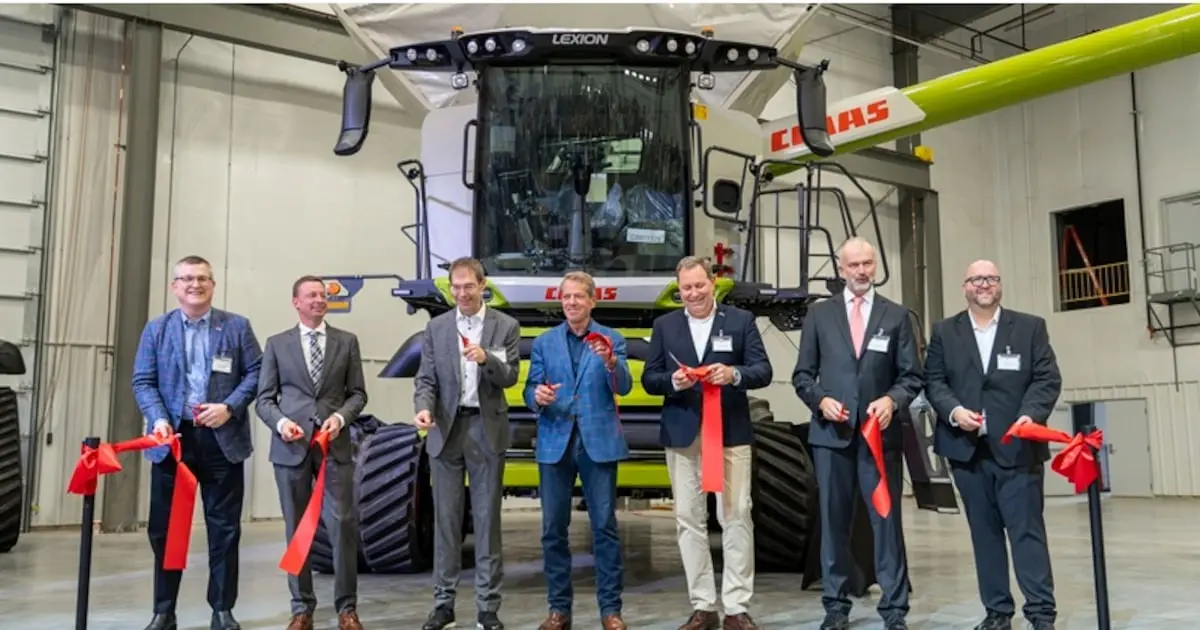
- October 8, 2025: A festive ribbon-cutting ceremony marked the official grand opening of the Omaha R&D center. Company leadership, local officials, and engineering teams gathered to celebrate the facility’s immediate integration into Claas’s global R&D pipeline.
- September 2026: Expanding beyond its harvesting dominance, Claas made significant waves at the annual Farm Progress Show by showcasing its newly minted Arion 6 and Axion 8 and 9 tractor lineups, spanning a robust 165 to 450 horsepower range tailored specifically for mixed-farming operations and massive row-crop enterprises.
Supporting Context & Metrics: Engineering for the American Heartland
The newly operational Omaha R&D facility is far more than a collection of drafting tables and conference rooms; it is a sophisticated testing and evaluation ecosystem. According to Matthias Ristow, Managing Director of Business Administration at Claas, the core function of the facility is to subject machinery to the punishing, unique rigors of North American topography, climate, and farming practices, and to distill that data for corporate headquarters in Harsewinkel, Germany.
Bridging Local Realities and Global Engineering
North American agriculture is defined by scale. Fields span thousands of acres, harvest windows are fiercely compressed by unpredictable weather events, and soil conditions vary wildly from the rolling hills of the Midwest to the heavy clay of the Canadian prairies. European-spec machines, while marvels of efficiency, often require specific calibration and structural hardening to survive the sheer throughput demanded by North American large-scale farmers.
The Omaha R&D center addresses this gap by placing boots on the ground. Engineers stationed at the facility are immersed in the local ecosystem. They interface directly with regional dealers, commercial custom harvesters, and multi-generation farmers to identify pain points—whether those involve residue management in high-yield corn, electronic control integration, or structural fatigue under heavy loads.
Protecting Intellectual Property and Fostering Collaboration
Modern agricultural machinery is essentially a rolling supercomputer, packed with proprietary software, telemetry systems, and advanced metallurgical formulas. Recognizing the high stakes of agricultural technology development, Claas invested heavily in cutting-edge security measures for the Omaha facility. The two-story structure incorporates robust digital firewalls and physical access protocols designed to safeguard sensitive intellectual property while maintaining a collaborative, open-plan workspace conducive to rapid prototyping and cross-continental digital conferencing.
Localization Metrics: Building Where You Sell
Beyond research and development, Claas has quietly advanced its domestic supply chain footprint. Shifting economic pressures and freight logistics have made hyper-localized manufacturing an operational imperative.
- Component Localization: An estimated 40% of the components utilized in the construction of Claas Lexion combines are now sourced and manufactured directly within North America.
- Structural Investments: The company has localized the production of major structural elements, including high-capacity grain tanks, reducing ocean freight dependency and shielding the assembly line from certain maritime supply chain disruptions.
- Footprint Expansion: The combined Omaha manufacturing and R&D campus spans a massive footprint, anchoring Claas’s physical presence in the agricultural heartland and ensuring that replacement parts and technical support remain within arm’s reach of regional dealers.
Official Statements and Industry Insights
To fully grasp the motivations behind the Omaha expansion and the strategic maneuvering required in today’s macroeconomic climate, industry observers look directly to the leadership guiding the enterprise. Matthias Ristow recently sat down to elaborate on the philosophy driving Claas’s North American strategy.
The Value of Proximity
"The advantage of having a local R&D team is it’s staffed by local people who know the local markets, who know the local technologies, the local harvesting needs, and their job is to communicate that knowledge to their colleagues in Germany," Ristow explained.
This feedback loop is vital for product lifecycles. Rather than designing equipment in a vacuum and attempting to retrofit it for foreign markets, Claas ensures that regional requirements are baked into the foundational blueprint of tomorrow’s machinery.
"When new products are prepared for the future markets, then it’s their job to communicate this and make sure that those needs of the local farmers can be found in the new product set," Ristow added.
Navigating the Tariff Maze
The agricultural equipment sector does not operate in a political vacuum. Over recent years, shifting trade policies, cross-border disputes, and aggressive tariff implementations have disrupted traditional supply chains. Claas, which relies on a sophisticated web of parts shipped from European production facilities to be assembled in North America, has had to adapt rapidly.
During periods of acute trade uncertainty—such as when the previous administration’s tariff frameworks altered the cost basis of imported steel, electronics, and mechanical assemblies—Claas was forced to make agile adjustments. This included temporarily shifting specific combine production lines back to Germany. However, the company prioritized its workforce during the transition.
"For a company like us that is importing many parts from overseas, tariffs are an issue—no question," Ristow stated candidly. "And we closely monitored that topic together with our colleagues in Germany. [We] formed our own tariff task force and exchanged information, making sure that our folks at corporate are well informed about what’s going on here."
Keeping Watch on Northern Borders
The work of the internal tariff task force is far from finished. Today, the committee continues to monitor trade friction between the United States and its northern neighbors. Following the breakdown of certain trade discussions and the implementation of steep tariff rates on various Canadian goods—including industrial machinery and automotive components—manufacturers with integrated cross-border supply chains have been placed on high alert.
"Canada is a big market for us. I don’t think that the discussions are totally over with the Canadian government and the U.S. government," Ristow noted, highlighting the fluid nature of North American trade diplomacy. "So, we have to closely monitor that and see what’s coming in the future."
Future Outlook: Planting Seeds for Long-Term Growth
Despite the complexities of global trade, currency fluctuations, and cyclical downturns in farm income that have occasionally dampened machinery sales volume across the broader OEM market, Claas’s leadership remains unreservedly bullish on the North American theater.
The debut of the Arion 6 and Axion 8 and 9 tractor series—spanning the highly competitive 165 to 450 horsepower brackets—proves that Claas is expanding its portfolio beyond its world-renowned combine harvesters. By targeting mixed-farming operations and intensive row-crop applications, the company is positioning itself to capture market share in segments historically dominated by domestic and legacy short-line competitors.
Furthermore, the operational integration of the Omaha R&D facility ensures a steady stream of market-adapted innovations. Whether through the integration of artificial intelligence, autonomous field features, enhanced telemetry, or more durable mechanical assemblies, the Omaha hub will serve as the proving ground for the next generation of agricultural productivity tools.
"We want to grow. That means we also need to grow in North America, and for that we need to invest and prepare us for the future," Ristow concluded, summarizing the overarching corporate sentiment. "And the group executive board has done that, so Claas is ready. We are here to stay."
As North American agriculture continues to consolidate, face labor shortages, and embrace precision farming technologies, manufacturers equipped with local engineering agility and strong industrial roots will be best positioned to weather the storms. Through strategic investments in Nebraska and a watchful eye on global trade dynamics, Claas has signaled that it is not merely participating in the North American market—it is helping shape its future.