
Executive Overview
For generations, the chronicle of animal life on Earth has been read as a sudden, dramatic prologue to the Cambrian explosion. Traditional paleontology pointed to a relatively abrupt emergence of complex, multicellular organisms roughly 540 to 530 million years ago, suggesting that the kingdom Animalia burst onto the global stage in a tight evolutionary window. However, a landmark study published in Science Advances on October 2 has upended this foundational premise.
Led by an international team of researchers from the University of Oxford, alongside colleagues from the University of California Berkeley, ETH Zürich, and Yale University, the new study suggests that animals may have evolved up to 200 million years earlier than previously indicated by the definitive fossil record.
At the heart of this revelation is the dismantling of a core assumption that has long governed how scientists interpret ancient sedimentary deposits. By analyzing exceptionally preserved microfossils from the Kheseen Biota in Mongolia, the research team demonstrated that environments capable of preserving delicate organic remains can be entirely devoid of animal fossils—even during periods when it is known with absolute certainty that animals populated the Earth.
This finding shatters the long-standing dogma that the absence of animal fossils in older, exquisitely preserved deposits, such as China’s 590-million-year-old Weng’an Biota, proves animals had not yet evolved. When researchers adjusted their molecular-clock models to accommodate this wider margin of error, the estimated origin of the animal kingdom was pushed backward into the Neoproterozoic Era, placing the genesis of animal life between 800 and 700 million years ago.
This profound recalibration of evolutionary history places the dawn of the animal kingdom perilously close to, or perhaps even preceding, some of the most catastrophic global climate upheavals in planetary history: the extreme glacial crises colloquially known as "Snowball Earth."
Detailed Chronology: Deconstructing the Fossil Record and Rewriting the Timeline
To understand the magnitude of the Oxford-led study, one must examine how scientists have historically constructed the evolutionary timeline of multicellular life. The conventional narrative relied heavily on a straightforward deductive method: if a geological deposit displays extraordinary conditions capable of capturing microscopic, soft-tissue structures in exquisite detail, and yet contains no trace of animal fossils, it is safe to assume that animals simply did not exist when those rocks were formed.
The Weng’an Biota Dilemma
For years, the gold standard for this line of reasoning was the Weng’an Biota in South China. Preserved in Ediacaran-age rocks roughly 590 million years old, the Weng’an deposit is a paleontological treasure trove. It contains microscopic organisms, algae, and proto-animal candidates preserved with cellular-level fidelity. Yet, despite exhaustive study by multiple generations of paleontologists, not a single specimen from Weng’an can be definitively classified as an undisputed animal.
This glaring absence formed the bedrock of a major chronological constraint. Scientists argued that if complex metazoans (animals) had been roaming the ancient seas 590 million years ago, the exceptional preservation environment of Weng’an would have inevitably captured them. Therefore, the argument concluded, the absolute maximum age for the origin of the animal kingdom had to post-date the formation of the Weng’an Biota.
The Kheseen Biota as the Control Test
The new international research team decided to put this foundational assumption to a rigorous empirical test. They turned their attention to the Kheseen Biota, a fossil-rich assemblage located in Mongolia that is approximately 40 million years younger than the Weng’an Biota (dating to roughly 550 million years ago).
Crucially, the Kheseen Biota shares several species with Weng’an, proving that the two sites preserve overlapping biological communities. More importantly, independent lines of evidence—such as definitive animal body fossils recovered from contemporaneous strata in Namibia and South China—prove beyond a shadow of a doubt that animals were widespread and thriving globally by the time the Kheseen Biota was deposited.
Deploying advanced scanning electron microscopy across more than 140 samples, including material collected from previously unexplored geographic locations, the researchers conducted an exhaustive microfossil survey. The analysis revealed a stunning array of exquisitely preserved microfossils, including intricate acritarchs (spherical single-celled organisms adorned with delicate spines and branching projections) and mysterious, embryo-like structures complete with internal cell divisions.
Despite this astonishing level of preservation, the researchers found zero definitive animal remains within the Kheseen assemblage.
This empirical disconnect effectively broke the long-standing Weng’an argument. If a fossil assemblage as exquisitely preserved as Kheseen can completely fail to capture animals that are historically and globally known to have existed at that time, then the absence of animal fossils in Weng’an can no longer be used as proof of absence. The lack of animal remains in ancient rocks is revealed to be a function of ecological preference, micro-environmental patchiness, or localized chemical barriers to fossilization, rather than a definitive testament to the non-existence of the metazoan lineage.
Recalibrating the Molecular Clock
With the primary constraint keeping animal origins pinned to the late Ediacaran period effectively dismantled, the research team unlocked a new pathway for evolutionary modeling.
Scientists frequently utilize "molecular clocks"—a mathematical technique that analyzes the accumulation of genetic mutations over time across living species, combining this genetic data with known fossil calibration points and estimated rates of evolutionary divergence to project backward toward a common ancestor.
When previous models were constrained by the younger Ediacaran age of the Weng’an deposit, the molecular clock was artificially squeezed, compressing the deep history of animal evolution into a narrow temporal band. However, by removing Weng’an as a hard ceiling, the researchers were able to incorporate much older, highly fossiliferous geological formations dating from 850 to 730 million years ago. These included:
- The Svanbergfjellet Formation in Norway.
- The Bitter Springs Group in Australia.
- The Chuar Group in Arizona, United States.
These ancient, well-studied strata possess the chemical and physical capacities to preserve delicate organic remains, though no definitive animal fossils have yet been recovered from them. Using these older formations to establish the maximum evolutionary bounds, the updated molecular-clock calculations shifted the estimated genesis of the animal kingdom backward by roughly 200 million years. The newly computed timeline places the emergence of ancestral animals squarely in the interval between 800 and 700 million years ago.
Supporting Context & Metrics: Biomarkers, Soft Bodies, and Snowball Earth
Pushing the origin of animals back into the Tonian period—the era spanning from 1 billion to 720 million years ago—not only solves lingering theoretical tensions within evolutionary biology, but it also aligns neatly with several other independent proxies that have long hinted at a hidden, ghost lineage of early metazoans.
Chemical Fossils and the Sponge Hypothesis
Decades before body fossils appear in abundance, the chemical signature of life tells a different story. Organic geochemists studying ancient sedimentary rocks have identified specific molecular fossils, known as biomarkers, that serve as biological fingerprints.
Prominent among these are specific steranes—chemically stable breakdown products of biological lipids—that are consistent with the presence of demosponges living at least 650 million years ago. These chemical biomarkers predate the oldest undisputed macroscopic animal body fossils by tens of millions of years. Critics of the biomarker hypothesis have historically argued that such molecules could have been produced by archaic protists or early algal lineages, but the Oxford study provides a vital phylogenetic bridge, demonstrating that the genetic and evolutionary machinery for early animal life was not only possible at this depth in time, but mathematically probable.
The Vulnerability of Early Metazoans
Why did these ancient animals leave virtually no physical trace in the pre-Ediacaran record? The answer lies in taphonomy—the study of how organisms decay and become fossilized.
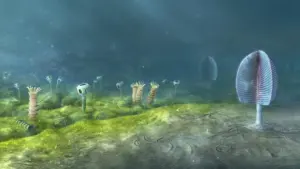
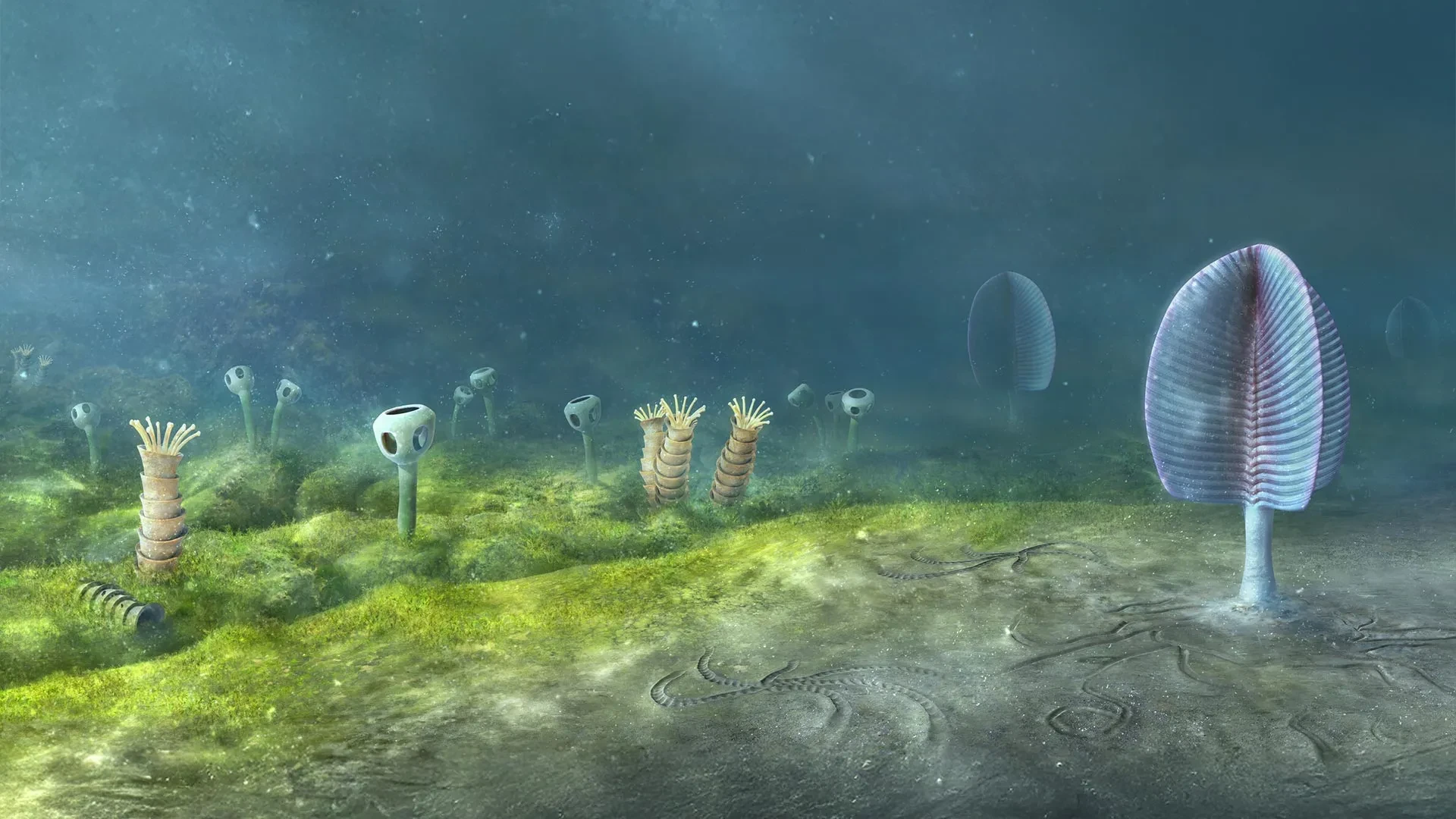
The earliest ancestral animals would have been exceedingly small, delicate, and entirely soft-bodied. Lacking mineralized skeletons, calcareous shells, rigid carapaces, or dense collagenous frameworks, these primitive organisms possessed an extraordinarily low fossilization potential. When an ancient organism died, it was almost entirely consumed by scavengers and microbial decay long before sediment could blanket and protect its tissues.
Furthermore, the likelihood of fossilization depends on a precarious confluence of chemical conditions: rapid burial in anoxic (oxygen-depleted) sediments, early mineral precipitation, and rare geochemical micro-environments. Without this improbable alignment of factors, soft-bodied pioneers of the animal kingdom were destined to vanish completely from the physical strata.
Crossing the Threshold of Snowball Earth
Perhaps the most tantalizing implication of a 700-to-800-million-year-old origin for animals involves the Cryogenian Period, which commenced approximately 720 million years ago. This geologic epoch is infamous for hosting the "Snowball Earth" events—some of the most severe, prolonged global ice ages in planetary history, during which thick ice sheets advanced all the way from the poles to the tropics.
For decades, scientists debated whether the extreme environmental stress of Snowball Earth served as a severe bottleneck that wiped out nascent metazoan experiments, or conversely, whether the shifting environmental pressures acted as an evolutionary crucible that forced complex multicellularity to adapt, survive, and ultimately flourish.
By establishing that animals may have originated either immediately before or during the onset of these global glaciations, the new research breathes new life into the latter hypothesis. It suggests that ancestral animal lineages weathered the deep freeze, surviving in localized ice-free marine refugia, hydrothermal vent systems, or beneath thin equatorial ice sheets, primed to radiate outward once the global thaw initiated the Ediacaran and Cambrian ecological explosions.
Official Statements and Academic Insights
The implications of the research have resonated deeply within the global paleontological community, sparking renewed debate over how deep time is measured and interpreted.
Associate Professor Ross Anderson of the Oxford University Museum of Natural History, who served as the senior author of the study, emphasized how thoroughly the new data dismantles old certainties regarding fossil absence.
"The Kheseen Biota breaks the argument that the exceptional microfossils of Weng’an mean we would have seen animal fossils in the assemblage had they existed at the time," Professor Anderson noted. "The Kheseen microfossils are just as well-preserved, yet animals continue to be absent—despite the fact we know at that point they existed."
Highlighting the necessity of looking beyond simple presence-absence paradigms in ancient rocks, Anderson added:
"This suggests animals may have occupied environments different from those represented in the Kheseen deposits, or that the chemical conditions responsible for fossilization there were not suitable for preserving animal remains."
Orin Lole Durbin, the study’s first author—who began the research as an undergraduate at the University of Oxford and is now pursuing his doctoral studies at Virginia Tech—addressed the cautious nuance required when interpreting molecular clocks and absent body fossils.
"Pre-Ediacaran animal body fossils still elude us, and this analysis does not prove that animals existed 800 million years ago," Durbin stated. "However, our new fossil evidence from Mongolia undermines one of the main arguments for restricting animal origins to the Ediacaran interval. Meanwhile, our molecular-clock analyses show how much further back their evolutionary history could extend."
Future Outlook: The Quest for the First Animals
As the academic community digests the findings published in Science Advances, the hunt for the earliest animal life is entering a dynamic new phase. Paleontologists and geobiologists agree that resolving the exact birth date of the animal kingdom will require a departure from traditional, localized fossil hunting.
Expanding the Search Parameters
Future research initiatives must cast a wider net, systematically examining fossil deposits across a much broader spectrum of geographic locations, paleo-environments, and depositional settings. Rather than focusing solely on exceptionally preserved shale or chert deposits that happen to resemble classic Lagerstätten, researchers must target environments that represent the diverse ecological niches of the Neoproterozoic marine world—from deep-water slope environments to shallow marginal marine basins.
Integrating Multi-Proxy Data
The path forward demands a truly interdisciplinary approach. The scientific community can no longer rely on body fossils alone to piece together the history of complex life. Future breakthroughs will depend on the seamless integration of:
- Macro and micro-body fossils: Continued scrutiny of Ediacaran and Tonian strata for cryptic micro-structures.
- Trace fossils: The search for subtle bioturbation, burrowing, and locomotive tracks left in ancient sediments by soft-bodied organisms that chose not to leave their bodies behind.
- Biomarker chemistry: Advanced gas chromatography-mass spectrometry targeting lipid residues and molecular fossils trapped within ancient crystalline matrices.
- Refined molecular clocks: Continuous recalibration of genomic divergence rates using newly discovered fossil nodes and improving computational models.
Until these combined lines of evidence converge on physical specimens from the Tonian period, the absolute, calendar-date birth of the animal kingdom will retain an element of mystery. Yet, as Professor Anderson concluded:
"Until that evidence becomes available, the precise birth date of the animal kingdom remains uncertain—but we now know that our evolutionary roots run far deeper into the Earth’s history than our textbooks have dared to suggest."
Comparative Overview of Fossil Assemblages
| Assemblage Name | Approximate Age | Geographic Location | Preservation Quality | Animal Presence Confirmed? | Historical Assumption vs. Current Reality |
|---|---|---|---|---|---|
| Weng’an Biota | ~590 Million Years | South China | Exceptional (cellular-level microfossils) | No | Old assumption: Proves animals did not exist yet. New reality: Absence reflects environment/taphonomy, not lack of animals. |
| Kheseen Biota | ~550 Million Years | Mongolia | Exceptional (acritarchs, embryos) | No (within this specific site) | Old assumption: Exceptional preservation demands animal fossils if they exist. New reality: Proves well-preserved sites can lack animals even when animals globally exist. |
| Svanbergfjellet / Bitter Springs / Chuar | 850–730 Million Years | Norway, Australia, USA | High preservation potential | No (direct body fossils) | Old assumption: Used as maximum age constraints. New reality: Serves as recalibrated baseline pushing animal origins back ~200 million years. |