
Executive Overview
Deep within the arid expanse of Peru’s northern coast, archaeologists working at the ancient administrative and burial complex of Castillo de Huarmey have uncovered a groundbreaking piece of historical evidence. A recently published study in the Journal of Anthropological Archaeology details the discovery of the physical remains of Peruvian hairless dogs dating back more than 1,200 years—centuries before the rise of the Inca Empire.
The findings include naturally mummified specimens, distinct skeletal anomalies, and chemical signatures embedded in teeth and bone that paint a vivid, nuanced picture of ancient coexistence. Far from being simple working animals or uniform cultural symbols, these ancient dogs experienced a complex spectrum of treatment. While some were interred alongside society’s elite or carefully raised during puppyhood, others shared space with discarded refuse.
Led by an international team of researchers—including first author Weronika Tomczyk of Dartmouth College, alongside colleagues from the University of Warsaw and the University of Pittsburgh—this investigation offers an unprecedented window into the daily lives, societal roles, and domestic environments of a sophisticated pre-Columbian civilization. By bridging zooarchaeological techniques with advanced isotopic analysis, the research team has unlocked new perspectives on how ancient Andean populations interacted with their animal companions, challenging modern assumptions about pet ownership, human-animal bonds, and the layered complexities of ancient life.
Detailed Chronology
The discovery of the hairless dog remains at Castillo de Huarmey is the culmination of decades of careful excavation, punctuated by dramatic historical events, archaeological breakthroughs, and rigorous laboratory analysis.
1. The Wari Era (600–1050 CE)
Occupied more than 400 years before the rise of the Inca Empire, Castillo de Huarmey functioned as a vital regional administrative and elite burial center for the Wari Empire. Located approximately 190 miles north of Lima, the 110-acre complex thrived as a hub of political power, trade, and sophisticated craftsmanship. During this period, humans and animals—including South American camelids and dogs—interacted closely within the fortified settlement, leaving behind biological and cultural layers that would remain hidden beneath the desert sands for over a millennium.
2. The 1970 Earthquake and Subsequent Looting
For centuries, the deeper archaeological strata of the complex remained undisturbed. However, in 1970, a powerful earthquake struck the region, causing structural collapses within parts of Castillo de Huarmey. This seismic event inadvertently exposed deep burial chambers containing valuable ceramics and funerary objects, triggering a wave of illegal looting that disturbed large upper sections of the archaeological site. Despite this destruction, the deeper stratigraphic layers remained preserved, safeguarding the contextual integrity of the ancient Wari occupation.
3. Modern Archaeological Breakthroughs (2012–2022)
Scientific excavations at Castillo de Huarmey yielded world-class discoveries in the 21st century. In 2012, researchers uncovered the first completely undisturbed elite Wari tomb, unearthing the remains of 58 high-status women, six human sacrifices, and roughly 1,300 luxury artifacts. A decade later, in 2022, archaeologists identified nearby burials of elite craftspeople accompanied by advanced gold, silver, and bronze tools. These discoveries provided vital frameworks for understanding how the Wari Empire governed and maintained its far-reaching territories.
4. Excavation and Recovery of Canine Remains (2010–2025)
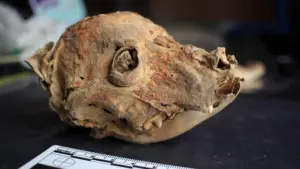
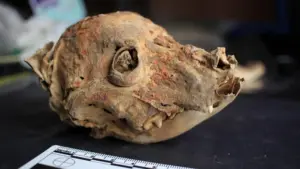
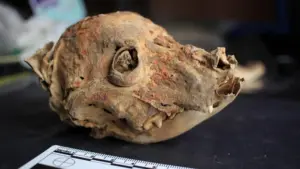
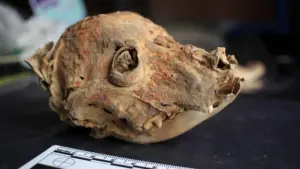
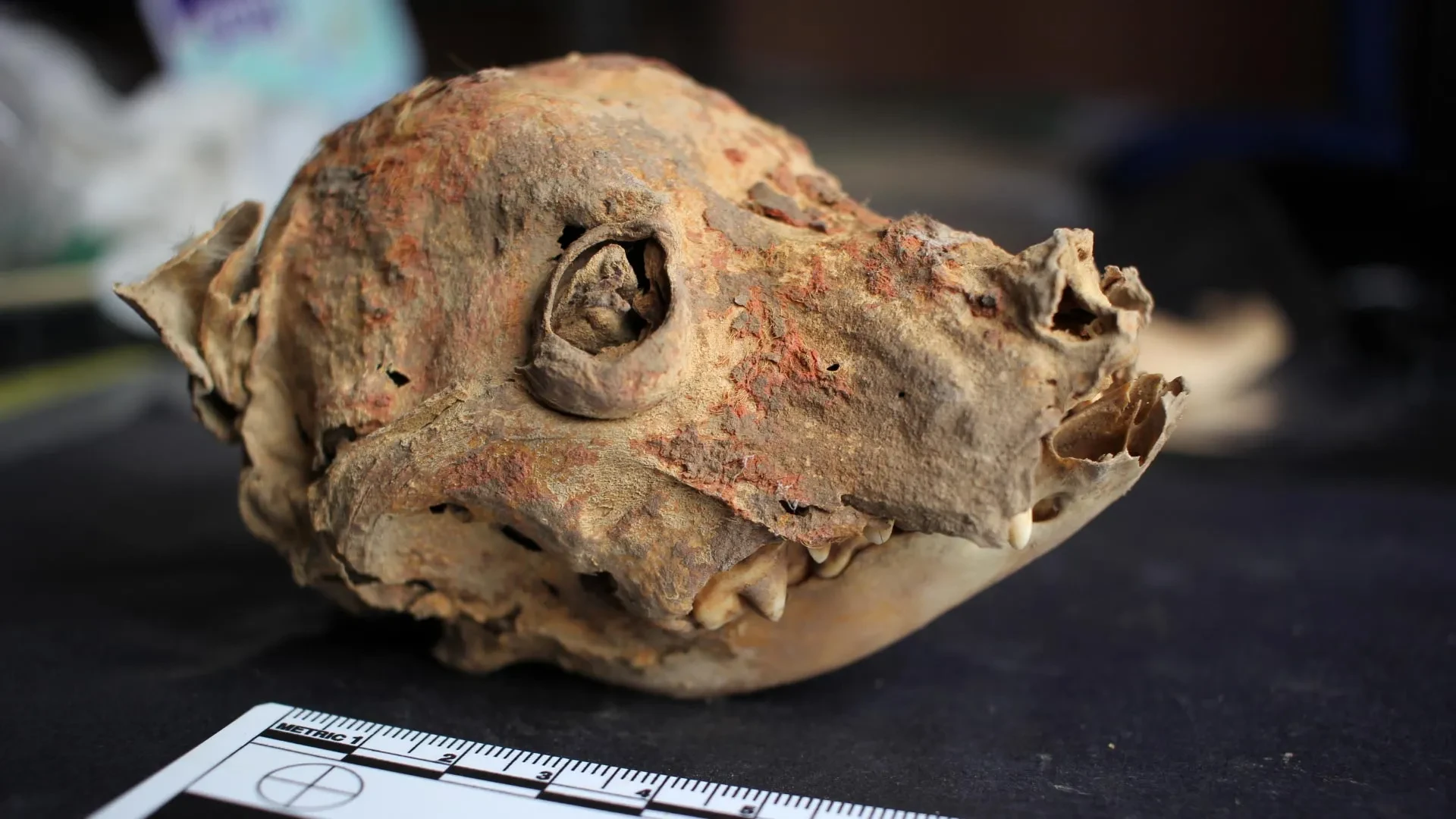
Between 2010 and 2025, systematic excavations in the northern section of the main ceremonial area brought to light hundreds of faunal specimens, culminating in the recovery of 341 dog bone fragments representing at least 19 individual dogs, alongside complete mummified remains. Among these were a naturally mummified skull colored with bright red cinnabar pigment, a larger dog skull, and a nearly complete male dog mummy buried in a shallow pit.
5. Laboratory Analysis and Publication (2025)
Using advanced osteological analysis, Tomczyk identified critical dental anomalies—specifically, congenitally missing first premolars—that matched the genetic markers of hairless dog breeds. Radiocarbon dating subsequently confirmed the complete mummified male dog to be at least 1,200 years old, making it the oldest radiocarbon-dated canine specimen recovered from the site. These findings were formally published in the Journal of Anthropological Archaeology, establishing the first concrete physical evidence of Peruvian hairless dogs at a Wari site.
Supporting Context & Metrics
To fully appreciate the significance of the Castillo de Huarmey discoveries, it is necessary to examine the biological, geographical, and methodological frameworks that guided the research team.
The Biological Signature: Hairlessness and Teeth
The Peruvian hairless dog—recognized today by the American Kennel Club as the Peruvian Inca Orchid and designated a Peruvian national cultural heritage symbol in 2000—is famous for its slender build, pointed ears, and lack of fur. However, the breed’s defining biological trait extends beneath the skin.
During the analysis of the Castillo de Huarmey specimens, researchers noticed that several dog skeletons lacked first premolars and, occasionally, last molars. Crucially, these teeth had never erupted rather than having been lost due to trauma, disease, or old age. Medical and genetic literature confirms that the precise genetic mutation responsible for canine hairlessness is directly linked to ectodermal dysplasia, which causes reduced dental development. This biological correlation served as the definitive "smoking gun," allowing researchers to securely identify the bones as belonging to Peruvian hairless dogs rather than generalized ancient canine populations.
Environmental Preservation in the Desert
Castillo de Huarmey’s location within an exceptionally arid stretch of Peru’s Pacific coast created ideal taphonomic conditions for organic preservation. In environments devoid of high moisture, biological materials that typically degrade rapidly—such as hair, skin, leather, textiles, bone, and organic pigments—survive for millennia. This unique microclimate allowed researchers to recover fragile mummified tissue, vivid cinnabar coloration, and intact organic matrices necessary for chemical analysis.
Isotopic and Zooarchaeological Metrics
To reconstruct the lives of these ancient animals, the research team deployed a battery of scientific techniques:
- Zooarchaeology: Systematic identification and cataloging of 341 faunal specimens representing a minimum number of 19 individual dogs, evaluating age profiles, skeletal completeness, and surface modifications (such as butchery marks).
- Radiocarbon Dating: Determining the absolute chronology of organic remains, verifying that key canine specimens exceeded 1,200 years of age.
- Isotopic Analysis: Examining stable isotopes of carbon, nitrogen, oxygen, and strontium preserved in bone collagen and tooth enamel.
- Tooth enamel establishes chemical signatures formed during early puppyhood.
- Bone collagen reflects dietary intake and mobility over the final year of life.
- Strontium isotopes trace geographic origins and movement by mapping geological signatures absorbed through food and water.
Official Statements
The researchers emphasize that understanding ancient human-animal relationships requires nuance, caution, and an avoidance of overly sentimental modern projections.
"Our findings indicate that humans and dogs coexisted at this Wari site, but reconstructing their bond is challenging, as past emotions are difficult to capture through archaeological methods," notes lead author Weronika Tomczyk, a research associate in Dartmouth’s Department of Anthropology and a postdoctoral fellow in its Ecology, Evolution, Environment and Society Program.
Tomczyk highlights the complex and often contradictory nature of human societies across time periods, noting that animals rarely fit into monolithic categories within a community:
"The goal of our study was to not only present data on Castillo de Huarmey’s dog burials, but also emphasize that people in the past had often contradictory relationships with the animals, just as they do today: a pet for one group of people could at the same time be considered a pest by their closest neighbors."
Discussing the surprising dietary patterns uncovered through isotopic testing—particularly the distinct nutritional intake of hairless puppies compared to adult dogs and other canids—Tomczyk adds:
"We do not know if the dogs were intentionally fed maize or if perhaps, they were just eating leftovers or trash. Yet, the distinct dietary patterns of hairless puppies provide insights into what may have been organized breeding."
Addressing the ultimate status of the excavated animals within Wari society, Tomczyk concludes:
"While we will never know if any of the three dogs were pets or how people treated them, it is evident they received different treatment than other dogs."
Future Outlook
The identification of 1,200-year-old Peruvian hairless dogs at Castillo de Huarmey opens compelling new avenues for Andean archaeology, zooarchaeology, and evolutionary biology. As researchers continue to process the vast array of artifacts recovered from the Wari administrative center, several key areas of future study are emerging:
- Expanded Ancient DNA (aDNA) Analysis: Future research will likely target genetic sequencing of the mummified tissue and bone samples. Extracting aDNA could provide deeper insights into the evolutionary lineage, population genetics, and historical breeding bottlenecks of the Peruvian hairless dog lineage before and after the rise of the Inca Empire.
- Broader Regional Comparisons: Archaeologists plan to compare the isotopic and osteological profiles of the Castillo de Huarmey dogs with faunal assemblages from other contemporary and subsequent Andean sites, such as Tiwanaku and Inca administrative hubs. This comparative work will help determine whether the specialized breeding and dietary management observed at Huarmey were widespread cultural practices or localized phenomena unique to Wari coastal elites.
- Refining Funerary and Ritual Contexts: With puppies discovered alongside elite craftspersons ("Master Basketmaker") and sacrificed tomb guardians, future excavations will explore the symbolic and cosmological dimensions of canine sacrifices in Andean mortuary programs. Understanding why specific dogs accompanied specific human statuses will clarify the religious and ideological frameworks of the Wari Empire.
- Interdisciplinary Methodological Integration: The success of combining zooarchaeology, dental genetics, and multi-isotope geochemistry sets a new methodological benchmark for Andean studies. Researchers anticipate applying this integrated toolkit to other poorly understood faunal collections across South America, ultimately illuminating the intricate, multifaceted webs of life that connected humans, animals, and landscapes across the pre-Hispanic Americas.