
Executive Overview
For generations, evolutionary biologists and paleontologists have relied on a foundational maxim of the fossil record: the absence of evidence is, under extraordinary circumstances of preservation, evidence of absence. When scientists examine exquisitely preserved ancient rock formations—Lagerstätten that capture microscopic life down to cellular detail—and find no trace of animal remains, they have historically drawn a definitive line in the sand. If creatures as complex as early Metazoa (animals) had existed at the time those sediments accumulated, surely the exceptionally favorable chemical conditions would have captured them.
That bedrock assumption has now been thoroughly dismantled.
In a groundbreaking study published on October 2 in Science Advances, an international research team led by the University of Oxford has revealed that the earliest animals may have evolved up to 200 million years before they make their first clear, unmistakable appearance in the conventional fossil record. By meticulously examining exceptionally preserved microfossils from the Kheseen Biota in Mongolia—and comparing them against older, world-renowned deposits like China’s Weng’an Biota—the researchers have upended the temporal boundaries of early animal evolution.
Using updated molecular-clock analyses constrained by older geological benchmarks, the team’s findings push the origin of the animal kingdom deep into the Neoproterozoic Era, placing the possible genesis of animal life between 800 and 700 million years ago. This radical timeline shift places the dawn of animal life squarely before—or right on the precipice of—some of the most catastrophic global climate upheavals in planetary history: the "Snowball Earth" ice ages of the Cryogenian Period.
This comprehensive report breaks down the mechanics of the new study, explores the fossil sites that shifted the paradigm, examines the delicate interplay between molecular genetics and paleontology, and weighs the profound implications for our understanding of life on Earth.
Detailed Chronology: Solving the Ediacaran Puzzle
To understand the magnitude of the Oxford-led study, one must first appreciate the enduring evolutionary puzzle of the late Precambrian. For decades, scientists have grappled with a stark contradiction in the history of life. On one hand, molecular clock techniques—which measure genetic mutations accumulated over deep time—have consistently suggested that the lineage leading to animals split from single-celled ancestors hundreds of millions of years before the Cambrian Period (which spans from 539 to 487 million years ago). On the other hand, the physical body fossil record tells a seemingly contradictory story: unmistakable macroscopic and microscopic animal fossils appear with abrupt, explosive suddenness shortly before the Cambrian, during the Ediacaran Period.
To reconcile this discrepancy, scientists needed a reliable way to anchor their molecular timelines. They turned to maximum age constraints: specific, exceptionally preserved fossil deposits that lacked animal remains, using them to argue that animals simply could not have evolved yet.
The Weng’an Biota Benchmark
At the heart of this methodology was the Weng’an Biota in South China, a fossil deposit roughly 590 million years old, preserved in rocks of Ediacaran age. The Weng’an site is a paleontological treasure trove, famous for preserving microscopic organisms, algae, and protozoan-like structures in breathtaking, three-dimensional cellular detail.
For years, the logic surrounding Weng’an was straightforward and seemingly ironclad:
- The deposit is ancient (approx. 590 million years).
- The preservation quality is pristine, capable of capturing microscopic, delicate biological structures.
- No definitive animal fossils have ever been recovered from Weng’an.
- Conclusion: Animals had not yet evolved when the Weng’an Biota was deposited. Therefore, 590 million years ago serves as a reliable maximum age cap for the origin of the animal kingdom.
The Mongolian Test: The Kheseen Biota
The new international research team—featuring scientists from the University of Oxford, University of California Berkeley, ETH Zürich, and Yale University—decided to rigorously test this foundational assumption. They turned their attention to the Kheseen Biota in Mongolia.
The Kheseen Biota is roughly 40 million years younger than the Weng’an Biota, yet the two fossil assemblages share several key species of microfossils. Crucially, the researchers knew from independent, global geological data that animals definitely existed by the time the Kheseen Biota formed, with confirmed animal fossils already documented in contemporaneous deposits in places like Namibia and South China.
The research team launched an extensive, multi-year investigation, analyzing more than 140 rock samples—including material gathered from previously undocumented stratigraphic locations—using advanced scanning electron microscopy (SEM).
The results were astonishing. The analysis revealed a suite of exquisitely preserved microfossil species, including intricate acritarchs (tiny spherical marine organisms adorned with complex spines and branching projections) and delicate, embryo-like fossils containing clearly defined internal cells.
Yet, despite this phenomenal level of preservation, none of the Kheseen microfossils could be confidently identified as an animal.
Shattering the Weng’an Argument
This discovery dealt a decisive blow to the traditional logic of the fossil record.
If the Kheseen Biota preserved microscopic life with the same extraordinary fidelity as Weng’an, and yet failed to capture animals—despite the indisputable fact that animals were already alive and swimming in Earth’s oceans at that time—then the absence of animal fossils in a deposit proves nothing about whether animals existed.
Animals could easily have been present during the deposition of the Weng’an Biota, too. They simply may have lived in ecological niches away from the specific environments captured by the fossil bed, or the local chemical microenvironments at the time may have been inherently unsuited for preserving fragile, soft-bodied animal tissues.
Supporting Context & Metrics: Re-running the Molecular Clock
With the Weng’an maximum-age constraint invalidated, the research team was forced to look much further back in time to establish new parameters for when animals could have first emerged.
Re-evaluating Ancient Formations
The researchers shifted their focus to significantly older geological formations dating from roughly 850 to 730 million years ago. These included:
- The Svanbergfjellet Formation (Norway)
- The Bitter Springs Group (Australia)
- The Chuar Group (Arizona, USA)
All three of these sites are fossil-rich, marine sedimentary deposits long recognized as possessing the chemical and geological capacity to preserve microscopic organic remains. However, despite intense scrutiny over the decades, no confirmed animal fossils have ever been discovered within them.
Instead of treating these older, barren formations as definitive proof of a pre-animal world, the Oxford team utilized them as new, deeper maximum-age constraints for their evolutionary models.
The Molecular Clock Methodology
Molecular clocks operate on the principle that DNA sequences mutate at a relatively constant average rate over long periods of time. By measuring the genetic divergence between living descendant groups (such as sponges, ctenophores, and bilaterians) and cross-referencing those mutation rates with calibrated dates from the fossil record, scientists can mathematically "turn back the clock" to estimate when the common ancestors of those lineages first walked, crawled, or drifted through primeval waters.
When the researchers plugged the older geological constraints (850–730 million years ago) into their models—discarding the younger, misleading Ediacaran constraint of the Weng’an Biota—the mathematical output shifted dramatically.
- The Shift: The estimated origin of the animal kingdom was pushed backward by approximately 200 million years.
- The New Timeline: The models now point to a window between 800 and 700 million years ago for the birth of the earliest animal lineages.
The Chemical Proxy: Biomarkers and Soft Bodies
This profound temporal shift does not stand in isolation; it aligns neatly with independent geochemical data that have long whispered of a much deeper, hidden antiquity for animal life.
For years, organic geochemists have studied lipid biomarkers—stable chemical molecules derived from biological membranes—preserved within ancient sedimentary rocks. Crucially, specific biomarkers (such as 24-isopropylcholestane) preserved in rocks dating back at least 650 million years are chemically consistent with the presence of demosponges. This biochemical footprint predates the oldest known macroscopic animal body fossils by tens of millions of years.
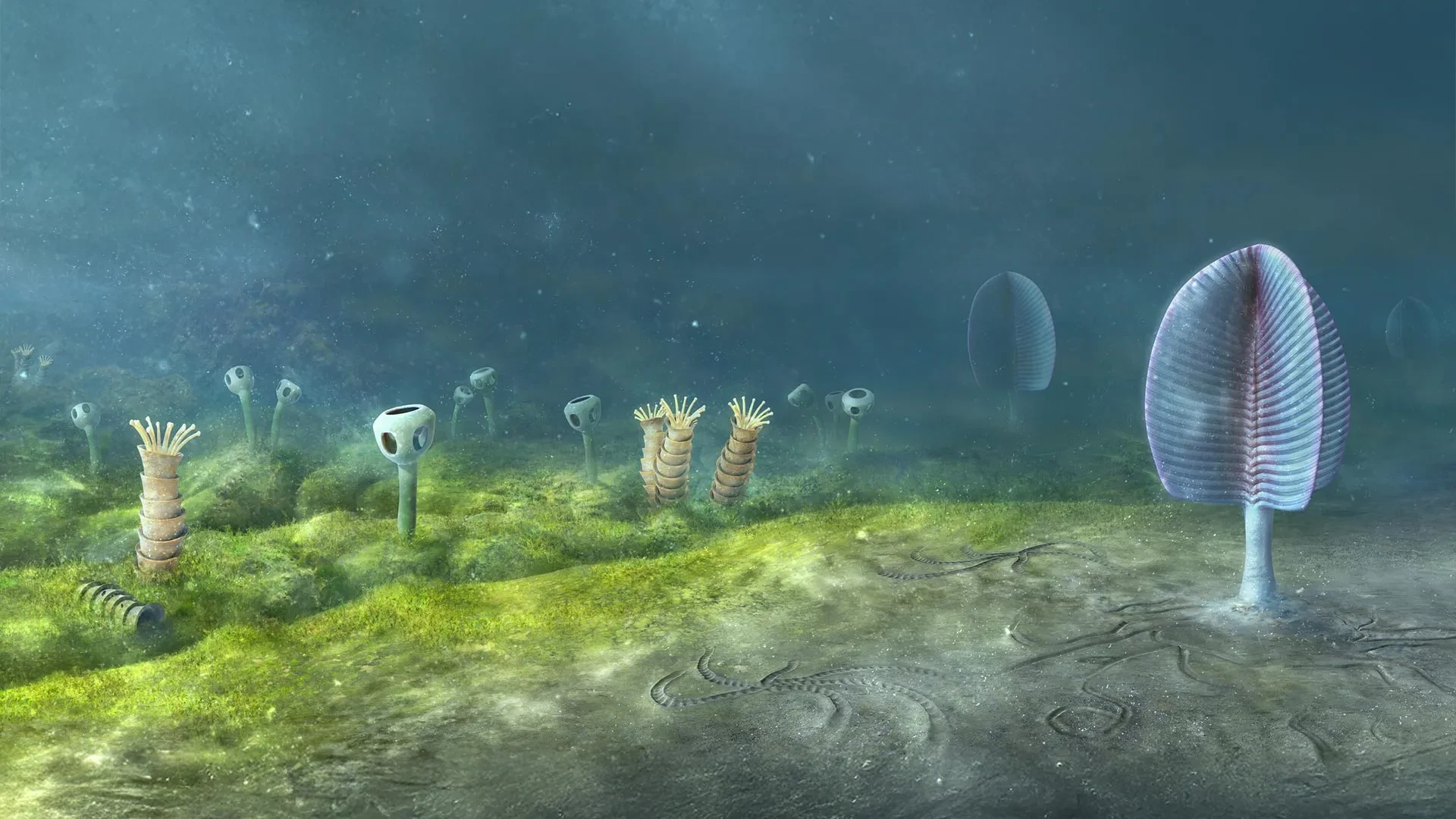
The reason for this prolonged ghost lineage is simple: the earliest animals were diminutive, fragile, and entirely soft-bodied. Lacking rigid mineralized skeletons, shells, or bones, these primitive organisms had an exceptionally low probability of surviving the destructive forces of decay and fossilization. Becoming a fossil requires a rare, highly specific sequence of geochemical events—a geological lottery that primitive, soft-tissued organisms rarely won.
Official Statements & Expert Perspectives
The profound implications of the study have reverberated across the global paleobiological community. The authors of the Science Advances paper emphasize that while the research does not provide direct body-fossil proof of 800-million-year-old animals, it removes the methodological barriers that forced scientists to reject that possibility.
"The Kheseen Biota breaks the argument that the exceptional microfossils of Weng’an mean we would have seen animal fossils in the assemblage had they existed at the time," explained Associate Professor Ross Anderson, senior author of the study from the Oxford University Museum of Natural History. "The Kheseen microfossils are just as well-preserved, yet animals continue to be absent—despite the fact we know at that point they existed."
Professor Anderson added that these findings force a philosophical reckoning in how paleontologists interpret negative evidence in the rock record:
"Until that evidence becomes available, the precise birth date of the animal kingdom remains uncertain. But we now know our old methods for drawing boundaries were fundamentally flawed."
Orin Lole Durbin, lead author of the study—who completed the research as an undergraduate at the University of Oxford and is now a PhD student at Virginia Tech—noted the careful nuance required when interpreting the data:
"Pre-Ediacaran animal body fossils still elude us, and this analysis does not prove that animals existed 800 million years ago," Durbin stated. "However, our new fossil evidence from Mongolia undermines one of the main arguments for restricting animal origins to the Ediacaran interval. Meanwhile, our molecular-clock analyses show how much further back their evolutionary history could extend."
Did Animals Survive "Snowball Earth"?
Perhaps the most electrifying implication of pushing the origin of animals back to the 800-to-700-million-year window involves its collision with one of the most extreme climatic chapters in Earth’s history: the Cryogenian Period.
Beginning roughly 720 million years ago, Earth entered a series of severe, prolonged global glaciation events colloquially known as "Snowball Earth." During these crises, continental ice sheets expanded from the poles toward the equator, and the global oceans may have been largely encased in thick sheets of ice, creating brutal environmental bottlenecks for early life.
If the Oxford team’s revised molecular clock and geological models are correct, they raise two extraordinary possibilities regarding the relationship between life and climate:
- Pre-Cryogenian Genesis: Animal life may have already evolved and successfully diversified before the planet plunged into the deep freeze of Snowball Earth, possessing adaptations that allowed lineages to weather the global icehouse.
- Cryogenian Crucible: Alternatively, the extreme environmental pressures, fluctuating oxygen levels, and intense nutrient influxes associated with the onset of Snowball Earth may have acted as the direct evolutionary catalyst that sparked the origin and early diversification of animal life in marine refugia.
Either way, the study bridges a glaring gap between geobiology and climatology, forcing researchers to model early animal evolution within the hyper-dynamic context of a freezing, volatile planet.
Future Outlook: The Next Frontier in Paleontology
As the ink dries on this landmark study, the paleontological community is already looking toward the horizon. The traditional view of a sudden, Ediacaran explosion of animal life is officially in retreat, replaced by a picture of a cryptic, deep-time origin that played out silently in the microscopic shadows of Precambrian oceans.
To definitively solve the mystery of when and how animals first appeared, the research team outlines a clear roadmap for future scientific inquiry:
- Expanding Geographic and Environmental Sampling: Paleontologists must cast a wider net, exploring sedimentary basins from a broader diversity of paleo-environments, latitudes, and depositional settings rather than relying on a handful of classic, heavily studied localities.
- Multi-Proxy Integration: Future studies must abandon single-method approaches. Unlocking the dawn of animal life will require the aggressive synthesis of multiple independent datasets: rare micro- and macro-body fossils, trace fossils (such as ancient bioturbation or burrowing marks), and organic geochemical biomarkers.
- Refining Geochronology: As high-precision uranium-lead (U-Pb) radiometric dating techniques improve, researchers can pin down the ages of Neoproterozoic rock formations with tighter margins of error, providing cleaner calibration points for molecular clocks.
Until a lucky paleontologist cracks open a pre-Ediacaran rock to reveal the undeniable body fossil of an 800-million-year-old primitive metazoan, the exact birth date of the animal kingdom will remain shrouded in mystery. Yet, thanks to the Kheseen Biota and the rigorous analytical framework forged at Oxford, science has taken a monumental leap forward—clearing away the rubble of bad assumptions and opening our eyes to a vast, hidden prologue in the history of life on Earth.