
Executive Overview
Deep within the hyper-arid expanses of Peru’s Pacific coast, archaeologists have unearthed a treasure trove of biological and cultural history that rewrites our understanding of human-animal relationships in the pre-Columbian Andes. Recent excavations at Castillo de Huarmey—the premier administrative and ceremonial hub of the ancient Wari Empire—have yielded the earliest physical evidence of Peruvian hairless dogs ever recorded. Dating back more than 1,200 years, these remarkable discoveries include naturally mummified remains, distinct skeletal anomalies, and chemical clues that illuminate how these unique creatures lived, what they ate, and how they integrated into a complex, stratified society centuries before the rise of the Inca Empire.
The findings, detailed in a landmark study published in the Journal of Anthropological Archaeology, bridge a significant gap in Andean zooarchaeology. Led by an international team of researchers from Dartmouth College and the University of Warsaw, the study sheds light on the nuanced roles animals played in antiquity. Far from being monolithic in their utility or status, these ancient hairless dogs occupied a multifaceted space within Wari society—functioning simultaneously as revered companions buried alongside elite craftspeople, sacrifices guarding royal tombs, or creatures whose varied treatment mirrors the complex, often contradictory relationships humans maintain with animals today.
Detailed Chronology: Unearthing Castillo de Huarmey
To contextualize the discovery of these ancient canines, one must examine the rich history of Castillo de Huarmey itself. Situated approximately 190 miles north of the modern capital of Lima, the 110-acre complex served as a major regional administrative and burial center for the Wari Empire, which flourished between 600 and 1050 CE. Long before the Inca carved out their famous mountainous domain, the Wari exerted profound cultural, political, and economic influence across the Andean coastal and highland landscapes.
Over the past several decades, Castillo de Huarmey has proven to be an archaeological goldmine, yielding critical insights into Wari governance, social hierarchy, and mortuary customs:
- Pre-2000s and Regional Occupation (600–1050 CE): The complex functions as a thriving Wari administrative nexus, characterized by monumental architecture, elite residences, and specialized workshops.
- The 1970 Cataclysm: A massive earthquake strikes the region, causing structural collapses within parts of Castillo de Huarmey. This seismic event inadvertently exposes internal burial chambers, rendering the upper archaeological layers vulnerable to extensive illicit looting.
- The 2012 Milestone: Archaeologists achieve a breakthrough by uncovering the first completely undisturbed elite Wari tomb. Inside, they discover the opulent remains of 58 high-status women, six human sacrificial victims, and roughly 1,300 meticulously crafted artifacts made of gold, silver, bronze, and precious textiles.
- The 2022 Discoveries: Excavations reveal nearby burials belonging to elite craftspeople. These graves are accompanied by sophisticated metalworking tools fashioned from precious metals, further cementing the site’s status as a center of elite manufacturing.
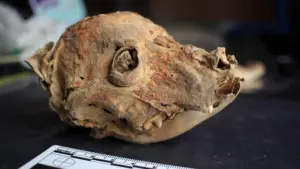
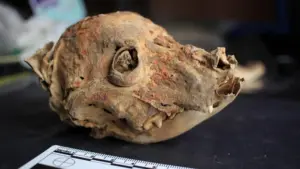
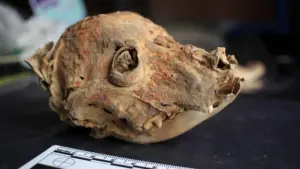
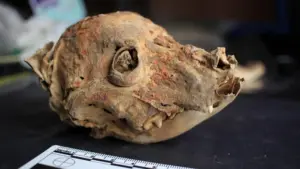
- The 2010–2025 Canine Excavations: Systematic archaeological digs in the northern section of the main ceremonial area uncover extensive faunal remains, culminating in the recovery of 341 dog bone specimens representing at least 19 individual animals, alongside pristine natural mummies. Radiocarbon dating confirms that these specimens—particularly a complete male dog mummy—represent the oldest scientifically dated canine remains at the site, anchoring them firmly in the first millennium CE.
Supporting Context & Metrics: Genetics, Diets, and Mortuary Archaeology
The identification of these ancient canines as Peruvian hairless dogs—a distinctive Indigenous breed known for slender physiques, alert pointed ears, and a lack of fur—relied on a convergence of osteological analysis, genetic deduction, and advanced biochemical testing.
The Genetic Clue: Missing Teeth
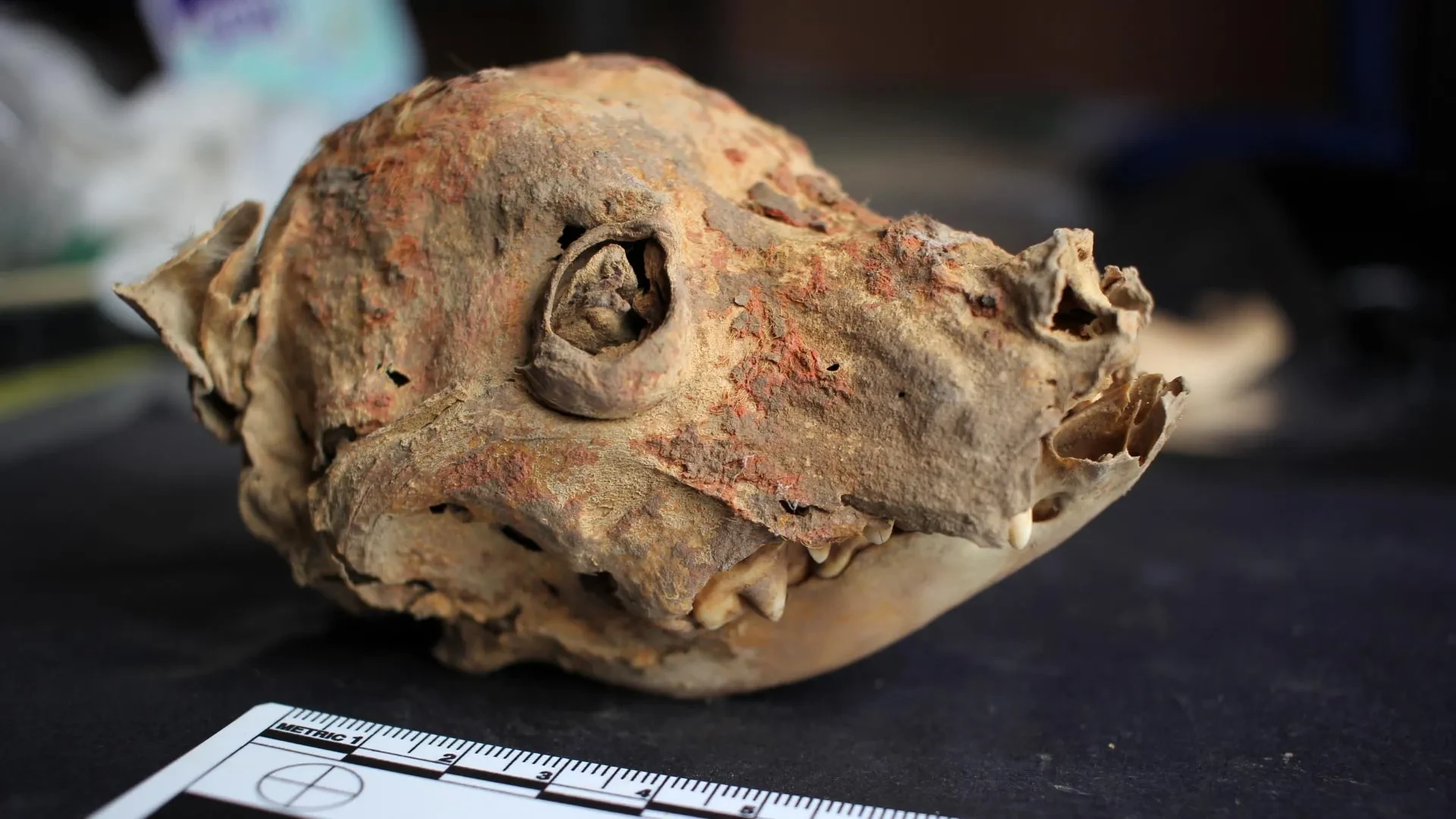
Initially, when researchers unearthed a naturally mummified male dog in a shallow pit, along with a striking skull colored with bright red cinnabar pigment (a mineral heavily favored in ancient Peruvian mortuary rituals), they suspected a more recent deposition, perhaps linked to twentieth-century looting activities.
However, lead researcher Weronika Tomczyk identified a critical anatomical anomaly: the dogs consistently lacked their first premolars and, in some cases, their final molars. Crucially, these teeth had never erupted during the animals’ lifespans rather than being lost to injury, disease, or old age. Medical and zoological literature confirms that the exact genetic mutation responsible for hairlessness in dogs is pleiotropic, meaning it also causes oligodontia (a reduced number of teeth). This biological fingerprint conclusively linked the skeletal remains to the ancient lineage of Peruvian hairless dogs—a breed recognized today by the American Kennel Club as the Peruvian Inca Orchid and officially designated as part of Peru’s national cultural heritage in 2000.
Isotopic Analysis: Tracing Diets and Life Histories
To move beyond morphology, the research team employed zooarchaeological techniques alongside stable isotope analysis. By extracting chemical signatures from the animals’ bones and teeth, scientists evaluated concentrations of carbon, nitrogen, oxygen, and strontium.
- Teeth vs. Bones: Tooth enamel forms early in life, preserving a chemical snapshot of puppyhood and early diet. Bone tissue undergoes continuous remodeling, reflecting the animal’s nutritional intake during the final year of life.
- Maize Consumption: Isotopic results demonstrated that the dogs’ diets heavily overlapped with those of the human populace at Castillo de Huarmey, characterized by a significant consumption of maize (corn), a staple of pre-Hispanic Andean agriculture.
- Puppy Parallels: Hairless puppies exhibited dietary isotopic signatures closely mirroring those of human children, suggesting that young hairless dogs may have received specialized provisioning, controlled care, or targeted feeding regimens indicative of organized breeding programs. Conversely, as the animals matured, their food sources diversified, pointing to a transition in how they were maintained within the community.
Mortuary Contexts and Social Status
The archaeological contexts of the canine burials reveal a stark stratification in how these animals were perceived and treated:
- Elite Associations: The skeletal remains of a puppy aged just 6 to 8 weeks were found directly associated with an elite craftsperson dubbed the "Master Basketmaker."
- Palatial Placement: Other adult dogs were recovered within the confines of the site’s primary palace structures.
- Guardians of the Dead: A partial puppy skeleton was discovered alongside an adult male designated as "XY," interpreted as a sacrificial individual interred to serve as a spiritual tomb guardian.
- Exclusion from the Menu: Despite the presence of hundreds of faunal remains, only a microscopic fraction of the dog bones displayed butchery or cut marks. This confirms that, unlike camelids (llamas and alpacas) which were frequently consumed or used as ritual offerings, dogs at Castillo de Huarmey were rarely, if ever, utilized as a food source.
Official Statements & Expert Perspectives
The complexity of these findings challenges modern researchers to avoid simplistic categorizations of ancient human-animal dynamics.
"Our findings indicate that humans and dogs coexisted at this Wari site, but reconstructing their bond is challenging, as past emotions are difficult to capture through archaeological methods," notes Weronika Tomczyk, first author of the study, research associate in Dartmouth’s Department of Anthropology, and postdoctoral fellow in its Ecology, Evolution, Environment and Society Program.
Tomczyk emphasizes that the material record reflects a spectrum of human attitudes that mirror contemporary society:
"The goal of our study was to not only present data on Castillo de Huarmey’s dog burials, but also emphasize that people in the past had often contradictory relationships with the animals, just as they do today: a pet for one group of people could at the same time be considered a pest by their closest neighbors."
Discussing the diagnostic breakthrough provided by the dental anomalies, Tomczyk explains:
"What I noticed is that some of the dog skeletons were missing teeth, and not that they lost them during their lifespan; some teeth, especially first premolars and sometimes last molars, had just never erupted. And then I found in the literature that the same gene which is responsible for hairlessness in dogs is responsible for a reduced number of teeth, indicating that these were Peruvian hairless dogs."
Regarding the isotopic indicators of nutrition, Tomczyk adds:
"We do not know if the dogs were intentionally fed maize or if perhaps, they were just eating leftovers or trash. Yet, the distinct dietary patterns of hairless puppies provide insights into what may have been organized breeding."
Summarizing the overarching socio-cultural implications of the discoveries, Tomczyk concludes:
"While we will never know if any of the three dogs were pets or how people treated them, it is evident they received different treatment than other dogs."
The collaborative international research team—which includes Miłosz Giersz, Wiesław Więckowski, and Roberto Pimentel Nita of the University of Warsaw, alongside Claire Ebert of the University of Pittsburgh—underscores that these insights were made possible only through multidisciplinary integration combining stratigraphy, radiocarbon dating, osteology, and biogeochemistry.
Future Outlook
The groundbreaking identification of 1,200-year-old Peruvian hairless dogs at Castillo de Huarmey opens exciting new avenues for Andean archaeology and bioarchaeological research. As methodologies in ancient DNA (aDNA) analysis and micro-isotopic sampling continue to advance, researchers anticipate several key developments in the years ahead:
- Genomic Mapping of Ancient Breeds: Future studies aim to extract mitochondrial and nuclear DNA from the mummified hairless dog remains to map genetic drift, pedigree relationships, and the deep evolutionary history of South American canines prior to European contact.
- Expanded Isotopic Databases: By broadening strontium and oxygen isotope testing across other Wari administrative centers in the Andes, scientists hope to trace whether elite hairless dogs were bred locally at Castillo de Huarmey or imported from distant ecological zones as high-value diplomatic gifts or trade items.
- Refined Chronological Frameworks: The successful radiocarbon dating of the male canine mummy provides a vital anchor for the site’s stratigraphy, offering a blueprint to re-evaluate mixed upper layers disturbed by the 1970 earthquake and subsequent looting.
- Broader Anthropological Re-evaluations: These findings challenge researchers to re-examine faunal assemblages at other pre-Columbian sites across the Americas. By shifting the analytical lens from mere subsistence economies to the nuanced social, ritual, and symbolic dimensions of human-animal entanglement, modern science continues to resurrect the vibrant, complex tapestry of daily life in the ancient Andean world.