
Executive Overview
For millions of family caregivers worldwide, the daily routine is a continuous exercise in interpretation. When caring for an individual who is nonverbal—whether due to a developmental disability, autism spectrum disorder, degenerative neurological condition, or traumatic brain injury—communicating even basic physical discomfort can become an insurmountable barrier. A sudden shift in dietary habits, an inexplicable reluctance to engage in morning hygiene, or repetitive self-soothing behaviors like touching the face or grinding the teeth often serve as the sole indicators that something is fundamentally wrong.
Chief among these hidden vulnerabilities is oral health. Dental pain, periodontal disease, and mechanical trauma within the oral cavity are notoriously difficult to diagnose when a patient lacks the verbal capacity to report them. Consequently, caregivers frequently find themselves trapped in an exhausting cycle of observation, second-guessing, and anxiety, constantly weighing whether an altered behavior is behavioral, sensory, or rooted in acute physical agony.
Fortunately, this burden does not have to be carried in isolation. Modern family dentistry is increasingly pivoting toward collaborative, proactive care frameworks designed specifically to assist caregivers. By partnering with a qualified family dentist, caregivers can transition from passive guesswork to structured, clinical monitoring. This comprehensive guide explores how family dentists help caregivers decode the subtle signs of oral distress in nonverbal patients, establish robust diagnostic baselines at home, and implement sustainable clinical and preventative interventions that safeguard both comfort and overall well-being.
Detailed Chronology of Care: From Subtle Behaviors to Clinical Intervention
Understanding oral health in nonverbal patients requires a paradigm shift in how symptoms are recognized and evaluated. Because clinical pathology rarely presents as a direct complaint, caregivers must learn to read a chronological progression of behavioral and physiological flags.
Phase 1: The Onset of Subtle Behavioral Shifts
In the earliest stages of a dental issue—such as the formation of an interproximal cavity, early-stage gingivitis, or the slow eruption of a molar—the nonverbal patient will rarely display overt signs of trauma. Instead, changes manifest subtly within daily routines. A caregiver might notice:
- Aversion to specific textures: Suddenly refusing crunchy foods, raw vegetables, or hot and cold beverages.
- Altered mastication patterns: Consistently chewing exclusively on the left or right side of the mouth to bypass a sensitive tooth.
- Disruption in sleep architectures: Waking up more frequently during the night, often accompanied by restlessness or whimpering without an apparent gastrointestinal or environmental cause.
Phase 2: Escalation and Manifestation of Physical Cues
If left unaddressed, localized discomfort intensifies, triggering more pronounced, unmistakable behavioral adaptations. Caregivers frequently report the emergence of new self-directed physical habits:
- Facial guarding or targeting: Repetitive touching, rubbing, or striking of the jaw, cheek, or temple area.
- Hygiene resistance: Sudden, aggressive refusals to permit tooth brushing, flossing, or mouth rinsing.
- Parafunctional habits: Increased nocturnal or daytime bruxism (teeth grinding), jaw clenching, or excessive drooling driven by inflammation and altered swallowing mechanics.
Phase 3: The Clinical Bridge—Collaborative Assessment
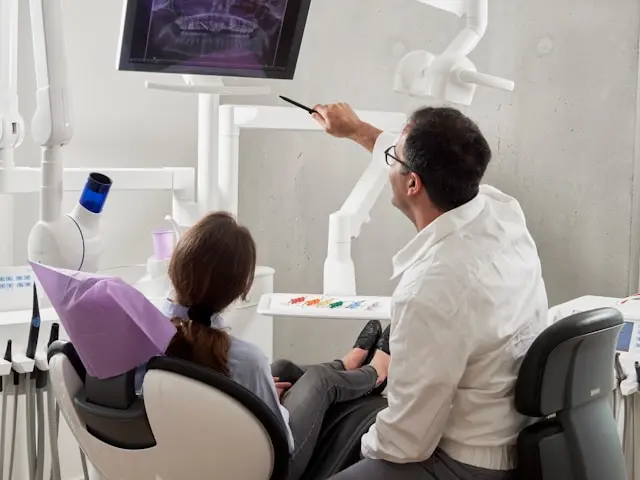
When these behaviors emerge, attempting to solve the mystery independently often leads to caretaker burnout. This is where the family dentist steps in as a vital diagnostic partner. By integrating the caregiver’s longitudinal observations with clinical examinations, dental professionals can connect external behaviors to internal pathology. For instance, what a caregiver interprets as behavioral agitation during feeding may be clinically diagnosed as a fractured filling or an acute periodontal abscess. Regular, routine dental visits establish a stable health baseline, allowing the dental team to identify micro-changes—such as localized enamel wear, subtle gingival discoloration, or appliance friction—that would be virtually impossible to detect in a home environment.
Supporting Context & Metrics: The Intersection of Disability and Oral Health
The challenges faced by nonverbal and developmentally disabled patients in accessing adequate dental care are well-documented by public health institutions. According to findings from the National Institute of Dental and Craniofacial Research (NIDCR), individuals with developmental and physical disabilities experience significantly higher rates of untreated dental caries, periodontal disease, and poorer overall oral hygiene compared to the general population.
This disparity is rarely the result of a lack of concern; rather, it stems from systemic barriers, including:
- Diagnostic Delay: As outlined, the absence of verbal feedback delays professional intervention until conditions reach an advanced, painful stage.
- Sensory Overload: The sights, sounds, and tactile sensations of a traditional dental operatory can induce severe sensory trauma in neurodivergent or cognitively impaired patients.
- Caregiver Strain: Family caregivers, who often manage complex, multi-system medical regimens, face immense emotional and physical tolls, increasing the risk of overlooking early-stage oral manifestations.
To contextualize these observations and provide actionable guidance for home monitoring, the following matrix outlines common behavioral indicators, their potential clinical etiologies, and the optimal timing for professional dental intervention:
| What You Notice at Home | What It Might Clinically Mean | When a Family Dentist Should Step In |
|---|---|---|
| Refusing food or chewing on one side | Pulpitis, cracked tooth, advanced caries, or localized mucosal ulceration. | If dietary restriction persists for more than 24–48 hours or recurs consistently. |
| New face touching, jaw rubbing, or mealtime agitation | Acute dental pain, pressure from erupting teeth, localized inflammation, or ill-fitting dental prosthetics. | If the behavior appears suddenly, escalates rapidly, or interferes with core nutrition. |
| Bleeding during or after brushing | Early-stage gingivitis, periodontal disease, traumatic brushing techniques, or systemic inflammation. | If bleeding is persistent, heavy, or accompanied by localized swelling or foul odor. |
| Chronic, unresolving halitosis (bad breath) | Advanced tooth decay, periodontal pockets, severe dry mouth (xerostomia), or trapped food debris. | If standard mechanical cleaning and hydration adjustments fail to resolve the odor. |
| Teeth grinding, wear facets, or fractured edges | Parafunctional habits, chronic psychological or physical stress, malocclusion, or sleep-related breathing disorders. | Early on, to document wear patterns and discuss protective appliances like customized night guards. |
Official Guidelines and Caregiver Support Frameworks
Navigating the complexities of supporting a nonverbal dependent requires leaning on established public health resources. Public health agencies emphasize that oral health cannot be isolated from systemic health; infections originating in the oral cavity can significantly impact cardiovascular health, glycemic control in diabetic patients, and overall systemic well-being.
Insights from the Centers for Disease Control and Prevention (CDC)
The CDC provides extensive educational frameworks tailored to adult oral health maintenance and specialized caregiving. Through their designated resources on adult oral health prevention, health authorities stress the importance of daily mechanical plaque removal, fluoride supplementation where appropriate, and regular clinical evaluations.
Furthermore, the CDC’s dedicated portal for family caregivers acknowledges the profound emotional and psychological weight placed on those caring for individuals with disabilities. Caregiving is not merely a logistical challenge; it is an endurance test where every unexplained sigh, grimace, or behavioral shift carries emotional gravity. Building a collaborative, formalized system with a family dentist alleviates a significant portion of this psychological burden by distributing the responsibility of health monitoring to trained clinical professionals.
Practical Action Plan for Caregivers
To bridge the gap between home observations and clinical visits, caregivers can implement a systematic, low-stress observation and preparation protocol:
- Establish a Micro-Observation Routine: Dedicate a specific, low-stress moment each day—such as during evening wind-down or immediately following morning hygiene—to briefly inspect the visible oral structures. Check the lips, marginal gingiva, anterior teeth, and hydration levels of the oral mucosa. Keep a simple, running log. Notes such as "Tuesday: pushed away breakfast, held right jaw" provide invaluable data points over time.
- Translate Behaviors into Contextual Data for the Dentist: When attending dental appointments, abandon the pressure to use clinical terminology. Instead, act as a reporter. Detail the exact timeline of the behavior, the time of day it occurs, environmental triggers, and any concurrent shifts in sleep or elimination patterns. Whenever possible, capture short video clips of repetitive self-soothing gestures or chewing alterations to share with the dental team.
- Co-Design a Pragmatic Prevention Plan: Collaborate with your family dentist to formulate a home-care regimen that respects the patient’s sensory profile and your physical capacity. Discuss alternative hygiene tools (such as three-sided toothbrushes, specialized floss holders, or electric toothbrushes with sensory-friendly vibration profiles), optimal positioning techniques for home care, and a customized recall schedule that balances preventative efficacy with patient tolerance.
Future Outlook: The Evolution of Accessible Family Dentistry
Looking ahead, the landscape of family dentistry for nonverbal and special-needs patients is undergoing a profound transformation. Advances in dental technology—ranging from intraoral scanners that reduce the need for uncomfortable, traditional impression trays to minimally invasive laser dentistry—are making clinical visits faster, quieter, and vastly more tolerable for sensitive patients.
Moreover, the integration of teledentistry is revolutionizing how caregivers consult with professionals. By allowing caregivers to securely transmit photographs, short videos, and behavioral logs directly to their family dentist between visits, preliminary triage can occur remotely. This reduces the stress of unnecessary travel and ensures that in-person clinical visits are reserved for targeted treatments or comprehensive examinations.
Ultimately, caring for a nonverbal individual requires patience, vigilance, and a strong community of support. By forging a proactive partnership with a trusted family dentist, caregivers can transform the exhausting unknown into a manageable, collaborative healthcare strategy. You do not need to possess all the answers yourself; by uniting your intimate daily observations with clinical expertise, you can ensure your loved one enjoys a life defined by comfort, dignity, and optimal oral health.