
Executive Overview
In an agricultural machinery market heavily saturated by a relentless race toward full autonomy, artificial intelligence, and dizzying arrays of digital overlays, British original equipment manufacturer (OEM) JCB is deliberately taking the road less traveled. Rather than chasing every tech-centric trend dictated by market competitors, the company is doubling down on its foundational strengths—specifically, its pioneering history in agricultural material handling and its signature line of telehandlers.
This strategic positioning was highlighted by Bruce Mustard, product manager at JCB North America, during a comprehensive interview at the 2026 Farm Progress Show. As modern North American farming operations continue to evolve—grappling with shifting macroeconomic pressures, fluctuating commodity prices, tariff-related supply chain headwinds, and tight operational margins—JCB is carving out a distinct niche. The company’s growth blueprint in the United States and Canada relies not on rushed, speculative digital products, but on deep-rooted manufacturing commitments, heavy capital investment in domestic facilities, and a steadfast focus on utilitarian efficiency.
This report explores JCB’s calculated North American trajectory. It analyzes the company’s structural investments in Savannah, Georgia, and San Antonio, Texas; evaluates its flagship machinery lineups, including the robust Fastrac 6300 tractor and its market-leading telehandlers; examines how the manufacturer is navigating contemporary economic headwinds; and details its pragmatic philosophy toward artificial intelligence and technological integration.
Detailed Chronology: Building a U.S. Footprint
JCB’s journey toward becoming a staple of North American agricultural and construction operations has been decades in the making. While the company maintains its global headquarters in Staffordshire, United Kingdom, its localized integration into the North American industrial landscape represents a long-term, multi-generational commitment.
The Foundation: Savannah, Georgia (2002)
More than twenty years ago, JCB recognized that servicing the sprawling, highly specialized North American market required localized manufacturing muscle. In 2002, the company opened a state-of-the-art production facility in Savannah, Georgia. This site was strategically chosen to streamline supply chains, reduce transatlantic shipping friction, and respond directly to the unique demands of American contractors and farmers. Over the years, the Savannah plant became the bedrock of JCB’s compact equipment output, specializing in the production of compact track loaders (CTLs) and innovative side-door-entry skid-steer loaders—a design hallmark that significantly improved operator safety and cab egress compared to traditional overhead-entry alternatives.
The Multi-Million Dollar Doubling Down: San Antonio, Texas (2024)
Having successfully established its Southeast manufacturing hub, JCB made its most aggressive play for North American market share to date in 2024. The company announced and initiated a massive $500 million investment to construct a brand-new, ultra-modern manufacturing campus in San Antonio, Texas.
This facility is designed to significantly expand JCB’s production capacity for core agricultural and construction machinery, acting as a direct counterweight to supply chain vulnerabilities. By producing machinery closer to the heartland of American agriculture—the vast row-crop and livestock regions of the Midwest and South—JCB positioned itself to drastically reduce lead times, better absorb localized manufacturing costs, and aggressively target market share historically dominated by domestic and legacy short-line competitors.
Showcasing at the 2026 Farm Progress Show
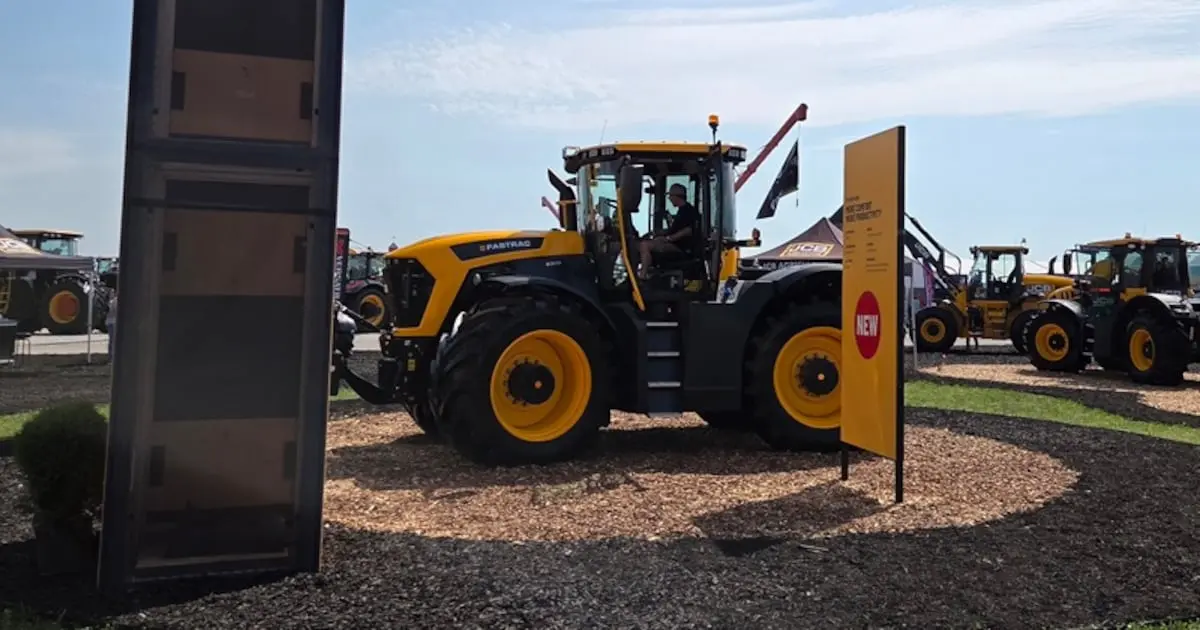
Fast-forward to the 2026 Farm Progress Show, and the fruits of JCB’s localized strategy were prominently on display. The company drew significant industry attention by showcasing the Fastrac 6300 335-horsepower tractor, a high-speed, heavy-draft powerhouse designed to bridge the gap between heavy field work and high-speed road transit. Alongside the Fastrac 6300, JCB placed its comprehensive portfolio of agricultural material-handling equipment front and center, signaling to growers that the brand is ready to tackle the heavy lifting required on modern, high-throughput farms.
Supporting Context & Metrics: Navigating Market Pressures and Material Handling Realities
JCB’s methodical expansion does not exist in a vacuum. The agricultural machinery sector in 2026 is navigating a complex matrix of macroeconomic challenges, shifting farm demographics, and evolving operational requirements.
The Economics of Modern Farming
Farmers across North America are currently dealing with a tight operating environment. Strained farmer economics, driven by historical inflation in input costs (fertilizer, seed, chemicals, and replacement parts) and compressed profit margins, have made capital expenditure decisions far more deliberate. Equipment purchases are no longer driven by impulse or routine fleet turnover; instead, every asset must prove its immediate return on investment (ROI).
Adding fuel to these operational fires are international trade dynamics. According to industry observations, tariffs continue to exert a "huge impact" on ag machinery manufacturing, complicating the cross-border sourcing of raw materials, specialized steel, and critical electronic components. For an OEM like JCB, mitigating these cost pressures requires meticulous forward-planning. As Bruce Mustard noted, production forecasting for the upcoming spring season must be submitted to global factories well in advance, leaving little room for sudden market miscalculations.
The Silver Lining: Commodity Prices and Year-End Capital Flow
Despite these persistent headwinds, the agricultural economy retains periods of resilience. Late-year shifts in commodity prices have provided a modest financial cushion for cash-crop producers. As grain and livestock markets fluctuate, unexpected upward ticks in commodity valuations can alter balance sheets just in time for year-end tax planning and capital asset acquisitions. JCB is banking on this late-cycle momentum, hoping that cash-crop farmers with healthier-than-expected year-end ledgers will invest in high-utility fleet upgrades.
The Material-Handling Imperative
At the heart of JCB’s North American strategy is a foundational truth of modern farming: farms move massive quantities of material every single day.
Whether managing massive confinement livestock operations, high-capacity grain handling facilities, or complex row-crop enterprises, modern agriculturalists spend an extraordinary number of hours moving feed, fertilizer, seed bags, silage, cereals, and manure. Traditional loaders and standard tractors often fall short when it comes to reach, placement height, and maneuverability in confined spaces.
JCB commercialized telehandler technology in the United Kingdom back in the 1970s—decades before North American row-crop farmers widely adopted the machine type. By leveraging this decades-long engineering pedigree, the company has identified a prime growth vector. Rather than trying to out-muscle dominant tractor manufacturers in pure horsepower wars alone, JCB is positioning itself as the undisputed leader in farm-yard material handling.
Official Statements: Perspectives from the Front Lines
Understanding JCB’s corporate mindset requires examining the direct commentary of its operational leadership. In his statements at the 2026 Farm Progress Show, Bruce Mustard offered a transparent look at the calculus driving the company’s product development and marketing strategies.
Positioning for Material-Handling Supremacy
Articulating JCB’s core mission in the ag sector, Mustard stated:
"We’re trying to position ourselves as the number one in ag material handling. So, a lot of farms today, whether it’s row crop or livestock operations, move significant amounts of material every day, including manure, feed, cereals, and more. And that’s really where we are positioning ourselves to be the leader with our range of equipment."
This quote underscores a strategic pivot: while tractors grab headlines, material handlers do the daily heavy lifting that keeps a farm operational. By framing telehandlers and specialized loaders as indispensable assets, JCB is carving out a defensive moat against competitors who view material handling as an afterthought to tillage and planting.
Strategic Product Planning Amid Trade Headwinds
Addressing the logistical and macroeconomic realities of building machinery in an era of tariffs and shifting demand, Mustard elaborated on the intensive foresight required by modern OEMs:
"From a JCB side of things, there’s a lot of planning going on this year for what product we want coming to us for next year, for next spring. We have to give the factories advance warning of that, and then really to close out this year, the recent increase in commodity prices will hopefully help with year-end purchases. Hopefully, [farmers] are going to make a little bit more money than they thought they were going to in the cash-crop world."
The Pragmatic Tech Philosophy: Value Over Hype
Perhaps the most revealing commentary from Mustard centered on the industry-wide rush toward digitization, artificial intelligence, and automated systems. While acknowledging that technology is a necessary arena for contemporary manufacturers, Mustard sounded a note of pragmatic caution:
"You’ve got to embrace [technology]. You have to keep up with the market, but you’ve also got to be careful that you’re only coming to market with something that offers value to a customer."
He further dissected the opportunity cost of software development versus core mechanical excellence:
"There’s so much work to do to get a good outcome. So, it’s a balance between whether you put your resources into making a great AI platform for whatever it would do or use your resources to just be better at what you do."
Future Outlook: Striking a Balance with Technological Innovation
As the agricultural machinery landscape marches toward the latter half of the 2020s, OEMs face a profound fork in the road. On one side lies the hyper-digital frontier: fully autonomous tractors, cloud-connected fleet management ecosystems, predictive maintenance algorithms driven by generative AI, and complex precision-ag sensor suites. On the other side lies the enduring demand for physical reliability, mechanical durability, operator comfort, and straightforward utility.
Resisting the "Tech-For-Tech’s-Sake" Trap
Many agricultural equipment manufacturers have fallen into the trap of developing digital features simply to check marketing boxes against rival brands. However, end-users—farmers navigating tight labor pools and volatile profit margins—are increasingly pushing back against overly complex electronic architectures that require specialized dealership intervention for routine repairs.
JCB’s calculated restraint serves as a counter-narrative. By focusing its engineering resources on making its core machinery—telehandlers, skid steers, compact track loaders, and the Fastrac tractor lineup—fundamentally better, more fuel-efficient, and more ergonomically refined, the company is catering to pragmatists. Farmers do not want technology that adds cognitive load or introduces new points of failure in the middle of harvest; they want tools that work reliably under heavy, grueling workloads.
Selective AI Integration in Engineering
This is not to say that JCB is ignoring technology entirely. The company actively explores the application of artificial intelligence behind the scenes—utilizing machine learning and advanced computing to streamline its internal engineering workflows, optimize manufacturing tolerances in its Savannah and San Antonio plants, and improve component longevity.
By utilizing AI internally to build better iron, rather than forcing half-baked software platforms onto the dashboard of a farm loader, JCB is adopting a disciplined, customer-centric approach to innovation.
The Path Forward in North America
JCB’s trajectory in North America is defined by patience, heavy capital commitment, and a clear-eyed understanding of what farmers actually need. With its multi-million dollar footprint in Texas, its long-established manufacturing base in Georgia, and an expanding network of specialized dealers, the British OEM is well-positioned to weather macroeconomic storms.
By leaning into its rich telehandler heritage, championing material-handling efficiency, and refusing to chase fleeting digital trends at the expense of core build quality, JCB is proving that sometimes the smartest way forward is to master what you have always done best. As North American agriculture looks for stability in uncertain economic times, JCB’s pragmatic, iron-first strategy may well prove to be its greatest competitive advantage.