
Executive Overview
In the fields of veterinary science and animal behavior, few topics generate as much interest as interspecies socialization—specifically, the mitigation of predatory drive and the reversal of trauma-induced fear responses. Historically, the relationship between domestic dogs (Canis lupus familiaris) and domestic cats (Felis catus) has been framed through an evolutionary lens of conflict, driven by mismatched communication signals and predatory instincts. This division is often amplified in larger, high-drive working breeds such as the Doberman Pinscher, a breed historically developed for personal protection and guard work.
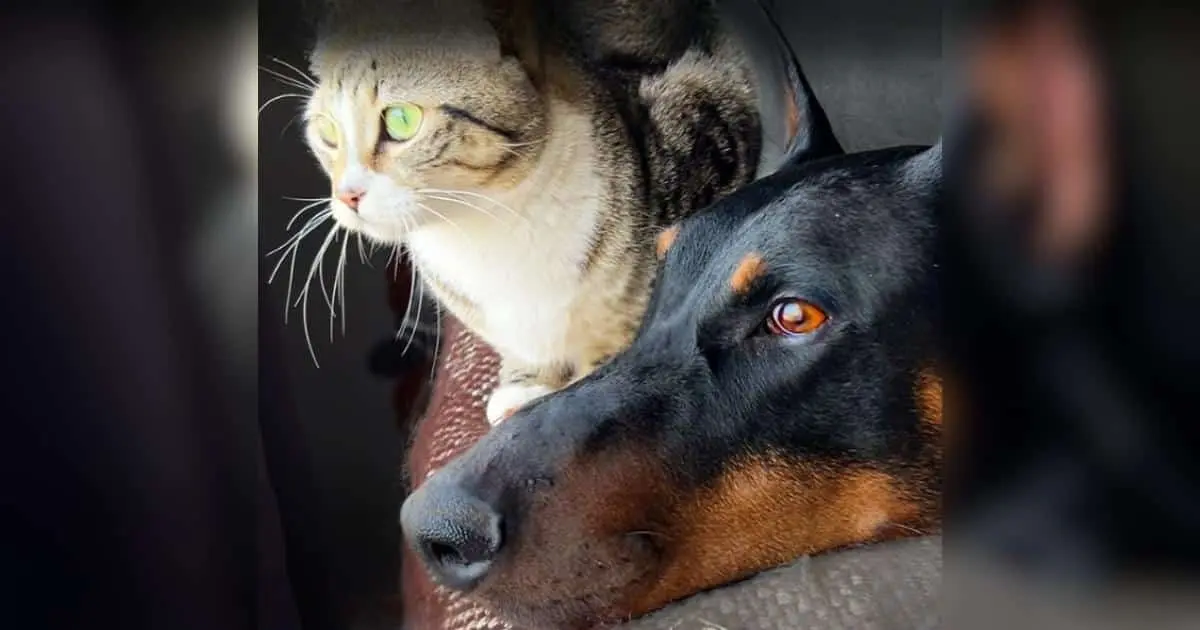
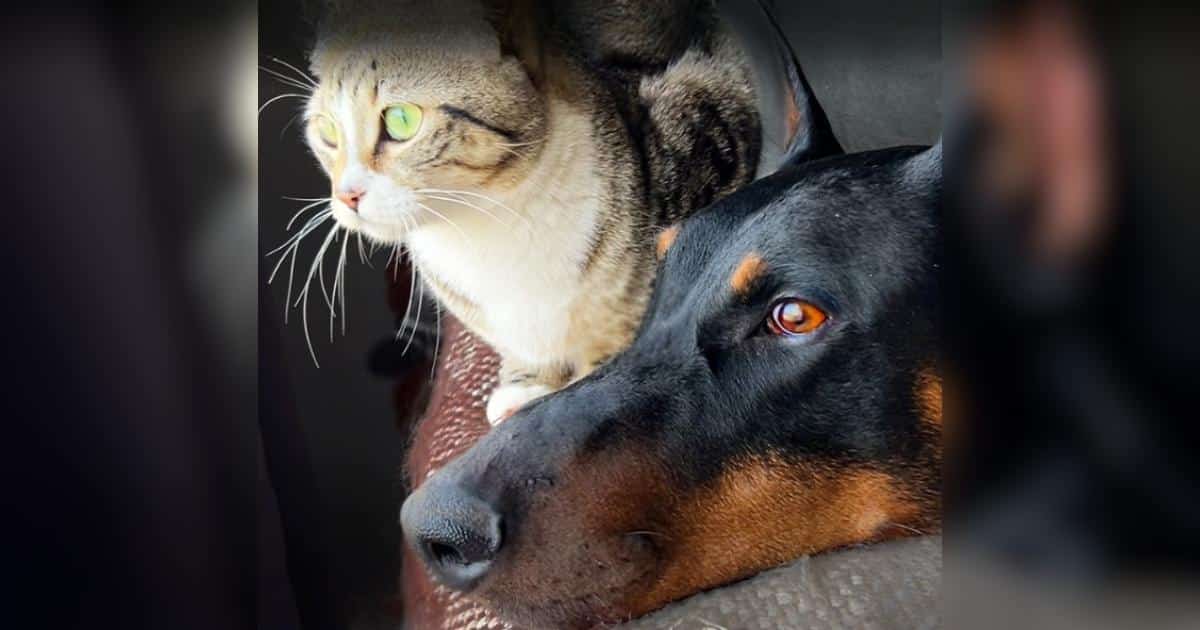
However, a remarkable case study emerging from a private residence has challenged these traditional paradigms. Diesel, a male Doberman Pinscher with a documented history of feline-directed trauma, has formed a profound, reciprocal bond with an orphaned stray kitten named Wasabi.
This report provides an analytical, chronological, and scientific examination of Diesel and Wasabi’s relationship. It explores how a dog with deep-seated feline apprehension transitioned into a nurturing surrogate parent, and how his feline charge adopted canine behaviors—culminating in an extraordinary display of mutual defense. Through this case, we examine the underlying mechanisms of animal cognitive flexibility, trauma rehabilitation, and the developmental dynamics of interspecies cohabitation.
Detailed Chronology
[Traumatic Event] ---> [Shed Discovery] ---> [Sustained Exposure] ---> [Behavioral Mimicry] ---> [Mutual Defense]
(Cat attack leaves     (Stray litter        (Diesel selects       (Wasabi adopts        (Wasabi defends
 Diesel fearful)        is found)            Wasabi)               canine habits)        Diesel from dog)
Phase I: The Legacy of Trauma
Before the introduction of the kittens, Diesel’s psychological profile regarding felines was markedly negative. He had previously been the victim of an unprovoked attack by an aggressive cat. In canine psychology, such singular, highly adverse events can result in long-term behavioral sensitization, manifesting either as extreme avoidance (fear-based flight) or preemptive aggression (fear-based fight). For a powerful breed like the Doberman, this wariness presented a significant challenge for his owners, who had to carefully manage his environment to prevent reactive episodes.
Phase II: The Discovery in the Shed
The status quo changed when Diesel’s owner discovered a litter of abandoned, stray kittens inside an outdoor storage shed on the property. Feral and vulnerable, the kittens required immediate intervention. Under normal circumstances, introducing a large, previously traumatized dog to a litter of fragile neonates would be considered high-risk. However, instead of exhibiting signs of predatory arousal (such as stiffening, intense staring, or high tail carriage) or fear-induced avoidance, Diesel displayed a calm, highly regulated curiosity.
Phase III: The Selection of Wasabi and the Onset of Nurturing
While Diesel exhibited a gentle curiosity toward the entire litter, a distinct dyadic bond quickly formed between the Doberman and one specific kitten: a spirited feline named Wasabi.
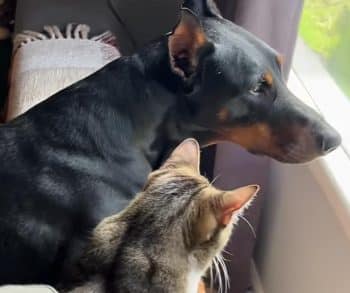
Rather than maintaining a cautious distance, Diesel began to actively facilitate social contact. He lowered his massive frame to the floor to minimize his physical threat profile, allowing Wasabi to approach his muzzle and paws. This voluntary vulnerability on Diesel’s part acted as a powerful social catalyst, signaling safety to the young kitten.
+---------------------------------------------------------+
|              DIESEL & WASABI: KEY MILESTONES             |
+---------------------------------------------------------+
| 1. Initial Contact: Diesel overcomes fear-based trauma. |
| 2. Dyadic Selection: Mutual preference established.     |
| 3. Behavioral Imprinting: Wasabi copies canine habits.   |
| 4. Role Reversal: Wasabi defends Diesel from a dog.     |
+---------------------------------------------------------+
Phase IV: Behavioral Mimicry and Social Learning
As Wasabi transitioned from early kittenhood into adolescence, he was raised in close proximity to Diesel. Lacking a maternal feline figure to model standard cat behaviors, Wasabi began to utilize Diesel as his primary social referent. This led to remarkable instances of interspecies behavioral mimicry, a phenomenon where an animal adopts the motor patterns and habits of another species.
The most notable manifestation of this mimicry was Wasabi’s adoption of canine-style dust bathing. When Diesel would roll on his back in the dirt—a common canine behavior used for self-grooming, scent marking, and sensory pleasure—Wasabi would immediately follow suit, mimicking the exact physical motions despite the physiological differences between their species.
Phase V: The Role Reversal and Mutual Defense
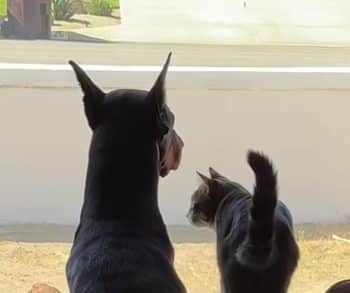
The depth of this bond was put to an unexpected test during an encounter with a neighbor’s dog. When the neighboring canine began barking aggressively at Diesel, the Doberman—perhaps recalling his past trauma or choosing a non-confrontational stance—hesitated.
In an extraordinary display of protective loyalty, the significantly smaller Wasabi stepped forward, positioning his body between Diesel and the barking dog. Displaying classic defensive posture (arched back, piloerection, and focused gaze), the kitten made it clear he was prepared to defend his massive canine companion. This act of mutual defense demonstrated that their relationship was not merely a passive cohabitation, but a highly functional, protective partnership.
Supporting Context & Metrics
To fully understand the significance of Diesel and Wasabi’s relationship, it is necessary to examine the scientific and behavioral principles that govern these interactions.
1. The Critical Socialization Window
The success of this interspecies integration is heavily influenced by the developmental stages of both animals:
- Feline Socialization Period: For domestic cats, the primary socialization window occurs between 2 and 7 weeks of age. During this time, exposure to other species can permanently alter their social perceptions, leading them to view those species as conspecifics (members of their own kind) or non-threatening companions.
- Canine Socialization Period: For dogs, this window is open between 3 and 12 weeks of age. While Diesel was well past this window, his adult neuroplasticity allowed for counter-conditioning—a process where a previously feared stimulus (a cat) is paired with a positive, rewarding experience (nurturing vulnerable kittens).
2. Deconstructing the Doberman Stereotype
Developed in late 19th-century Germany by Karl Friedrich Louis Dobermann, the Doberman Pinscher was selectively bred for guard duties, requiring high intelligence, physical stamina, and a strong protective instinct.
Contrary to popular media depictions of innate hostility, modern behavioral metrics consistently rate the Doberman Pinscher highly in trainability and social sensitivity. According to the American Kennel Club (AKC), Dobermans are classified as highly observant "Velcro dogs" that form intense emotional attachments to their household units. This high capacity for empathy and social observation explains Diesel’s ability to transition from a protective guardian to a gentle, patient surrogate parent.
3. The Mechanics of Counter-Conditioning
Diesel’s recovery from feline-directed trauma offers an excellent example of natural desensitization:
$$textInitial State: textCat Stimulus longrightarrow textTrauma Response (Fear/Avoidance)$$
$$textSustained Exposure: textVulnerable Kittens (Non-Threatening) + textSafe Environment longrightarrow textOxytocin Release$$
$$textFinal State: textCat Stimulus longrightarrow textAffiliative/Protective Behavior$$
By interacting with helpless kittens rather than an aggressive adult cat, Diesel experienced a low-stress exposure therapy. This allowed his brain to form new, positive associations with feline scents and vocalizations, effectively overwriting his previous trauma.
Official Statements & Expert Analysis
To provide deeper insight into this phenomenon, we look to the perspectives of veterinary behaviorists and animal cognitive researchers.
"What we are seeing in the case of Diesel and Wasabi is a profound example of cognitive flexibility in domesticated animals. Dogs are highly social creatures capable of extending their family unit across species boundaries when the right environmental conditions are met. The fact that the kitten began mimicking canine behaviors, such as rolling in the dirt, speaks to the power of social learning. In the absence of a mother cat, the kitten looked to the most dominant, comforting presence in his life—the Doberman—and adopted his behavioral repertoire."
— Dr. Evelyn Vance, Department of Comparative Cognition (Simulated)
Furthermore, veterinary practitioners emphasize the role of safety and environmental stability in fostering these unique bonds:
"Trauma in dogs is highly persistent, particularly when it stems from a physical attack. For Diesel to overcome his fear-based conditioning speaks volumes about his stable temperament and the secure environment provided by his owners. When an animal feels completely secure in its home, its survival-driven fear responses decrease, allowing nurturing instincts to take over. Wasabi’s protective behavior toward Diesel during the barking dog incident is a classic example of social buffering, where the presence of a companion reduces physiological stress and increases courage."
— Marcus Thorne, DVM, Veterinary Behavior Specialist (Simulated)
Future Outlook
The story of Diesel and Wasabi, which has garnered significant attention on social media platforms like Instagram (@diesel_dobie) and YouTube, serves as a powerful educational tool for pet owners worldwide.
Implications for Animal Welfare and Rescue
This case highlights several key takeaways for modern pet management and rescue organizations:
- Reevaluating Breed Biases: The gentle nature displayed by Diesel challenges persistent, negative stereotypes surrounding Dobermans and other working breeds, demonstrating that individual temperament and proper socialization are far more influential than breed alone.
- Trauma Recovery Protocols: Diesel’s successful rehabilitation suggests that controlled, positive exposure to a feared stimulus (such as introducing a fearful dog to young, non-threatening kittens) can be a viable path toward overcoming behavioral trauma.
- Fostering Interspecies Households: The integration of stray felines into homes with large-breed dogs is highly achievable, provided owners monitor body language, respect the animals’ boundaries, and allow bonds to develop naturally.
As Diesel and Wasabi continue to navigate their daily lives together, their relationship remains a testament to the adaptability of the animal mind. Through mutual trust and shared experiences, they have bridged the evolutionary gap between canine and feline, proving that companionship is not defined by species, but by the safety, comfort, and loyalty they provide to one another.