
Executive Overview
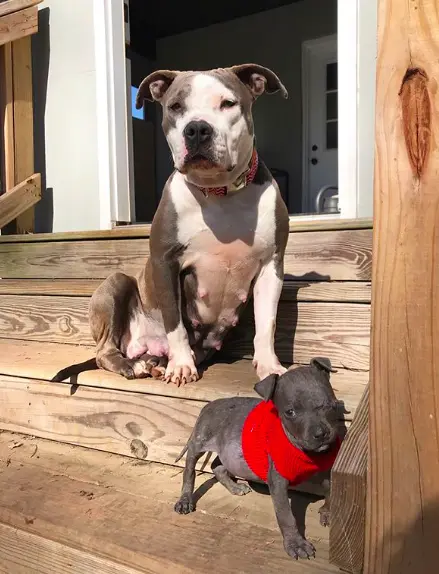
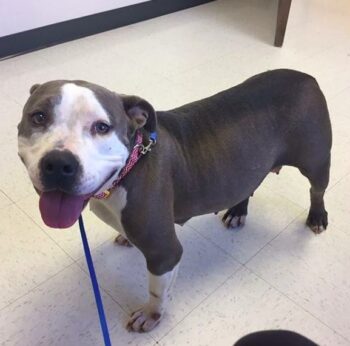
In the animal welfare and rescue sector, the intersection of trauma, medical crisis, and maternal instinct often presents complex rehabilitation challenges. When local Animal Control officers impounded a heavily pregnant stray Pit Bull, they recognized that a crowded, high-stress municipal shelter environment would pose severe risks to her imminent labor and psychological well-being. Partnering with Halfway There Rescue, a non-profit animal rescue organization, officers facilitated her immediate transfer into a specialized foster framework.
Named Daya, the rescue dog soon faced a devastating outcome: an underlying medical crisis led to the in utero loss of her entire litter and required emergency, life-saving surgery. In the wake of her loss, Daya exhibited profound grief, attempting to mother inanimate objects such as plush toys and socks. Simultaneously, the rescue organization took in Raisin, a critically vulnerable, single-pup orphan found abandoned along a roadway with a catastrophic eye injury.
What followed was a scientifically compelling and deeply moving case of surrogate cross-fostering. By pairing the grieving mother with the traumatized, newly operated puppy, rescue coordinators initiated a natural biological and psychological healing process. This comprehensive report outlines the chronology of Daya and Raisin’s rehabilitation, examines the biological mechanisms of maternal substitution in canines, and analyzes the broader systemic impact of community-based rescue networks.
Detailed Chronology
[Animal Control Intervention] ──> [Transfer to Halfway There Rescue]
                                         │
                                         ▼
                             [Medical Crisis & Surgery]
                             (In utero loss / Infection)
                                         │
                                         ▼
                             [Behavioral Displacement]
                             (Nesting socks & plush toys)
                                         │
                                         ▼
[Raisin Rescued & Operated] ──> [Strategic Introduction]
(Roadside orphan / Eye removal)          │
                                         ▼
                             [Symbiotic Bonding & Growth]
                                         │
                                         ▼
                             [Dual Successful Adoptions]
Act I: Intake and the Onset of Medical Crisis
The case began when municipal Animal Control officers encountered Daya roaming as a stray. Recognizing her advanced state of pregnancy and the physical strain associated with her condition, officers bypassed traditional intake housing. To protect her from the respiratory pathogens and elevated cortisol levels typical of high-volume shelter environments, they arranged an immediate intake with Halfway There Rescue.
Shortly after entering rescue care, Daya’s health deteriorated rapidly. Medical evaluation revealed that her unborn pups had died in utero, triggering a severe, life-threatening intrauterine infection (pyometra/septic metritis). Veterinary surgeons performed an emergency spay and surgical lavaging to neutralize the systemic toxicity. While the operation successfully preserved Daya’s life, it abruptly ended her physiological pregnancy, leaving her body flooded with post-partum hormones without an outlet for maternal care.
Act II: Psychological Displacement and Grief Behaviors
Following her surgical recovery in a temporary foster home, Daya displayed pronounced behavioral symptoms of canine grief and phantom maternity. Driven by elevated prolactin and oxytocin levels, Daya began gathering soft household items—primarily socks, shoes, and small plush toys—carrying them gently in her mouth to a designated bedding area.
She guarded these inanimate objects, licked them repeatedly, and tucked them beneath her abdomen in a clear attempt to fulfill an unexpressed maternal instinct. Rescue caretakers recognized that while her physical incisions were healing, her psychological recovery remained stalled by the absence of her offspring.
       +-------------------------------------------------------+
       |             CANINE HORMONAL FLUX & GRIEF              |
       |                                                       |
       |  Post-Operative Prolactin / Oxytocin Surge             |
       |  ▲                                                    |
       |  │                                                    |
       |  └──> Maternal Instinct Seeking Outlet                |
       |       │                                               |
       |       ├──> Inanimate Object Nesting (Socks/Toys)       |
       |       │                                               |
       |       └──> Receptive State for Surrogate Fostering   |
       +-------------------------------------------------------+
Act III: The Rescue of Raisin and Strategic Pairing
During this same period, Halfway There Rescue responded to an urgent field report regarding an abandoned, solitary puppy discovered on a public roadway. The puppy, subsequently named Raisin, was severely malnourished, disoriented, and suffering from a ruptured eye caused by blunt-force trauma or untreated infection.

Veterinary staff performed an emergency enucleation (surgical removal of the eye) to prevent spreading cranial infections. At merely a few weeks old, Raisin faced a critical developmental void: she lacked both maternal antibodies/nutrition and the maternal behavioral feedback necessary for social maturation.
Recognizing the convergent needs of both animals, the leadership team at Halfway There Rescue orchestrated a controlled, monitored introduction between Daya and Raisin.
+------------------------------------+------------------------------------+
|               DAYA                 |              RAISIN                |
+------------------------------------+------------------------------------+
| • Grieving loss of entire litter   | • Abandoned roadside orphan        |
| • Surgical recovery (Infection)    | • Emergency enucleation surgery    |
| • Seeking maternal outlet          | • Deprived of maternal care        |
| • Nesting inanimate surrogates     | • In need of social development    |
+------------------------------------+------------------------------------+
                                  │
                                  ▼
                     [STRATEGIC CROSS-FOSTERING]
                                  │
                                  ▼
+-------------------------------------------------------------------------+
|                          MUTUAL REHABILITATION                          |
| • Immediate physiological nursing & grooming responses                 |
| • Rapid decrease in stress-related displacement behaviors               |
| • Accelerated surgical recovery for both animals                        |
+-------------------------------------------------------------------------+
Act IV: Mutual Rehabilitation and Developmental Progression
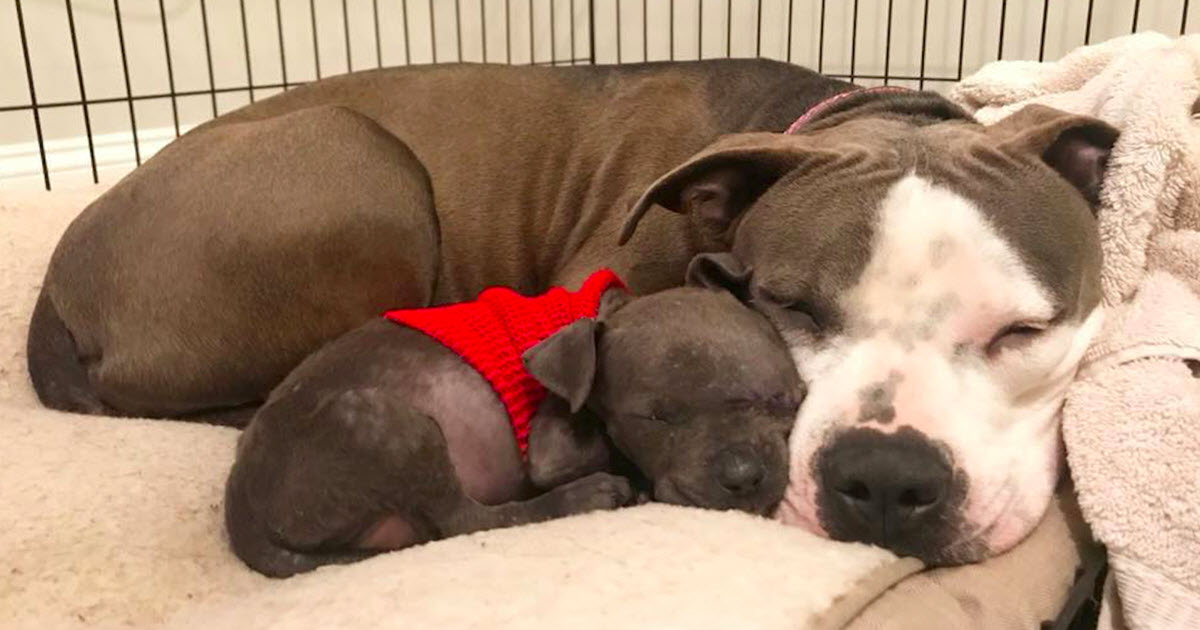
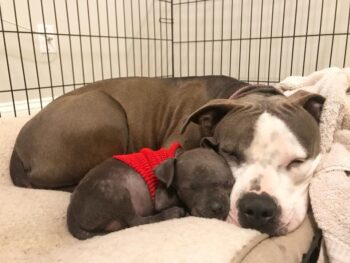
The initial interaction yielded an immediate, transformative outcome. Upon smelling and seeing the tiny, vulnerable puppy, Daya discarded her collection of socks and instantly adopted Raisin. She began grooming the young pup, nuzzling her, and positioning her body to provide warmth and security.
Raisin instinctively sought refuge against Daya, vocalizing contentedly and settling into a routine of co-sleeping and social bonding. Over the subsequent weeks:
- Physiological Recovery: Both dogs experienced rapid physical healing. The emotional stabilizing of Daya accelerated her systemic recovery from surgery, while Raisin flourished under constant physical warmth and meticulous grooming.
- Socialization: Daya taught Raisin critical canine social cues, bite inhibition, and emotional self-regulation—developmental milestones that orphaned puppies routinely miss.
- Natural Transition: As Raisin matured into adolescence, the intense maternal dependency naturally receded. Raisin grew increasingly independent, exploring her environment and seeking play interactions with other canine companions.
Act V: Permanent Adoption Pathways
Once both dogs reached full medical clearance and emotional stability, Halfway There Rescue transitioned them into long-term adoptive placements:
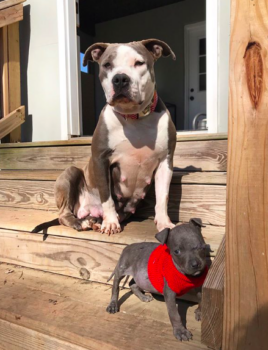
- Raisin’s Outcome: Raisin was permanently adopted by her foster family. Integrated into a home with a stable adult dog named Charlie, Raisin demonstrated exceptional social adaptability. Her adoptive owners noted that her early socialization with Daya equipped her with impeccable canine communication skills despite her visual impairment.
- Daya’s Outcome: Daya returned to her primary foster caregiver, who made the decision to adopt her permanently. Daya now serves as an anchor dog in a multi-pet home, assisting a resident dog suffering from severe anxiety. Her innate nurturing instincts have transferred seamlessly into calming her dynamic household companion.
Supporting Context & Metrics
The Science of Canine Cross-Fostering and Grief
Canine maternal grief is rooted in endocrinology. Following parturition or emergency surgical termination of pregnancy during late stages, a female dog’s endocrine system experiences elevated levels of prolactin (which stimulates lactation and maternal behavior) and oxytocin (the hormone responsible for bonding). When no offspring are present, these neurochemical drives manifest as pseudopregnancy behaviors or displacement activities, such as hoarding toys.
Interventions involving surrogate fostering leverage these active hormonal pathways. Introducing a vulnerable, maternal-dependent puppy:
- Triggers dopamine release, relieving stress-induced anxiety in the adult dog.
- Reduces cortisol levels, mitigating systemic inflammation and aiding post-surgical healing.
- Fills a vital developmental gap for the orphan, preventing behavioral issues like fear-aggression or separation anxiety in adulthood.
Quantitative Impact of Animal Welfare Networks
The resolution of Daya and Raisin’s case illustrates the crucial role played by foster-based rescue organizations and specialized community programs. Traditional, municipal shelter infrastructure often lacks the staffing ratio and isolated quiet space required to manage high-stakes medical and psychological cases simultaneously.
+-------------------------------------------------------------------------+
|                  REGIONAL & NATIONAL RESCUE IMPACT METRICS              |
+-------------------------------------------------------------------------+
| Metric Category                         | Volume / Value Achieved       |
+-----------------------------------------+-------------------------------+
| Shelter Meals Distributed (Partner Nets)| 50,000,000+ Meals             |
| At-Risk Animal Relocations (Air/Ground) | 1,201+ Dogs Saved             |
| Domestic Violence Pet Retention Grants  | $66,782 Direct Funding        |
| Service Dog Pairings for Veterans       | $1,881,595 Direct Placement   |
+-----------------------------------------+-------------------------------+
Community-supported rescue frameworks mitigate shelter overcrowding by:
- Diverting High-Risk Cases: Taking in pregnant, injured, or senior animals that would otherwise face high risk of euthanasia in municipal facilities.
- Utilizing Specialized Foster Networks: Providing individualized home care that allows recovering animals to heal without exposure to shelter-acquired infections.
- Cross-Regional Relocation: Leveraging transport logistics to move animals from overpopulated jurisdictions to areas with high adoption demand.
Official Statements and Expert Analysis
Rescue Leadership Perspective
Representatives from Halfway There Rescue emphasized the importance of adaptive behavioral management when handling complex trauma cases in shelter animals:
"When Daya lost her litter, her emotional distress was visible. She was actively searching for something to mother, clinging to plush toys as if her life depended on it. On the other side of our network, we had Raisin—a tiny, single orphan recovering from a major surgery with no mother to guide her. Matching them wasn’t just a convenient space-saving decision; it was a clinical intervention. Watching Daya instantly step into the role of mother proved to us how powerful biological instinct can be when paired with proper rescue strategy."
Veterinary and Behavioral Insights
Veterinary professionals involved in shelter medicine highlight the critical timing required for successful surrogate introductions:
"In cases of severe maternal loss complicated by medical emergencies like septic metritis, an animal’s emotional state directly affects physical healing. High stress retards wound healing and depresses immune responses. By introducing an orphaned pup like Raisin, rescue workers provided a target for Daya’s lingering hormonal drives. The resulting reduction in maternal anxiety creates a parasympathetic state that accelerates physical convalescence. Simultaneously, Raisin acquired essential canine etiquette that no human caregiver, regardless of dedication, could ever teach."
Future Outlook
The success of Daya and Raisin’s co-rehabilitation highlights several emerging best practices within the animal rescue sector:
- Expanded Foster-Based Medical Units: Rescue organizations are increasingly expanding specialized foster networks equipped to handle concurrent medical and psychological rehabilitation, minimizing the reliance on physical shelter kennels for delicate cases.
- Integration of Cross-Fostering Protocols: Shelters are formalizing cross-fostering registries, matching orphaned litters or singletons with females experiencing pseudopregnancy or recent maternal loss across broader geographical regions.
- Holistic Trauma-Informed Care: Veterinary protocols are shifting to address emotional and behavioral health alongside surgical recovery, recognizing that emotional stabilization directly influences medical outcomes.
Today, both Daya and Raisin are thriving in their respective permanent homes. Their journey from roadside abandonment and near-fatal medical crises to fully integrated family pets demonstrates the profound effectiveness of targeted, compassionate animal welfare interventions.
Key Takeaways for Community Advocates
- Support Foster Networks: Foster homes serve as the primary bridge between crisis intervention and permanent adoption for vulnerable animals.
- Recognize Behavioral Cues: Understanding phantom pregnancy and canine displacement behaviors allows caregivers to intervene effectively rather than punishing unexpected behaviors.
- Promote Local Rescue Initiatives: Community funding and volunteering directly support life-saving surgical interventions and specialized care programs for animals in need.