
Executive Overview
Few agricultural commodities are as deceptively delicate as the potato. Beneath their rugged, earthy exteriors lies a fragile crop highly susceptible to mechanical bruising during harvest and transport. Across the global agricultural supply chain, this physical vulnerability translates into staggering economic waste, resulting in millions of dollars in lost revenues annually. Damaged tubers cannot be processed into premium chips or crisp products, forcing farmers and consumer packaged goods (CPG) giants alike to absorb heavy losses.
While agricultural technology has traditionally focused on soil sensors, automated irrigation, and autonomous tractors, a critical link in the supply chain has historically been neglected: human capital, training, and operational upskilling. Recognizing this blind spot, consumer goods titan PepsiCo and agricultural machinery manufacturer Grimme have forged a groundbreaking cross-industry partnership. Together with immersive learning technology provider Altoura, the companies have developed highly accurate digital replicas—commonly known as digital twins—of Grimme’s EVO and SE series potato harvesters.
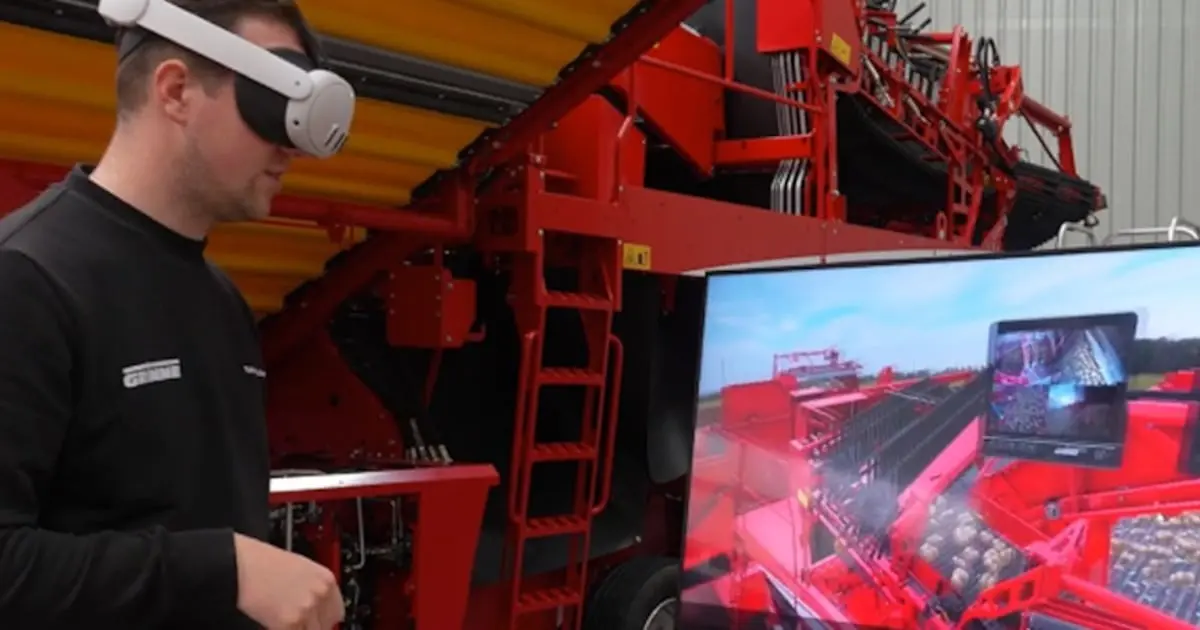
This immersive training initiative allows machine operators to virtually inspect complex machinery, remove internal panels, diagnose mechanical faults, and practice optimal harvesting techniques within a risk-free virtual environment. Designed primarily for virtual reality (VR) headsets, the platform is remarkably versatile, offering seamless accessibility across desktops, tablets, and smartphones. Crucially, once the application is downloaded, it operates entirely offline, eliminating the connectivity barriers that frequently plague remote agricultural regions.
The initial rollout of this pilot program yielded extraordinary results, boasting an 87% increase in bruise-free potato yields and a 1.7-fold reduction in severe bruising during field tests. Following successful implementations across Latin America and Europe, PepsiCo and Grimme are scaling the technology globally, tailoring the platform to regional dialects, machinery configurations, and local farming realities. This initiative marks a pivotal milestone in agtech, demonstrating that virtual reality and industrial simulation are no longer restricted to manufacturing plants and aerospace engineering—they are powerful tools capable of transforming grassroots farming, closing the agricultural skills gap, and securing the future of global food supply chains.
Detailed Chronology: From Concept to Global Rollout
The genesis of this transformative partnership traces back to a convergence of persistent agricultural challenges and burgeoning industrial simulation technologies. For years, PepsiCo’s global agriculture teams grappled with the physical realities of potato harvesting. Operating massive, complex harvesters requires precise calibration; minor errors in tine depth, web speed, or shaker intensity can send shockwaves through the tubers, causing internal bruising that remains undetected until the crop reaches processing facilities.
Furthermore, the agricultural sector faces a severe, structural labor shortage. Farm work is increasingly seasonal, geographically dispersed, and reliant on a transient workforce speaking multiple languages. Delivering consistent, high-impact operational training under these conditions has historically been inefficient, expensive, and logistically daunting.
Phase 1: Internal Ideation and Cross-Industry Inspiration
The breakthrough came when agricultural leaders at PepsiCo looked inward at the broader corporation’s technological endeavors. PepsiCo had been experimenting with advanced industrial artificial intelligence and digital twins in its manufacturing and supply chain divisions, notably collaborating with tech behemoths like Nvidia and Siemens to simulate factory environments.
Rob Meyers, Vice President of Global Agriculture at PepsiCo, recognized that these industrial simulation frameworks possessed immense, untapped applicability for primary agriculture. If digital twins could optimize manufacturing plants, why couldn’t they simulate the inner workings of a multi-ton potato harvester in a farmer’s yard?
Phase 2: Strategic Collaboration and Technological Development
Seeking world-class machinery expertise and immersive learning capabilities, PepsiCo joined forces with Grimme—a globally renowned leader in potato harvesting technology—and Altoura, a specialist in immersive learning and spatial computing.
The objective was clear: build a hyper-realistic digital twin of Grimme’s flagship EVO and SE series potato harvesters. Unlike traditional 2D instruction manuals or static video tutorials, this digital twin provided an interactive, 3D spatial environment. Operators could virtually walk around the multi-million-dollar machines, step inside the operator cab, dismantle internal components, and observe real-time mechanical responses to operational adjustments.
Phase 3: Global Pilot Testing (Brazil and Mexico)
With the software developed, PepsiCo and Grimme initiated field testing in Latin America. Throughout last year, pilot programs were deployed in Brazil and Mexico. These regions presented diverse operating conditions, varying soil types, and unique workforce demographics, making them ideal testing grounds for the platform’s adaptability and user-friendliness.
The pilots were designed to measure whether virtual training could tangibly alter operator behavior in the field. The results exceeded expectations, validating the hypothesis that training operators on the mechanics of bruise prevention prior to harvest could drastically improve crop quality.
Phase 4: Expansion to Europe and Global Showcases
Buoyant with the success of the Latin American pilots, the partnership expanded its footprint into Europe. PepsiCo and Grimme rolled out the digital twin training platform to farming communities in Poland and Romania, two major agricultural hubs for the CPG giant.
To build broader industry momentum, the companies showcased the technology at PepsiCo’s prestigious Global Agro University in Germany, drawing agricultural experts, suppliers, and industry leaders from around the world. Here, attendees experienced firsthand how spatial computing bridges the gap between complex agricultural machinery and human operational proficiency.
Supporting Context & Metrics: The Economics of Potato Bruising
To understand the profound significance of the PepsiCo-Grimme collaboration, one must examine the profound economic and operational realities of potato farming. The potato supply chain is a delicate balancing act where narrow profit margins can be instantly erased by preventable crop degradation.
The True Cost of Crop Bruising
Potatoes are roughly 80% water, making them remarkably sensitive to kinetic impact. When harvested mechanically, tubers pass over webs, rollers, and separators. If harvester speeds are too high, or if drop heights within the machine are excessive, the potatoes suffer external scuffing, black spot bruising, or internal shattering.
- Financial Impact: Bruised potatoes are routinely rejected by processors because they spoil faster, develop rot during storage, and yield unsightly processed chips with dark blemishes. This results in tens of millions of dollars in direct agricultural losses annually.
- Sustainability Implications: Crop waste represents an inefficient use of vital natural resources. Water, fertilizer, land, and tractor fuel expended to grow bruised, discarded tubers represent a preventable environmental footprint. Preserving crop quality directly aligns with corporate sustainability and net-zero carbon initiatives.
Quantifying Success: The 87% Reduction Metric
The most compelling validation of the digital twin initiative lies in its empirical data. During the multi-region pilot programs in Brazil and Mexico, PepsiCo documented transformative improvements in harvest quality:
- 87% Increase in Bruise-Free Potatoes: Operators who underwent the virtual reality training regimen dramatically reduced the incidence of mechanical damage during actual harvests.
- 1.7x Reduction in Severe Bruising: The most economically damaging category of injury—deep structural bruising—was nearly halved, saving substantial tonnage from being downgraded or discarded.
Overcoming Infrastructure and Technological Hurdles
Deploying advanced technology in rural farming communities presents unique engineering challenges. High-speed, reliable internet connectivity cannot be taken for granted in agricultural fields.
Recognizing this, Altoura, PepsiCo, and Grimme engineered the platform for maximum accessibility and resilience:
- Hardware Agnosticism: While optimized for immersive VR headsets—which provide the highest degree of spatial presence and muscle memory retention—the software is fully functional on standard consumer hardware, including desktop computers, tablets, and smartphones.
- Offline Functionality: Once an operator downloads the Altoura application and syncs the training modules, the program operates entirely offline. Farmers in remote rural sectors without cellular service or reliable Wi-Fi can complete comprehensive training modules in their farm offices or equipment sheds without disruption.
Official Statements and Industry Insights
The success of the PepsiCo-Grimme partnership highlights a broader evolution in how multinational corporations collaborate with their agricultural supply chains. Moving away from top-down mandates, modern CPG leaders are investing heavily in capacity-building and collaborative upskilling.
Adapting to Local Realities
Rob Meyers, Vice President of Global Agriculture at PepsiCo, emphasized that technological sophistication means little if it fails to resonate with everyday users on the ground. In an interview with AgNavigator, Meyers elaborated on the strategic philosophy guiding the rollout:
"Adapting to local realities is often more important to driving adoption at scale. As we expand into new markets, we’re continuing to refine the experience, including language support and training content. The goal isn’t to introduce complexity. It’s to make proven expertise available to more operators, in more places, before they enter the field."
Meyers noted that the inspiration to bring virtual reality to the farm was born out of cross-pollination within PepsiCo’s diverse business units. Earlier in the year, the CPG giant announced a landmark artificial intelligence and digital twin collaboration with industrial software giants Siemens and Nvidia, designed to simulate and optimize manufacturing assembly lines.
"We had seen some of the work that our wider PepsiCo business was doing around using digital twins to improve operator training in the manufacturing space and felt there was a lot of applicability that could help us on the farming side," Meyers explained.
Tackling the Agricultural Labor Crisis
Beyond bruise reduction, the platform addresses one of modern agriculture’s most critical structural vulnerabilities: the shrinking availability of skilled, experienced labor. Farming communities across North America, Europe, and Latin America face aging rural populations and acute seasonal labor shortages.
"One of agriculture’s biggest challenges is delivering consistent, high-quality training to operators who may be seasonal, geographically dispersed or working in different languages and markets," Meyers stated. "The opportunity with digital tools is their ability to make expert training more accessible and scalable."
Addressing the inevitable skepticism surrounding the cost of implementing emerging technology in agriculture, Meyers pointed out that the investment pales in comparison to the financial downside of inaction:
"Of course, cost is always an important consideration for the adoption of any technology. The loss of revenue for a farmer due to bruising can be very high, and the VR technology costs are only a fraction of this risk."
Future Outlook: The Next Frontier in Agtech Immersive Learning
As the PepsiCo-Grimme digital twin initiative transitions from successful pilot programs to widespread commercial deployment, its implications extend far beyond potato farming. This partnership signals the dawn of a new era in agricultural education, where spatial computing, artificial intelligence, and digital twinning converge to redefine how humans interact with complex machinery.
Expanding Crop Categories and Machinery Ecosystems
The underlying architecture developed by Altoura, Grimme, and PepsiCo is inherently modular. The success demonstrated with potato harvesters paves the way for similar digital twin applications across other delicate, high-value specialty crops.
- Horticulture and Viticulture: Delicate fruits such as apples, berries, and wine grapes suffer from parallel mechanical harvesting challenges. Virtual training platforms could soon be deployed for sophisticated grape sorters, cherry shakers, and citrus harvesters.
- Broader Machinery Integration: While the initial focus has centered on Grimme’s EVO and SE series, future iterations could encompass a wider spectrum of agricultural equipment, ranging from combine harvesters and precision planters to advanced self-propelled sprayers.
The Democratization of Expert Knowledge
Traditionally, mastering the operation of a multi-hundred-thousand-dollar agricultural machine required years of trial and error in the field—an expensive education paid for in bruised crops, broken components, and lost productivity.
Virtual reality democratizes this expertise. A seasonal worker stepping into a field for the very first time can now possess the simulated muscle memory and diagnostic intuition of a seasoned veteran with decades of experience. By allowing operators to make mistakes in the virtual world, the technology prevents costly errors in the physical world.
A Blueprint for Sustainable Corporate Agriculture
The PepsiCo-Grimme initiative offers a compelling blueprint for how multinational corporations can partner directly with primary producers to drive sustainability and efficiency. Rather than imposing rigid regulations or punitive standards, this approach equips farmers with cutting-edge tools to naturally elevate their performance, protect their bottom lines, and secure their livelihoods.
As spatial computing hardware becomes increasingly lightweight, affordable, and ubiquitous, immersive learning will undoubtedly transition from a novel pilot experiment into an indispensable pillar of modern agronomy. In doing so, it proves that the future of agriculture relies not only on smarter machines, but on empowering the skilled human hands behind them.