
By the Investigative Pet Health Desk
Executive Overview
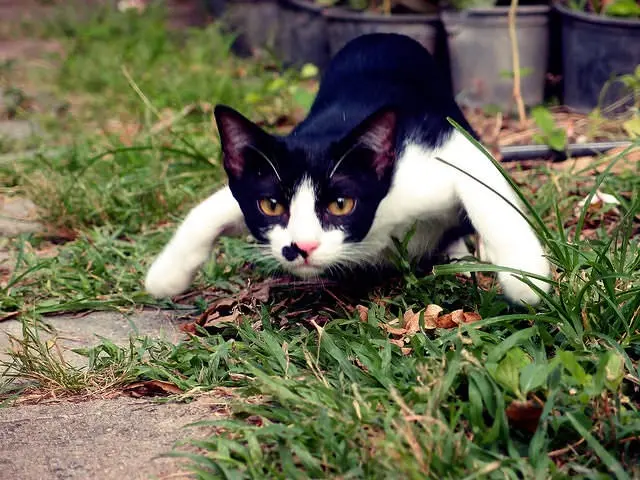
To the uninitiated cat owner, a sudden, claws-out ambush on a bare ankle or a frantic pounce beneath the bedcovers feels like an act of unprovoked aggression. It hurts, it startles, and it often occurs at the most inconvenient times—usually right as you are rushing down the hallway to get ready for work or trying to fall asleep.
However, veterinary behaviorists and feline researchers emphasize a critical distinction: your cat is not angry, spiteful, or dominant.
Instead, that midnight strike or hallway ambush is the direct result of an ancient, highly specialized predatory play drive. Unlike dogs, whose millennia of co-evolution alongside humans drastically reshaped their social and cognitive structures, domestic house cats remain genetically remarkably close to their wild ancestors (Felis lybica, the African wildcat). Stalking, chasing, and pouncing are not learned misbehaviors or quirky personality traits; they are hardwired biological imperatives.
This comprehensive report examines the evolutionary wiring behind foot-and-ankle attacks, explores why certain environments act as feline "watering holes," identifies high-risk demographics—such as kittens and single-cat households—and outlines actionable, evidence-based mitigation strategies to restore peace to your hallways.
Detailed Chronology: From Wild Ancestry to the Modern Living Room
To understand why a domestic cat views a human foot as a potential meal, one must look backward through millennia of evolutionary history.
The Evolutionary Timeline of Felis catus
- Pre-Domestication (Approx. 10,000+ years ago): Wild ancestors of the modern cat survived almost exclusively by hunting small, fast-moving prey: rodents, birds, insects, and reptiles. Success depended on meticulous energy conservation followed by explosive, short-burst sprints.
- The Agricultural Revolution: Cats began gravitating toward human settlements drawn by rodents near grain stores. While humans welcomed the pest control, cats were never truly "domesticated" in the pack-animal sense that dogs were. They retained their solitary hunting ethos.
- The 1970s Behavioral Breakthroughs: Animal behaviorists began documenting predatory systems in laboratory settings, discovering that the urge to hunt operates on a neural circuit entirely separate from the brain’s hunger center. A cat can be fully satiated by commercial food and still feel an overwhelming, biological urge to stalk and kill.
- Modern Feline Guidelines: Today, prominent organizations—including the Cornell Feline Health Center and the American Association of Feline Practitioners (AAFP)—classify predatory play as a foundational welfare requirement. When that requirement goes unmet, the instinct naturally manifests on whatever moving targets are available: your feet.
Supporting Context & Metrics: The Anatomy of an Ambush
Cats do not randomly pick targets; they calculate movement, shadows, and spatial advantages with the precision of elite predators.
The Hallway as a "Watering Hole"
In the wild, ambush predators do not wander aimlessly in search of prey. Instead, they identify bottlenecks—locations where prey is forced to pass predictably. Leopards stretch out on low-hanging branches above game trails; lions monitor the muddy banks of watering holes.
In a modern home, your cat applies this exact mathematical blueprint to domestic geography:
- The Hallway Corridor: Narrow, bounded by walls, and traversed by you at predictable times (e.g., morning coffee routines).
- The Under-Couch Blind: A low vantage point offering total concealment with an expansive field of vision over floor-level foot traffic.
- The Bottom of the Staircase: A gravity-assisted launching pad where descending feet create distinct, repetitive thuds and rhythmic visual cues.
The Blanket Phenomenon
Why do attacks peak under the covers at night? A human foot shifting beneath a duvet creates muffled, rustling sounds and undulating shadows. To a cat’s hyper-sensitive auditory and visual systems, this mimics a rodent moving through tall grass. It triggers an involuntary, hardwired predatory sequence: Stalk $rightarrow$ Chase $rightarrow$ Pounce $rightarrow$ Kill.
Demographics at Risk: Who Pounces and Why?
Data from feline behavioral clinics highlights clear demographic patterns among ankle-ambushers:
| Demographic Risk Factor | Underlying Mechanism | Typical Behavioral Manifestation |
|---|---|---|
| Kittens & Cats Under 2 Years | High metabolic energy, immature bite inhibition, and ongoing hunting technique refinement. | Frequent, high-intensity pouncing; difficulty gauging human skin sensitivity. |
| Single-Cat Households | Absence of conspecific (feline) playmates to practice mutual wrestling, batting, and boundary-testing. | Redirection of intense play-aggression entirely toward human ankles and hands. |
| Under-Stimulated Indoor Cats | Lack of structured environmental enrichment or interactive hunting simulation toys. | Frustration-induced ambushes targeting any available movement in the home. |
Official Statements & Expert Insights
Prominent veterinary institutions and behaviorists have consistently updated their guidelines to reframe how owners view feline play aggression.
"Predatory play is a biological drive, not a behavioral flaw. When a cat attacks an ankle, they are executing a normal behavioral sequence in an abnormal environment where proper prey outlets are missing."
— Dr. Rachel Malamed, Board-Certified Veterinary Behaviorist
The Cornell Feline Health Center notes in its clinical literature:
"Play aggression is most commonly observed in young cats whose play needs are not adequately met by their human companions. Because owners often make the mistake of using bare hands or feet to interact with kittens, the cat learns to associate human limbs with moving prey."
Furthermore, the ASPCA cautions owners against misinterpreting these incidents:
"Pun yelling, spraying water, or physically punishing a cat for ankle-attacking only damages the human-animal bond. The cat does not connect the punishment to the act of hunting; they simply learn to fear your approach, which can escalate play aggression into true defensive aggression."
Clinical Red Flags: When Play Aggression Crosses Into Pathology
While 90% of foot-ambushing is harmless play behavior rooted in boredom or high energy, owners must remain vigilant for sudden shifts in temperament.
Normal Play vs. Redirected Aggression
- Normal Play Aggression: Occurs during transitions, periods of high energy, or predictable household routines. The cat’s body language is dynamic, ears are forward or slightly swivelled, and attacks are often exploratory or accompanied by a quick retreat.
- Redirected Aggression (The Danger Zone): If a cat that has historically been a gentle pouncer suddenly begins biting hard enough to lacerate skin, pay close attention to accompanying physical signs. Hissing, pinned-back ears, dilated pupils, piloerection (hair standing on end), and a stiff, twitching tail indicate high physiological arousal and stress.
According to VCA Animal Hospitals, redirected aggression occurs when a cat becomes deeply agitated by an external stimulus they cannot reach—such as an outdoor stray cat visible through the window—and immediately redirects that pent-up fury onto the nearest living target: your ankles. If this behavior escalates without an obvious play trigger, a comprehensive veterinary examination is mandatory to rule out underlying pain, hyperthyroidism, or neurological discomfort.
Future Outlook & Actionable Mitigation Strategies
You do not have to live in fear of walking down your own hallway. Eliminating ankle attacks requires a two-pronged approach: removing human limbs from the prey equation and redirecting the cat’s biological hunting drive toward appropriate outlets.
1. The Full Predatory Cycle Play Routine
Cats need to complete the natural hunting sequence daily. A proper interactive play session should mirror a hunt:
- The Stalk: Use wand toys with feathers or ribbons, dragging them slowly behind furniture corners.
- The Chase: Make the toy dart quickly across the room to trigger fast-twitch muscle responses.
- The Catch: Let the cat successfully capture and "kill" the toy at least 50% of the time to build confidence.
- The Kill & Consumption: Immediately follow the play session with a small meal or high-value treat. In the wild, eating is the natural conclusion to a successful hunt; it triggers a drop in adrenaline and signals the brain that it is time to groom and sleep.
2. Zero-Tolerance for Limb Toys
Never use your hands, fingers, or feet underneath blankets as wrestling toys. While batting at a kitten’s paws seems endearing, it teaches the animal that human skin is an acceptable target. Once that cat weighs 12 pounds and possesses adult teeth, that "cute" habit becomes dangerous.
3. Tactical Environmental Management
- Distraction Before Walking: If your cat has a known ambush spot by the stairs or kitchen entrance, toss a ping-pong ball or a crinkle toy down the hallway before you walk through, giving them a designated target to intercept instead of your ankles.
- Puzzle Feeders: Implement automated puzzle feeders or food-dispensing balls to occupy your cat’s cognitive energy during peak activity hours (typically dawn and dusk).
Frequently Asked Questions
Is it normal for cats to attack feet?
Yes. It is one of the most frequently reported play-related behaviors among cat owners, particularly those with kittens and young adult cats. It is driven entirely by predatory instinct, not malice, and typically diminishes as the cat matures and receives structured, appropriate play.
How do I stop my cat from attacking my feet?
Rather than trying to suppress the instinct, redirect it. Invest in daily wand-toy sessions, introduce puzzle feeders, and institute a rigorous play session immediately before bedtime. Crucially, never use your hands or feet as play toys.
Why does my cat ambush my feet under the covers?
A foot moving under a blanket mimics the auditory and visual cues of small prey moving through tall grass. It serves as an irresistible, high-contrast trigger for a cat’s innate ambush reflex.
Why does my cat bite my ankles when I walk by?
Fast, repetitive movement at floor level activates the feline chase reflex. When combined with a hidden vantage point like a hallway corner or the base of a staircase, your walking pace creates the ultimate simulated hunting scenario from your cat’s perspective.