
Executive Overview
For generations, evolutionary biologists and paleontologists have relied on a foundational assumption to map the dawn of animal life: if an exceptionally preserved fossil deposit lacks animal remains, then animals simply did not exist when those rocks formed.
This logical pillar underpinned how scientists calculated the maximum age of the animal kingdom, steering decades of research into the late Precambrian. However, a landmark study published on October 2 in Science Advances has dismantled this long-held premise. Led by an international team of researchers from the University of Oxford, alongside colleagues from the University of California Berkeley, ETH Zürich, and Yale University, the new findings suggest that animals may have originated up to 200 million years earlier than their earliest clear appearances in the conventional fossil record.
By studying exceptionally preserved microfossils from the Kheseen Biota in Mongolia—dating to a time when scientists know animals already existed globally—the research team proved that premier preservation conditions do not guarantee the fossilization of early animal life. This revelation invalidates previous maximum-age constraints derived from older deposits like China’s Weng’an Biota. When researchers recalculated molecular clocks using older geological boundaries from 850 to 730 million years ago, the timeline for the origin of animals was pushed dramatically backward, placing the dawn of the animal kingdom deep within the Neoproterozoic Era, potentially before the catastrophic "Snowball Earth" ice ages.
Detailed Chronology: From the Cambrian Explosion to the Neoproterozoic
To fully grasp the magnitude of the new Oxford-led study, one must understand the historical puzzle of the fossil record. For centuries, the timeline of complex life appeared deceptively straightforward, though profoundly perplexing.
The Sudden Appearance of Complex Life
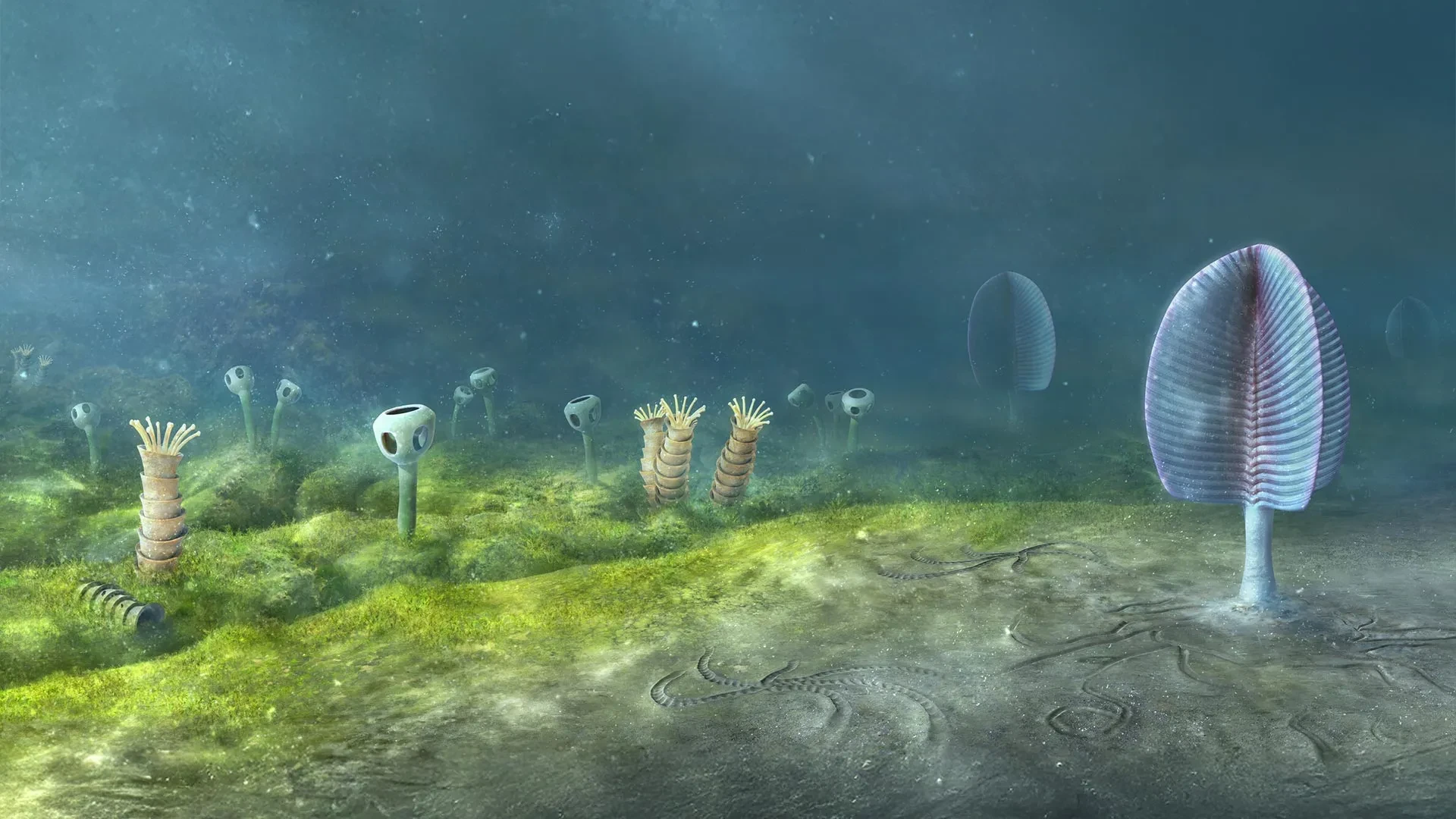
Classically, the history of complex multi-cellular life seemed to begin with the Cambrian Explosion (spanning roughly 539 to 487 million years ago). During this geologically brief window, an astonishing array of complex body plans—representing nearly all modern animal phyla—burst into the fossil record almost simultaneously.
Yet, evolutionary theorists recognized that such evolutionary velocity was impossible from scratch. Complex genetic toolkits, nervous systems, and physiological architectures must have been brewing long before the Cambrian. Pushing further back into the Ediacaran Period (635 to 539 million years ago), paleontologists discovered bizarre, soft-bodied macroscopic organisms known as the Ediacaran biota. While some of these organisms are recognized as early animal precursors (or stem-group metazoans), they still fail to capture the deep genetic roots of the animal tree.
The Weng’an Biota Bottleneck
To find the absolute maximum age for when animals first evolved, scientists turned to older microfossil assemblages. Chief among these was the Weng’an Biota in South China, a roughly 590-million-year-old fossil deposit from the Ediacaran Period.
The Weng’an Biota is famous among paleontologists for its exceptional preservation. Microscopic organisms, including cellular structures and embryo-like spheres, are fossilized in exquisite, three-dimensional detail. Because this deposit is so extraordinarily well-preserved yet completely devoid of any definitive animal fossils, scientists historically drew a hard line in the sand: Animals could not have evolved prior to 590 million years ago. The reasoning was foolproof—if animals had been roaming the ancient seas at that time, surely the microscopic detritus of their bodies or eggs would have been captured in such pristine environmental archives.
The Kheseen Biota Breakthrough
The recent Science Advances study shatters this exact assumption. The international research team focused their efforts on the Kheseen Biota in Mongolia, a rock formation roughly 40 million years younger than Weng’an (dating to around 550 million years ago), though sharing several overlapping microfossil species.
Crucially, independent fossil evidence from around the world—such as contemporaneous sites in Namibia and South China—confirms beyond a shadow of a doubt that animals did exist globally by the time the Kheseen Biota formed.
Using advanced scanning electron microscopy, the team analyzed more than 140 rock samples, uncovering beautifully preserved microfossils, including intricate acritarchs (spherical micro-organisms adorned with spines and branching appendages) and cellular clusters resembling ancient embryos. Despite this breathtaking level of preservation, not a single animal fossil was found in the Kheseen assemblages.
This discovery delivers a definitive blow to the Weng’an assumption. If environments can harbor world-class microfossil preservation while completely missing animal remains during an era when animals definitively existed, then the absence of animal fossils in older rocks (like Weng’an) proves nothing about whether animals were alive at that time.
Supporting Context & Metrics: Molecular Clocks and Deep Time
With the traditional maximum-age constraints dismantled, the research team sought a new way to calculate the true birth date of the animal kingdom. They turned to molecular clock analysis—a sophisticated bioinformatic technique used to estimate evolutionary timelines.
How Molecular Clocks Work
Molecular clocks operate on a relatively simple yet powerful premise: as species diverge from a common evolutionary ancestor, their DNA accumulates random genetic mutations at a roughly constant background rate. By comparing the genetic differences among living animal species today, factoring in calibrated fossil dates, and estimating evolutionary rates, scientists can work backward to calculate when ancestral lineages split.
However, molecular clocks are only as accurate as the geological constraints plugged into them. Previously, researchers anchored their molecular clock calibrations using maximum age boundaries derived from the Weng’an Biota (approx. 590 million years ago) and other Ediacaran sites.
Pushing Back the Clock by 200 Million Years
When the Oxford-led team recalibrated their molecular clock models using much older, fossil-rich geological formations dating from 850 to 730 million years ago—such as the Svanbergfjellet Formation in Norway, the Bitter Springs Group in Australia, and the Chuar Group in Arizona—the resulting evolutionary timeline shifted dramatically.
- Previous Maximum Limit: Restricted animal origins firmly within the Ediacaran interval (under ~600 million years ago).
- New Estimated Window: The calculated origin of animals moved backward by approximately 200 million years, placing the emergence of the animal kingdom between 800 and 700 million years ago.
The Chemical Fossil Evidence
This expanded timeline is not occurring in a vacuum; it aligns closely with independent geochemical data. Over the past decade, organic geochemists have identified biomarkers (chemical fossils) trapped within ancient sedimentary rocks.
Specific lipid molecules—most notably steroids indicative of Demosponges (modern sea sponges)—have been extracted from strata dating back at least 650 million years. These chemical breadcrumbs predate the earliest macroscopic body fossils of sponges by tens of millions of years, signaling that a ghost lineage of soft-bodied, microscopic animal life was thriving long before they left an impression in the stone.
Official Statements and Expert Insights
The implications of this study reach far beyond academic journals, forcing a fundamental re-evaluation of how geologists and paleontologists interpret the ancient biosphere.
Associate Professor Ross Anderson, Senior Author of the study from the Oxford University Museum of Natural History, explained the core significance of the Mongolian findings:
"The Kheseen Biota breaks the argument that the exceptional microfossils of Weng’an mean we would have seen animal fossils in the assemblage had they existed at the time. The Kheseen microfossils are just as well-preserved, yet animals continue to be absent—despite the fact we know at that point they existed."
Anderson noted that this absence points to ecological or taphonomic realities: early animals may have inhabited micro-environments entirely disconnected from the depositional settings preserved in these rock layers, or the local chemical conditions required for mineral fossilization simply could not capture soft-bodied tissue.
Orin Lole Durbin, first author of the study (who completed the research as an undergraduate at Oxford and is now a PhD student at Virginia Tech), offered a measured perspective on what the findings do—and do not—prove:
"Pre-Ediacaran animal body fossils still elude us, and this analysis does not prove that animals existed 800 million years ago. However, our new fossil evidence from Mongolia undermines one of the main arguments for restricting animal origins to the Ediacaran interval. Meanwhile, our molecular-clock analyses show how much further back their evolutionary history could extend."
Future Outlook: The Shadow of "Snowball Earth" and the Road Ahead
Pushing the origin of animal life back to an 800-to-700-million-year window introduces one of the most provocative questions in Earth science: Did animals evolve before, or even survive through, "Snowball Earth"?
The Cryogenian Ice Ages
Around 720 million years ago, Earth entered the Cryogenian Period, triggering some of the most extreme global ice ages in planetary history. During these episodes—often referred to as Snowball Earth—continental ice sheets expanded from the poles to the equator, locking the global ocean beneath massive sheets of glacial ice.
If animals genuinely originated between 800 and 700 million years ago, it means the earliest metazoans either established themselves in marine refugia right before planetary deep-freeze occurred, or that the selective pressures of these harsh, volatile environments actually catalyzed the evolutionary innovations that birthed multicellular animal life.
The Path Forward for Paleontology
Solving this profound mystery will require a coordinated global effort across multiple scientific disciplines. The research team emphasizes that future investigations cannot rely on a single line of evidence or isolated geographical areas.
To bridge the gap between molecular predictions and physical reality, scientists must:
- Expand Search Parameters: Scrutinize pre-Ediacaran deposits across a much wider array of depositional environments, paleolatitudes, and chemical preservation states.
- Triangulate Evidence: Combine microfossil searches with trace fossils (evidence of ancient movement or burrowing) and lipid biomarker analysis.
- Refine Geochronology: Improve the absolute dating accuracy of sedimentary basins from the Tonian and Cryogenian periods to narrow molecular clock confidence intervals.
Until definitive pre-Ediacaran body fossils are finally unearthed from the stone, the exact birth date of the animal kingdom remains wrapped in mystery. Yet, as this new Oxford-led research proves, the history of life on Earth is far older, deeper, and more resilient than science ever dared to imagine.