
Executive Overview
For generations, evolutionary biologists and paleontologists have wrestled with one of the most stubborn paradoxes in the Earth sciences: the sudden, dramatic appearance of complex animal life in the fossil record during the Cambrian period, roughly 539 to 487 million years ago. While Darwin himself noted this abrupt appearance—famously referred to as the "Cambrian explosion"—as a primary hurdle for his theory of evolution, modern science has leaned on molecular clocks, chemical biomarkers, and exceptionally preserved older fossil deposits to suggest a much deeper history.
Until recently, however, a critical anchor of geological reasoning stood firmly in the way of pushing this timeline back further. Scientists used the famous Weng’an Biota in China—a pristine, microfossil-rich rock deposit dating back approximately 590 million years—as a baseline for the absolute maximum age of animal origins. The logic was deceptively simple: if animals had already evolved by that time, such an extraordinarily detailed window into ancient life should have captured them. Because they were absent, science assumed they simply had not yet been born.
Now, groundbreaking research led by an international team of scientists from the University of Oxford, alongside colleagues from the University of California Berkeley, ETH Zürich, and Yale University, has shattered this foundational assumption. Published in Science Advances on October 2, the new study demonstrates that the absence of animal fossils in ancient deposits does not mean animals were absent from the Earth.
By analyzing newly discovered, exquisitely preserved microfossils from the Kheseen Biota in Mongolia—a site that entirely lacks animal remains despite dating from a time when animals are known to have roamed the globe—the researchers have dismantled the primary methodological barrier restricting animal origins to the late Ediacaran period. When integrated with advanced molecular clock analyses, this paradigm shift moves the theoretical dawn of the animal kingdom backward by an astonishing 200 million years.
If these models hold true, the earliest progenitors of the animal kingdom may have emerged between 800 and 700 million years ago. This radical timeline places the genesis of animal life squarely before, or directly in the crucible of, the planet’s most severe prehistoric glaciations: the brutal, planet-encapsulating ice ages of the Cryogenian period, commonly known as "Snowball Earth."
Detailed Chronology and Scientific Breakthrough
To understand the magnitude of the new Oxford-led study, one must trace the historical methodology used by paleontologists to construct the tree of animal life. For decades, researchers have relied on "maximum age constraints" derived from Lagerstätten—exceptional fossil sites where soft tissues, microscopic cells, and delicate organisms are mineralized in breathtaking detail.
The Weng’an Biota of South China, aged at roughly 590 million years old and nestled within the Ediacaran period, was long considered the gold standard of these constraints. The deposit preserves microscopic organisms, algae, and protozoans with cellular-level fidelity. Because no definitive animal body fossils have ever been recovered from Weng’an, paleobiologists reasoned that the environment was fully capable of preserving animals had they existed. Therefore, the evolutionary genesis of Metazoa (multicellular animals) was pegged to a timeline starting just prior to or during the Ediacaran.
The Mongolian Test: The Kheseen Biota
To test the validity of this cornerstone assumption, the research team turned their attention to the Kheseen Biota in Mongolia. The Kheseen deposit is roughly 40 million years younger than Weng’an, placing it deeper into a geological era where the global presence of animals is no longer a matter of debate. By this point in Earth’s history, indisputable animal body fossils and trace fossils had begun appearing across various global localities, including pioneering reef-builders and soft-bodied organisms in Namibia and South China.
Employing advanced scanning electron microscopy, the international team examined more than 140 rock samples, including materials recovered from previously undocumented field locations. The analytical rigor yielded extraordinary results: the samples were packed with newly identified, exquisitely preserved microfossil species. Among them were acritarchs—mysterious, tiny spherical organisms adorned with intricate spines and branching projections—alongside embryo-like structures containing preserved internal cells.
Yet, despite the breathtaking preservation quality of the Kheseen microfossils, a striking anomaly emerged: not a single fossil could be definitively classified as an animal.
This discovery served as the empirical wedge that cracked the old paradigm wide open. As senior author Associate Professor Ross Anderson of the Oxford University Museum of Natural History explained, the Kheseen Biota fundamentally breaks the logic of the Weng’an argument.
"The Kheseen microfossils are just as well-preserved, yet animals continue to be absent—despite the fact we know at that point they existed," Anderson noted.
The implications are profound. If animals can be entirely absent from a fossil assemblage as pristine as Kheseen even when we know they were alive on Earth, then their absence in older sites like Weng’an can no longer be used as proof of non-existence. Animals may have inhabited ecological niches entirely unrepresented by these specific rock types, or the local geochemical conditions at the time of burial may have been fundamentally unsuited for mineralizing fragile animal tissues.
Rewinding the Molecular Clock
With the Weng’an constraint effectively invalidated as an absolute boundary, the research team sought to recalculate the timeline of animal evolution using deeper, older geological checkpoints.
They turned their focus to ancient, highly preserved sedimentary formations dating back between 850 and 730 million years. These included:
- The Svanbergfjellet Formation in Norway,
- The Bitter Springs Group in Australia, and
- The Chuar Group in Arizona, USA.
All three are fossil-rich formations widely considered capable of preserving microscopic and delicate biological remains, though no confirmed animal fossils have ever been unearthed within them. Historically, these older deposits were too distant to be reliably paired with modern evolutionary estimates. However, by substituting these deeper geological boundaries into a sophisticated molecular clock analysis, the research team unlocked a vastly expanded timeline.
Molecular clock analysis is a powerful computational method that compares genetic mutations and differences among living descendant species. By calibrating these genetic divergence rates against known fossil dates and estimated mutation speeds, scientists can mathematically project backward to determine when common ancestral lineages first branched apart.
When the researchers ran their models using the older 850–to–730-million-year constraints rather than the younger Ediacaran Weng’an site, the estimated origin of the animal kingdom was pushed backward by approximately 200 million years. The resulting probability window places the true emergence of animals firmly between 800 and 700 million years ago.
Supporting Context & Metrics
To appreciate the gravity of pushing the evolutionary clock back to 800 million years ago, one must examine the supporting geochemical and biological evidence that has quietly accumulated over the past two decades.
The Biomarker Puzzle
Body fossils are not the only records left behind by ancient life. Organisms synthesize complex organic molecules—known as biomarkers or chemical fossils—that can persist in rock matrices for hundreds of millions of years long after the biological tissues that produced them have vanished.
For years, organic geochemists studying ancient rocks have recovered lipid biomarkers (specifically specific types of steranes) that are strongly diagnostic of modern demosponges. These chemical traces have been retrieved from rock strata dating back at least 650 million years.
If sponges—already displaying advanced multicellular organization, specialized cell differentiation, and sophisticated biochemical synthesis—were thriving 650 million years ago, they could not have materialized overnight. Their evolutionary lineage must have branched off significantly earlier, lending independent, biochemical weight to the Oxford team’s 800-million-year molecular clock projections.
The Taphonomic Bias of Soft Bodies
Why has the fossil record hidden these ancient animals for so long? The answer lies in taphonomy—the study of how organisms decay and become fossilized.
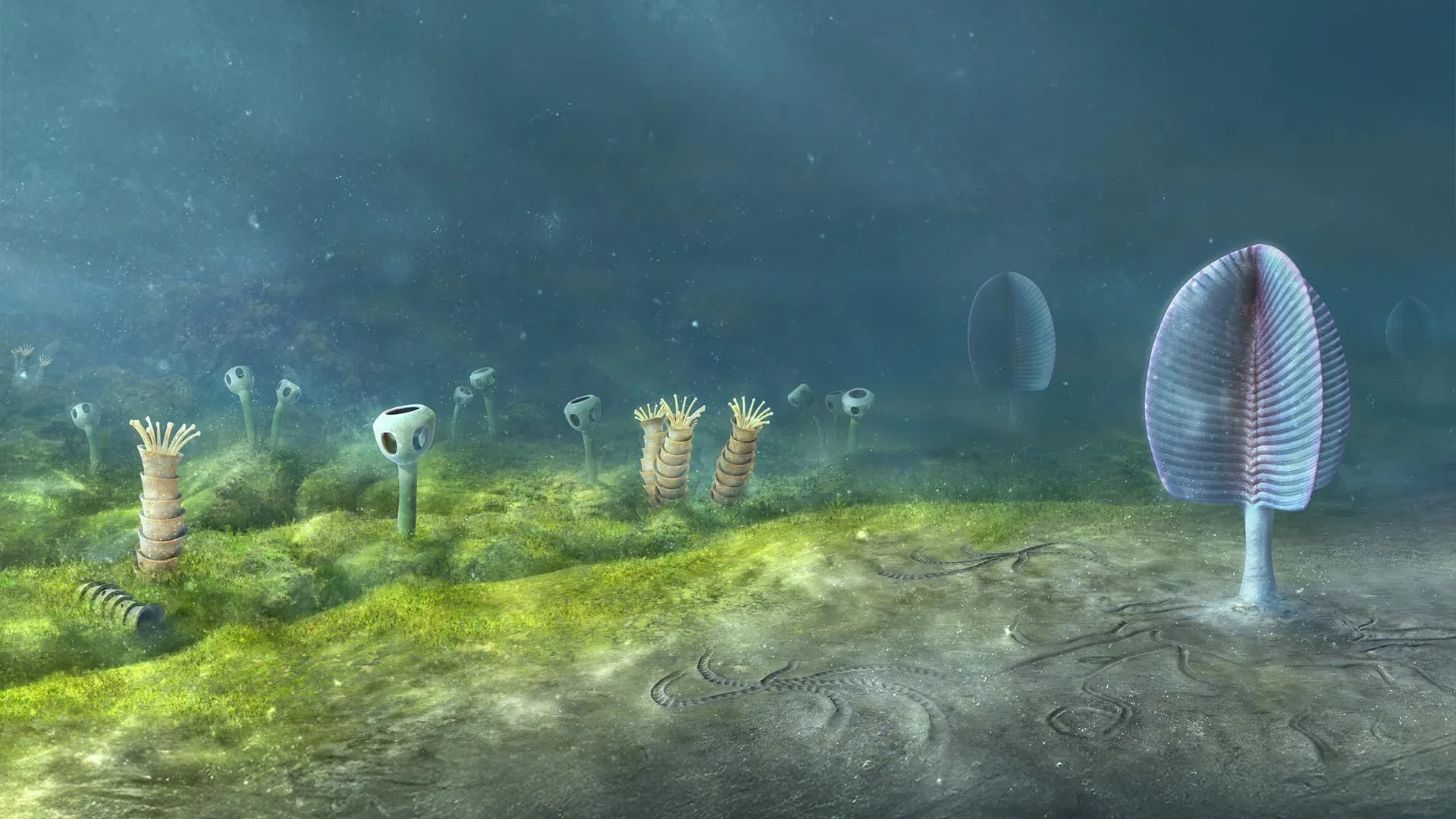
The earliest animals did not possess the mineralized shells, heavy carapaces, or robust skeletal bones that characterize later marine life like trilobites or brachiopods. Instead, primordial animals were microscopic, gelatinous, and entirely soft-bodied.
- Fragility: Without hard structures, decay sets in rapidly upon death, driven by microbial activity.
- Environmental Filters: Fossilization of soft tissue requires a vanishingly rare combination of rapid burial in fine-grained sediment, low oxygen levels to halt decay, and precise geochemical triggers—such as early micro-encapsulation by phosphate or silica—to replace organic material with minerals before it degrades.
- Ecological Niche Partitioning: Early animals may have occupied pelagic zones (the open water column) or deep-sea environments where fossilization processes are rarely exposed on modern landmasses.
The "Snowball Earth" Connection
Perhaps the most thrilling consequence of this shifted timeline is its intersection with one of the most violent climatic chapters in planetary history: the Cryogenian Period, which commenced approximately 720 million years ago.
During the Cryogenian, Earth underwent episodes of extreme global glaciation where ice sheets marched all the way from the poles to the equator. These "Snowball Earth" events represent some of the most hostile environments imaginable for the persistence of life, squeezing marine ecosystems into narrow, equatorial liquid-water refugia or hydrothermal vents.
If animals originated between 800 and 700 million years ago, it means they either predated these catastrophic global freezes or evolved directly through them. This revelation completely flips the script on how geobiologists view environmental stressors. Rather than viewing the end of Snowball Earth as the clean slate that triggered the origin of animals, scientists must now consider whether the pressures of surviving these global glaciations acted as an evolutionary crucible, driving the innovations—such as multicellularity, metabolic adaptations, and genetic regulation—that ultimately forged the animal kingdom.
Official Statements and Research Perspectives
The study has generated intense academic discussion across the global paleobiological community, underscoring both the caution required in interpreting deep-time data and the raw transformative power of the new findings.
Orin Lole Durbin, the study’s first author—who began the research as an undergraduate at the University of Oxford and is now pursuing his doctoral studies at Virginia Tech—emphasized the nuanced nature of the discovery while highlighting its disruptive impact on established models:
"Pre-Ediacaran body fossils still elude us, and this analysis does not prove that animals definitively existed 800 million years ago. However, our new fossil evidence from Mongolia undermines one of the main arguments for restricting animal origins strictly to the Ediacaran interval. Meanwhile, our molecular-clock analyses show just how much further back their cryptic evolutionary history could potentially extend."
Associate Professor Ross Anderson, senior author of the study based at the Oxford University Museum of Natural History, underscored the necessity of rethinking how the scientific community approaches the oldest pages of the fossil ledger:
"The Kheseen Biota breaks the dogma that the exceptional microfossils of Weng’an mean we would have seen animal fossils in the assemblage had they existed at the time. The Kheseen microfossils are just as well-preserved, yet animals continue to be absent—despite the fact we know at that point they existed. Until new physical evidence of pre-Ediacaran animals becomes available, the precise birth date of the animal kingdom remains a moving target, but our constraints have fundamentally shifted."
Future Outlook: The Path Forward in Deep-Time Paleontology
As the ink dries on the Science Advances publication, the scientific community is already turning its gaze toward the next frontier of exploration. The realization that 200 million years of early animal evolution may be hiding in plain sight—camouflaged by taphonomic biases and flawed geological assumptions—has galvanized researchers to rethink field strategies and analytical techniques.
1. Diversifying Lithological Exploration
Paleontologists emphasize that future expeditions must cast a much wider net, exploring sedimentary basins across diverse geographic locations, depositional environments, and lithofacies. Focusing solely on exceptionally preserved cherts like Weng’an or Kheseen risks repeating historical blind spots. Researchers must target environments that record different chemical regimes, ranging from deep-water shales to shallow, high-energy carbonate platforms.
2. Multiproxy Integration
The hunt for the earliest animals cannot rely on body fossils alone. Future research initiatives must systematically integrate three distinct pillars of evidence:
- Body Fossils: Continued high-resolution micro- and nano-imaging of older Ediacaran and Cryogenian deposits.
- Trace Fossils: Looking for subtle burrows, trackways, or behavioral modifications in ancient sediments that indicate motile, multi-celled organisms long before skeletal remains appear.
- Biomarkers & Isotope Geochemistry: Expanding organic geochemical surveys to map the distribution of ancient lipid chains and isotopic shifts that trace metabolic pathways unique to animals.
3. Refining Molecular Clocks
As genetic databases of living organisms grow exponentially and computational models become more refined, molecular clock techniques will continue to sharpen. By pairing these genetic tools with increasingly rigorous absolute radiometric dating of ancient rocks, researchers hope to narrow the current 800-to-700-million-year window down to a much finer point.
Ultimately, the Oxford-led study serves as a humbling reminder of how much of Earth’s history remains locked away in microscopic grains of stone. By removing a major theoretical roadblock, science has opened a new window into the deep past—one where the shadowy, delicate ancestors of all animal life, from microscopic sponges to humanity itself, may have first learned to navigate a frozen, changing world.