
Executive Overview
In an era where digital connectivity frequently bridges distances that once seemed insurmountable, the extraordinary case of Turtle—a long-haired gray cat who vanished from his Greenwich, Connecticut, home—stands as a testament to the power of modern animal rescue networks, community vigilance, and permanent pet identification.
For 571 days, Kelly Moore and her family lived in a state of agonizing limbo. Turtle, an affectionate feline originally rescued as a stray from Tennessee, had seemingly dissolved into thin air after being accidentally startled near the exit of his home. What followed was a multi-year ordeal encompassing localized search operations, motion-activated trail cameras, professional pet tracking, a clandestine interstate journey, and, ultimately, a chance digital discovery across state lines in Mamaroneck, New York.
This exhaustive report examines the mechanics of Turtle’s disappearance and miraculous recovery. By analyzing the timeline, the logistical hurdles of cross-border pet recovery, the indispensable role of microchip technology, and the psychological toll exacted on families navigating ambiguous pet loss, this article provides an in-depth look at one of the most remarkable feline homecomings in recent regional history.
Detailed Chronology
Phase 1: Origins and the Inciting Incident
Turtle’s journey to the Moore household was rooted in resilience. Originally a stray roaming the landscapes of Tennessee, he was adopted by Kelly Moore’s daughter, eventually finding his permanent sanctuary in Greenwich, Connecticut. By all accounts, Turtle was an intelligent, highly affectionate, and observant cat. Prior to joining the family, he had been sterilized—evidenced by a classic tipped ear—and fitted with a passive integrated transponder (PIT) microchip, a routine veterinary measure that would ultimately prove to be his lifeline.
The tranquility of domestic life was shattered in 2025 during an ordinary, rushed departure. Rushing out the door, Moore inadvertently startled Turtle. The sudden movement triggered a fight-or-flight response, causing the feline to bolt out of the home and into the unfamiliar terrain surrounding the Greenwich property.
"I was rushing out so fast I startled him and he ran," Moore recalled in a subsequent interview with ABC7 New York.
Phase 2: The Initial Search and Surveillance Operations
Recognizing the urgency of the situation, Moore immediately initiated recovery protocols. Understanding the limits of amateur searching, she enlisted the expertise of Rocco from Taurus Rocket Lost Pet Rescue, a professional organization specializing in the recovery of missing companion animals.
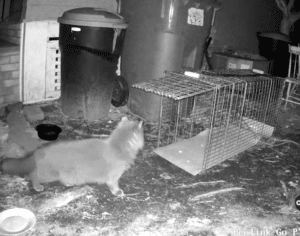
Rocco’s strategy deployed modern tracking methodologies. Motion-activated trail cameras were strategically placed around the perimeter of the Moore family’s property to establish whether Turtle remained in the immediate vicinity or had wandered deeper into the neighborhood.
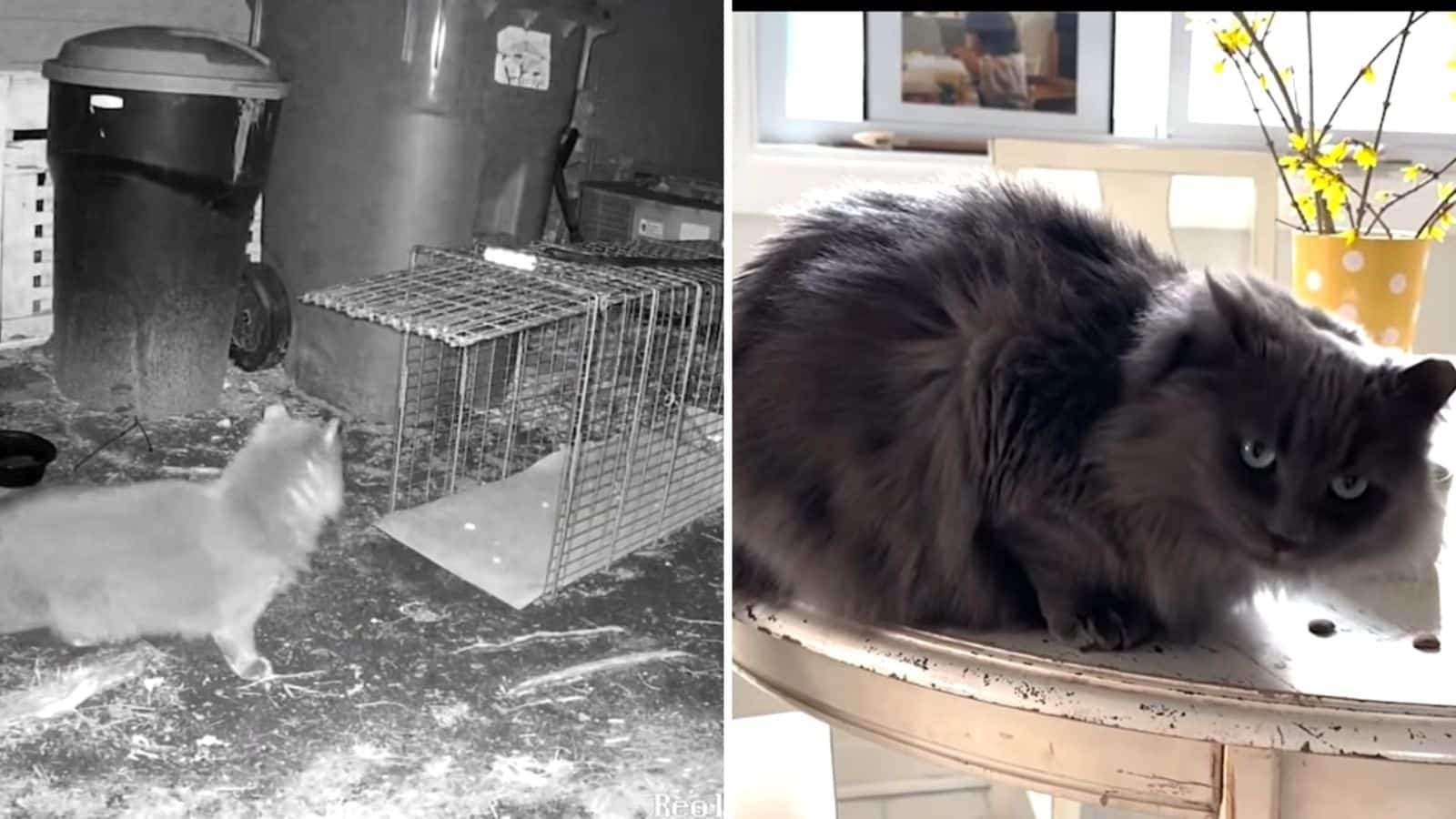
For a brief window, the cameras provided a glimmer of hope. Infrared captures confirmed that Turtle was still haunting the property’s periphery under the cover of darkness. However, translating visibility into physical recovery proved exceptionally difficult. Turtle harbored a distinct aversion to traditional pet carriers and enclosed spaces. This phobia paralyzed rescue efforts; even when rescuers knew his location, capturing a cage-shy cat without spooking him into permanent flight required a delicate, methodical touch that time simply did not afford.
Before a successful capture could be executed, the nocturnal sightings abruptly ceased. The trail went cold, and Turtle vanished from the camera frames entirely.
Phase 3: The 571-Day Void
As weeks bled into months, the psychological weight of the disappearance settled upon the Moore family. Without concrete evidence of Turtle’s fate, Moore confronted the chronic grief of ambiguous loss—a condition well-documented by psychologists as particularly debilitating because it lacks closure.
"I cried, I cried so many nights," Moore admitted, reflecting on the heavy burden of self-blame she carried after accidentally startling him.
Without ongoing sightings, traditional localized search parameters became obsolete. Posters faded in the elements, neighborhood alerts aged out of algorithmic feeds, and the search transformed from an active recovery mission into a quiet, enduring heartache. The family had no conceptual framework to guess where a frightened, cage-shy cat could have traveled. They assumed the worst, yet held onto a quiet, persistent hope.
Phase 4: The Digital Breakthrough in New York
The turning point arrived unexpectedly, over a year and a half after Turtle’s initial escape. The breakthrough did not originate from active patrolling in Greenwich, but rather from the decentralized, sprawling network of digital animal welfare communities operating across state lines.
A concerned citizen in Mamaroneck, New York, encountered a stray cat wandering through their neighborhood. Recognizing that the animal appeared to be a displaced pet, the individual photographed the cat and uploaded an appeal to social media.
By sheer coincidence, Rocco—the very pet rescuer who had assisted the Moore family 571 days prior—happened to scroll past the digital post. Examining the facial structure and distinct markings of the stray cat in Mamaroneck, Rocco experienced a moment of professional intuition. Something about the cat strongly resembled Turtle.
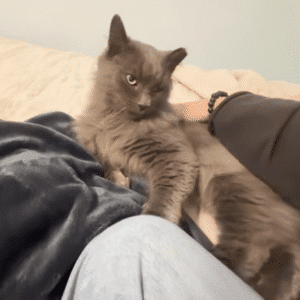
Mamaroneck sits across the state line from Greenwich, representing a significant geographical leap. For a cat to traverse this distance implied an extraordinary physical journey across suburban infrastructure, roadways, and potentially hazardous terrain.
Phase 5: Verification and Return
To transition from suspicion to certainty, rescuers relied on the gold standard of animal identification: the microchip scanner. Upon capturing the Mamaroneck stray, local animal welfare workers scanned the cat’s subcutaneous tissue. The transponder emitted a unique numeric code that instantly cross-referenced with national databases, confirming the identity of the cat.
It was Turtle. He had survived 571 days on his own, crossing state boundaries and eluding countless hazards to end up miles away from his point of origin.
Yet, a final logistical hurdle remained: Turtle’s deeply ingrained aversion to carriers. Rescuers had to exercise immense patience, employing gentle handling and familiar soothing techniques to secure the seasoned traveler without causing psychological trauma. Once safely crated, Turtle embarked on his final, triumphant journey back to Connecticut.
Supporting Context & Metrics
To fully appreciate the scope of Turtle’s recovery, it is helpful to examine the broader statistics surrounding lost pets, cross-border travels, and the efficacy of modern recovery tools.
Microchip Efficacy Rates
According to data compiled by animal welfare organizations such as the American Humane Association, dogs and cats fitted with microchips experience drastically higher rates of reunification compared to their unchipped counterparts.
- Cat Reunification Statistics: While dogs fitted with microchips are returned to their owners at rates exceeding 52%, cats historically face much lower return rates (around 38% according to older studies, though modern scanning protocols continue to improve these numbers).
- The Missing Link: The primary failure point in microchip reunions is not the technology itself, but outdated owner contact information. In Turtle’s case, because his registration remained active and accurate from his adoption days, the discovery in Mamaroneck translated into an immediate phone call.
Behavioral Psychology of Frightened Felines
When an indoor-access or strictly indoor cat is startled into bolting, they rarely run in a straight line or travel with intentionality. Ethologists note that startled cats typically enter a state of sensory overload, sprinting blindly until they find a dark, secure hiding spot (such as beneath a deck, inside a crawlspace, or within dense brush).
- The "Homing" vs. "Hiding" Paradox: Within a 3-mile radius of their home, cats frequently go into a feral-like lockdown state. They may remain silent and refuse to respond to their owner’s voice for weeks.
- Interstate Travel: For Turtle to reach Mamaroneck, New York, from Greenwich, Connecticut, he likely engaged in opportunistic traveling—utilizing wooded corridors, storm drains, and railway paths over an extended period. Animal behaviorists suggest that cats displaced over long distances rarely "navigate" home intentionally; rather, they drift along continuous greenbelts searching for reliable food sources until they are intercepted by humans or wildlife.
Official Statements
The emotional resonance of Turtle’s return was captured vividly in interviews conducted following his homecoming.
Kelly Moore reflected on the sheer improbability of the event, emphasizing the psychological shift from despair to validation:
"I was rushing out so fast I startled him and he ran. I cried, I cried so many nights… If this can happen, anything can happen."
Rocco, representing Taurus Rocket Lost Pet Rescue, underscored the exceptional nature of the distance traveled and the critical importance of keeping rescue networks interconnected across municipal and state borders. In professional tracking circles, the distance between Greenwich and Mamaroneck represents an outlier event, highlighting that lost pets can cover vast acreage when given months to roam.
Future Outlook & Best Practices for Pet Owners
Turtle’s 571-day odyssey offers critical lessons for pet owners, animal rescue organizations, and community advocates. While his story concluded with a joyful reunion, it highlights vulnerabilities in pet safety that can be mitigated through proactive planning.
1. Mandatory and Verified Microchipping
Turtle’s return would have been mathematically impossible without his microchip. Owners must treat microchipping not as a one-time veterinary checkbox, but as a dynamic registry. Whenever phone numbers, physical addresses, or email contacts change, updating the microchip registry with the manufacture database is paramount. Furthermore, annual vet checks should include a quick scanner pass to ensure the chip has not migrated or malfunctioned.
2. Social Media Vigilance and Regional Cross-Posting
The breakthrough in Turtle’s case occurred because a stranger posted a found cat online, and a rescuer across state lines recognized the visual cues. Pet owners and rescuers are encouraged to utilize localized social media lost-and-found pet groups that transcend municipal boundaries. Stray animals do not respect town lines or state borders; therefore, search radiuses should always expand outward past immediate neighborhood boundaries.
3. Professional Lost Pet Intervention
Investing in professional tracking services—such as trail cameras, baited drop-traps, and scent-tracking dogs—substantially increases recovery odds during the critical first weeks of a disappearance. As Turtle’s case demonstrates, even when initial tracking efforts stall, maintaining a digital paper trail ensures that if the pet resurfaces months later, the historical data is readily available to connect the dots.
4. Conclusion
For Kelly Moore and her family, the 571-day chapter of uncertainty is finally closed. Turtle is no longer a missing statistic or a haunting memory of a door left ajar. He is home—resting safely in the environment he was always meant to inhabit, proving that with persistence, technology, and community compassion, even the most improbable journeys can find their way home.