
Executive Overview
True pink birds are a distinct anomaly across the North American continent. Even when ornithologists and bird enthusiasts stretch the definition of pink to encompass rare vagrants, fleeting seasonal plumages, and species with minimal rosy highlights, fewer than a dozen species fit the description.
Yet, what this avian palette lacks in quantity, it more than makes up for in spectacle. Among these few species are some of the most extraordinary creatures observable in the United States, ranging from iconic, long-legged coastal waders to elusive high-altitude finches and glittering desert hummingbirds.
Understanding North America’s pink avifauna requires looking beneath the surface, as these birds achieve their signature coloration through entirely distinct biological mechanisms. For charismatic waders like the Roseate Spoonbill and the American Flamingo, feather pigments are strictly diet-dependent, relying on the ingestion of carotenoid-rich crustaceans and algae.
In contrast, hummingbirds owe their electric, iridescent pink crowns and gorgets to the complex physics of microscopic, pancake-like structures within their feathers that refract light. Meanwhile, the reddish-pink hues of certain finches are hardwired at the genomic level.
This comprehensive guide examines the biology, distribution, and identification of North America’s pink birds, offering practical field strategies for enthusiasts seeking to observe them in the wild or attract them to backyard habitats.
Detailed Chronology and Categorization: The Spectrum of Pink
The occurrence of pink plumage in North American birds can be systematically categorized into three distinct tiers: iconic coastal waders, common feeder visitors and hummingbirds, and high-elevation alpine specialties.
Tier 1: The Iconic Coastal Waders
[American Flamingo] --- Completely Pink Body --- Filter Feeder / Inverted Foraging
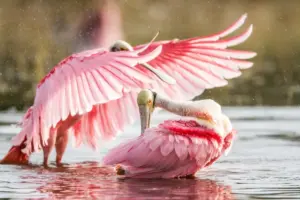
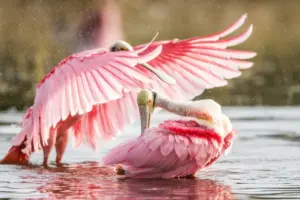
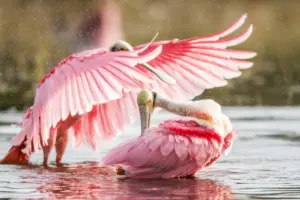
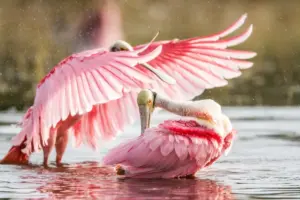
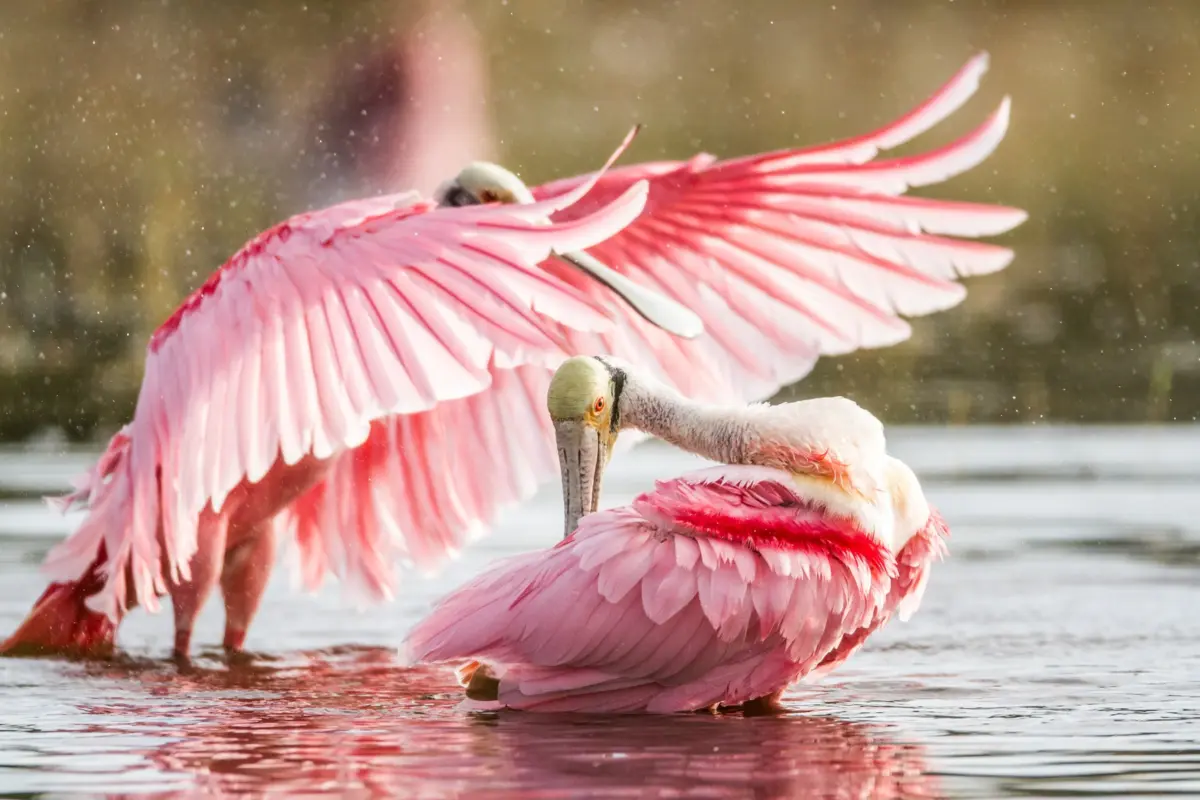
[Roseate Spoonbill] --- White Neck / Green Head --- Sensor-Rimmed Spoon Bill
The American Flamingo (Phoenicopterus ruber)
For generations, popular culture has associated flamingos with the Florida landscape. However, ornithological science reveals a more complex history. While historical records indicate vagrant wild flamingos have occasionally blown ashore due to tropical storms, scientists have long debated whether Florida ever maintained a stable, self-sustaining native breeding population.
That ecological narrative is currently shifting. In recent years, wild birds displaced by powerful hurricanes have taken up permanent, year-round residence in the Sunshine State, raising exciting possibilities of natural colony establishment in environments like the Everglades.
As one of only two long-legged pink waders in the United States—the other being the Roseate Spoonbill—the American Flamingo is instantly identifiable. It stands apart due to its entirely pink plumage, long serpentine neck, and heavily decurved, black-tipped bill. Flamingos utilize this specialized beak for inverted foraging, sweeping their heads upside down through shallow water to filter out microscopic organisms.
The Roseate Spoonbill (Platalea ajaja)
While far from ubiquitous, the Roseate Spoonbill is considerably more common than the flamingo. A resilient population thrives year-round along the Gulf Coast and throughout the brackish wetlands of southern Florida.
From a distance, a silhouetted spoonbill might momentarily evoke a flamingo, but its distinctively shaped, paddle-like bill immediately distinguishes it. Foraging in coastal estuaries, shallows, and mangrove-fringed marshes, the spoonbill sweeps its sensor-rimmed bill in a rhythmic, side-to-side motion through the muck. This specialized bill is densely packed with nerve endings, allowing the bird to detect and snap up small fish and aquatic invertebrates by touch rather than sight.
Unlike the monochrome flamingo, the Roseate Spoonbill features a stark white neck and a bare, greenish head. In recent decades, conservationists have observed spoonbills expanding their geographic range northward into new coastal wetlands, signaling shifting ecological conditions in the American Southeast.
Tier 2: Backyard Favorites and Shimmering Hummers
Beyond the coastal wetlands, backyard birders and garden enthusiasts are far more likely to encounter smaller, brilliantly colored pink species.
+------------------------+--------------------------+-------------------------------------+
| Species                | Primary Region           | Key Identification Marker           |
+------------------------+--------------------------+-------------------------------------+
| Anna’s Hummingbird     | Pacific Coast / Arizona  | Electric pink iridescent crown      |
| Calliope Hummingbird   | Western Canada / Rockies | Magenta patchy flared gorget        |
| Broad-tailed Humming   | Mountain West / SW US    | Rose-pink gorget & metallic buzz    |
| Purple Finch           | Northeast / West Coast   | Deep maroon to light pink plumage   |
| Cassin’s Finch         | Western Conifers         | Soft pink breast / bright red cap   |
+------------------------+--------------------------+-------------------------------------+
Anna’s Hummingbird (Calypte anna)
When the head of an adult male Anna’s Hummingbird catches the sunlight, it blazes with an unmistakable electric pink iridescence. Unlike most North American hummingbirds, which reserve their bright colors strictly for the throat patch (gorget), male Anna’s feature iridescent feathers across their entire crown as well. Once restricted to California chaparral, this adaptable species has expanded its year-round range up the Pacific Coast and east into southern Arizona, making it a regular visitor to backyard nectar stations.
Calliope Hummingbird (Selasphorus calliope)
Sizing up as the smallest breeding bird in North America, the male Calliope sports a unique, patchy gorget that flares outward around the neck, flashing in shades ranging from delicate rose-pink to deep magenta. During the breeding season, these diminutive travelers occupy higher elevations, ranging from Northern California and the Intermountain West northward into western Canada.
Broad-tailed Hummingbird (Selasphorus platycercus)
A familiar avian fixture of the Mountain West and southwestern states, male Broad-tailed Hummingbirds display a glowing rose-pink gorget. While they readily visit high-elevation backyard feeders, their natural habitat preference centers on montane forests and subalpine meadows. In direct flight, the wings of a medium-sized male produce a distinctive, high-pitched metallic buzz that often alerts birders to their presence before they are seen.
Purple Finch (Haemorhous purpureus)
Despite its somewhat misleading common name, the male Purple Finch exhibits a wash of red plumage that shifts from a deep, rich maroon to a delicate pastel pink. A largely brown-streaked bird overall, the Purple Finch is a prized feeder visitor. While year-round populations persist in the Northeast, around the Great Lakes, and along the West Coast, the majority of the population breeds deep within Canada’s boreal forests. During cyclical winter irruption years, large flocks push southward across the eastern United States, thrilling backyard bird watchers.
Cassin’s Finch (Haemorhous cassinii)
Closely related to the Purple Finch, the male Cassin’s Finch also features red-to-pink plumage, showcasing a soft pink breast and face coupled with a bright crimson, spiky crown patch. A nomadic forager of western coniferous forests, Cassin’s Finches prefer high elevations and are frequently heard singing their complex, musical warbles from the very tops of tall evergreens.
Tier 3: The Elusive Rosy-Finches
For serious birders and life-listers, the high-altitude rosy-finches of the American West represent the ultimate challenge.
- Black Rosy-Finch (Leucosticte atrata): A permanent resident of the Great Basin’s wind-swept, highest-elevation peaks. The male features a striking combination of dark brown, black, and gray body feathers offset by bold pink highlights across its wings and belly. Its remote alpine habitat makes it a prized grail species for dedicated birders.
- Brown-capped Rosy-Finch (Leucosticte australis): A more subdued relative, the Brown-capped exhibits warmer brown tones on the head and body, paired with slightly softer pink highlights. Its global distribution is exceptionally restricted, breeding exclusively in the alpine tundra of the Rocky Mountains from Wyoming down to New Mexico.
- Gray-crowned Rosy-Finch (Leucosticte tephrocotis): The most widespread of the three rosy-finch species, distinguished by prominent gray patches on the head and a more conservative wash of pink. They nest from western Alaska south to the high peaks of California and winter throughout the Intermountain West.
Supporting Context and Metrics: The Science of Coloration
The physiological mechanisms that produce pink plumage in birds are among the most fascinating topics in avian biology. Ornithologists divide these processes into three distinct categories:
- Dietary Carotenoids (Chemical Pigmentation): Flamingos and Roseate Spoonbills are born with pale, grayish-white down feathers. Their signature pink, coral, and magenta hues are acquired entirely through diet. These birds consume microscopic algae, brine shrimp, crabs, and small fish rich in carotenoids—natural chemical pigments found in plants and aquatic organisms. Once ingested, these pigments are metabolized and deposited directly into growing feather keratin. Consequently, a wild bird’s brightness serves as a direct biological indicator of its nutritional health and foraging success.
- Microscopic Feather Structures (Structural Coloration): Unlike flamingos, hummingbirds carry no chemical pink pigments in their feathers. The electric pink flashes seen on the crowns and gorgets of Anna’s, Calliope, and Broad-tailed Hummingbirds are the result of structural coloration. Air-filled microscopic "pancake" structures within the feather barbules refract and scatter light waves, creating intense optical iridescence that shifts depending on the viewing angle.
- Genomic Pigmentation: In finches (Purple, Cassin’s, and the rosy-finches), pink and red plumage is derived from dietary carotenoids modified at the genetic and metabolic level. These birds metabolize yellow plant pigments and chemically convert them into red-to-pink ketocarotenoids, which are then integrated into the growing feather matrix during annual molt cycles.
Field Guide: Where and How to Observe North American Pink Birds
Because North America’s pink-feathered species are geographically restricted or specialized in their habitat requirements, successful observation requires targeted planning:
- Coastal Waders: To observe Roseate Spoonbills, visit reliable Gulf Coast strongholds such as J.N. "Ding" Darling National Wildlife Refuge in Florida or Smith Oaks Rookery in Texas. For American Flamingos, wild populations are most consistently encountered in remote southern sectors of Everglades National Park, Biscayne Bay, and the Florida Keys.
- High-Altitude Rosy-Finches: While finding these alpine specialists independently can be exceedingly difficult, the legendary Sandia Crest just outside Albuquerque, New Mexico, serves as a premier winter destination. It remains the only accessible location in North America where observers can regularly study all three rosy-finch species feeding in close proximity.
- Backyard Attractants: Homeowners outside the deep South can easily host finches and hummingbirds. Standard nectar feeders containing a simple 4-to-1 ratio of water to white granulated sugar will attract hummingbirds. Meanwhile, heavy-duty tube or hopper feeders stocked with black oil sunflower seeds and safflower will reliably draw in Purple and Cassin’s Finches during migration and winter months.
Future Outlook: Conservation and Changing Ranges
As North American ecosystems experience shifting climatic baselines, the distribution patterns of pink-feathered birds are undergoing noticeable evolution.
Ornithologists monitoring coastal wetland dynamics note that Roseate Spoonbills are increasingly pushing northward along the Atlantic seaboard, establishing nesting colonies further up the coast than previously recorded. Similarly, the long-term ecological restoration of the Florida Everglades is expected to provide more stable foraging grounds for wading birds, potentially securing permanent breeding colonies for the American Flamingo.
However, high-elevation specialists face severe environmental pressures. Alpine rosy-finches, constrained by their strict cold-weather adaptations and shrinking tundra habitats, remain vulnerable to warming mountain temperatures. Conservation organizations continue to monitor these populations through community-science platforms like eBird, ensuring that baseline data remains robust for future wildlife management strategies.
Whether spotting a glittering Anna’s Hummingbird in a coastal suburban garden or tracking elusive rosy-finches across snowy western peaks, observing North America’s rare pink birds offers a profound appreciation for the subtle and striking diversity of the natural world.