
EXECUTIVE OVERVIEW
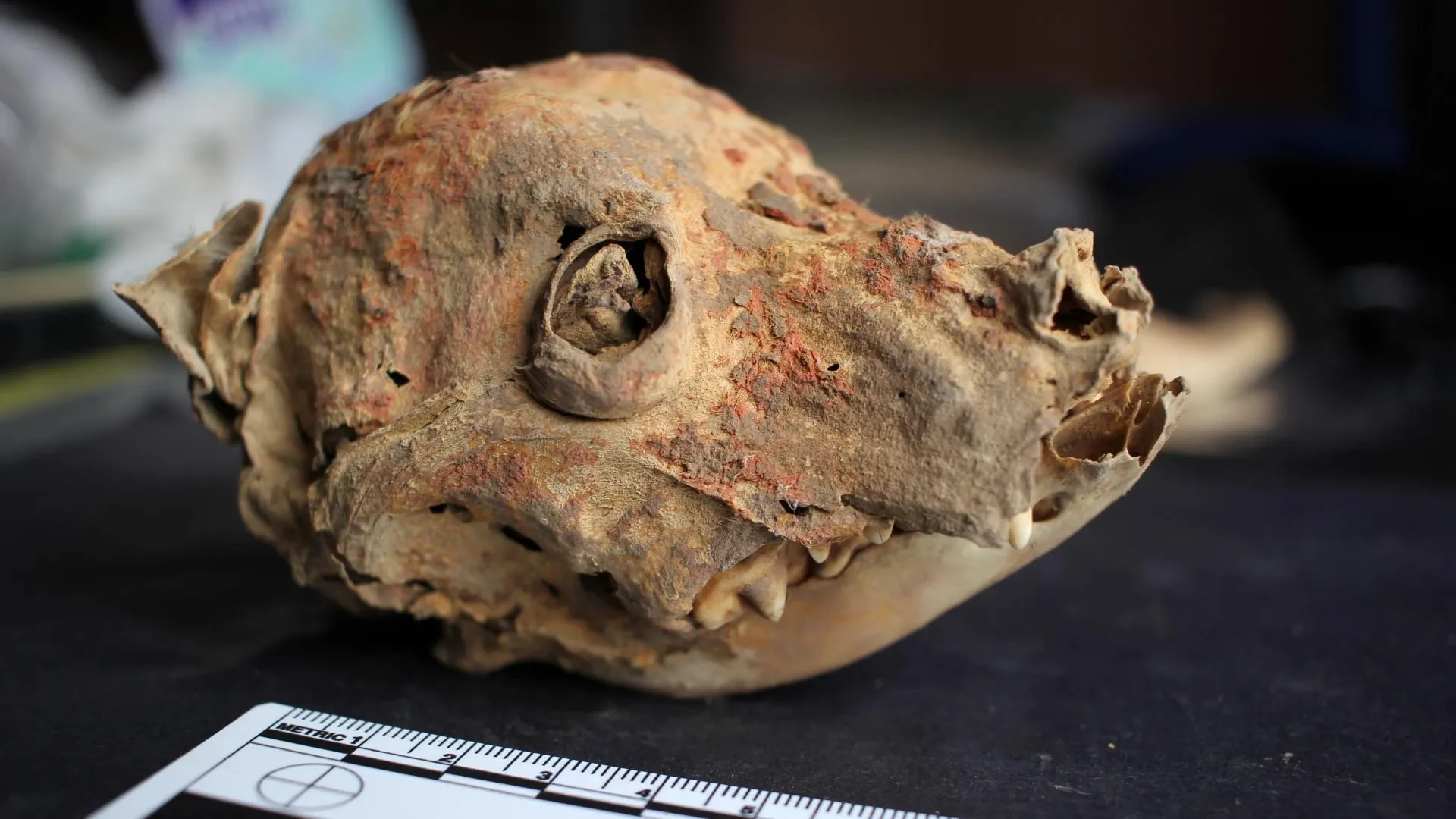
Archaeological excavations at the remote, windswept desert complex of Castillo de Huarmey in Peru have yielded an extraordinary discovery: the physical remains of hairless dogs dating back more than 1,200 years. Published in the Journal of Anthropological Archaeology, this breakthrough provides the first concrete biological evidence of Peruvian hairless dogs at a Wari Empire site, predating the rise of the Inca Empire by roughly four centuries.
The find includes naturally mummified remains, distinct skeletal anomalies, and chemical isotopic signatures that illuminate the complex, multifaceted relationship between humans and canines in pre-Columbian Andean society. Led by an international team of researchers—including first author Weronika Tomczyk of Dartmouth College, alongside colleagues from the University of Warsaw and the University of Pittsburgh—the study bridges a critical gap in zooarchaeology. It reveals that the bonds between people and animals over a millennium ago were fraught with the same nuanced contradictions, affection, and utility that characterize modern human-animal relationships.
DETAILED CHRONOLOGY: UNCOVERING THE SECRETS OF CASTILLO DE HUARMEY
Situated approximately 190 miles north of Lima, Castillo de Huarmey spans an expansive 110-acre plateau. Between 600 and 1050 CE, the site served as a vital administrative, religious, and burial stronghold for the Wari Empire, an expansive civilization that dominated the central Andean highlands and coast long before the Inca established their hegemony.
A History of Monumental Discoveries
The recent unearthing of canine remains is the latest chapter in a long history of high-stakes archaeological breakthroughs at Castillo de Huarmey:
- The 2012 Milestone: Researchers uncovered the first completely undisturbed elite Wari tomb. Hidden deep within the complex, the chamber held the remains of 58 high-status women, six human sacrificial victims, and approximately 1,300 luxury artifacts crafted from gold, silver, and precious stones.
- The 2022 Milestone: Archaeologists identified nearby burials belonging to elite craftspeople. These tombs were accompanied by specialized tools of gold, bronze, and silver, underscoring the sophisticated industrial and artistic output of the Wari state.
- The 2010–2025 Canine Excavations: Across more than a decade of systematic digging in the northern sector of the main ceremonial area, teams recovered 341 individual dog bone specimens representing at least 19 distinct dogs, culminating in the discovery of complete mummified remains.
Natural Preservation in the Peruvian Desert
The extreme aridity of Peru’s Pacific coast created optimal preservation conditions for organic matter. While most archaeological sites lose soft tissue to decay, the hyper-arid microclimate of Castillo de Huarmey preserved hair, skin, bone, textiles, leather, pigments, and fragile ceramics. Among the non-human artifacts recovered is a striking ceramic vessel depicting a seated hairless dog with anthropomorphic features, seemingly clutching a musical instrument.
However, the site’s historical timeline was violently interrupted. A devastating earthquake in 1970 caused portions of the archaeological complex to collapse, exposing ancient chambers and inviting widespread looting. While upper strata were thoroughly disturbed and mixed with modern debris, deeper archaeological strata remained pristine, preserving sealed Wari contexts that allowed researchers to isolate and radiocarbon-date the ancient canine specimens accurately.
SUPPORTING CONTEXT & METRICS: GENETICS, ISOTOPES, AND DIETARY INSIGHTS
The identification of the ancient dogs relied on an intersection of molecular anthropology, zooarchaeology, and chemical analysis. The physical evidence presented unique diagnostic puzzles that were ultimately unlocked by dental anomalies.
The Genetic Link: Missing Teeth and Hairlessness
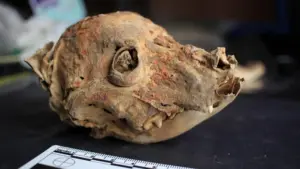
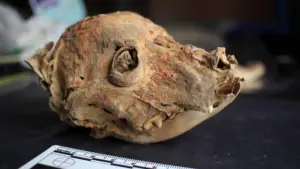
Initially, researchers confronted with a remarkably preserved, naturally mummified male dog suspected the remains might be of relatively recent origin—perhaps a victim of twentieth-century looting activity. However, two critical morphological markers dismissed this hypothesis:
- Cutaneous Evidence: The mummified skull and body retained visible patches of hairless skin and structurally intact, prominent ears.
- Dental Anomaly: The specimens—including a mummified male dog and two distinct canine skulls—consistently lacked their first premolars and, in some cases, the last molars.
According to lead researcher Weronika Tomczyk, these teeth were never lost to injury, age, or periodontal disease; they simply never erupted. This specific dental phenotype corresponds directly to the genetic mutation responsible for hairlessness in the breed. This genetic link definitively identified the specimens as ancestral Peruvian hairless dogs—the ancient precursors to the modern breed recognized by the American Kennel Club as the Peruvian Inca Orchid, which Peru officially designated part of its national cultural heritage in 2000.
Chemical Signatures and Isotopic Analysis
To understand the life histories, geographic origins, and diets of these animals, the research team employed zooarchaeological techniques alongside isotopic analysis. By examining isotopes of carbon, nitrogen, oxygen, and strontium preserved in the animals’ bones and teeth, scientists reconstructed environmental conditions and nutritional intake:
- Tooth Enamel Isotope Analysis: Because canine teeth erupt rapidly during early development, dental isotopes captured a chemical snapshot of the animal’s puppyhood.
- Bone Collagen Isotope Analysis: Bone turnover rates provided a cumulative record of the animal’s diet during the final year of its life.
- Strontium Tracking: Strontium isotopes varied according to local geological baselines, allowing researchers to track the mobility and geographic origins of the dogs relative to human populations.
The chemical data revealed that the diets of the Castillo de Huarmey dogs heavily overlapped with those of their human caretakers. The vast majority of the canines consumed significant amounts of maize (corn), a staple agricultural crop of pre-Hispanic Andean societies.
Most intriguingly, hairless puppies exhibited a dietary profile during their early weeks of life that closely mirrored that of human children. As these animals matured, their diets diversified. This distinct juvenile nutritional pattern suggests that hairless puppies may have received specialized human attention, perhaps indicating deliberate, controlled breeding practices within Wari settlements.
OFFICIAL STATEMENTS & EXPERT ANALYSIS
The implications of the Castillo de Huarmey study extend far beyond osteological cataloging, touching upon the sociology of human-animal interactions in antiquity.
"Our findings indicate that humans and dogs coexisted at this Wari site, but reconstructing their bond is challenging, as past emotions are difficult to capture through archaeological methods," notes first author Weronika Tomczyk, research associate in Dartmouth’s Department of Anthropology and postdoctoral fellow in its Ecology, Evolution, Environment and Society Program.
Tomczyk emphasizes that the archaeological record challenges modern romanticized notions of ancient animal husbandry. The team’s overarching objective was to demonstrate that ancient societies maintained complex, multidimensional attitudes toward fauna, mirroring contemporary paradoxes.
"The goal of our study was to not only present data on Castillo de Huarmey’s dog burials, but also emphasize that people in the past had often contradictory relationships with the animals, just as they do today: a pet for one group of people could at the same time be considered a pest by their closest neighbors."
The context of the canine burials underscores this dichotomy. While the majority of the discovered dogs were adults at the time of death, their deposition varied widely:
- Elite Accompaniment: The skeletal remains of a puppy estimated to be merely 6 to 8 weeks old were recovered directly alongside an elite craftsperson designated the "Master Basketmaker."
- Palatial and Sacrificial Contexts: An adult dog was unearthed within the spatial boundaries of the site’s palace structure, while part of a puppy skeleton was recovered alongside an individual classified as an adult male ("XY"), who likely served as a ritual tomb guardian.
- Secular and Discarded Remains: Conversely, numerous other dog bones were recovered from discarded refuse heaps and mixed contexts. Only a small fraction of the bone specimens bore butchery marks, indicating that while dogs were integrated into elite rituals and daily life, they were rarely consumed as a primary food source.
Radiocarbon dating crowned the mummified male dog as the oldest securely dated biological specimen recovered from Castillo de Huarmey to date, anchoring the chronological baseline of the site firmly in the early Wari occupation phase.
The study’s collaborative framework brought together international specialists, featuring co-authors Miłosz Giersz, Wiesław Więckowski, and Roberto Pimentel Nita of the University of Warsaw, alongside Claire Ebert of the University of Pittsburgh.
FUTURE OUTLOOK
The identification of 1,200-year-old Peruvian hairless dog mummies at Castillo de Huarmey opens new avenues for Andean zooarchaeology. As researchers continue to process the extensive biological and material data recovered from the site, several key areas of future investigation have emerged:
- Ancient DNA (aDNA) Sequencing: Future projects aim to extract mitochondrial and nuclear DNA from the mummified tissue and bone samples. Genetic sequencing will help map the precise phylogenetic lineage of these ancient hairless dogs, tracking how genetic diversity within the breed evolved from the Wari period through the subsequent rise of the Inca Empire and the arrival of European colonizers.
- Expanded Isotopic Mapping: By broadening strontium and oxygen isotope analyses across a wider array of coastal and highland Wari administrative centers, researchers hope to determine whether these prized hairless dogs were traded over long distances or bred locally within specialized urban kennels.
- Comparative Iconography: Integrating the physical osteological data with contemporary Andean iconography—such as Moche and Wari ceramic representations—will allow scholars to decode the symbolic and religious weight carried by hairless canines in the spiritual architecture of the pre-Columbian Andes.
Ultimately, the discoveries at Castillo de Huarmey dismantle simplistic narratives of ancient animal use. By demonstrating that hairless canines shared hearth, diet, and elite sepulchers with humans more than a millennium ago, the study affirms that our deep emotional, cultural, and pragmatic attachments to domestic animals are ancient, enduring facets of the human experience.