
Executive Overview
In the vast tapestry of North American ornithology, true pink plumage is an extraordinary anomaly. Even when expanding the taxonomic definition to incorporate rare vagrants, marginal tints, and minimal plumage highlights, fewer than a dozen species on the continent sport shades of rose, magenta, or electric pink. Yet, these few species command disproportionate attention from scientists, conservationists, and everyday birders alike. From the iconic, long-legged waders of the southern wetlands to elusive high-altitude finches and shimmering western hummingbirds, North America’s pink-hued avian fauna represents a fascinating study in evolutionary adaptation, biogeography, and specialized diet.
Fact-checked and curated in consultation with leading field editors, this comprehensive guide examines the biological mechanisms behind these rare hues, distinguishes among lookalike species, maps out prime viewing locations across the United States, and offers practical strategies for attracting backyard visitors. Far from being merely a visual novelty, the presence—and in some cases, the shifting range—of these pink birds serves as an ecological barometer for changing North American landscapes, from the ever-expanding Everglades to the fragile alpine ecosystems of the American West.
Detailed Chronology and Scientific Context: How Birds Get Their Pink
To understand North America’s pink birds, one must first understand that nature employs entirely different biological engineering feats to produce this rare coloration. Across the taxonomic spectrum, pink plumage is achieved through three distinct mechanisms: diet-derived pigmentation, microscopic feather structures, and genomic expression.
The Nutritional Palette: Waders and Carotenoids
For wetland icons such as the American Flamingo (Phoenicopterus ruber) and the Roseate Spoonbill (Platalea ajaja), the intensity of their pink coloration is not written in their DNA; rather, it is consumed. These species ingest organisms—primarily brine shrimp, microscopic crustaceans, mollusks, and small fish—that feed on carotenoid-laden microalgae. Carotenoids are natural pigments yielding red, orange, and yellow hues.
As the birds digest these organisms, the pigments are metabolized and deposited into their growing feathers. Consequently, a flamingo or spoonbill deprived of a proper, carotenoid-rich diet will gradually fade to a pale, washed-out white or light gray. The brilliance of their plumage is, therefore, a direct visual proxy for their foraging success and environmental health.
Structural Coloration: The Physics of Hummingbirds
In stark contrast to the chemical pigmentation of waders, the striking pink gorgets and crowns of western hummingbirds—specifically Anna’s Hummingbird (Calypte anna), the Calliope Hummingbird (Selasphorus calliope), and the Broad-tailed Hummingbird (Selasphorus platycercus)—rely on physics rather than chemistry.
These birds owe their mesmerizing iridescence to microscopic, air-filled platelet structures within their feather barbules. When light strikes these nanoscale "pancake" structures, light waves interfere with one another, amplifying specific wavelengths while canceling others out. This structural coloration creates an electric, shifting flash of magenta or rose-pink that appears to catch fire only when the bird hits the optimal angle relative to the observer’s eye.
Genomic Expression: The Finches
Among North America’s perching birds, the reddish-pink plumage observed in species such as the Purple Finch (Haemorhous purpureus), Cassin’s Finch (Haemorhous cassinii), and the specialized Rosy-Finches (Leucosticte species) is governed at the genomic level. The brilliant rose-red and pink hues on their crowns, breasts, and rumps are derived from carotenoid pigments extracted from seeds, buds, and tree sap, but their specific deposition patterns, cellular structures, and metabolic conversions are hardwired into their genetic codes.
Supporting Context & Metrics: Field Identification of Major Species
North America’s pink-hued avifauna can be categorized into waders, common backyard and garden visitors, and high-altitude rarities. Proper identification requires keen attention to bill morphology, geographic range, and behavioral patterns.
The Waders: American Flamingo vs. Roseate Spoonbill
+--------------------+----------------------------------+----------------------------------+
| Feature            | American Flamingo                | Roseate Spoonbill                |
+--------------------+----------------------------------+----------------------------------+
| Primary Color      | Entirely pink body               | Deep pink body, white neck,      |
|                    |                                  | greenish head                    |
| Bill Morphology    | Heavily curved, black-tipped,    | Long, flat, spatulate ("spoon")  |
|                    | specialized for inverted feeding | with sensory nerve endings       |
| Habitat            | Coastal shallows, bays, lagoons  | Estuaries, mangroves, wetlands   |
| Status in U.S.     | Vagrant/re-establishing colonies | Gulf Coast and southern Florida  |
+--------------------+----------------------------------+----------------------------------+- American Flamingo: Long considered a rare vagrant in Florida rather than a stable, native breeding population, the status of the American Flamingo is undergoing a fascinating reassessment. Hurricanes frequently blow wild birds northward from Caribbean populations into the Sunshine State, where some individuals have taken up year-round residence. Standing tall on stilt-like legs, the flamingo is instantly recognizable by its fully pink plumage and sharply angled, black-tipped bill, which it uses to filter-feed upside down.
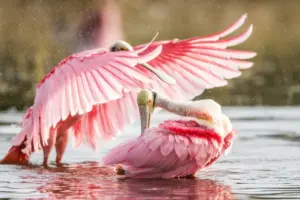
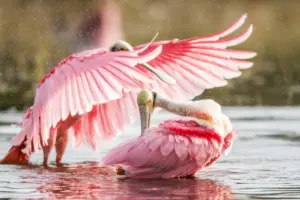
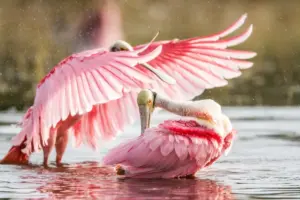
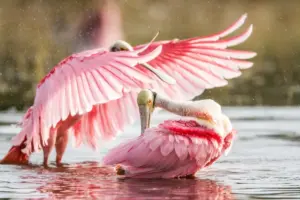
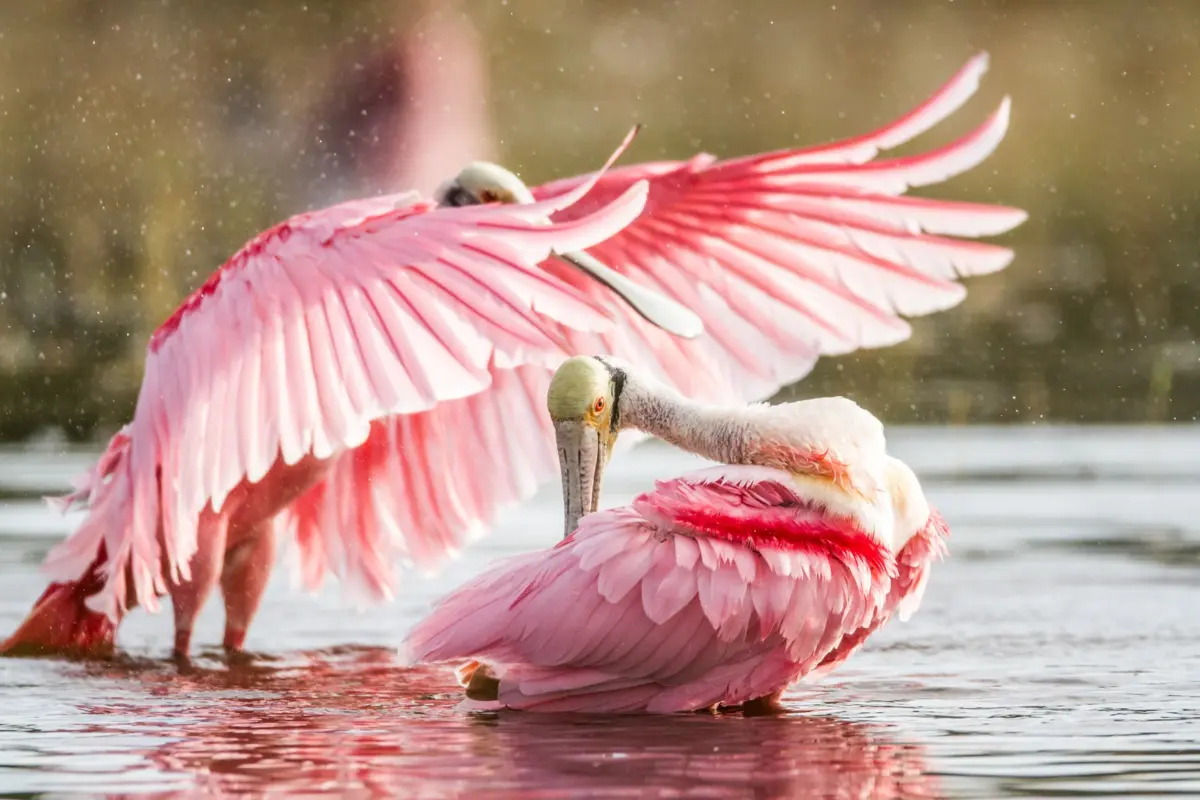
- Roseate Spoonbill: While certainly not an abundant backyard bird, the Roseate Spoonbill is far more common than the flamingo, maintaining healthy, year-round breeding populations across the Gulf Coast and southern Florida. From a distance, its pink silhouette can mimic a flamingo, but its distinctively flattened, spoon-shaped bill immediately gives it away. Spoonbills sweep their sensor-rimmed bills back and forth through shallow water and muck, detecting hidden aquatic prey via tactile mechanoreceptors. Notably, spoonbills feature a contrasting white neck and greenish head, and populations have increasingly expanded their breeding range northward.
Common Western Hummingbirds and Finches
- Anna’s Hummingbird: Males possess an iridescent crown and gorget that flash electric pink when catching the light. Expanding its range northward up the Pacific Coast and eastward into southern Arizona, it is a frequent, year-round visitor to suburban gardens and feeders.
- Calliope Hummingbird: Recognized as North America’s smallest breeding bird, the male Calliope sports a patchy, flared gorget ranging from pink to deep magenta. It breeds across the Intermountain West, Pacific Northwest, and into western Canada.
- Broad-tailed Hummingbird: A staple of high-elevation western meadows and forests, males flash a brilliant rose-pink gorget and produce a distinct metallic hum or buzz with their wings during flight.
- Purple Finch: Despite its moniker, the male’s plumage ranges from deep maroon to light pink. Though breeding primarily in Canada’s boreal forests, they migrate to the eastern United States and along the West Coast during winter, frequently swarming backyard seed feeders during irruption years.
- Cassin’s Finch: A nomadic forest dweller of the West, the male Cassin’s features a soft pink breast and face paired with a bright red, spiky crown cap.
High-Altitude Specialists: The Rosy-Finches
For dedicated birders, the high-elevation rosy-finches represent the ultimate alpine quarry:
- Black Rosy-Finch: A rare resident of the Great Basin’s highest peaks, combining a dark black-brown body with bold, contrasting pink highlights on the belly and wings.
- Brown-capped Rosy-Finch: Subdued brown body plumage offset by a lighter pink wash, restricted strictly to the highest rocky elevations from Wyoming to New Mexico.
- Gray-crowned Rosy-Finch: The most widespread of the three, sporting a distinct gray cap, nesting from western Alaska down to California and Montana.
Official Statements and Conservation Perspectives
Conservation biologists and avian ecologists from organizations such as the National Audubon Society emphasize that monitoring pink bird populations provides vital insights into broader environmental shifts.
"The expansion of the Roseate Spoonbill into northern latitudes serves as a biological indicator for ecological restoration projects in the Greater Everglades," notes senior ornithological field staff. "As freshwater flows and wetland habitats shift in response to climate and conservation management, avian species adjust their ranges accordingly. Tracking these movements gives us a real-time report card on ecosystem health."
Furthermore, the precarious status of alpine specialists like the Black and Brown-capped Rosy-Finches highlights the acute vulnerabilities of high-elevation ecosystems. Warming global temperatures threaten to squeeze these cold-adapted species off the tops of mountains, making baseline monitoring and eBird tracking critical components of modern conservation strategies.
Future Outlook: Observing and Protecting North America’s Pink Avifauna
As birding continues to surge in popularity as both a recreational pastime and a citizen-science engine, understanding where and how to observe these species responsibly is paramount.
Where to Find Them
- Wetlands and Coasts: To observe Roseate Spoonbills reliably, conservation areas such as Florida’s J.N. "Ding" Darling National Wildlife Refuge or Texas’s Smith Oaks Rookery remain premier destinations. For wild American Flamingos, sustained sightings are increasingly reported within Everglades National Park, Biscayne Bay, and the Florida Keys.
- The Alpine Grail: Birders seeking to cross all three rosy-finches off their life lists can target specialized winter feeding stations, most famously Sandia Crest in New Mexico, which remains the single most reliable location in North America to observe all three species in a single afternoon.
- Backyards and Trails: High-elevation western mountain trails during spring and summer offer prime viewing for Calliope and Broad-tailed Hummingbirds, while Pacific Coast gardens attract Anna’s Hummingbirds year-round.
Habitat Enhancement and Backyard Conservation
Homeowners wishing to attract these species can employ targeted horticultural and feeding strategies. Standard nectar feeders containing a simple, dye-free four-to-one water-to-sugar ratio will readily draw in hummingbirds. Meanwhile, outfitting platform and tube feeders with high-quality black oil sunflower seeds and safflower will consistently attract Purple and Cassin’s Finches.
Ultimately, whether tracking the expanding range of coastal waders, marveling at the microscopic physics of hummingbird gorgets, or scaling snowy mountain passes in search of the elusive rosy-finch, North America’s pink birds offer a vivid reminder of the complexity, beauty, and fragility of our natural world.