
On a crisp December morning in Fort Collins, Colorado, volunteers step out into the freezing dawn, packing binoculars, field guides, and thermos flasks before joining local census groups. Across the Western Hemisphere, this scene repeats hundreds of thousands of times over a three-week window, uniting passionate amateurs and seasoned ornithologists alike. This is the Audubon Christmas Bird Count (CBC), the world’s longest-running community science wildlife survey.
The 126th CBC (conducted between December 14, 2025, and January 5, 2026) delivered unprecedented engagement metrics, breaking records for both completed circles and total human participation. Yet, beneath the celebratory statistics of record-breaking turnouts and newly added geographic sectors lies a complex ecological narrative. Data harvested from tens of thousands of observers highlights a continuing, sobering macro-trend: while localized conservation triumphs bring hope, the overall total raw count of wild birds continues its multi-decade decline.
As climate change shifts traditional winter ranges, extreme weather patterns disrupt regional migratory distributions, and Audubon initiates a sweeping three-year modernization project to future-proof its data pipelines, the 126th CBC stands as a critical checkpoint for North American and international conservation policy.
Detailed Chronology & Operational Scope
Organizing an operation spanning the Arctic tundra of Northern Canada down through the dense canopies of Central and South America is a monumental logistical undertaking. The 126th CBC unfolded across a designated operational window from mid-December 2025 through early January 2026, navigating a tapestry of starkly contrasting environmental conditions.
Continental Weather Disparities
Seasonal weather patterns deeply influenced observation efforts during this year’s count period. Eastern and central regions of the United States, alongside Alaska and Northern Canada, experienced severe winter weather characterized by bitter cold snaps and disruptive blizzards. Conversely, the western United States and Western Canada enjoyed unusually mild temperatures paired with heavy lower-elevation precipitation and historically low mountain snowpacks.
In the American South, Central America, and South America, conditions were predominantly warm, though punctuated by localized flooding events, torrential downpours, and bouts of extreme heat. These volatile meteorological conditions forced organizers in several circles to delay or temporarily cancel surveys, or to reduce their overall footprint.
Participation Milestones
Despite weather disruptions, the 126th CBC achieved an all-time high for human participation. A staggering 85,222 participants—comprising 74,229 field observers and 10,993 feeder counters—scoured landscapes, managed backyard stations, and tracked avian movements across the Americas. This eclipses the previous high-water mark of 83,186 set during the 124th CBC.
Regionally, participation broke down as follows:
- United States: 65,136 observers (58,179 field, 6,957 feeder)
- Canada: 15,577 observers (11,886 field, 3,691 feeder)
- Latin America, the Caribbean, and Pacific Islands: 4,509 observers (4,164 field, 345 feeder)
Managing this massive army of volunteers required the tireless work of hundreds of compilers, sector leaders, group organizers, and newly appointed Community Engagement Leaders—a specialized role introduced for the 126th count to streamline recruitment, onboarding, and participant hospitality. A total of 104 individual count circles mobilized 100 or more participants each, led by heavyweights like Edmonton, Alberta (567 observers), Lower Hudson, New Jersey (410 observers), and Victoria, British Columbia (407 observers).
Supporting Context, Metrics, and Avian Highlights
The primary objective of the Christmas Bird Count remains biological census-taking: documenting species richness, tracking population anomalies, and charting geographical shifts over time.
Global Tally and New Discoveries
During the 126th count, participants documented an astonishing 2,435 species, alongside 427 identifiable forms and hybrids. While slightly lower than the 2,503 species logged during the previous year’s count, this total outpaces the 124th count’s tally of 2,380.
Within the United States alone, counters recorded 664 species, bolstered by 84 infraspecific forms and 31 exotic species. Notably, the Red-tailed Tropicbird spotted at Midway Atoll, Hawaii, marked a brand-new species entry for a U.S. CBC. Several other rare species were documented exclusively during "count week" across U.S. circles, including:
- Rock Ptarmigan (Unalaska Island, AK)
- White-tailed Ptarmigan (Aspen, CO)
- Sabine’s Gull (Columbia Estuary, OR)
- Gray Gull (Sarasota, FL)
- Boreal Owl (Fairbanks, AK)
- Gyrfalcon (Confluence, MO, and Ninepipe N.W.R., MT)
- Bank Swallow (Salton Sea South, CA)
Canada also expanded its national registry with the historic addition of the Eurasian Bullfinch (Watson Lake, YT), supplemented by count-week documentations of the Little Gull (Pictou Harbour, NS) and Yellow-throated Warbler (Cheticamp, NS).
On the global program level, 11 new species were added to the master CBC list, with an overwhelming 91% of these originating from Latin American circles in Peru, Ecuador, Panama, Colombia, and Mexico. Highlights include the Cactus Canastero and White-throated Earthcreeper (Arequipa, Peru), Sumichrast’s Wren (Veracruz, Mexico), Gray-cheeked Nunlet (Darién, Panama and Bolívar, Colombia), and the Elliot’s Storm-Petrel (Galápagos, Ecuador).
Regional Shifts and Climate Indicators
Climate change continues to alter wintering strategies across the hemisphere, and the CBC data provides a reliable early warning system for these shifts.
- Range Expansions: Eastern Virginia circles recorded record-high numbers of Common Ravens, underscoring the species’ steady eastward expansion. Similarly, the White Ibis continued its northward march up the Atlantic coast, hitting record highs in Virginia and logging its third historical record for a New Jersey CBC. South Carolina observed explosive numbers of Black-bellied Whistling Ducks, a species pushing northward since the 1970s. Both Turkey Vultures (Virginia) and Black Vultures (Missouri) demonstrated continued northern range expansion.
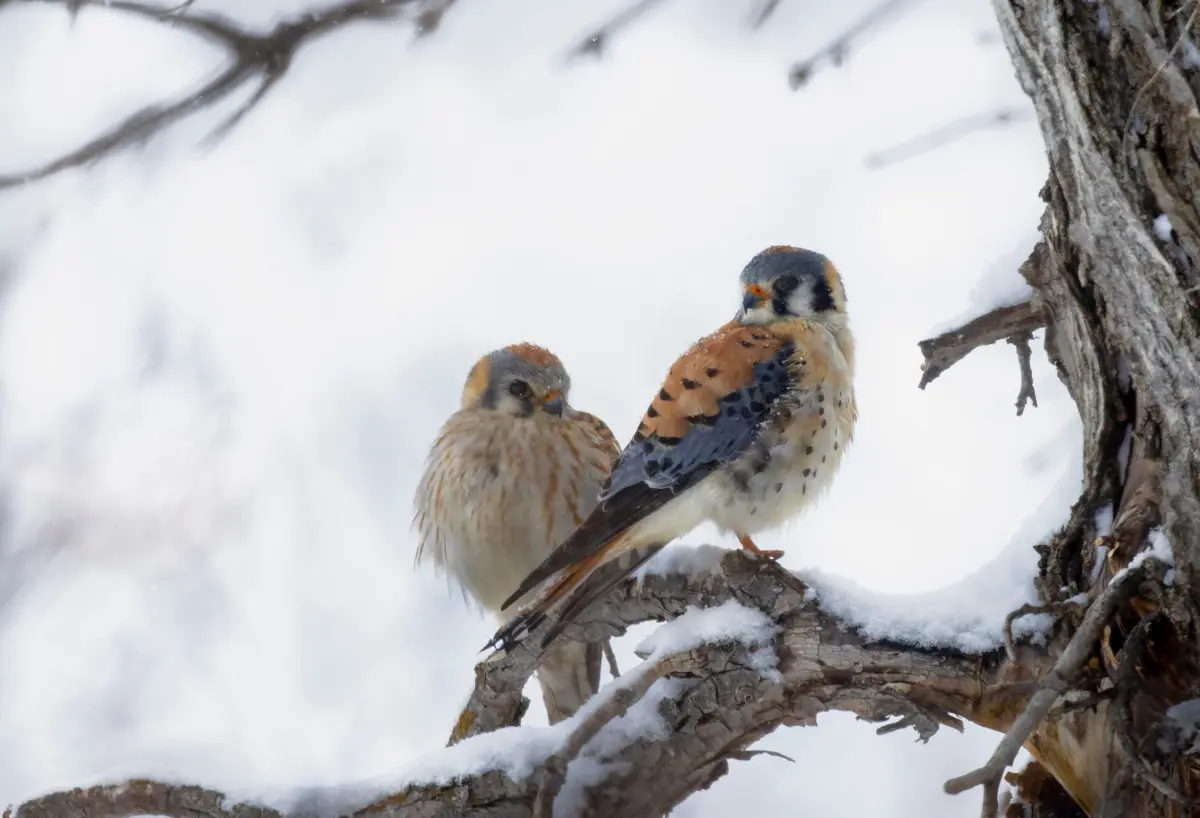
- The Pacific Lizard Effect: Along the Pacific coast, observers in California, Oregon, and Vancouver reported exceptionally high numbers of American Kestrels. Researchers hypothesize that the proliferation of the invasive European Wall Lizard in British Columbia is providing an abundant supplemental food source during the breeding season, directly driving up winter survival rates.
- Thrush and Warbler Anomalies: Despite harsh winter storms in the eastern U.S. driving down overall bird counts in states from Virginia to Minnesota, thrushes bucked the trend. Record numbers of American Robins and Hermit Thrushes were reported from New Jersey across to Montana. Meanwhile, mild weather in California and Nevada yielded an extraordinary year for warblers, producing rare sightings of Ovenbirds, Louisiana Waterthrushes, Prothonotary, Tennessee, Nashville, Kentucky, and Cape May Warblers, alongside surging populations of common yellowthroats and orange-crowned warblers.
Conservation Success Stories
Amidst widespread ecological pressures, the 126th CBC captured vital conservation wins. Most notable was the return of the endangered ‘Ēkupu’u (or Laysan Finch) on Midway Atoll (Kuaihelani). Extirpated from the atoll in the mid-1940s due to invasive rat introductions, this native honeycreeper was successfully reintroduced to Kuaihelani in July 2025. During the 126th CBC, the Midway Atoll circle proudly documented 8 of these reintroduced birds, not only confirming their early survival in their ancestral home but also establishing a brand-new species entry for the local count circle.
Official Statements and Data Analysis
The sheer scope of the 126th CBC generated 4,73 completed circles across Canada (473), the United States (2,051), and Latin America, the Caribbean, and Pacific Islands (177). Audubon scientists also achieved a major methodological milestone this year, successfully generating bird population trend estimates for 44 species across 182 count circles in Latin America and the Caribbean.
However, the aggregate raw data harbors a troubling reality. During the 126th CBC, participants counted a cumulative total of 43,815,563 individual birds (39.9 million in the U.S., 3.3 million in Canada, and 517,675 in Latin America/Caribbean/Pacific). While this figure represents a slight rebound from the 124th and 123rd counts, it remains down from the 125th count’s total of 44,259,423.
Audubon’s Community Science Team notes that this fits a wider, distressing pattern visible since 2014: even as volunteer recruitment scales up, new circles are established, and observation effort increases, total raw counts of individual birds continue to trend downward. These findings reinforce the urgent need for targeted habitat protection, climate policy intervention, and continuous longitudinal monitoring.
Future Outlook: Modernizing the World’s Oldest Count
Recognizing the irreplaceable value of the Christmas Bird Count in guiding North American wildlife policy, Audubon has committed to a sweeping three-year CBC modernization initiative.
Over the coming years, the program will undergo a comprehensive structural overhaul designed to elevate the user experience for veteran birders while breaking down barriers to entry for new, diverse communities across the Americas. Planned modernization upgrades span the entire operational pipeline:
- Outreach & Recruitment: Reimagining how communities discover, access, and register for local CBC circles.
- Digital Infrastructure: Upgrading the technology stack utilized for field data capture, submission, and validation.
- Data Analytics & Sharing: Streamlining how collected data is processed, visualized, and deployed by researchers, policy-makers, and conservationists.
As the Audubon Community Science Team looks toward the future, the primary sentiment remains one of profound gratitude. The monumental achievements of the 126th Christmas Bird Count—from the 35 new circles established in countries like Colombia, Ecuador, Mexico, and Peru, down to the single backyard feeder watcher in rural Maine—are built entirely on the dedication of human hands and watchful eyes. Through this collective vigilance, the Christmas Bird Count remains an unshakeable pillar of modern conservation science.