
Executive Overview
Long before a puppy learns to sit politely on command, walk loosely on a leash, or master the complex navigation required to guide an individual through a bustling city, an intricate and profound biological process is already unfolding behind the scenes. In the quiet, dimly lit whelping boxes of specialized breeding and training facilities, the foundation of a future guide or service dog is being laid.
At Dogs Inc, preparing elite working dogs is not a process that begins when formal training starts at six months or a year of age. Instead, it is an exhaustive, lifelong continuum of care that originates on day one. During a puppy’s earliest weeks of life, rapid physiological and neurological developments take place at a staggering pace. Even though neonates are born blind, deaf, and entirely dependent on their mother and littermates, their brains and central nervous systems are exceptionally active.
To capitalize on this critical window of vulnerability and potential, organizations like Dogs Inc integrate science-based protocols into their early-rearing strategies. One of the most foundational of these methodologies is Early Neurological Stimulation (ENS). Far from being a rigid training regimen, ENS introduces brief, controlled sensory inputs designed to stimulate the neurological system safely. When combined with subsequent phases of socialization, environmental enrichment, and positive reinforcement, these early practices help transform vulnerable newborns into confident, emotionally resilient, and highly adaptable working partners. This report explores the science, strategy, and meticulous care behind the early development of future guide and service dogs, examining how foundational weeks dictate lifelong success.
Detailed Chronology: From the Whelping Box to Adolescence
The developmental timeline of a canine is rapid, marked by distinct stages that require specialized handling, environmental exposure, and progressive challenges. Understanding this chronology is vital for appreciating how early experiences ripple forward into adult behavior.
[Birth - 2 Weeks: Neonatal Stage]
   └── ENS, maternal dependency, rapid neurological growth
        ↓
[2 - 4 Weeks: Transitional Stage]
   └── Eyes/ears open, first steps, barking, transition to solid food
        ↓
[3 - 12 Weeks: Socialization Window]
   └── Active exploration, positive associations, environmental stimuli
        ↓
[6+ Months: Adolescent Stage]
   └── Boundary testing, fear periods, advanced obedience & task training
The Neonatal Stage (Birth to Two Weeks)
During the neonatal stage, newborn puppies exist in a state of complete reliance. Their world is dictated by warmth, nursing, and sleep. Because their eyes and ear canals remain tightly sealed, they navigate entirely by touch, smell, and thermal cues. They cannot yet regulate their own body temperatures, requiring a warm whelping box and constant maternal vigilance.

Despite their apparent fragility, the neonatal brain is undergoing explosive growth. This is the precise window during which Early Neurological Stimulation is deployed. Because the nervous system is malleable, introducing gentle, controlled tactile stressors stimulates the neurological pathways, effectively "waking up" cardiovascular and adrenal systems in a safe, stress-free environment.
The Transitional Stage (Two to Four Weeks)
As puppies cross the threshold into the transitional stage, sensory horizons expand dramatically. Around two weeks of age, their eyes open, followed closely by the opening of their ear canals. Suddenly, the neonate becomes an active explorer.
By four weeks, puppies are attempting their first tentative steps, beginning to vocalize with barks, and interacting playfully with their littermates. This period also marks the emergence of baby teeth, signaling a gradual, crucial shift from exclusive nursing toward soft gruel and, eventually, solid food. Learning during this phase expands rapidly as they begin to process sights and sounds for the very first time.
The Socialization Period (Three to Twelve Weeks)
Widely recognized by animal behaviorists as the single most critical window in a canine’s life, the socialization period overlaps with the tail end of the transitional stage and extends through the third month. Between three and twelve weeks of age, a puppy’s brain is uniquely wired to accept novelty rather than fear it.
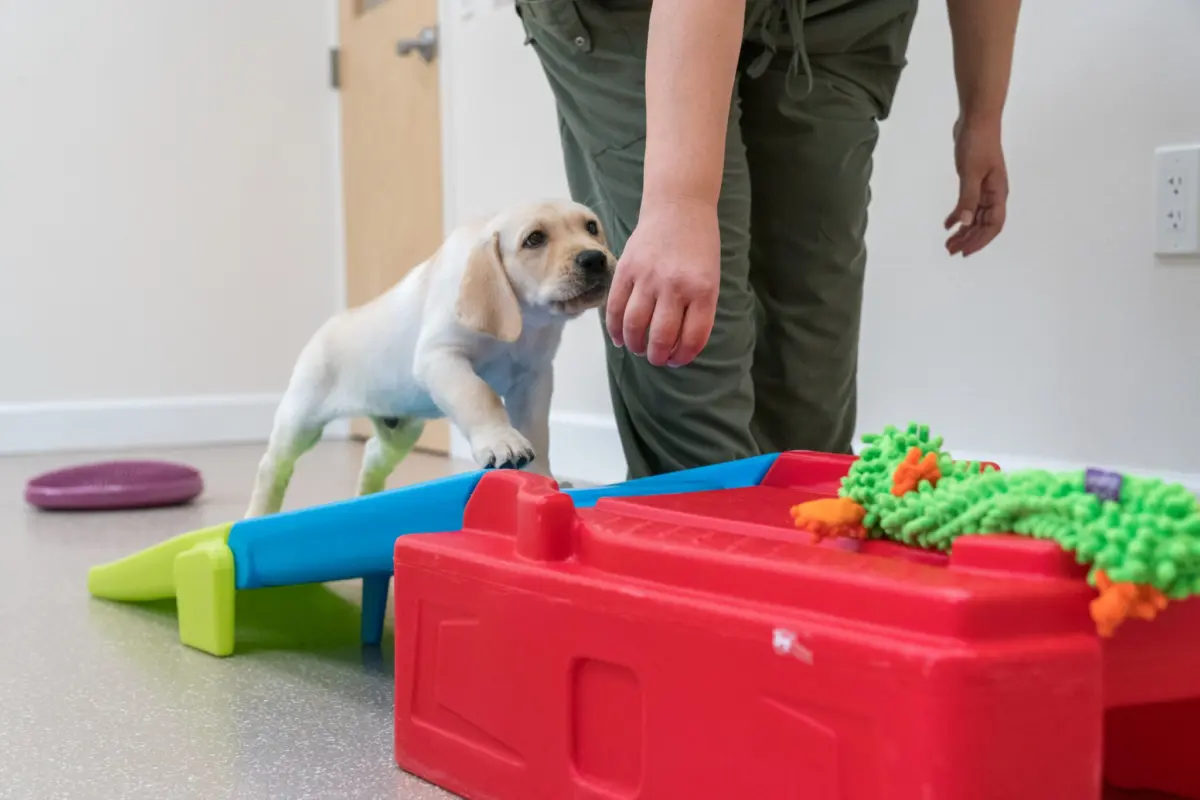
During this timeframe, structured exposures are paramount. Puppies must be introduced to various surfaces, novel sounds, diverse human demographics, and other animals. By twelve weeks, proactive socialization helps build robust emotional resilience, mitigating the risk of anxiety, reactivity, or phobias later in life. Furthermore, around eight weeks of age, many puppies transition from their birth facilities to volunteer puppy raisers, setting the stage for domestic integration.

The Adolescent Stage and Beyond (Six Months to Maturity)
As dogs mature, they enter the adolescent stage, which can begin as early as six months. Much like human teenagers, adolescent dogs frequently test boundaries, display independent streaks, and navigate hormonal shifts. For intact females, this often includes their first heat cycle, while males exhibit hormone-driven behaviors.
This stage also coincides with natural developmental milestones, including an average of four distinct "fear periods" where familiar objects or environments may suddenly appear startling. Navigating these phases requires compassionate, positive reinforcement-based handling. By sixteen weeks, formal puppy classes and structured obedience training anchor their learning, guiding them steadily toward their ultimate roles as calm, capable service partners.
Supporting Context & Metrics: The Science of Early Neurological Stimulation
To understand the mechanics of Early Neurological Stimulation, one must examine its origins and physiological targets. Originally developed as part of the "Biosensor" program (commonly known as the "Army Bio-Sensor" or "Super Dog" program), ENS was designed to improve the performance of dogs destined for military and demanding working roles.
The protocol involves handling puppies once per day between the third and sixteenth days of life—a window when the neurological system is developing at its most rapid rate. The routine consists of five distinct, gentle exercises, each lasting approximately three to five seconds:
- Tactile Stimulation: Holding the puppy in one hand and gently tickling the pad of one foot using a Q-tip. The foot is stimulated for 3–5 seconds.
- Head Up: Holding the puppy perpendicular to the ground, with its head pointing straight up, for 3–5 seconds.
- Head Down: Holding the puppy securely while pointing its head downward toward the ground for 3–5 seconds.
- Supine Position: Holding the puppy so that it is sleeping or resting comfortably on its back, with its muzzle pointing toward the ceiling, for 3–5 seconds.
- Thermal Stimulation: Placing the puppy feet-down on a damp towel that has been chilled in a refrigerator for a minimum of five minutes. The puppy is allowed to move freely on the cool surface without being restrained.
Physiological Impacts and Benefits
These exercises are brief by design. They do not induce panic or distress; rather, they introduce mild, acute physiological stress responses in a controlled setting. Decades of observational data and physiological studies suggest that this process stimulates the endocrine system by kick-starting adrenal gland function, improves cardiovascular performance, enhances stress tolerance, and strengthens neurological systems.

Potential benefits observed in dogs subjected to early protocols include:
- Improved cardiovascular performance (heart rate and function)
- Stronger adrenal gland responses
- Greater tolerance to psychological stress
- Enhanced disease resistance and immune system resilience
- Greater adaptability when confronting unfamiliar environments
However, experts caution that ENS is not a silver bullet. A puppy’s ultimate temperament, work ethic, and success as a service dog depend on a complex matrix of genetics, maternal care, veterinary health, ongoing socialization, and expert training. ENS is merely the first chapter in a comprehensive developmental library.
Official Perspectives: The Dogs Inc Approach
Organizations dedicated to breeding and training elite assistance dogs operate under the philosophy that excellence is engineered, not accidental. At Dogs Inc, the operational framework respects every stage of development, ensuring that puppies are neither rushed through their vulnerable neonatal days nor deprived of crucial sensory challenges as they mature.
Animal behavior and breeding specialists at Dogs Inc emphasize that early interventions must always prioritize welfare and scientific validation. "We are not trying to manufacture robots or force adult behaviors onto infant animals," notes canine development leadership. "Our objective is to provide a nurturing, structured scaffolding that allows each puppy’s natural genetic potential to unfold safely. Every touch, every sound, and every graduated challenge is calculated to build emotional fortitude."
This institutional philosophy recognizes the distinct line between neonatal stimulation and later-stage socialization. While ENS builds a resilient physiological baseline, socialization builds a confident psychological worldview. By keeping these timelines distinct yet complementary, trainers ensure that when a puppy faces the unpredictable environment of a crowded airport, a university campus, or a busy medical center, its nervous system is primed to remain steady, focused, and reliable.

Furthermore, the transition of puppies from breeding facilities to volunteer puppy raisers at approximately eight weeks represents a crucial partnership. These volunteer raisers are educated on the milestones of canine development, equipped with positive reinforcement techniques, and coached through the management of adolescent boundary-testing and fear periods. Through this unified approach, Dogs Inc ensures continuity of care from the whelping box to final placement.
Future Outlook: Raising Life-Changing Partners
As the science of canine behavior and developmental biology continues to evolve, the methodologies employed by elite organizations like Dogs Inc are also advancing. The future of guide and service dog breeding relies heavily on data-driven insights, combining genetic markers for temperament and health with standardized behavioral tracking during early development stages.
The demand for reliable, highly specialized service and guide dogs continues to outpace supply. Conditions such as visual impairment, mobility limitations, and invisible disabilities like PTSD require assistance animals that possess unwavering calm, immaculate focus, and an innate ability to problem-solve in chaotic human environments. Achieving this level of behavioral reliability cannot be left to chance; it requires the meticulous, intentional foundation that begins on day one of a puppy’s life.
Looking forward, the integration of targeted neonatal protocols like ENS with modern enrichment strategies promises to produce an even higher caliber of working dogs. By continuously refining how we handle, expose, and train dogs through every developmental window—from the neonatal whelping box to the transitional stage, and through the trials of adolescence—we optimize their chances of success.
Ultimately, a puppy’s earliest weeks pass in the blink of an eye, but their impact echoes across a lifetime of service. Through uncompromising dedication, scientific rigor, and deep compassion, organizations like Dogs Inc ensure that these tiny paws grow up to become steady, life-changing partners for individuals who depend on them most.