
Executive Overview
Long before a puppy takes its first clumsy steps on a leash, learns to sit on command, or prepares to guide a visually impaired individual through a bustling metropolitan center, an intricate biological symphony is already playing out behind the scenes. At organizations like Dogs Inc, the journey of a future service or guide dog begins at the very dawn of life—during the delicate neonatal stage.
While newborn puppies appear entirely vulnerable, sleeping and nursing away their earliest days with eyes and ears tightly sealed, their central nervous systems are operating at a breakneck pace. To harness this critical window of rapid neural development, canine science utilizes specialized, evidence-based practices such as Early Neurological Stimulation (ENS). Though ENS is only one foundational chapter in a comprehensive, multi-year developmental curriculum, it sets the stage for emotional resilience, stress tolerance, and environmental adaptability.
This report investigates the science, protocols, and long-term implications of early puppy development. By examining the precise milestones of the neonatal and transitional phases, contrasting ENS with subsequent socialization windows, and reviewing the lifelong training trajectories implemented by elite working-dog organizations, we uncover how deliberate early intervention transforms ordinary puppies into extraordinary, life-changing partners.
Detailed Chronology: From Neonatal Beginnings to Adolescent Growth
Understanding how a dog evolves from a fragile neonate into a steady, focused working companion requires tracing its development through distinct biological chapters. Each phase presents unique neurological milestones, behavioral shifts, and specific care requirements.

Phase 1: The Neonatal Stage (Birth to Two Weeks)
During the first fortnight of life, puppies exist in a state of complete dependency. Blind, deaf, and unable to regulate their own body temperatures, they rely entirely on their mother and littermates for warmth, nutrition, and physical security.
Despite their seemingly inactive exterior, the puppy’s brain and central nervous system are undergoing explosive growth. Because their sensory apparatus is not yet fully online, this period is ideal for introducing mild, non-invasive tactile challenges without inducing psychological panic. This is the exclusive window for Early Neurological Stimulation (ENS), where trained handlers administer brief, highly regulated physical exercises designed to stimulate the neurological system.
Phase 2: The Transitional Stage (Two to Four Weeks)
As puppies cross the two-week threshold, a profound awakening occurs. Their eyes and ears unseal, opening them up to the sights and sounds of the world for the first time. By the time they reach four weeks of age, puppies begin to walk with shaky coordination, test out their vocal cords with tentative barks, and emerge from the whelping box to interact directly with their littermates.
Simultaneously, baby teeth begin to erupt, signaling a biological shift away from exclusive nursing toward soft, and eventually solid, food. This phase marks the beginning of active social awareness, where interactions with littermates teach foundational canine etiquette, such as bite inhibition.

Phase 3: The Socialization Period (Three to Twelve Weeks)
If the neonatal stage is about biological wiring, the socialization period is about psychological expansion. Spanning roughly from week three through week twelve, this window is arguably the most critical for shaping a dog’s lifetime temperament.
- Weeks 3 to 8: Puppies begin building powerful positive associations with human handlers, various household sounds, diverse floor surfaces, and other dogs. By week eight, the groundwork is firmly laid for a confident, adaptable companion.
- Weeks 8 to 12: As puppies enter new homes or puppy-raising environments, structured exposures accelerate. Handlers introduce novel environments, friendly strangers, and everyday objects to build robust environmental stability. Crucially, this period coincides with what animal behaviorists identify as the early fear imprint stages—moments where negative experiences can leave deep, lasting psychological scars, underscoring the absolute necessity of positive reinforcement.
Phase 4: Adolescence and Reproductive Maturity (Six Months to One Year)
Development does not plateau after puppyhood. Around six months of age, dogs typically enter adolescence. Much like human teenagers, adolescent dogs begin testing boundaries, questioning established rules, and experiencing hormonal fluctuations.
Female dogs generally undergo their first heat cycle, marking their entry into broader reproductive cycles, while male dogs display heightened hormone-driven behaviors. During this stage, structured training, boundary setting, and consistent positive reinforcement are vital to guide the dog through emotional maturation and solidify their working discipline.
Supporting Context & Metrics: The Science and Strategy of ENS
To fully appreciate the value of programs like those at Dogs Inc, one must examine the specific mechanics of Early Neurological Stimulation and understand how it interacts with broader biological factors.

What is Early Neurological Stimulation?
Originally developed through military canine programs and later popularized for broader working-dog breeding operations, ENS involves a series of five distinct, gentle handling exercises performed daily from the third day of life through the sixteenth day. Each exercise lasts approximately three to five seconds per puppy. The routine includes:
- Tactile Stimulation: Holding the puppy in one hand and gently tickling the pad of one foot using a Q-tip.
- Head Up: Holding the puppy perpendicularly straight up with both hands, so its head is directly above its tail.
- Head Down: Holding the puppy firmly in both hands with its head inverted and pointed downward toward the ground.
- Supine Position: Cradling the puppy so that it is sleeping on its back, resting calmly in the handler’s hands.
- Thermal Stimulation: Placing the puppy feet-down on a damp, cool towel for a brief, controlled duration.
The Biological Rationale
The premise behind ENS is that brief, mild neurological stressors stimulate the endocrine system, improve cardiovascular performance, enhance adrenal function, and increase stress tolerance. Scientific observations suggest that dogs subjected to these early exercises display greater resistance to disease and a superior ability to adapt to stressful, unfamiliar situations later in life.
However, experts emphasize that ENS is not a magic bullet. A puppy’s ultimate temperament, health, and aptitude for service work are governed by a complex matrix of variables:
- Genetics: Inherited traits and innate working drives.
- Health and Nutrition: Optimal physiological maintenance from conception onward.
- Environment and Socialization: The quality of human interaction and exposure to worldly stimuli post-neonatal stage.
- Training Methodologies: The consistent application of positive reinforcement.
Official Perspectives: Breeding for Purpose at Dogs Inc
The meticulous attention paid to a puppy’s first hours and weeks reflects a broader philosophy shared by elite guide and service dog training organizations. According to canine development specialists at institutions like Dogs Inc, producing a dog capable of mitigating a handler’s disability requires an unbroken chain of intentional care.

"A guide dog or service dog cannot simply be well-trained; they must be constitutionally equipped to handle the relentless unpredictability of the human world," notes a senior canine development coordinator. "They must navigate crowded transit systems, ignore overwhelming distractions, and remain preternaturally calm under pressure. Those profound psychological traits do not materialize by accident in adulthood. They are engineered through a lifetime of stepwise preparation, beginning the moment a puppy draws its first breath."
Organizations emphasize that while public admiration often focuses on the polished obedience of an adult working dog, the true bedrock of that success is established long before formal commands are ever spoken. By investing in neonatal stimulation, careful socialization windows, and lifelong positive reinforcement, breeding and training programs stack the deck in favor of success.
Future Outlook: A Lifetime of Continuous Learning
As the science of animal behavior advances, the protocol for raising elite service dogs continues to evolve. Modern organizations increasingly recognize that learning is a lifelong continuum.
Moving beyond the neonatal and transitional stages, future guide and service dogs transition into structured crate-training regimens to foster independence, participate in specialized puppy classes around sixteen weeks of age, and engage in short, positive reinforcement training sessions starting as early as three months old. Furthermore, safe exposures to other species, diverse urban environments, and complex social stimuli ensure that these dogs remain well-adjusted, confident, and eager to work.
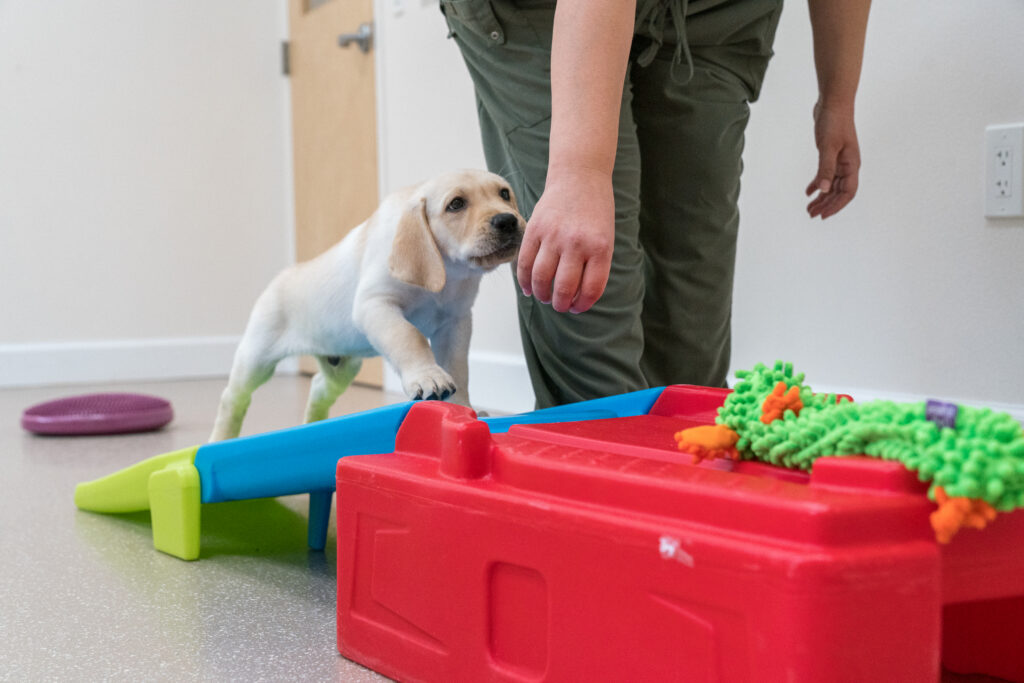
Ultimately, the rigorous early-stage protocols practiced by institutions like Dogs Inc prove that the path to independence for a person with visual impairments or mobility challenges begins with tiny paws taking their very first, carefully nurtured steps. By safeguarding and stimulating a puppy’s development from day one, these organizations ensure that tomorrow’s working dogs are ready to meet the world with unwavering courage, focus, and grace.