
Executive Overview
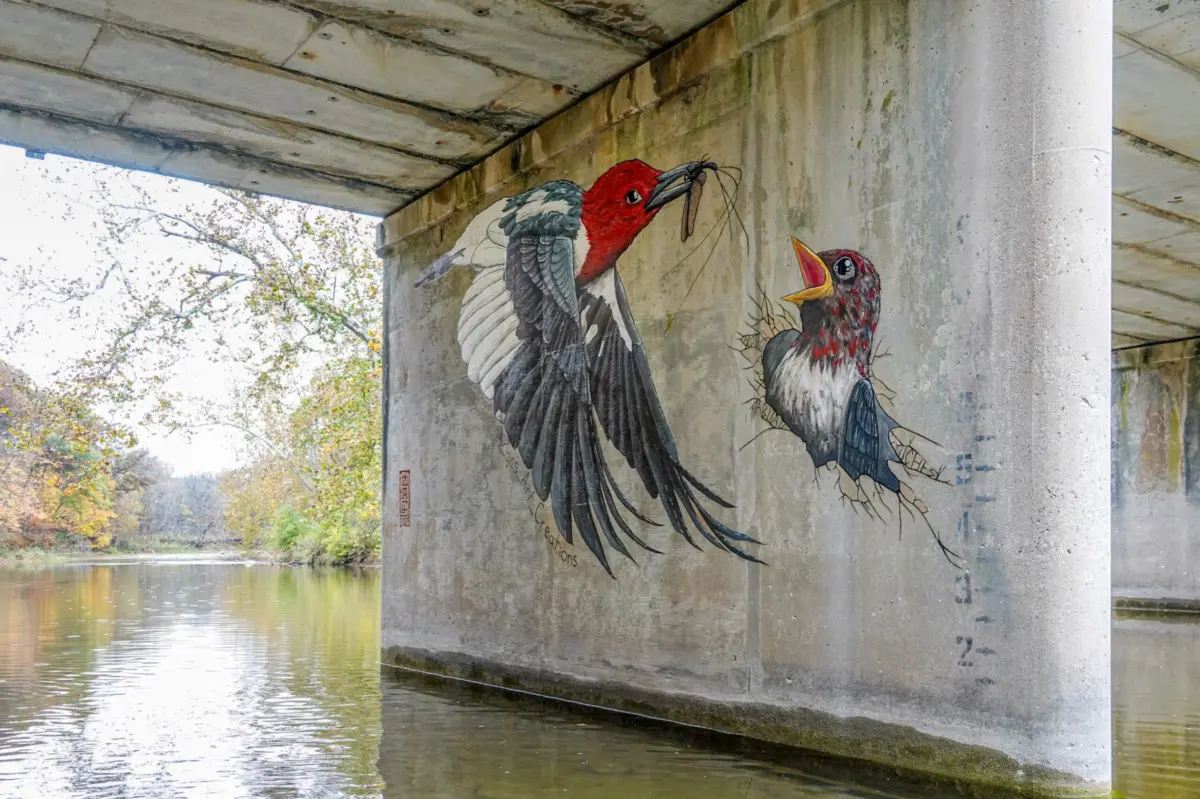
In the heart of Warren County, Indiana, where the sprawling waters of the Wabash River converge with the picturesque Big Pine Creek, a striking new piece of public art has emerged from the concrete shadows. Completed on October 7, 2025, a monumental mural spans the south pylon of the Twin Bridges underpass, breathing vibrant life into an industrial infrastructure. Created by local artist Zac Cody as part of the prestigious Audubon Mural Project, the artwork depicts a breathtaking, larger-than-life Red-headed Woodpecker clutching a mayfly as it swoops down to feed a newly hatched nestling.
This installation is far more than a visual aesthetic upgrade for a rural bridge; it is a deliberate, community-driven initiative commissioned by the Warren County Community Foundation in partnership with the Wabash River Blueway art series. Executive Director Michele Stucky and regional stakeholders designed the project to serve as a catalyst for environmental engagement, luring outdoor enthusiasts, kayakers, and hikers to the water’s edge to foster a deeper connection with the local ecology.
Yet, beneath the masterful brushstrokes of black, white, and firetruck-red paint lies a pressing environmental narrative. The Red-headed Woodpecker, once an omnipresent fixture of eastern North American woodlands, faces mounting threats from habitat fragmentation, invasive species, and the intensifying pressures of climate change. By weaving the powerful words—“Protect,” “Habitat,” and “Niches”—into the splintering concrete design around the baby bird’s head, Cody’s mural transcends traditional public art. It functions as a visual manifesto for land stewardship, a celebration of local biodiversity, and an urgent reminder of the fragile balance sustaining our natural world.
Detailed Chronology: From Ashes to Public Art
The journey that led Zac Cody to the concrete pylons of Warren County is a testament to resilience, reinvention, and an unwavering devotion to the natural world. For years, Cody navigated a dual existence. Like many modern artists, he balanced a traditional day job—in his case, working as a professional photographer—while pursuing various artistic mediums on the side, including painting and pottery. Though his creative inclinations were vast, the constraints of daily life kept his passion projects tethered to the periphery.
That paradigm shifted dramatically in 2023. In a devastating turn of events, Cody lost his home in a catastrophic fire. Amid the smoke and ruin, as he salvaged what little he could from the wreckage, he managed to rescue a single, invaluable possession: his watercolor paints. Standing amidst the remnants of his life, Cody experienced a profound psychological and professional turning point. The tragedy forced a radical reassessment of his priorities, time, and ambitions.
"I had a big realization," Cody reflects on the aftermath of the fire. "I wanted to run my own business and try and make it."
That pivotal moment galvanized a leap of faith. Cody committed himself entirely to wildlife painting, transitioning to a full-time career centered on capturing the intricate beauty of the natural world. Working out of Indiana, he quickly expanded his portfolio from intimate watercolor studies to large-scale public murals.
When the Warren County Community Foundation sought an artist capable of marrying local ecology with impactful visual storytelling, Cody proved to be an ideal fit. His unique background as a wildlife photographer deeply influences his painting style, granting him an intimate understanding of lighting, anatomy, and micro-perspectives. The resulting mural under the Twin Bridges represents the culmination of this post-tragedy renaissance—a permanent monument born from personal loss, dedicated to preserving and celebrating the enduring resilience of nature.
Supporting Context & Metrics: The Ecological Significance of the Red-Headed Woodpecker
To fully appreciate the cultural and ecological weight of Cody’s mural, one must understand the subject itself. The Red-headed Woodpecker (Melanerpes erythrocephalus) is an avian species unlike any other in the North American landscape. Instantly recognizable by its striking, high-contrast plumage of jet-black and pristine white patches, anchored by a vibrant, firetruck-red head, the bird was historically a ubiquitous fixture throughout the eastern and central United States.
Ecologically, these woodpeckers are classified as primary cavity nesters, relying on dead trees, snags, and open habitats such as savannas, orchards, and forest clearings. They are renowned for their harsh, rattling vocalizations and their acrobatic prowess, frequently launching from perches into mid-air to hawk flying insects—a behavior vividly captured in Cody’s mural.
Population Declines and Environmental Pressures
Despite their historical abundance, Red-headed Woodpecker populations have experienced sustained, documented declines over recent decades. Ornithologists and conservation biologists attribute this downward trend to several compounding anthropogenic and ecological factors:
- Habitat Loss and Sanitation Forestry: Modern forestry practices often prioritize the removal of dead standing timber (snags) for aesthetic or safety reasons. Unfortunately, these snags are precisely what Red-headed Woodpeckers require for nesting and foraging.
- Invasive Species Competition: The introduction and proliferation of aggressive non-native species, particularly European Starlings, have intensified competition for scarce nesting cavities, frequently resulting in woodpeckers being driven out of their traditional breeding grounds.
- Roadside Mortality: Because these birds frequently forage for insects along rural roadsides and utilize utility poles as hunting perches, they suffer disproportionately high rates of vehicular strikes.
Climate Change Projections
While the International Union for Conservation of Nature (IUCN) currently lists the Red-headed Woodpecker as a species of "Least Concern," emerging climate models paint a far more precarious long-term picture. According to comprehensive projections from the National Audubon Society’s landmark Survival by Degrees report, unchecked global temperature increases could devastate the species’ geographic distribution.
The report reveals that if warming trends continue at their current trajectory, the Red-headed Woodpecker could lose an astonishing 94 percent of its current summer breeding range. This alarming statistic underscores the prophetic nature of the words embedded within Cody’s mural. The call to action inscribed around the nestling—Protect, Habitat, Niches—is not merely poetic garnish; it is an urgent ecological imperative.
Official Statements: Visionaries Behind the Brush and the Foundation
The integration of fine art into rural infrastructure is a strategic endeavor championed by local civic leaders who recognize the symbiotic relationship between community development and environmental conservation. Michele Stucky, Executive Director of the Warren County Community Foundation, has been at the helm of this cultural movement, spearheading the Wabash River Blueway art initiative.
Stucky’s vision for the project extends far beyond beautification; she views public art as a tangible bridge connecting citizens to the waterways that define the region’s geography and history.
"Because the mural is so detailed, it will make them want to get closer, whether that be taking off their shoes and wading over or bringing a kayak to get right next to it," Stucky explains. "We’re using the mural to encourage people to come and see the space, and then we’re hoping that they’ll want to spend longer there."
Furthermore, Stucky notes that the subject matter of the mural functions as a biological report card for the health of Warren County’s ecosystems. During the painting process, artist Zac Cody personally counted three live Red-headed Woodpeckers in the immediate vicinity—an encouraging sign of local environmental health.
"[The mural] is a nod to good land stewardship," Stucky remarks. "If you have the Red-headed Woodpecker here, it means you’re doing a good job with how you’re taking care of the land."
Artist Zac Cody shares this philosophy, viewing his work as an interactive educational tool for the public. Unlike urban street art, which benefits from high foot traffic in metropolitan centers, Cody’s rural installations offer a more contemplative, immersive discovery process.
"You mostly see murals in urban places," Cody observes. "लेकिन (But) they feel a little more special, hidden, and few and far between out in the country."
To maintain the highest standards of scientific and artistic integrity, Cody engages in rigorous preparation before laying down a single stroke of paint. He meticulously studies avian anatomy, behavioral patterns, and ecological requirements. When sharing his artistic process with followers online via his digital platform, Zac’s Art Creations, he deliberately pairs visual progress updates with educational trivia about the wildlife he depicts.
"What I like to do with my art is highlight unseen things," Cody states. "I like to do wildlife up close because it’s a perspective that, if you’re not a photographer or sitting in the woods watching animals, you don’t always see."
Future Outlook: The Role of Public Art in Modern Conservation
As communities across the United States grapple with the dual crises of habitat degradation and declining public engagement with the outdoors, initiatives like the Warren County Community Foundation’s art series offer a blueprint for innovative solutions. By transforming utilitarian public structures—such as the concrete underpasses of the Twin Bridges over Big Pine Creek—into open-air art galleries, regional leaders are proving that conservation can be both accessible and deeply engaging.
The success of Zac Cody’s Red-headed Woodpecker mural highlights several key takeaways for the future of rural conservation and public art:
- Placemaking as Conservation: Pairing environmental education with public infrastructure projects successfully draws citizens out of their homes and into natural spaces, fostering grassroots appreciation for local watersheds.
- Amplifying Indigenous Wildlife: Highlighting vulnerable or declining species—such as the Red-headed Woodpecker—raises public awareness about localized environmental pressures long before species reach critical endangered thresholds.
- The Intersection of Science and Art: Artists who ground their work in rigorous ecological research serve as vital science communicators, translating complex conservation data into visually captivating narratives that resonate emotionally with the general public.
Looking ahead, stakeholders in Warren County hope the Twin Bridges mural will inspire similar artistic and conservation projects along the Wabash River Blueway corridor. As climate pressures mount and species distributions shift, community-led land stewardship will remain the first line of defense. Through the quiet, watchful eyes of a newly hatched woodpecker painted on a concrete pylon, residents and visitors alike are reminded of their shared responsibility to safeguard the natural heritage of Indiana—ensuring that the words Protect, Habitat, and Niches echo far beyond the banks of Big Pine Creek.