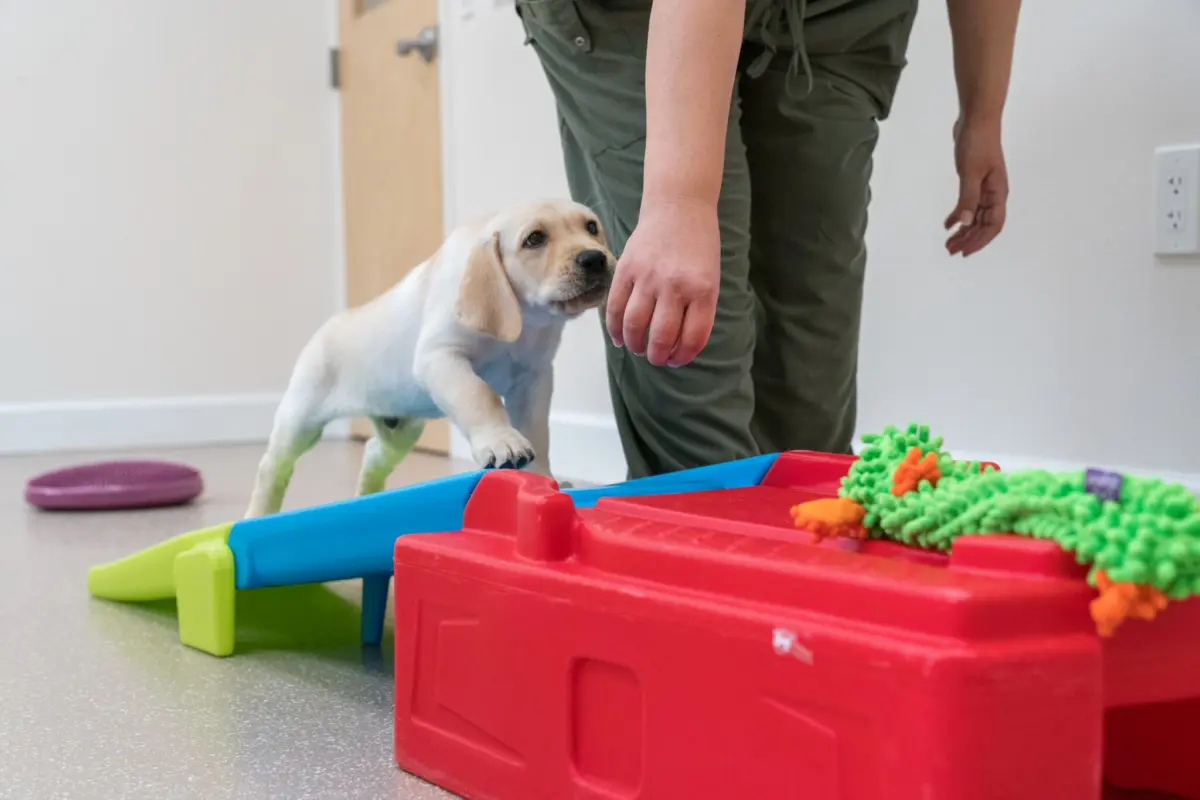
Long before a puppy takes its first deliberate step on a leash, learns to sit on command, or prepares to guide a visually impaired handler through a bustling urban landscape, an intricate world of biological development is unfolding behind the scenes. At organizations like Dogs Inc, the journey of a future guide or service dog does not begin when formal training kicks off at several months of age. Instead, it starts in the quiet, fragile hours of the neonatal stage, long before the puppy’s eyes or ears have even opened to the world.
Modern canine science confirms that the earliest weeks of a puppy’s life are critical epochs of rapid neurological growth. During this period, foundational frameworks are established that dictate how a dog will process stress, learn new concepts, and adapt to unfamiliar environments later in life. One of the cornerstone practices utilized during this fragile window is Early Neurological Stimulation (ENS). Though ENS is just a single component within a comprehensive, lifelong curriculum of socialization, environmental enrichment, and positive reinforcement training, it illustrates the deeply methodical, science-driven approach required to breed and rear elite working dogs.
This report explores the biological mechanisms of neonatal canine development, the mechanics and philosophy of Early Neurological Stimulation, how ENS contrasts with the broader socialization period, and why investing in a puppy’s first days of life is essential for producing the calm, resilient, and life-changing partners relied upon by individuals worldwide.
Detailed Chronology: From Neonatal Beginnings to Adolescent Milestones
Understanding how a service dog is shaped requires tracking its development across distinct, chronological stages. Each phase presents unique biological benchmarks and behavioral opportunities that build directly upon the last.
1. The Neonatal Stage (Birth to 2 Weeks)
During the first fortnight of life, newborn puppies are entirely dependent on their mother and littermates. Clinically, they are unable to regulate their own body temperature, and their eyes and ears remain sealed shut. They spend the vast majority of their time alternating between nursing and deep sleep.
Despite their apparent vulnerability and inactivity, the neonatal brain and nervous system are hard at work. This is the precise window during which protocols like Early Neurological Stimulation are applied. Because the nervous system is malleable and rapidly forming pathways, gentle, age-appropriate stimulation introduces mild biological stressors that trigger beneficial physiological responses, fostering greater stress tolerance and cardiovascular performance.
2. The Transitional Stage (2 to 4 Weeks)
As puppies cross the two-week threshold, a dramatic transformation occurs. Their eyes and ears open, permanently altering how they perceive their environment. By the time they reach four weeks of age, puppies begin to find their footing, taking their first wobbly steps and exploring vocalizations like barking.
Simultaneously, their primary teeth begin to erupt. This marks the gradual, natural shift away from exclusive nursing toward soft foods, and eventually, solid nutrition. Interactions with littermates during this stage help teach foundational social rules, such as bite inhibition, as puppies learn how their actions affect others.
3. Early Socialization and Environmental Exposure (3 to 12 Weeks)
Once the transitional stage gives way to the core socialization period, a puppy’s capacity to absorb and categorize environmental stimuli explodes. Between 3 and 12 weeks of age, structured exposure to novel sounds, unique surfaces, diverse human faces, and various animals becomes paramount.
By 8 weeks of age, many of these positive experiences have laid the psychological groundwork necessary for a friendly, well-adjusted adult dog. By the 12-week mark, comprehensive exposure protocols ensure that puppies have interacted with a wide array of stimuli. This active engagement helps mitigate future anxiety and aggression, fostering robust confidence and adaptability.
4. Adolescent Boundaries and Developmental Windows (6 Months and Beyond)
As dogs mature past puppyhood, they encounter new hormonal and psychological milestones. The adolescent stage can manifest as early as 6 months of age, during which young dogs often test boundaries—a phase remarkably similar to human adolescence. Reproductive maturity typically settles in between 6 and 12 months. For female dogs, this encompasses their first heat cycle and the broader hormonal shifts associated with it; for males, it introduces new hormone-driven behavioral tendencies.
Furthermore, behavioral scientists note that puppies navigate an average of four distinct "fear periods" as they grow. These temporary developmental phases make thoughtful, positive handling crucial. Introducing novel stimuli too harshly during these windows can induce lasting phobias, whereas careful, supportive management builds lifelong resilience.
Supporting Context & Metrics: The Science of Early Neurological Stimulation
While public perception often assumes that training begins when a dog is old enough to wear a collar and respond to verbal cues, elite breeding and training institutions recognize that biology waits for no one. ENS was originally developed based on canine research indicating that neonatal stimulation can permanently alter neurological capacities.
What is ENS?
Early Neurological Stimulation consists of a series of five brief, gentle exercises performed daily from approximately the third day of life through the sixteenth day. Each exercise lasts only three to five seconds and is meticulously structured to prevent physical harm while introducing mild, non-painful sensory inputs.
The standard ENS protocol includes:
Tactile Stimulation: Holding the puppy in one hand and gently tickling the pad of one foot using a Q-tip or finger for three to five seconds.
Head Erect: Holding the puppy perpendicular to the ground (head up, tail down) for three to five seconds.
Head Inverted: Holding the puppy perpendicular with the head pointing toward the ground for three to five seconds.
Supine Position: Holding the puppy so that it is sleeping comfortably on its back, resting in the palm of the handler’s hand for three to five seconds.
Thermal Stimulation: Placing the puppy feet-down on a damp, cool towel for three to five seconds.
The Biological Impact
These brief exercises simulate mild physical stress while the puppy is in its most impressionable state. Controlled studies tracking the physiological effects of these protocols have noted several key benefits:
Improved Cardiovascular Performance: Enhanced heart rate and vagal tone regulation.
Greater Stress Tolerance: Stronger adrenal gland responses and cortisol regulation when faced with novel challenges later in life.
Enhanced Immune System: Increased resistance to certain illnesses and infections during early development.
Greater Electroencephalographic (EEG) Activity: More active and complex brain-wave patterns, translating to improved problem-solving capabilities.
However, experts emphasize that ENS is not a silver bullet. A puppy’s ultimate temperament, work ethic, and suitability as a service animal are determined by a complex interplay of genetics, general health, early socialization, continuous environmental enrichment, and formal training. ENS is simply the foundation upon which all future learning is built.
ENS vs. Socialization: Understanding the Distinction
A common point of confusion among puppy raisers and the general public is equating Early Neurological Stimulation with socialization. Though both are crucial, they serve entirely different functions at different stages of life:
Metric / Feature
Early Neurological Stimulation (ENS)
Socialization Period
Timing
Neonatal stage (Days 3 through 16)
Weeks 3 through 12 (and beyond)
Primary Focus
Physiological and neurological development
Psychological adaptation and social skills
Nature of Activity
Brief, controlled sensory/tactile exercises
Active exposure to people, places, sounds, and objects
Independence Level
Puppy is entirely dependent on mother/handler
Puppy is actively mobile, exploring, and learning
Official Statements and Institutional Philosophy
Organizations dedicated to breeding and training life-changing assistance dogs view early development through a holistic lens. The philosophy at institutions like Dogs Inc is anchored in the belief that excellence is engineered from day one.
"Long before a puppy learns to sit, walk on a leash, or one day guide someone through the world, a lot is already happening behind the scenes," notes the development team at Dogs Inc. "Preparing future guide dogs and service dogs starts long before formal training begins. It is about providing thoughtful experiences that support healthy growth, emotional maturity, and future learning."
Institutional leadership stresses that early developmental protocols are designed to foster resilient minds capable of handling the immense psychological demands of service work. A guide dog or mobility assistance dog cannot afford to panic when confronted with unexpected sirens, crowded subway stations, or sudden shifts in a handler’s environment.
"Guide dogs and service dogs need more than advanced skills," industry experts point out. "They also need the ability to navigate busy environments, adjust to changing situations, and remain calm and focused alongside the people who depend on them. Those qualities don’t appear overnight."
By embedding rigorous, science-based protocols like ENS into the earliest days of a puppy’s life, and following them up with structured socialization, crate training, positive reinforcement, and specialized puppy classes around 16 weeks of age, organizations ensure that every dog reaches its maximum potential.
Future Outlook: A Lifetime of Learning and Partnership
As canine behavioral science continues to evolve, the methodologies used to breed and rear service animals are refined to ensure the highest possible success rates. Modern breeding programs increasingly rely on data-driven tracking of puppy development stages, ensuring that interventions are timed precisely with neurological windows of opportunity.
Looking ahead, the integration of structured early interventions like ENS with advanced post-neonatal training frameworks promises to produce even more adaptable, confident, and emotionally stable working dogs. As these puppies graduate from the neonatal nursery into the hands of dedicated puppy raisers, and eventually into formal training, every early touch, every controlled challenge, and every positive reinforcement session compounds into something extraordinary.
For the individuals who rely on guide and service dogs for their independence, mobility, and safety, this meticulous attention to detail during the first weeks of life is nothing short of life-changing. It transforms a tiny, vulnerable newborn into a steadfast, intelligent partner ready to navigate the world hand-in-paw.