
GARNER, N.C. — As autumn brings cooler temperatures and ideal soil conditions to the Southeast, gardeners and conservationists across the Tar Heel State are rolling up their sleeves for the fall planting season. But this year, the seasonal ritual carries a deeper, state-sanctioned significance. From October 19 to 25, North Carolina observes its official Native Plants Week—a dedicated period meant to focus public attention on the ecological engine driving the state’s rich biodiversity.
From the windswept outer banks of Corolla to the rugged peaks of Boone, conservationists are using the week to highlight a simple yet profound truth: if you want to save our native birds, pollinators, and ecosystems, you must start from the roots up. Spearheaded by groups like Audubon North Carolina, this year’s campaign goes beyond aesthetic gardening. It represents an urgent, science-backed call to action addressing habitat fragmentation, climate resilience, and the critical intersection of native flora and avian survival.
Executive Overview: The Ecological Imperative of Native Flora
At its core, North Carolina Native Plants Week serves as a timely reminder of what is at stake when foreign, ornamental species replace local biodiversity. Native plants are defined ecologically as those that have evolved over thousands of years in concert with the local climate, soils, insects, and wildlife that call a specific region home.
This deep evolutionary history has forged specialized relationships. Species like the Carolina Wren, the Brown-headed Nuthatch, and countless migratory songbirds have adapted over millennia to depend precisely on the resources and structural benefits provided by North Carolina’s indigenous trees, shrubs, and flowering perennials.
In recent years, however, suburban expansion, commercial development, and the introduction of aggressive non-native ornamentals—such as English ivy, Bradford pear, and Chinese privet—have disrupted these ancient webs of life. The result is a silent crisis: landscapes that look green and manicured to human eyes, but are essentially biological deserts to local wildlife.
North Carolina Native Plants Week seeks to reverse this trend. By educating homeowners, urban planners, and policy-makers, the initiative champions the idea that residential backyards and public parks can double as critical wildlife sanctuaries. By choosing to plant native oaks, spicebushes, and longleaf pines instead of sterile foreign imports, North Carolina residents are directly fueling the recovery of populations that face unprecedented environmental pressures.
Detailed Chronology: The Evolution of Native Plant Advocacy in the Tar Heel State
To understand the momentum behind the October 19–25 initiative, it is necessary to examine the trajectory of environmental advocacy and policy wins that have recently reshaped conservation in North Carolina.
Laying the Groundwork: Decades of Grassroots Conservation
For decades, organizations like the National Audubon Society and its state program, Audubon North Carolina, recognized that protecting birds meant far more than establishing protected wildlife refuges. While coastal sanctuaries and mountain preserves are vital, the vast majority of North Carolina’s land is privately owned.
Conservationists realized early on that bridging the gap between large-scale preservation and backyard conservation was essential. Programs like Audubon’s "Plants for Birds" initiative began laying the educational groundwork years ago, teaching communities that urban and suburban spaces could become stepping stones for migratory pathways if planted with the right species.
Legislative and Policy Milestones
Over the past several years, this grassroots educational push began yielding tangible policy wins across North Carolina. Municipalities and state agencies started recognizing native plants not merely as a matter of landscaping preference, but as a critical component of municipal stormwater management, urban heat island mitigation, and climate resilience.
Local ordinances began favoring native species in public landscaping projects, while state-level pushes highlighted the economic and ecological value of protecting heritage trees and reducing the reliance on water-guzzling, pest-prone exotic plants. The formal recognition and celebration of North Carolina Native Plants Week serve as the culmination of these regulatory shifts and community victories, bringing together state lawmakers, environmental nonprofits, and everyday citizens under a unified ecological banner.
Supporting Context & Metrics: The Science of Survival
The push for native plants is not based on sentimentality; it is rooted in hard science, evolutionary biology, and robust ecological metrics.
The Caterpillar Connection and Avian Diets
To understand why native plants are irreplaceable, one must look at the dietary needs of baby birds. During the breeding season, a single pair of chickadees or titmice must forage thousands of caterpillars to successfully rear a single clutch of chicks.
Research pioneered by renowned entomologists and conservationists shows that native plants support vastly more insect biomass than non-native species. For instance, native oak trees (Quercus spp.) support over 500 species of caterpillars, serving as veritable cafeterias for breeding birds. In stark contrast, popular non-native ornamental trees often host virtually zero native insect species, starving local birds of the high-protein fuel they require to reproduce.
Fall Migration and Nutritional Fuel
The timing of North Carolina Native Plants Week—late October—coincides with one of the most miraculous spectacles in the natural world: the autumn migration. Billions of Neotropical migratory birds are moving southward through the Atlantic Flyway, stopping to refuel in North Carolina’s forests, wetlands, and backyards.
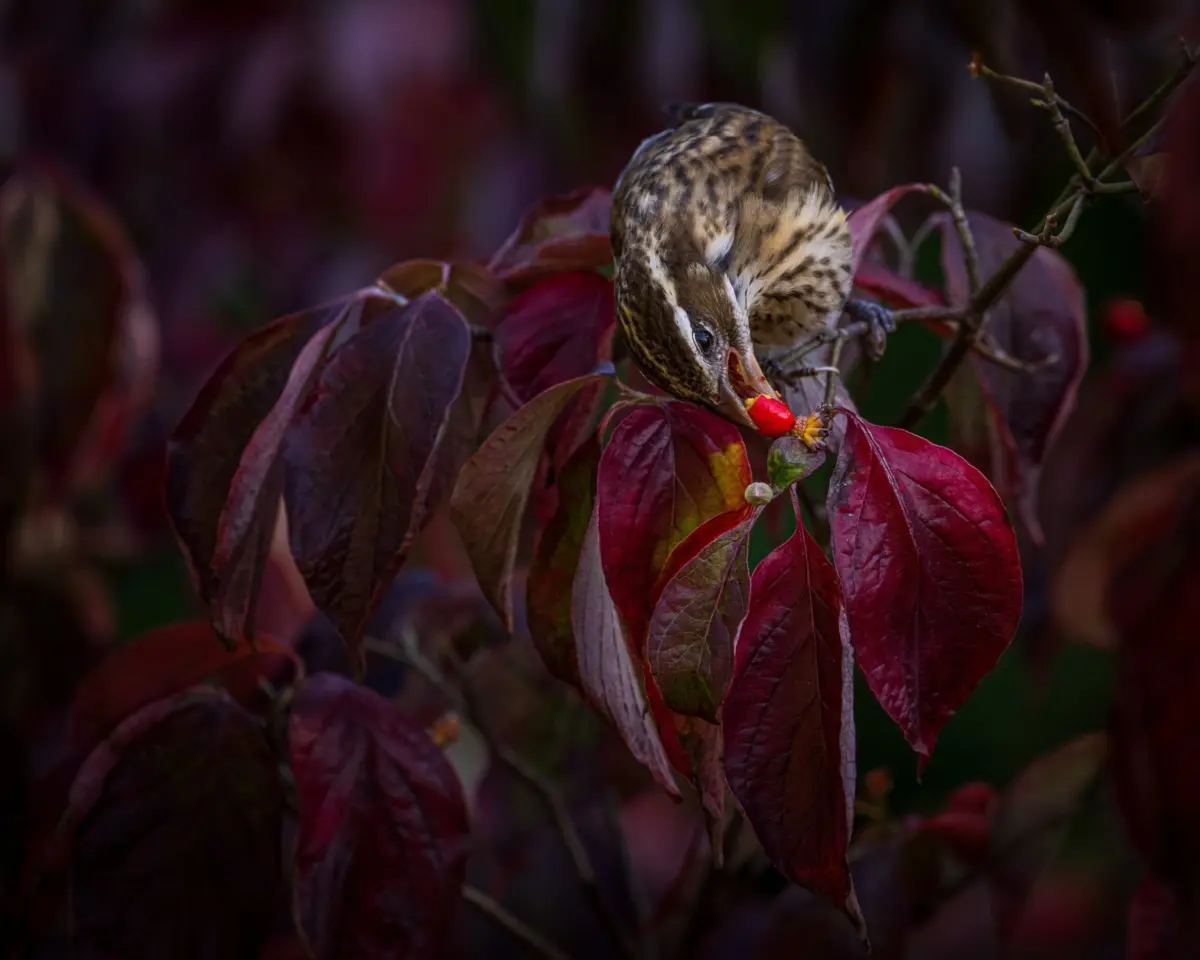
During this grueling journey, thrushes, catbirds, warblers, and tanagers rely heavily on the lipid-rich berries and drupes produced by native shrubs and understory trees. Species such as American beautyberry (Callicarpa americana) and northern spicebush (Lindera benzoin) provide the high-energy fuel migrants need to sustain multi-hundred-mile flights. Without these specific food sources, migration mortality rates skyrocket.
A Biodiversity Hotspot
North Carolina’s geography is remarkably diverse, ranging from the high-elevation spruce-fir forests of the Blue Ridge Mountains to the vast bottomland hardwoods of the Coastal Plain. This varied topography has blessed the state with more than 3,900 native plant species.
Among these are botanical royalty that define the state’s natural heritage:
- The Flowering Dogwood (Cornus florida): Designated as the state flower, its spring blossoms feed early pollinators, while its red autumn berries provide essential fats for resident and migrating birds.
- The Longleaf Pine (Pinus palustris): Once covering millions of acres across the Southeast, this keystone state tree supports an entire ecosystem of rare and endangered species, including the Red-cockaded Woodpecker.
Official Statements and Strategic Guidance: Caring for Our Urban Trees and Birds
As the state celebrates Native Plants Week, conservation leaders are emphasizing that how and where we plant matters just as much as what we plant. Urban and suburban environments present unique challenges, including compacted soils, limited root space, and altered hydrology.
Recognizing the need for practical, actionable advice, Audubon North Carolina has developed an exhaustive Tree Care Guide (Caring for Our Urban Trees and Birds). This resource is designed to help property owners navigate the complexities of planting and maintaining urban canopies to maximize ecological benefits.
"Native plants are the foundation of healthy ecosystems. When we plant native trees and shrubs, we are essentially rolling out the welcome mat for birds and pollinators that have adapted alongside them for millennia," notes the conservation team at Audubon North Carolina. "As momentum builds across our state, every homeowner has the power to turn their yard into a sanctuary."
Experts highlight several key principles outlined in the guide for maximizing planting success during the October window:
- Prioritize Diversity: Avoid monocultures. Planting a mix of canopy trees, understory shrubs, and flowering perennials creates structural layers that mimic natural forest edges, providing nesting sites, shelter from predators, and varied foraging zones.
- Timing is Everything: Fall planting takes advantage of warm soil temperatures and cooler air temperatures, allowing root systems to establish deep, robust networks before the stress of summer heat arrives.
- Mind the Sourcing: Ensure that plants purchased from nurseries are truly native genotypes and have not been treated with systemic insecticides (such as neonicotinoids) that can inadvertently poison the very pollinators and birds the plants are meant to support.
Future Outlook: The Road Ahead for North Carolina’s Ecosystems
Looking forward, the success of North Carolina Native Plants Week will be measured not just by the number of saplings planted during this single October week, but by a permanent cultural shift in how North Carolinians view their relationship with the land.
As climate change accelerates, increasing the frequency of severe weather events, droughts, and pest outbreaks, the resilience of our natural and built environments will depend heavily on native biodiversity. Native plants, with their deep, complex root systems, are uniquely equipped to stabilize soils, absorb stormwater runoff during intense hurricanes, and withstand regional droughts far better than exotic turfgrasses and shallow-rooted ornamentals.
Furthermore, state-wide momentum is translating into expanded urban forestry programs, community-led habitat restoration projects, and increased funding for conservation easements. Educational outreach initiatives are reaching younger generations through school gardens and community science programs, ensuring that the next generation of North Carolinians understands the intrinsic value of local flora.
Ultimately, North Carolina Native Plants Week is an invitation to participate in a restorative relationship with nature. Whether planting a single spicebush in a suburban backyard in Garner or restoring an acre of longleaf pine in the Sandhills, every action counts. As the birds return each spring and fall, depending on the choices we make today, the message from the natural world is clear: plant native, and the ecosystem will thrive.
About Audubon North Carolina
Audubon North Carolina, a state program of the National Audubon Society, protects birds and the places they need, today and tomorrow. Operating with regional offices in Durham, Boone, Corolla, and Wilmington, the organization works tirelessly across the state to advocate for sound environmental policies, educate communities, and implement on-the-ground conservation science.
To learn more about North Carolina Native Plants Week, access the tree care guide, or get involved with local conservation efforts, visit nc.audubon.org and follow their updates on social media platforms including Twitter, Facebook, and Instagram. To learn more about the broader mission of the National Audubon Society, established in 1905 as a nonprofit conservation leader throughout the Americas, visit www.audubon.org or follow @audubonsociety.