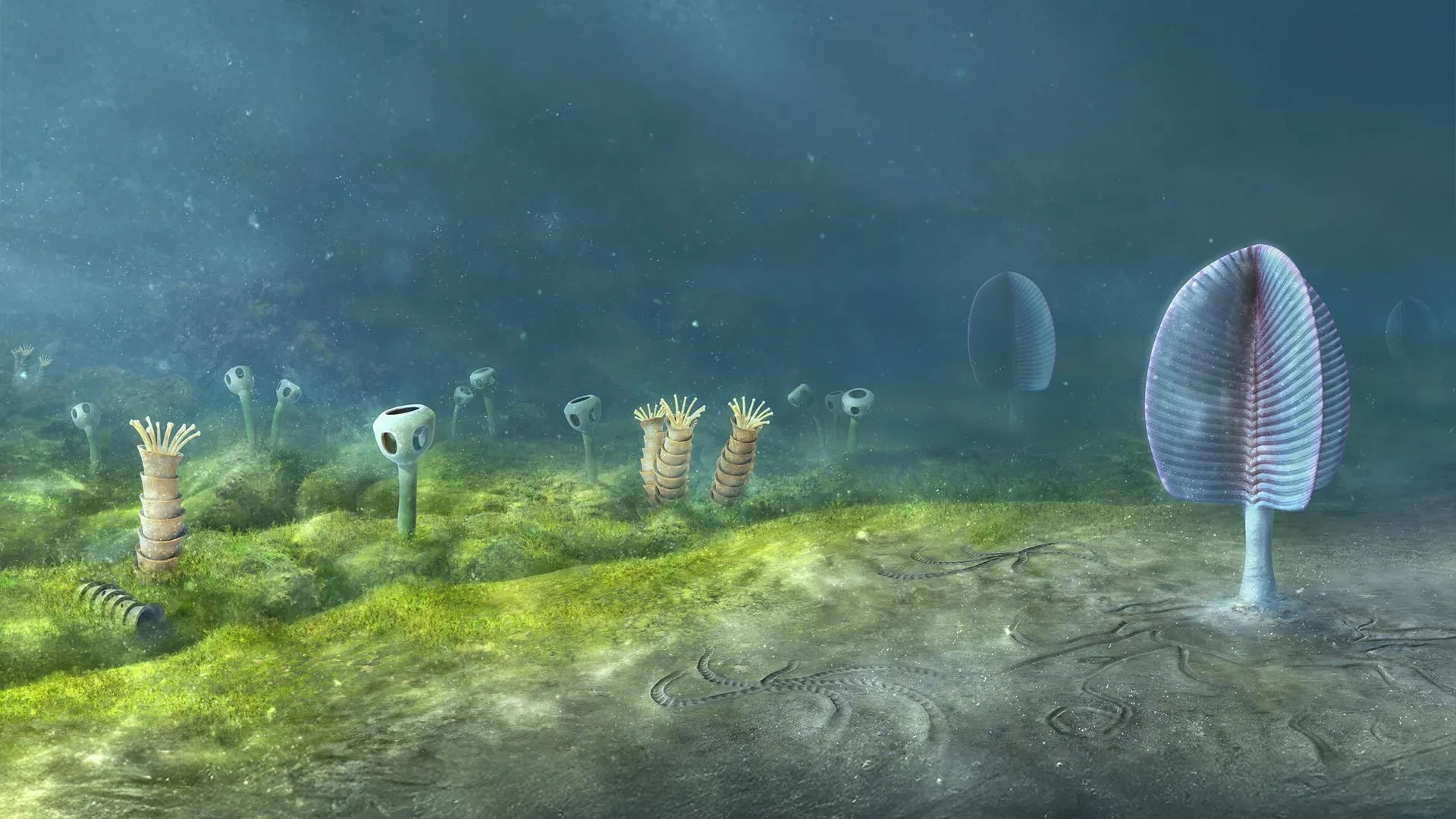

Executive Overview
For generations, evolutionary biologists and paleontologists have relied on a foundational rule of thumb: if an exceptionally well-preserved fossil deposit lacks any trace of animal life, it is because animals simply did not exist yet. This logical pillar has long served as a crucial anchor for dating the emergence of the metazoan kingdom, defining the outer boundaries of when multi-cellular animal life could have first gained a foothold on Earth.
However, a groundbreaking international study published on October 2 in Science Advances has dismantled this long-standing assumption, setting off shockwaves across the geosciences. Led by researchers at the University of Oxford—in collaboration with institutions such as the University of California, Berkeley, ETH Zürich, and Yale University—the new research demonstrates that animals may have evolved up to 200 million years earlier than their earliest clear appearance in the traditional fossil record.
By examining exquisitely preserved microfossils from the Kheseen Biota in Mongolia, researchers proved that even when optimal conditions for fossilization are present, early animal life can remain entirely absent from the rock record despite definitively existing elsewhere on the globe at the same time. This revelation shatters the primary argument used to cap the maximum age of animal origins at roughly 590 million years.
When researchers integrated this realization into updated molecular-clock models using much older geological constraints—dating from 850 to 730 million years ago—the timeline for the genesis of the animal kingdom was pushed significantly further back. The mathematical models now place the possible emergence of Earth’s first animals deep within the Neoproterozoic Era, between 800 and 700 million years ago. This radical recalibration suggests that animal life may have predated, or perhaps even survived, some of the most severe planetary glaciation events in Earth’s history, rewriting the prologue of evolutionary biology.
Detailed Chronology: From the Cambrian Explosion to the Neoproterozoic Dawn
To understand the magnitude of the Oxford-led study, one must view it against the backdrop of Earth’s deep-time history, a chronology that has puzzled scientists since the days of Charles Darwin.
The Apparent Suddenness of the Cambrian
For centuries, the earliest chapters of animal life presented an evolutionary paradox. Just prior to the Cambrian Period—spanning roughly from 539 to 487 million years ago—complex, macroscopic animals appear in the fossil record with astonishing abruptness. This geological event, frequently dubbed the "Cambrian Explosion," showcased a sudden diversification of trilobites, brachiopods, mollusks, and arthropods.
Yet, even as Darwin himself lamented, the sudden appearance of fully formed complex organisms without an obvious trail of gradual ancestors seemed to defy the slow, steady pace of natural selection. Over the decades, paleontology gathered alternative lines of evidence—including trace fossils, molecular clocks, and chemical biomarkers—strongly hinting that the evolutionary roots of the animal kingdom stretched far back into the Precambrian. However, establishing an airtight timeline remained elusive because of a major hurdle: the scarcity of soft-bodied fossil preservation in ancient strata.
The Weng’an Biota Paradigm
To navigate this dark stretch of Earth’s history, scientists turned to "Konservat-Lagerstätten"—rare fossil deposits capable of preserving delicate, microscopic organisms in three dimensions. Among the most famous is the Weng’an Biota in South China, a roughly 590-million-year-old assemblage of Ediacaran-age rocks.
The Weng’an Biota is renowned for its astonishing fidelity. It preserves microscopic life forms, cell clusters, and embryo-like structures down to the cellular level. Because such an exceptionally pristine window into ancient ecosystems contained zero definitive animal remains, scientists established a crucial premise: if animals had already evolved by 590 million years ago, the biological richness and preservation quality of Weng’an should have captured them. Therefore, researchers reasoned, Weng’an provided a reliable maximum age limit, effectively proving that the animal kingdom had not yet come into existence when those rocks were laid down.
The Kheseen Biota Destroys the Rule
The new study breaks this methodological paradigm wide open. The international research team undertook an exhaustive investigation of microfossils from the Kheseen Biota in Mongolia, a geological formation roughly 40 million years younger than Weng’an (dating to the Ediacaran Period, but post-dating Weng’an).
Using advanced scanning electron microscopy on more than 140 samples—including material gathered from previously uncataloged field locations—the team uncovered a stunning array of microfossils. These included acritarchs (enigmatic, tiny spherical organisms adorned with intricate spines and branching projections) and complex, embryo-like structures containing preserved internal cell divisions.
Despite the breathtaking preservation of the Kheseen microfossils—rivaling the microstructural fidelity of Weng’an—not a single specimen could be confidently identified as an animal.
This finding is the linchpin of the entire investigation. At the time the Kheseen Biota formed, scientists already have definitive, ironclad evidence from other global localities (such as Namibia and South China) that animals were actively swimming, crawling, or burrowing in Earth’s oceans. Yet, they left no trace in Kheseen. This proves that an absence of animal fossils in a given deposit does not mean animals were absent from the planet. They may have inhabited different ecological niches outside the depositional environment, or local chemical conditions may have systematically inhibited the fossilization of delicate animal tissues.
Supporting Context & Metrics
The dismantling of the Weng’an assumption forced the research team to re-evaluate the entire structural framework used to date the origins of animal life.
Recalibrating the Molecular Clock
With the Weng’an deposit disqualified as a hard maximum age limit for animal origins, the researchers pushed their baseline back to much older, pre-Ediacaran formations dating between 850 and 730 million years ago. Key sites evaluated in this broader sweep included:
- The Svanbergfjellet Formation (Norway)
- The Bitter Springs Group (Australia)
- The Chuar Group (Arizona, United States)
These ancient sedimentary deposits are rich in microfossils and possess the geological capacity to preserve delicate biological materials, though no confirmed animal fossils have yet been recovered from them. Historically, scientists avoided using these older formations for strict evolutionary calibration because doing so yielded molecular-clock dates that seemed implausibly ancient.
By feeding these older geological constraints into sophisticated molecular-clock analyses—a computational technique that correlates genetic mutation rates among living descendants with fossil-dated split times—the researchers achieved a dramatic shift. The mathematical models pushed the estimated origin of the animal kingdom backward by approximately 200 million years, squarely locating the birth of the metazoan lineage between 800 and 700 million years ago.
Biomarkers and the Soft-Bodied Reality
This 200-million-year pushback aligns remarkably well with converging lines of geochemical evidence. For years, organic geochemists have studied ancient hydrocarbon biomarkers—molecular fossils trapped within ancient rocks—that point to the presence of sponge-like organisms living at least 650 million years ago, tens of millions of years prior to the appearance of the earliest macroscopic animal body fossils.
The challenge of finding these organisms lies in their anatomy. The earliest animals were microscopic, soft-bodied creatures devoid of mineralized shells, hard carapaces, or dense skeletal structures. Without hard parts to resist decay, these organisms decayed rapidly after death. Their preservation required a vanishingly rare combination of rapid burial, fine-grained sediment chemistry, and early mineral authigenesis (such as phosphatization or silicification) to capture their forms before they vanished.
The "Snowball Earth" Connection
Pushing the genesis of animals back to the 800–700 million-year window introduces a profound environmental implication: Did animals evolve before, or even during, "Snowball Earth"?
Around 720 million years ago, Earth entered the Cryogenian Period, an epoch characterized by some of the most catastrophic global glaciation events in planetary history. During these episodes, massive ice sheets advanced from the poles toward the equator, locking the planet in a glacial grip for tens of millions of years.
If the Oxford study’s molecular clock models are correct, animal life did not merely survive these planetary deep freezes; it may have originated on the precipice of them, or found ways to endure the extreme ecological pressures of a globally iced-over world. This reopens intense scientific debate regarding whether the extreme environmental stress of Snowball Earth acted as an evolutionary catalyst—driving the adaptations that eventually gave rise to complex multi-cellularity.
Official Statements and Expert Perspectives
The study’s authors emphasize that while the research does not provide a direct body fossil of an 800-million-year-old animal, it effectively removes the primary road-block that has prevented science from accepting an earlier evolutionary timeline.
Associate Professor Ross Anderson, Senior Author of the study from the Oxford University Museum of Natural History, explained the significance of the Mongolian discoveries:
"The Kheseen Biota breaks the argument that the exceptional microfossils of Weng’an mean we would have seen animal fossils in the assemblage had they existed at the time. The Kheseen microfossils are just as well-preserved, yet animals continue to be absent—despite the fact we know at that point they existed."
Addressing the wider implications for fossil taphonomy, Professor Anderson noted that absence of evidence cannot be treated as evidence of absence:
"This suggests animals may have occupied environments different from those represented in the Kheseen deposits, or that the chemical conditions responsible for fossilization there were not suitable for preserving animal remains… Until that evidence becomes available, the precise birth date of the animal kingdom remains uncertain."
Orin Lole Durbin, first author of the study (who conducted the research as an undergraduate at Oxford and is now a PhD student at Virginia Tech), reflected on the cautious yet paradigm-shifting nature of the findings:
"Pre-Ediacaran animal body fossils still elude us, and this analysis does not prove that animals existed 800 million years ago. However, our new fossil evidence from Mongolia undermines one of the main arguments for restricting animal origins to the Ediacaran interval. Meanwhile, our molecular-clock analyses show how much further back their evolutionary history could extend."
Future Outlook: The Hunt for the First Animals
As paleontology digests the implications of the Science Advances publication, the scientific community is charting a new course for the search for Earth’s earliest animals. Researchers agree that the traditional playbook—relying on a handful of celebrated, exceptionally preserved Lagerstätten to draw absolute lines in the sand—is no longer sufficient.
Multi-Pronged Exploratory Strategies
Future investigations will need to expand across several distinct fronts:
- Geographical and Environmental Diversification: Paleontologists must systematically comb pre-Ediacaran and early Neoproterozoic deposits across a much wider array of depositional environments—ranging from deep-water basins to shallow coastal shelves—to account for the possibility that early animals inhabited localized ecological niches unrepresented in classic fossil sites.
- Integrated Multidisciplinary Analysis: The search for early animal life can no longer rely on body fossils alone. Future breakthroughs will demand the synthesis of multiple independent methodologies:
- Macroscopic and microscopic body fossil searches utilizing high-resolution computed tomography (CT) and scanning electron microscopy.
- Trace fossil analysis targeting microscopic burrows, bioturbation marks, or movement trails left by soft-bodied precursors.
- Chemostratigraphy and biomarker tracking, pushing the boundaries of organic chemistry to identify lipid remnants and structural hydrocarbons unique to metazoans.
- Refinement of Molecular Clocks: As genetic datasets of extant basal animals (such as sponges, ctenophores, and placozoans) grow more comprehensive, and as calibration points from newly verified geological horizons are integrated, molecular-clock models will yield tighter, more testable confidence intervals for the tree of life.
The quest to find the exact birth date of the animal kingdom remains one of the greatest detective stories in science. By proving that the absence of fossils in ancient rocks is a deceptive silence rather than a definitive historical record, this new Oxford-led research has torn down an old barrier—opening a sprawling, 200-million-year window into a hidden chapter of evolutionary history waiting to be discovered.