
Executive Overview
Deep within the hyper-arid expanses of Peru’s Pacific coast, an extraordinary archaeological discovery has rewritten our understanding of human-animal relationships in pre-Columbian South America. Researchers working at Castillo de Huarmey—a sprawling 110-acre administrative and ceremonial hub of the ancient Wari Empire—have unearthed the first definitive physical evidence of Peruvian hairless dogs dating back more than 1,200 years.
Long before the rise of the majestic Inca Empire, the Wari civilization shared its spaces, rituals, and even tables with these slender, distinctive canines. Published in the Journal of Anthropological Archaeology, a comprehensive study led by Dartmouth College researcher Weronika Tomczyk details the recovery of naturally mummified remains, rare skeletal formations, and chemical signatures locked inside bones and teeth. These findings paint a vivid portrait of how ancient societies interacted with animals—revealing a spectrum of treatment that ranged from sacred burial alongside elite craftspeople to the casual discard of waste.
By analyzing genetic markers, missing dental structures, and isotopic diets, the international research team has unlocked a rare window into the daily lives of animals that continue to serve as a profound national symbol of modern Peru.
Detailed Chronology
To fully grasp the significance of the Castillo de Huarmey dog mummies, researchers must frame these findings within the broader, complex timeline of the site and the Wari Empire. The history of this ancient location stretches across centuries of imperial expansion, natural disasters, and modern archaeological breakthroughs.
The Wari Era (600–1050 CE)
Occupied roughly four centuries before the Inca Empire consolidated power across the Andes, Castillo de Huarmey functioned as a vital administrative, religious, and burial center for the Wari Empire. Located approximately 190 miles north of modern-day Lima, the complex stood as a powerful manifestation of imperial control along Peru’s northern coast. During this window, humans, domesticated camelids (such as llamas and alpacas), and distinctive hairless dogs coexisted within the sprawling compound, leaving behind layers of refuse, ceremonial offerings, and architectural expansions.
The 1970 Cataclysm and Subsequent Looting
For centuries, the deepest archaeological layers of Castillo de Huarmey remained securely sealed beneath desert sands. However, in 1970, a powerful earthquake struck the region, causing structural collapses that exposed interior burial chambers packed with valuable ceramics and textiles. This tragedy triggered a wave of extensive looting. Unauthorized diggers heavily disturbed the upper archaeological strata, thoroughly mixing animal remains, pottery shards, and structural debris. Fortunately, the deeper, primary Wari contexts remained intact, preserving the pristine historical layers that modern archaeologists now meticulously explore.
Modern Excavation Milestones (2010–2025)
Decades after the earthquake, systematic scientific excavations began to unravel the complex history of Castillo de Huarmey. The site quickly yielded world-class archaeological treasures:
- 2012: Researchers uncovered the first completely undisturbed elite Wari tomb. This remarkable find contained the remains of 58 high-status women, six human sacrifices, and approximately 1,300 luxury artifacts crafted from gold, silver, and precious stones.
- 2022: Archaeologists identified nearby burial sites belonging to elite craftspeople. These individuals were interred alongside specialized bronze, silver, and gold tools of their trade, offering unprecedented insight into Wari industry and social stratification.
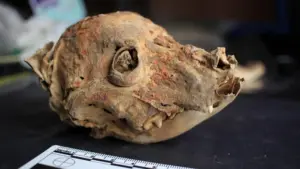
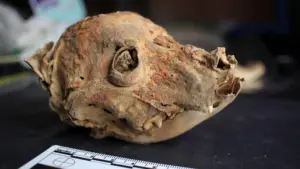
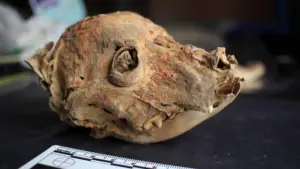
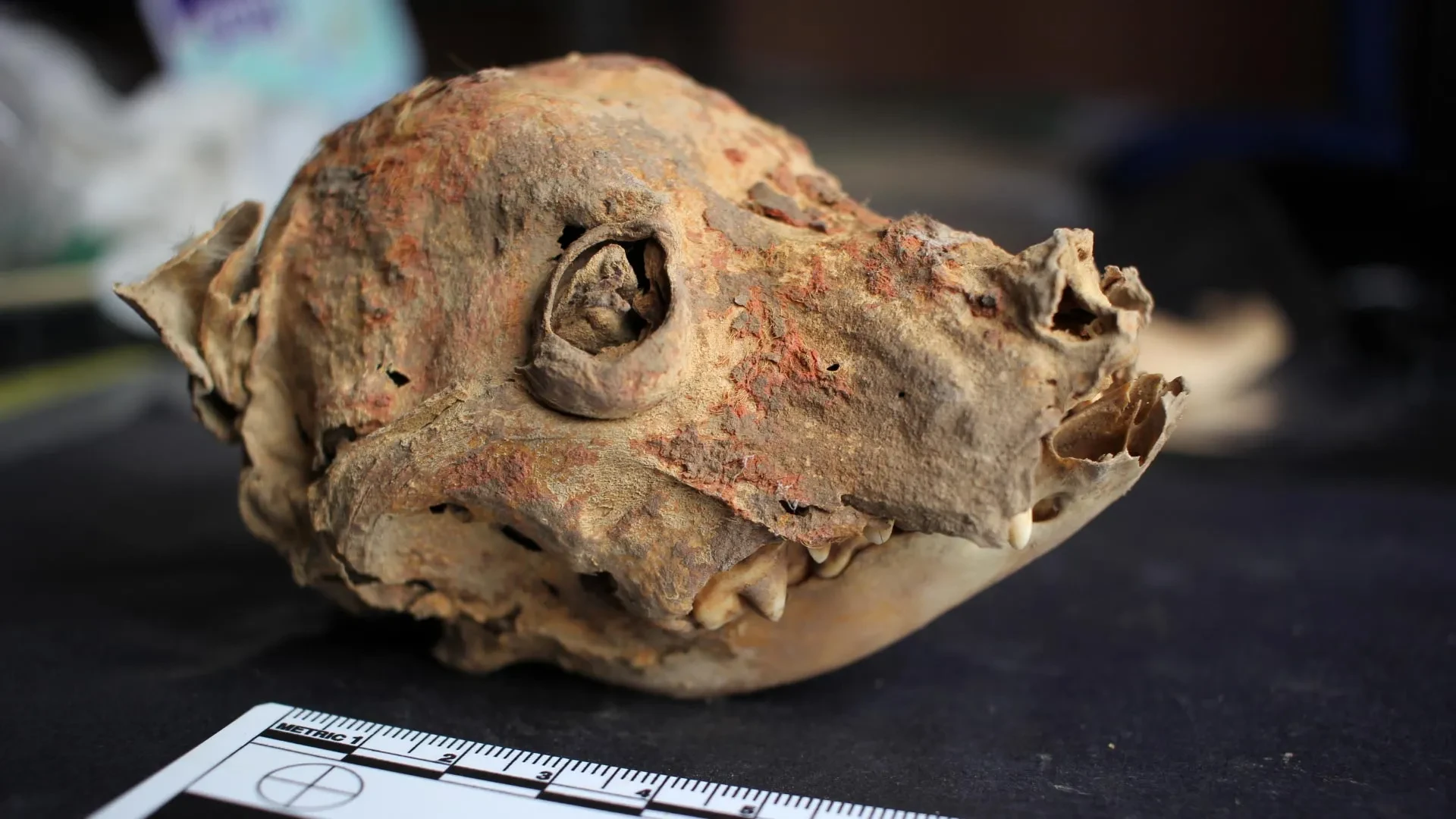
- 2010–2025: Continuous excavations across the northern sections of the main ceremonial area and palace structures brought to light 341 dog bone specimens representing at least 19 individual canines. This collection culminated in the recovery of a fully intact, naturally mummified male dog—the oldest radiocarbon-dated specimen of its kind recovered from the complex to date.
Supporting Context & Metrics: Unlocking the Biological Clues
The identification of the Castillo de Huarmey canines as Peruvian hairless dogs—ancestors of the modern breed recognized by the American Kennel Club as the Peruvian Inca Orchid—relied on a combination of osteological analysis, genetic deduction, and advanced biochemistry.
The Dental Marker of Hairlessness
When the research team first encountered the preserved dog remains, distinguishing their true identity presented a challenge. The upper layers of the site were heavily disturbed, leading initial observers to question whether the mummified remains might be of a much more recent vintage, perhaps left behind by modern looters or farmers decades prior.
The breakthrough came when lead researcher Weronika Tomczyk identified an unmistakable biological anomaly: the dogs were missing their first premolars and, in some cases, their last molars. Crucially, these teeth had never erupted during the animals’ lifespans; they were not lost due to trauma, disease, or old age.
Consulting veterinary and evolutionary literature, Tomczyk connected the missing teeth directly to the genetic mechanism of hairlessness. In dogs, the exact same genetic pathways responsible for the absence of fur also stunt dental development, resulting in congenital oligodontia (reduced tooth count). This genetic link confirmed that the remains belonged specifically to Peruvian hairless dogs rather than generalized ancient curs.
Isotopic Analysis: Reconstructing Ancient Diets
To understand how these animals lived, the research team employed zooarchaeological techniques alongside isotopic analysis. By measuring the chemical signatures of carbon, nitrogen, oxygen, and strontium preserved in the dogs’ bones and teeth, scientists gained a molecular diary of the animals’ lives.
- Strontium Isotopes: Varying according to local geology, strontium helped researchers trace the geographic origins and movement patterns of the canines.
- Carbon and Nitrogen Isotopes: These elements revealed dietary preferences. Because tooth enamel forms rapidly during puppyhood, teeth capture the early nutritional intake of the animal. Bone collagen, by contrast, records the diet of roughly the final year of life.
The chemical data revealed that the Castillo de Huarmey dogs consumed significant amounts of maize (corn), mirroring the staple diet of the human population. Interestingly, the hairless puppies displayed isotopic signatures closely resembling those of human children, suggesting they may have been fed directly from household supplies or specially provisioned. As the animals matured, their diets diversified, pointing to a shift in how they foraged or were managed within the settlement.
Burial Contexts and Metrics at a Glance
- Total Bone Specimens: 341 individual bone fragments recovered.
- Minimum Individual Count: At least 19 distinct dogs identified across the complex.
- Age Distribution: Ranging from neonates (such as a 6- to 8-week-old puppy) to fully mature adults.
- The Mummified Male: An exceptionally preserved adult male, naturally mummified by the hyper-arid desert climate, retaining visible hairless skin, attached ears, and traces of red cinnabar pigment.
- Elite Associations: A puppy buried directly alongside an elite craftsperson known as the "Master Basketmaker"; an adult dog interred within the palace; and a puppy skeleton discovered with a ritually sacrificed male tomb guardian.
Official Statements and Expert Perspectives
The complexity of human-animal bonds in the ancient Andes is a central theme of the research, emphasizing that past civilizations held multifaceted, sometimes contradictory views toward the creatures living alongside them.
"Our findings indicate that humans and dogs coexisted at this Wari site, but reconstructing their bond is challenging, as past emotions are difficult to capture through archaeological methods," explains Weronika Tomczyk, first author of the study, a research associate in Dartmouth’s Department of Anthropology, and a postdoctoral fellow in its Ecology, Evolution, Environment and Society Program.
Tomczyk highlights the dual nature of how societies view animals—a dynamic that transcends millennia.
"The goal of our study was to not only present data on Castillo de Huarmey’s dog burials, but also emphasize that people in the past had often contradictory relationships with the animals, just as they do today: a pet for one group of people could at the same time be considered a pest by their closest neighbors."
Discussing the genetic and dental indicators that unlocked the identity of the mummies, Tomczyk notes:
"What I noticed is that some of the dog skeletons were missing teeth, and not that they lost them during their lifespan; some teeth, especially first premolars and sometimes last molars, had just never erupted. And then I found in the literature that the same gene which is responsible for hairlessness in dogs is responsible for a reduced number of teeth, indicating that these were Peruvian hairless dogs."
Regarding the dietary patterns uncovered by isotopic testing, Tomczyk adds:
"We do not know if the dogs were intentionally fed maize or if perhaps, they were just eating leftovers or trash. Yet, the distinct dietary patterns of hairless puppies provide insights into what may have been organized breeding."
Concluding on the ambiguous yet privileged status of the animals within the Wari hierarchy, Tomczyk observes:
"While we will never know if any of the three dogs were pets or how people treated them, it is evident they received different treatment than other dogs."
The collaborative study represents an international effort, featuring co-authors Miłosz Giersz, Wiesław Więckowski, and Roberto Pimentel Nita from the University of Warsaw, alongside Claire Ebert of the University of Pittsburgh.
Future Outlook
The discovery of 1,200-year-old Peruvian hairless dog mummies at Castillo de Huarmey opens exciting new avenues for Andean zooarchaeology and evolutionary biology. As researchers continue to analyze the vast array of organic materials preserved in the Peruvian coastal desert, several key areas will shape the trajectory of future investigations:
- Ancient DNA (aDNA) Sequencing: While osteological and isotopic markers strongly point to the lineage of Peruvian hairless dogs, future extraction and sequencing of mitochondrial and nuclear DNA could map the precise genetic evolution of the breed across pre-Hispanic cultures, tracking how selective breeding was managed by the Wari and later civilizations.
- Broader Regional Comparisons: Archaeologists plan to compare the Castillo de Huarmey dog remains with findings from other Wari administrative centers and contemporary coastal cultures. This will determine whether specialized breeding and elite funerary placement of hairless dogs were widespread imperial practices or localized phenomena unique to Huarmey.
- Refined Chronological Modeling: With the successfully radiocarbon-dated mummified male standing as the oldest securely dated canine specimen at the site, researchers have a new temporal anchor. This benchmark will help calibrate stratigraphic sequences across the entire 110-acre complex, offering sharper resolution on the rise, peak, and collapse of the Wari Empire.
- Conservation of Organic Artifacts: Given the vulnerability of mummified tissues and textiles in shifting climates, ongoing conservation protocols will be vital. Protecting these delicate remains ensures that future generations of scientists can apply emerging non-destructive imaging and biochemical technologies.
Ultimately, the barking echoes of the ancient Andes remind modern observers that our deep-rooted affection for—and complex entanglement with—our canine companions is not a modern invention. More than a millennium ago, beneath the sun-baked sands of coastal Peru, humans and hairless dogs were already writing a shared history etched in bone, teeth, and desert dust.