
Executive Overview
It often begins subtly. A glass of water becomes a constant companion throughout the day, favorite foods lose their familiar savor, or a persistent, glue-like stickiness settles into the mouth upon waking. For many, these initial discrepancies are easily dismissed as fleeting inconveniences or the natural toll of aging. However, when these symptoms persist, anxiety inevitably follows. Is this a benign quirk of biology, an adverse reaction to a pharmaceutical regimen, or an early warning sign of an underlying systemic condition?
For individuals seeking a trusted dentist in Applewood Mississauga, navigating these oral shifts requires professional insight. Saliva is far more than a simple fluid; it is a vital biological shield essential for speaking, chewing, swallowing, sleeping, and maintaining oral integrity. When the delicate balance of saliva production falters—whether through a drastic reduction causing dry mouth (xerostomia), a thickening of secretions, or unexpected overproduction—the daily quality of life is immediately compromised.
This comprehensive report explores the critical role that How General Dentists Help Patients Understand Changes In Saliva plays in modern healthcare. Far beyond merely treating surface-level symptoms, general dentists serve as primary investigative partners, helping patients decipher what their bodies are communicating. By bridging the gap between oral discomfort and systemic health, dental professionals provide actionable pathways to protect dental structures, alleviate discomfort, and uncover root causes that might otherwise go unnoticed.
Detailed Chronology: The Cascade of Salivary Disruption
To understand why dental professionals place such high importance on salivary changes, one must first trace the chronological progression of how these issues develop and impact the human body. Salivary dysfunction rarely happens overnight; rather, it follows a distinct pathway from initial biological shift to structural oral damage.
[Initial Trigger: Medication / Dehydration / Stress]
       ↓
[Phase 1: Subtly Altered Viscosity & Reduced Flow]
       ↓
[Phase 2: Loss of Buffering & Antimicrobial Protection]
       ↓
[Phase 3: Clinical Manifestations (Cavities, Sores, Dysphagia)]
       ↓
[Phase 4: Intervention & Management via General Dentistry]
Phase 1: The Initial Trigger and Functional Decline
The timeline typically begins with an external or internal catalyst. Common triggers include the initiation of a new medication (such as antihypertensives, antihistamines, or antidepressants), systemic dehydration, chronic mouth breathing, or localized stress affecting autonomic nervous system function. At this stage, patients notice mild dry mouth or a sticky oral mucosa.
Phase 2: The Breakdown of Oral Defense Mechanisms
As saliva production drops or changes in composition, the mouth loses its primary protective mechanisms. Saliva acts as a natural cleanser, washing away food debris and neutralizing harmful acids produced by plaque bacteria. Without this continuous bath, the oral environment grows acidic. Minerals begin to leach out of the tooth enamel faster than they can be replenished, setting the stage for rapid decay.
Phase 3: Clinical Manifestations and Escalating Symptoms
Without timely intervention, Phase 3 introduces pronounced clinical challenges. Patients frequently report chronic halitosis (bad breath), painful oral mucosal sores, burning sensations on the tongue (burning mouth syndrome), and extreme difficulty wearing removable dentures. Speech may become impaired due to friction, and swallowing dry foods turns into a chore.
Phase 4: Professional Intervention and Long-Term Management
This is where the expertise of a general dentist becomes indispensable. Recognizing the distinct patterns of salivary disruption, a dentist can intervene before irreversible damage—such as rampant cervical root caries or severe periodontal infection—takes hold. Through targeted therapies, lifestyle modifications, and interdisciplinary referrals, the clinical progression is halted and reversed.
Supporting Context & Metrics: The Anatomy of Salivary Function
Saliva is a complex, miraculous biological fluid produced primarily by the three major pairs of salivary glands (parotid, submandibular, and sublingual) alongside hundreds of minor glands scattered across the oral mucosa. A healthy adult typically produces between 0.5 to 1.5 liters of saliva daily.
The Multifaceted Role of Saliva
- Enzymatic Digestion: Saliva contains amylase, which initiates the breakdown of starches into simpler sugars even before food reaches the stomach.
- Lubrication and Protection: Mucins within saliva coat the soft tissues, protecting them from mechanical trauma during mastication and speech.
- Remineralization: Rich in calcium, phosphate, and fluoride ions, saliva actively repairs microscopic demineralization sites on tooth surfaces.
- Immunological Defense: Saliva houses secretory IgA, lysozymes, and lactoferrin, which actively combat pathogenic bacteria, fungi, and viruses.
Prevalence and Risk Factors
Epidemiological data from public health agencies indicates that xerostomia affects approximately 20% to 30% of the general population, with prevalence soaring past 40% among older adults due to polypharmacy (the simultaneous use of multiple medications). According to insights from the National Institute of Dental and Craniofacial Research (NIDCR), over 400 commonly prescribed and over-the-counter medications list dry mouth as a primary side effect.
Furthermore, systemic conditions such as Sjögren’s syndrome, diabetes mellitus, thyroid disorders, and autoimmune diseases frequently manifest first as unexplained salivary gland hypofunction. This underscores why a dental examination is often the first line of defense in detecting broader systemic health issues.
| Salivary Condition | Common Primary Symptoms | Primary Diagnostic Focus |
|---|---|---|
| Xerostomia (Dry Mouth) | Sticky feeling, cracked lips, difficulty swallowing, rampant decay | Medication review, hydration status, systemic screening |
| Sialorrhea (Hypersalivation) | Drooling, frequent swallowing, oral irritation | Neuromuscular assessment, gastrointestinal checks |
| Viscous/Thick Saliva | Foamy texture, coated tongue, altered taste perception | Sinus/respiratory evaluation, chronic dehydration |
| Glandular Swelling/Pain | Tenderness near the jaw or ear, foul taste upon expression | Obstruction (sialolithiasis), infection, autoimmune workup |
Official Statements and Authoritative Insights
Medical and dental authorities consistently emphasize that alterations in oral moisture should never be brushed off as a trivial annoyance.
"Saliva is the mirror of oral health. When its flow or composition is compromised, the entire ecosystem of the oral cavity is thrown into jeopardy. Dentists are uniquely positioned to spot these microscopic vulnerabilities long before the patient feels actual pain."
— Clinical Advisory Excerpt, National Institute of Dental and Craniofacial Research (NIDCR)
Healthcare professionals point out that patients often fall into a dangerous self-management trap. For instance, individuals suffering from persistent dry mouth frequently resort to sucking on hard candies or sipping acidic fruit juices all day to stimulate moisture. While this temporarily relieves the sensation of dryness, it floods the already vulnerable, unbuffered teeth with a continuous stream of sugar and acid, exponentially accelerating the formation of cavities.
The National Institute on Aging (NIA) echoes these concerns, noting that older populations are particularly susceptible to age-related compounding factors. Changes in diet, reduced mobility making hydration more difficult, and an increased reliance on pharmaceuticals create a high-risk matrix for oral deterioration. Public health guidelines urge patients to bring comprehensive medication lists to every dental visit to ensure that iatrogenic (medication-induced) dry mouth is properly identified and managed in coordination with primary care physicians.
The Diagnostic Approach: What Happens During a Salivary Evaluation?
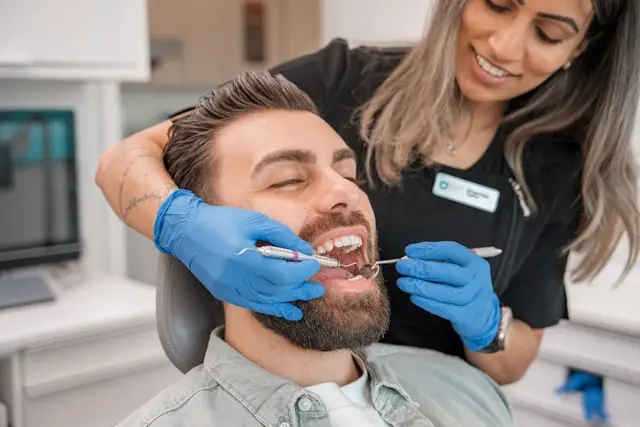
When a patient visits a general dental clinic reporting changes in their saliva, the consultation is structured, methodical, and deeply investigative. Dentists do not simply look for cavities; they evaluate the entire oral ecosystem.
1. Detailed Patient History and Pattern Recognition
The diagnostic dialogue typically begins with targeted inquiries:
- When did the sensation first manifest, and has it progressed gradually or suddenly?
- Is the dryness constant, or does it worsen at specific times, such as overnight or immediately following medication intake?
- Have you noticed any swelling around the jawline, changes in your sense of taste, or difficulty speaking for extended periods?
2. Clinical Examination of Mucosal Tissues
A general dentist will carefully inspect the soft tissues of the cheeks, tongue, and floor of the mouth. In a healthy mouth, the mucosa is moist and glistening. In a compromised environment, the tissues may appear red, dry, shiny, or sticky, and the tongue may show characteristic fissuring or depapillation. The dentist will also check for signs of opportunistic fungal infections, such as oral candidiasis (thrush), which thrives in low-saliva environments.
3. Assessing Caries Risk
Because the natural buffering capacity of saliva is diminished, teeth are inspected closely for atypical decay patterns, particularly along the gumline (cervical caries) and on the root surfaces exposed by gum recession. Early identification allows for preventive interventions rather than invasive restorative treatments.
Actionable Strategies: Managing Salivary Changes
Once the underlying cause of salivary disruption is understood, a customized management plan is developed. Depending on the diagnosis, this may involve a combination of professional treatments and targeted at-home practices.
Professional Interventions
- Prescription Sialagogues: Medications such as pilocarpine or cevimeline may be recommended by a physician in consultation with the dentist to stimulate salivary gland secretion in severe cases.
- Topical Fluoride Treatments: In-office high-concentration fluoride varnishes or prescription-strength home fluoride toothpastes are deployed to remineralize enamel and protect against rapid decay.
- Salivary Substitutes: Recommendations for over-the-counter artificial saliva sprays, gels, or rinses that mimic the lubricating properties of natural saliva.
Patient-Led At-Home Protocols
- Track Your Symptoms: Keep a daily log noting when dryness or thick saliva peaks, correlating it with meals, stress levels, or medication schedules.
- Optimize Hydration Safely: Sip water consistently throughout the day rather than gulping large amounts intermittently. Avoid sugary or acidic beverages that exploit low-saliva defenses.
- Upgrade Oral Hygiene Products: Switch to alcohol-free mouthwashes to prevent further mucosal irritation, and use non-abrasive, fluoride-rich toothpastes.
- Stimulate Safely: If saliva production needs a gentle boost, opt for sugar-free gum or xylitol-based lozenges rather than sugar-laden sweets.
Future Outlook: The Intersection of Saliva Diagnostics and Modern Dentistry
As dental science progresses, the role of saliva in healthcare is expanding far beyond simple lubrication and protection. The future outlook for salivary research points toward groundbreaking diagnostic capabilities, often referred to as "liquid biopsies."
Researchers are actively developing point-of-care salivary diagnostics capable of detecting systemic diseases—ranging from cardiovascular markers and diabetes indicators to various forms of cancer—through a simple, non-invasive oral rinse. Because saliva contains a rich profile of proteins, DNA, RNA, and metabolites, future general dental check-ups may routinely screen for systemic health conditions long before physical symptoms appear elsewhere in the body.
Furthermore, regenerative medicine is exploring stem-cell therapies and tissue engineering aimed at repairing damaged or irradiated salivary glands (a common side effect for head and neck cancer survivors). These advancements promise permanent relief for millions who suffer from chronic, intractable dry mouth.
Until these futuristic therapies become commonplace in everyday clinics, the foundational advice remains clear: do not ignore the subtle shifts in your mouth. Whether it is a fleeting dryness, a strange stickiness, or an unexplained excess of fluid, your saliva is sending a message. Partnering with a skilled general dentist ensures that those messages are interpreted accurately, protecting your smile, your systemic health, and your peace of mind.