On August 18, 2026, a prominent consumer advocacy group officially submitted a six-page administrative complaint to the U.S. Government Accountability Office (GAO), alleging severe programmatic mismanagement and selective enforcement of federal food safety statutes by the Food and Drug Administration’s Center for Veterinary Medicine (FDA CVM). Filed on behalf of American pet owners by Susan Thixton, founder of TruthaboutPetFood.com and the Association for Truth in Pet Food, the document charges the regulatory agency with misallocating congressional appropriations and failing to execute its core mandate to protect animal health and ensure transparent marketplace standards.
The complaint alleges that the FDA CVM operates an arbitrary enforcement apparatus—choosing which manufacturers to hold accountable, which ingredients to scrutinize, and which statutory mandates to disregard. Central to the filing is the assertion that the federal regulator actively permits deceptive labeling practices and knowingly sanctions the incorporation of diseased animal tissues and non-slaughtered carcasses into commercial pet food without consumer disclosure. By exercising uncodified "enforcement discretion," the agency effectively facilitates a taxpayer-subsidized, hidden waste disposal framework for agricultural byproducts, while presenting misleading "human-grade" marketing imagery to unsuspecting pet owners.
This regulatory petition seeks a comprehensive GAO investigation into the CVM’s operational priorities, spending allocations, and oversight mechanics, calling upon key congressional oversight committees to intervene and demand regulatory compliance under existing federal statutes.
Detailed Chronology
The administrative filing with the GAO represents the culmination of a multi-year effort by consumer advocates to expose structural flaws within the FDA CVM’s regulatory strategy. The operational history outlined in the filing details a timeline of administrative inaction, delayed public disclosures, and explicit policy deviations from written federal law.
+-----------------------------------------------------------------------------------+
| CHRONOLOGY OF REGULATORY EVENTS                                                   |
+-----------------------------------------------------------------------------------+
| April 2019           | FDA formalizes policy permitting diseased/non-slaughtered     |
|                      | animal materials in pet food via Citizen Petition response |
|                      | (FDA-2016-P-3578).                                         |
+----------------------+------------------------------------------------------------+
| Unspecified 6-Month  | FDA CVM receives 1,705 adverse event reports regarding     |
| Monitoring Period    | Purina Pet Foods, including 206 reported pet deaths.       |
+----------------------+------------------------------------------------------------+
| 7 Months Post-Report | FDA issues a delayed public advisory, acknowledging that   |
|                      | only 8% of received adverse event complaints were examined. |
+----------------------+------------------------------------------------------------+
| Subsequent Inspection| FDA executes a single "Preventive Controls Surveillance"    |
|                      | audit at 1 of 20+ Purina plants; reviews 24 complaints.   |
+----------------------+------------------------------------------------------------+
| August 18, 2026      | Formal complaint alleging programmatic mismanagement filed |
|                      | with the Government Accountability Office (GAO).           |
+-----------------------------------------------------------------------------------+
The 2019 Policy Precedent
The statutory rift between federal code and FDA practice was formally articulated in April 2019. In response to Citizen Petition FDA-2016-P-3578, the FDA stated in writing that it did not consider the use of diseased animals or animals that died otherwise than by slaughter to pose a safety concern in animal food, confirming its intent to exercise "enforcement discretion." This formal admission signaled an official policy shift away from strict adherence to the Federal Food, Drug, and Cosmetic Act (FD&C Act).
The Purina Adverse Event Handling
During a concentrated six-month monitoring window, federal databases logged 1,705 formal adverse event reports linked to Purina Pet Foods, a brand family produced across more than 20 domestic manufacturing facilities. These reports included 206 potential animal fatalities.
Despite the volume and severity of these claims, the agency refrained from issuing formal Warning Letters to the manufacturer. It was not until seven months after the data threshold was reached that the agency published a public alert. In that disclosure, the FDA acknowledged that it had investigated only 8% of the total adverse event reports received regarding the matter.
Inspection Limitations and Inaction
Following the delayed public alert, federal officials conducted an audit of a single Purina manufacturing location out of the company’s network of over two dozen operational plants. Rather than performing a comprehensive, targeted "for-cause" investigation, the agency conducted a standard "Preventive Controls Surveillance" inspection.
Regulatory logs reveal that during this singular plant visit, agency inspectors reviewed only 24 consumer complaints with plant management, nine of which were stale files dating back to 2007. No broader systemic enforcement actions or operational mandates were executed.
GAO Complaint Submission
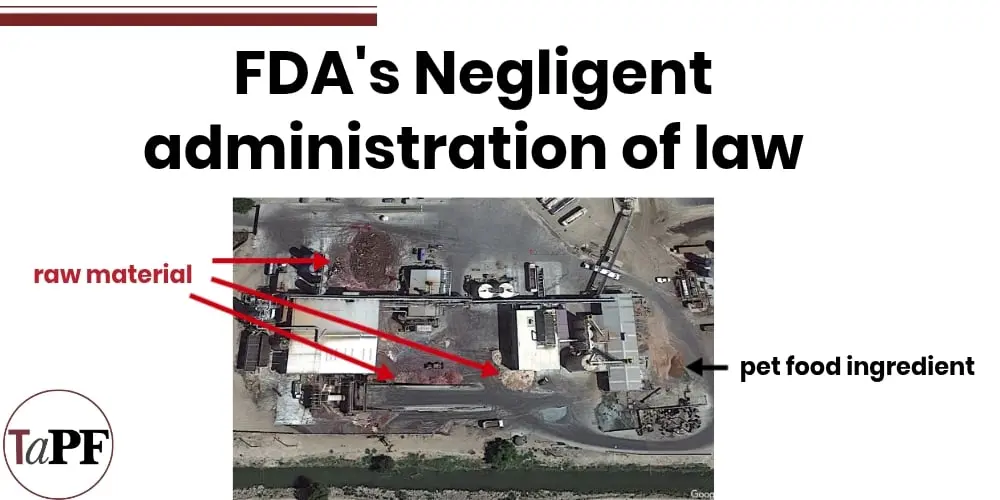
On August 18, 2026, advocate Susan Thixton filed the formal complaint with the GAO, combining statutory analysis, internal agency metrics, and photographic evidence from commercial rendering plants to substantiate allegations of mismanaged congressional appropriations.
Supporting Context & Metrics
To evaluate the operational deficiencies highlighted in the GAO petition, it is necessary to examine the metrics surrounding adverse event handling, inspection methodologies, and statutory conflicts regarding ingredient labeling.
Quantitative Oversight Breakdown
The filing illustrates a stark gap between consumer reports of harm and regulatory intervention. The table below highlights the operational metrics cited in the complaint regarding agency oversight during major safety inquiries:
Regulatory Variable
Recorded Metric
Operational Context
Adverse Event Reports Received
1,705 cases
Logged within a single 6-month window for a major manufacturer.
Reported Animal Fatalities
206 deaths
Included within the 1,705 total adverse event filings.
Investigation Rate
8% of total cases
Percentage of logged complaints actively evaluated by FDA staff.
Public Alert Delay
7 months
Lag time between signal detection and public communication.
Manufacturing Plant Audits
1 facility evaluated
Out of 20+ operational production sites nationwide.
Inspection Category
Surveillance
Conducted as routine "Preventive Controls," not "For-Cause."
Consumer Complaints Reviewed
24 total files
Discussed during plant audit (37.5% dated back to 2007).
ADVERSE EVENT INVESTIGATION GAP
[==================================================] 1,705 Adverse Event Reports
[====] 8% Actively Investigated by FDA CVM
Statutory Law vs. Administrative Practice
The core legal argument presented to the GAO rests on a direct conflict between written statutory law enacted by Congress and administrative practices adopted by the FDA CVM. Under Section 402(a)(5) of the Federal Food, Drug, and Cosmetic Act (21 U.S.C. 342(a)(5)), a food is deemed adulterated if it is, in whole or in part, the product of a diseased animal or an animal that has died otherwise than by slaughter.
       FEDERAL LAW (FD&C Act Sec. 402(a)(5))
       Prohibits diseased animal tissue or non-slaughtered
       carcasses in food.
                         |
                         v [CONFLATING REGULATORY DISCRETION]
                         |
       FDA CVM POLICY (April 2019 Enforcement Policy)
       Permits adulterated rendered ingredients in pet food
       without scientific safety verification.
                         |
                         v [MARKETPLACE EFFECT]
                         |
       CONSUMER DECEPTION
       Allowing identical common names ("Chicken") and
       wholesome marketing claims ("Real Meat") for
       condemned waste material.
The GAO complaint demonstrates that the FDA CVM explicitly nullifies this statutory mandate through administrative policy, without possessing scientific evidence confirming that non-slaughtered or diseased tissues are safe for long-term domestic animal consumption.
Marketplace Deception and Labeling Paradoxes
The structural failure described in the complaint extends directly to point-of-sale product labeling. Under current CVM guidelines, ingredients derived from USDA-inspected and passed human-grade livestock and those derived from condemned, diseased, or roadkill livestock are permitted to use identical common or usual names on product packaging.
Identical Naming Conventions: Condemned poultry tissues and healthy, slaughtered poultry are both listed simply as "Chicken" in the ingredient panel.
Deceptive Marketing Imagery: The CVM permits packaging to feature marketing claims such as "Made with Real Chicken" accompanied by graphics of wholesome, human-edible roasted or grilled meats, even when the underlying batch contains non-slaughtered or condemned material.
Economic Impact: Consumers pay premium prices for products under the assumption that they meet sanitary food standards, while receiving products containing unverified rendered industrial waste.
Official Statements
The allegations brought before the GAO highlight deep divisions between consumer safety representatives and federal regulators regarding administrative transparency, congressional funding utilization, and enforcement priorities.
The Advocate’s Position
Susan Thixton, speaking on behalf of the Association for Truth in Pet Food, articulated the core rationale behind targeting the agency’s funding mechanisms through the GAO:
"We bring this formal notice to the Government Accountability Office to evidence the FDA Center for Veterinary Medicine is engaged in programmatic mismanagement, misallocating its congressional funding. The agency has a regulatory history of selectively targeting some pet food manufacturers and targeting enforcement activities only with some federal laws, failing to consistently enforce all federal laws across all pet food manufacturers…
"Congressional funding allocated to FDA CVM is directly supporting a secret waste disposal system via pet food; a secret disposal system 100% facilitated by FDA CVM. In our battle against FDA CVM, we are right. No pet food should contain undisclosed diseased animal material or decomposing animal material. No consumer should be deceived by misleading marketing on pet food labels."
The Regulatory Agency’s Position
The FDA CVM has historically justified its regulatory framework through public policy statements and formal administrative responses, relying on the doctrine of prosecutorial discretion to manage industrial streams. In its April 2019 official response to Citizen Petition FDA-2016-P-3578, the agency stated:
"…we do not believe that the use of diseased animals or animals that died otherwise than by slaughter to make animal food poses a safety concern and we intend to continue to exercise enforcement discretion."
The agency maintains that its risk-based oversight system prioritizes acute biological and chemical hazards—such as Salmonella contamination or toxic chemical adulteration—over technical statutory non-compliance regarding raw material sourcing. However, critics counter that this approach lacks statutory authority and operates without peer-reviewed scientific studies establishing long-term feeding safety for rendered, non-slaughtered materials.
Future Outlook
The filing of the GAO complaint marks the beginning of a coordinated political and legal strategy aimed at forcing systemic reform within the FDA CVM. Because the GAO functions as the supreme audit institution of the federal government, a formal inquiry could trigger mandatory fiscal and operational reviews of how CVM spends its appropriated budget.
+-----------------------------------------------------------------------------------+
| POTENTIAL LEGISLATIVE & REGULATORY PATHWAYS                                       |
+-----------------------------------------------------------------------------------+
| STEP 1: GAO Assessment                                                            |
| Evaluation of complaint specifics regarding budget allocation & statutory adherence|
+-----------------------------------------------------------------------------------+
| STEP 2: Congressional Committee Engagement                                        |
| House Energy & Commerce and Senate HELP Committees review oversight requests.      |
+-----------------------------------------------------------------------------------+
| STEP 3: Formal GAO Audit Authorization                                            |
| Direct investigation into CVM inspection records, adverse event databases, & policy|
+-----------------------------------------------------------------------------------+
| STEP 4: Legislative Reform Mandates                                               |
| Binding statutory language requiring strict ingredient transparency & law enforcement|
+-----------------------------------------------------------------------------------+
The Role of Congressional Oversight
For a formal GAO investigation to proceed swiftly, members of Congress—specifically those sitting on key oversight committees—must back the call for an inquiry. The two primary bodies holding statutory jurisdiction over the FDA are:
House Committee on Energy and Commerce: Responsible for public health oversight, food and drug safety regulations, and consumer protection affairs.
Senate Committee on Health, Education, Labor and Pensions (HELP): Responsible for evaluating public health legislation and supervising federal administrative agencies under its purview.
Advocacy groups are mobilizing nationwide grassroots campaigns to encourage constituents to petition their congressional representatives. With political campaigns heightening focus on federal administrative oversight and consumer protection, advocates view this timeframe as a critical window to compel legislative action.
Strategic Objectives for Regulatory Reform
If the GAO initiates a formal investigation into the FDA CVM, regulatory experts anticipate that public pressure could force several structural changes:
Mandatory Labeling Transparency: Eliminating shared ingredient definitions between human-grade meats and rendered, non-slaughtered animal materials.
Termination of Unlawful Discretion: Compelling the FDA CVM to enforce Section 402(a)(5) of the FD&C Act uniformly, or explicitly seek statutory amendments from Congress rather than acting outside written law.
Budget Alignment: Binding CVM congressional appropriations directly to measurable enforcement milestones and public transparency metrics.
As public scrutiny over pet food safety increases, the outcome of this GAO complaint may reshape how federal agencies manage regulatory discretion, enforce statutory law, and protect the health of millions of domestic pets across the United States.