Executive Overview: Big Kibble’s Billion-Dollar Shift to ‘Fresh’
For decades, the multi-billion-dollar commercial pet food industry in the United States was dominated by ultra-processed dry kibble and canned wet foods. However, driven by pet humanization, premiumization trends, and shifting consumer expectations regarding canine health, direct-to-consumer (DTC) "fresh" pet food startups dramatically disrupted the market. In response, legacy pet food conglomerates—historically built on shelf-stable kibble production—have launched or acquired their own "fresh" dog food lines to defend market share.
An investigation into the marketplace reveals a stark reality beneath the sleek, refrigerated displays: of the major traditional manufacturers pivoting into fresh dog food, only one product line meets the legal standard for "human grade" feed safety. Furthermore, while these conglomerates aggressively expand their canine fresh food offerings, none of these traditional manufacturers have developed a corresponding fresh line for cats, leaving feline nutrition entirely in the legacy kibble and canned domains.
Worse still, this market shift is taking place in a regulatory vacuum. Neither the U.S. Food and Drug Administration (FDA) nor the Association of American Feed Control Officials (AAFCO) has legally defined what constitutes "fresh" pet food. Consequently, standard commercial practices allow pet food manufacturers to label cooked, raw, frozen, refrigerated, or highly processed products as "fresh" without meeting standardized quality benchmarks.
Compounded by inexplicable pricing disparities—where identical "feed-grade" formulations vary by more than 100% in daily feeding costs—industry observers are raising critical questions. Are legacy kibble manufacturers testing the limits of consumer price elasticity, or are they intentionally inflating fresh pet food costs to drive budget-conscious consumers back to high-margin dry kibble?
The Regulatory Vacuum: What Does ‘Fresh’ Actually Mean?
To understand the market dynamics of fresh pet food, consumers must first understand the complete absence of regulatory oversight regarding marketing terminology in pet nutrition.
+-----------------------------------------------------------------------+
|                       THE REGULATORY VACUUM                           |
+-----------------------------------------------------------------------+
|  Term: "FRESH"                                                        |
|  FDA/AAFCO Legal Definition: NONE                                     |
|  Allowed Formats Under "Fresh":                                       |
|    • Frozen Raw / Cooked Meat      • Shelf-Stable Extruded Pouches    |
|    • Refrigerated Chub / Rolls     • Highly Processed Feed-Grade      |
+-----------------------------------------------------------------------+
|  Term: "HUMAN GRADE"                                                  |
|  FDA/AAFCO Legal Definition: Strictly Regulated                       |
|  Requirements:                                                        |
|    • All ingredients suitable for human consumption                   |
|    • Manufactured in a USDA/FDA licensed human food processing plant  |
|    • Full traceability through human supply chain                     |
+-----------------------------------------------------------------------+
Under current FDA guidelines and AAFCO model regulations, there is no official legal standard for the term "fresh." In practical terms, a manufacturer can apply the term "fresh" to virtually any product format, including:
Deep-frozen raw or cooked meat purees.
Refrigerated cooked chubs or sausage-style rolls.
Vacuum-sealed, gently cooked pouches.
Shelf-stable wet formulations subjected to high-pressure processing (HPP) or heat pasteurization.
Feed Grade vs. Human Grade: The Critical Distinction
In the absence of a legal definition for "fresh," the primary technical metric governing pet food quality remains the legal distinction between Feed Grade and Human Grade:
Feed Grade: Standard commercial pet foods made under livestock feed guidelines. These products may contain rendered animal by-products, meats from non-slaughtered animals (4D meats: dead, dying, diseased, or disabled), and ingredients produced in facilities that do not adhere to human food hygiene standards.
Human Grade: Products where 100% of the ingredients are legally classified as suitable for human consumption, and the product is processed, packaged, and stored in a USDA-inspected, licensed human food manufacturing facility.
With a single exception, every traditional kibble manufacturer offering a "fresh" option is marketing feed-grade pet food packaged in refrigerated or soft-pouch packaging, giving consumers the visual illusion of fresh human food without the corresponding sourcing or safety standards.
Comprehensive Brand Analysis: Corporate Players in the Fresh Segment
To evaluate the current fresh pet food landscape, we examined the offerings of the primary traditional manufacturers that have entered the category, evaluating their legal claims regarding human-grade status, humane meat certification, organic ingredients, and daily feeding costs for a standard 30-pound adult dog.
+----------------------------------------------------------------------------------------------------+
|                               BRAND & PRICING COMPARISON OVERVIEW                                 |
+-------------------+-----------------+------------------+-----------------+-------------------------+
| Parent Company    | Brand           | Product Line     | Quality Grade   | Daily Cost (30lb Dog)   |
+-------------------+-----------------+------------------+-----------------+-------------------------+
| Mars Petcare      | NomNom          | Fresh Meals      | Feed Grade      | $8.40 - $11.50          |
| Mars Petcare      | Royal Canin     | Fresh Health     | Feed Grade      | $17.28                  |
| Mars Petcare      | Orijen          | Fresh Prey       | Human Grade     | $12.50                  |
| Wellness Pet Co.  | Wellness        | Protein Bowls    | Feed Grade      | $10.20 - $13.50          |
| General Mills     | Blue Buffalo    | Love Made Fresh  | Feed Grade      | $8.80 - $9.90           |
| Colgate-Palmolive | Hill's Science  | Fresh Roll       | Feed Grade      | $6.50                   |
| Independent       | Fromm           | Chickibowls      | Feed Grade      | $14.27                  |
+-------------------+-----------------+------------------+-----------------+-------------------------+
1. Mars Petcare: The Market Dominator
Mars Petcare—the world’s largest pet food manufacturer—has strategically acquired and launched fresh food lines across multiple price tiers and brand portfolios.
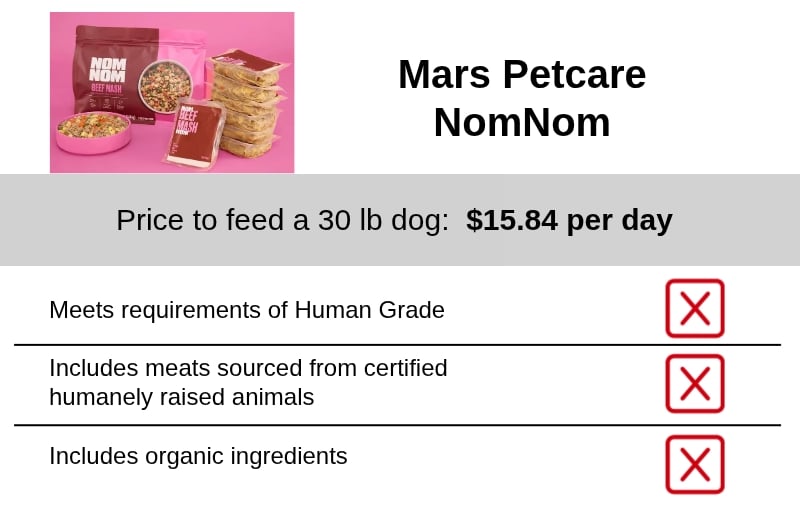
NomNom
Acquisition Year: Purchased by Mars Petcare in 2022.
Legal / Quality Claims: Makes no human-grade claims, contains no certified humanely raised meat certifications, and contains no certified organic ingredients.
Daily Cost (30 lb dog): Estimated at $8.40 – $11.50 per day.
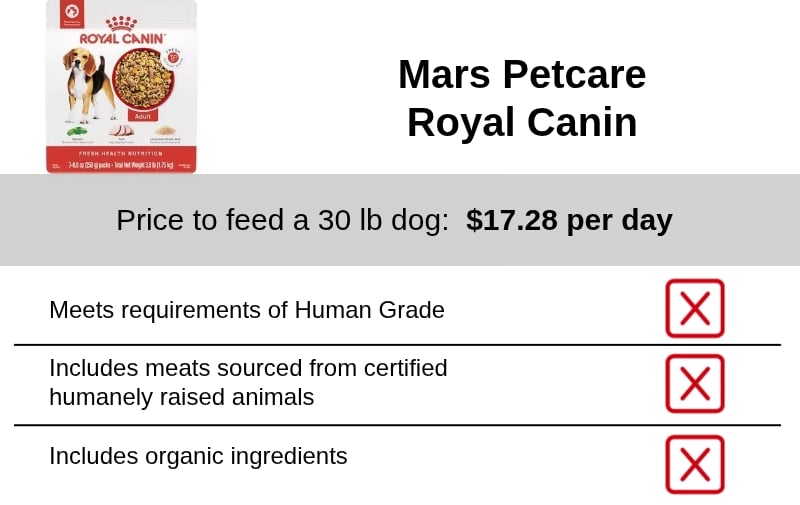
Royal Canin ("Fresh Health Nutrition")
Ownership: Mars Petcare.
Legal / Quality Claims: Makes no human-grade claims, contains no certified humanely raised meat certifications, and contains no certified organic ingredients.
Daily Cost (30 lb dog): Estimated at $17.28 per day.
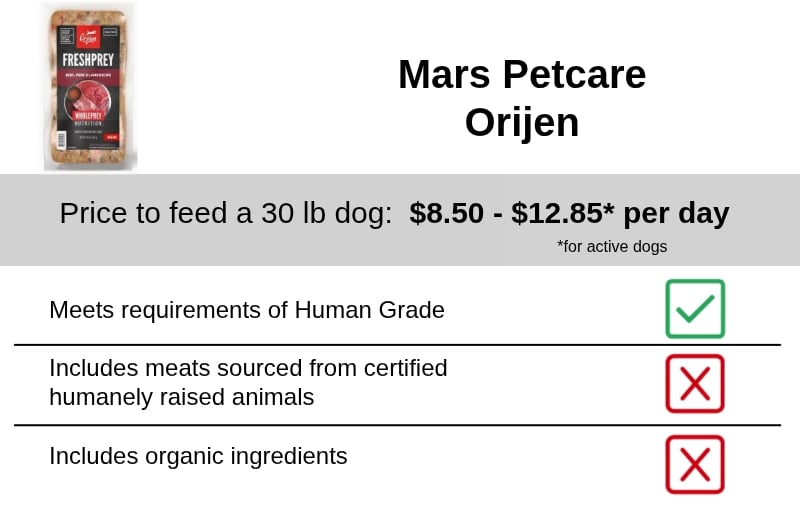
Orijen ("Fresh Prey")
Acquisition Year: Champion Petfoods (maker of Orijen and Acana) was acquired by Mars Petcare in 2022.
Legal / Quality Claims: Makes explicit Human Grade claims on the package label. Processed in a licensed human food facility. Does not claim certified humanely raised meats or organic ingredients.
Daily Cost (30 lb dog): Estimated at $12.50 per day.
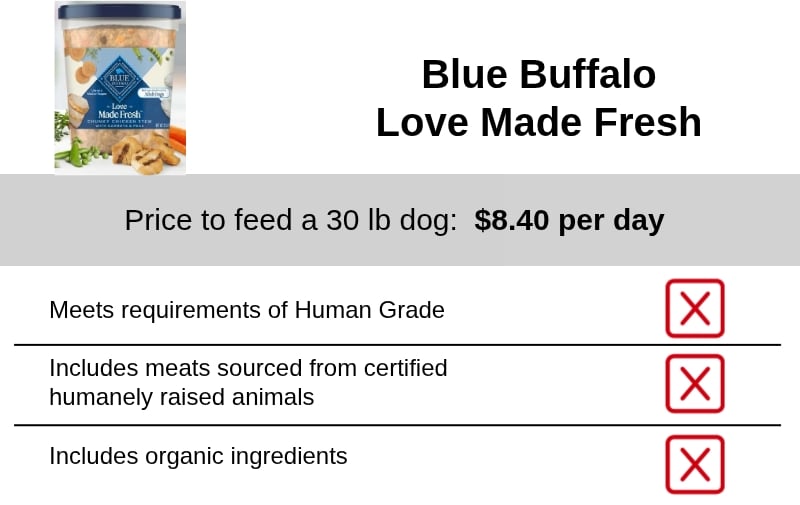
2. General Mills: Blue Buffalo ("Love Made Fresh")
General Mills entered the fresh pet food category through its Blue Buffalo subsidiary, aiming to capture mainstream retail shelf space in grocery and pet specialty fridges.
Legal / Quality Claims: Makes no human-grade claims, contains no certified humanely raised meat certifications, and contains no certified organic ingredients.
Product Style: Refrigerated stews and cooked tubs.
Daily Cost (30 lb dog): Estimated at $8.80 – $9.90 per day.
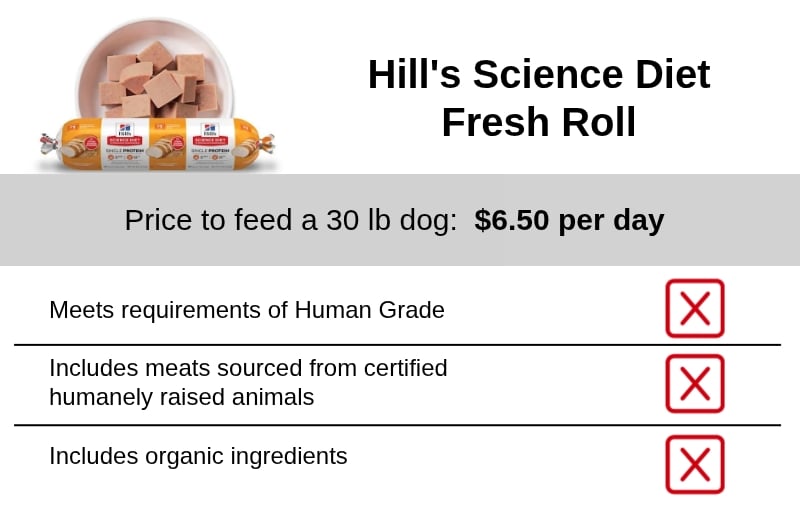
Hill’s Science Diet, owned by consumer goods giant Colgate-Palmolive, introduced a fresh roll format designed for slicing and dicing, utilizing a traditional pasteurized roll packaging model.
Legal / Quality Claims: Makes no human-grade claims, contains no certified humanely raised meat certifications, and contains no certified organic ingredients.
Daily Cost (30 lb dog): Estimated at $6.50 per day.
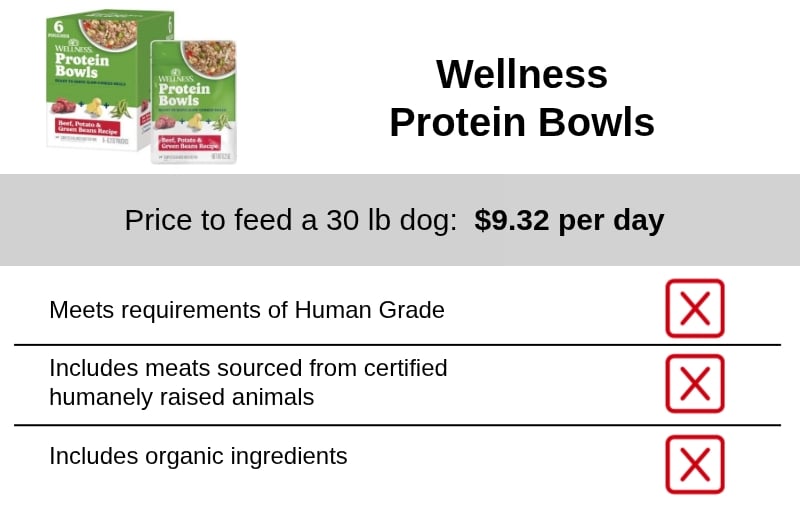
4. Wellness Pet Company: ("Protein Bowls")
Wellness Pet Food introduced a bowl-style fresh presentation aimed at health-conscious consumers seeking high-meat-protein inclusion.
Legal / Quality Claims: Makes no human-grade claims, contains no certified humanely raised meat certifications, and contains no certified organic ingredients.
Product Style: Gently cooked refrigerated meals served in re-sealable bowls.
Daily Cost (30 lb dog): Estimated at $10.20 – $13.50 per day.
5. Fromm Pet Food: Bonnihill Farms ("Chickibowls")
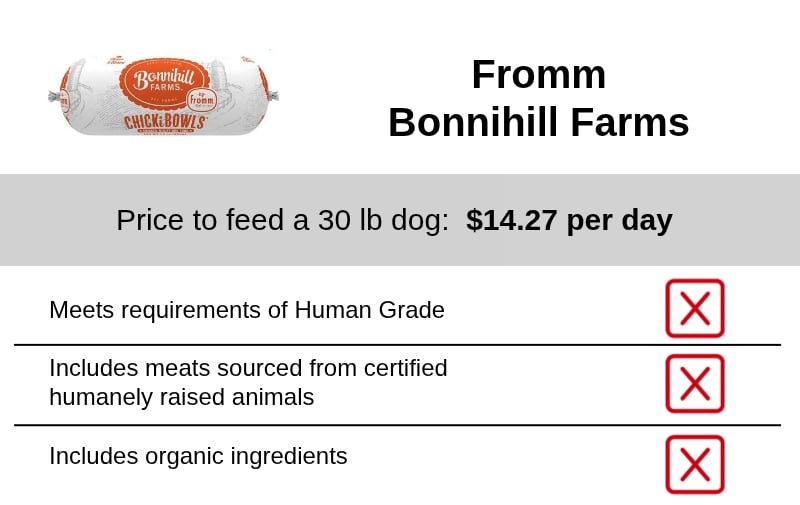
Wisconsin-based, family-owned Fromm Pet Food entered the direct fresh competition via its Bonnihill Farms brand extension, offering fresh options in both pouch/bowl and sliceable roll formats.
Legal / Quality Claims: Makes no human-grade claims, contains no certified humanely raised meat certifications, and contains no certified organic ingredients.
Product Style: Gently cooked dog food available in pouch ("Chickibowls") and refrigerated roll formats.
Daily Cost (30 lb dog): Estimated at $14.27 per day.
Supporting Metrics & Comparative Cost Analysis
A rigorous examination of the pricing data reveals significant discrepancies across the traditional pet food sector. The cost to feed a standard 30-pound adult dog a complete "fresh" diet from these legacy kibble manufacturers spans from $6.50 per day to $17.28 per day—representing a price differential of 165% for products that operate within identical or near-identical manufacturing and legal framework bounds.
When grouping these products by format and manufacturing quality, traditional market logic regarding production cost and retail price breaks down entirely.
Category A: Pouch and Tub Formats ($8.40 – $17.28 per day)
Royal Canin Fresh Health Nutrition sits at the absolute top of the price scale at $17.28 per day. However, it is a standard feed-grade product manufactured using traditional pet food processing streams.
Orijen Fresh Prey, by contrast, costs $12.50 per day—over $4.70 per day cheaper than Royal Canin—despite Orijen holding official Human Grade designation and being processed in a human food facility.
Blue Buffalo Love Made Fresh yields a cost of roughly $8.80 per day, less than half the daily cost of Royal Canin, despite both products utilizing feed-grade ingredients and similar gentle-cooking or tub-packaging methods.
Category B: Fresh Roll Formats ($6.50 – $14.27 per day)
Hill’s Science Diet Fresh Roll provides the lowest barrier to entry among legacy brands at $6.50 per day.
Fromm Bonnihill Farms Roll/Chickibowls costs $14.27 per day for an equivalent 30-pound dog—more than double the cost of Hill’s for a functionally identical feed-grade sliceable roll format.
Regulatory Landscape & Advocacy: The ‘Human Grade’ Disconnect
Consumer advocate Susan Thixton, founder of TruthaboutPetFood.com and a representative at AAFCO through the Association for Truth in Pet Food (ATPF), has drawn national attention to the regulatory mechanisms enabling these inconsistencies.
"Without a legal definition of the term ‘fresh,’ there is no legal standard that pet food manufacturers must meet," notes Thixton. "At this point, ‘fresh’ can be frozen, refrigerated, shelf-stable, cooked, raw, or more processed styles. When Big Pet Food enters this space, consumers assume they are paying for higher quality, human-grade ingredients. In reality, with very few exceptions, they are buying standard feed-grade kibble alternatives packaged in a refrigerator display."
The Transparency Gap in Meat Sourcing and Claims
Beyond the absence of a legal definition for "fresh," the corporate fresh pet food movement exhibits a systemic lack of third-party ethical and quality certifications:
+-------------------------------------------------------------------------------------+
|                  TRANSPARENCY & CERTIFICATION METRICS AUDIT                         |
+----------------------+--------------------+--------------------+--------------------+
| Brand                | Human-Grade Label? | Certified Humane?  | Organic Ingredients|
+----------------------+--------------------+--------------------+--------------------+
| NomNom               | NO                 | NO                 | NO                 |
| Royal Canin          | NO                 | NO                 | NO                 |
| Orijen               | YES                | NO                 | NO                 |
| Wellness             | NO                 | NO                 | NO                 |
| Blue Buffalo         | NO                 | NO                 | NO                 |
| Hill's Science Diet  | NO                 | NO                 | NO                 |
| Fromm                | NO                 | NO                 | NO                 |
+----------------------+--------------------+--------------------+--------------------+
None of the legacy kibble manufacturers currently entering the fresh space utilize certified humanely raised meats (such as Global Animal Partnership or Certified Humane) or certified organic agricultural ingredients. As a result, consumers paying up to $17.00 per day are often paying for branding and specialized cold-chain logistics rather than superior raw agricultural inputs.
Why are legacy pet food conglomerates pricing feed-grade fresh options at such extreme premiums? Industry analysts and consumer advocates point to three strategic motivations currently driving Big Pet Food’s pricing behavior:
1. Consumer Price Elasticity Testing
As legacy brands roll out refrigerated equipment across national retail chains like Petco, PetSmart, and regional grocery stores, corporate strategists are actively testing what price ceilings pet parents will tolerate.
Demonstrating this volatility, Mars Petcare’s Orijen Fresh Prey was introduced in early 2026 at a higher MSRP. Within months, retail partners like Petco instituted sweeping $2.00 per pouch price cuts, indicating that initial price points met consumer resistance.
2. Defending Legacy Kibble Profit Margins
Extruded dry kibble remains the highest-margin product category for major manufacturers. Kibble utilizes low-cost ingredients, requires no cold-chain storage, has a multi-year shelf life, and incurs minimal transport overhead.
By artificially inflating the daily feeding cost of fresh food options ($10.00–$17.00/day), legacy manufacturers create psychological anchor pricing. This makes their premium kibble lines ($2.00–$4.00/day) appear economically attractive by comparison, effectively steering price-sensitive pet owners back to traditional dry food while capturing top-tier spend from affluent buyers.
Startups like The Farmer’s Dog, Ollie, and JustFoodForDogs built multi-million-dollar market shares by capitalizing on consumer distrust of commercial kibble. By flooding retail shelves with legacy-backed "fresh" alternatives, corporate giants aim to capture impulse retail buyers before they migrate to dedicated DTC subscription services.
Future Outlook: Navigating the Changing Pet Food Aisle
As traditional manufacturers expand their footprint in retail refrigeration, the fresh pet food category is entering a critical juncture. Moving forward, industry stakeholders anticipate several structural shifts:
+-----------------------------------------------------------------------------------+
|                        FUTURE INDUSTRY TRAJECTORY                                 |
+-----------------------------------------------------------------------------------+
|  1. Regulatory Pushback                                                           |
|     Consumer advocacy groups will pressure AAFCO and FDA to establish a legal      |
|     definition for "fresh" and restrict feed-grade marketing claims.              |
|                                                                                   |
|  2. Market Realignment & Price Adjustments                                         |
|     Overpriced feed-grade fresh options ($14-$17/day) will face pressure          |
|     from true human-grade brands offering better sourcing at comparable costs.    |
|                                                                                   |
|  3. Eventual Expansion to Feline Fresh Nutrition                                  |
|     As dog nutrition stabilizes, consumer demand will force legacy manufacturers  |
|     to develop specialized fresh nutrition options for cats.                      |
+-----------------------------------------------------------------------------------+
Key Takeaways for Pet Owners
For consumers seeking to navigate the modern pet food section, advocates recommend prioritizing regulatory transparency over commercial marketing claims:
Look for the "Human Grade" Statement: Do not rely on packaging terms like "fresh," "gently cooked," or "raw." Check the fine print on the back label to see if the product explicitly claims 100% Human Grade compliance.
Evaluate the Cost-to-Quality Ratio: Compare the daily cost of corporate feed-grade fresh brands against certified human-grade independent brands. In many cases, true human-grade food processed in USDA facilities is available at equal or lower price points than feed-grade options from legacy manufacturers.
Demand Regulatory Reform: Support advocacy organizations like the Association for Truth in Pet Food that lobby AAFCO and the FDA for clear labeling definitions, transparent ingredient sourcing, and equal enforcement of safety standards across commercial pet feeds.
While Big Pet Food has embraced the fresh food trend, the current retail landscape requires pet owners to look beyond the refrigerator door to ensure their pets receive genuine nutrition rather than clever corporate repositioning.