
Executive Overview
As the amber hues of autumn begin to replace the vibrant greens of a productive New England summer, conservationists at Audubon Vermont are taking stock of a transformative season. While the high-tempo demands of field biology—ranging from avian acoustic monitoring to nesting surveys—slow down with the receding temperatures of September, the organization is pivoting toward critical project evaluations. Chief among these initiatives is an intensive, multi-phase riparian restoration project along the banks of the Huntington River at the Green Mountain Audubon Center in Huntington, Vermont.
What began in the bitter chill of an April slush-and-snowstorm as a community-driven tree planting event has evolved into a masterclass in modern ecological restoration. Faced with the biting winds of spring’s final winter storm, a dedicated coalition of Audubon Conservation Biologists, participants from the Youth Conservation Leadership Program, and intrepid local volunteers installed 339 native trees and shrubs. This ambitious undertaking was not merely an exercise in arboriculture; it represented a strategic, science-backed intervention designed to heal a compromised riparian buffer, combat invasive species, and rebuild critical nesting and foraging habitats for declining migratory bird populations.
Over the subsequent months, this nascent ecosystem became the focal point of rigorous scientific monitoring, targeted vegetation management, and adaptive conservation practices. Partnering with a University of Vermont (UVM) Extension Intern, Audubon staff tracked the survivorship, health, and physiological development of the plantings through the heat of midsummer. Simultaneously, field teams deployed heavy machinery, motorized weedwhackers, and traditional hand scythes to give the young forest fragments a fighting chance against aggressive, fast-growing meadow vegetation.
As these 339 saplings prepare to face their inaugural New England winter, the stakes for this riparian corridor could not be higher. Once fully established, this meticulously managed shrubland is projected to provide vital shelter, nesting substrates, and food web support for an array of priority bird species, including the Field Sparrow (Spizella pusilla), Yellow Warbler (Setophaga petechia), Common Yellowthroat (Geothlypis trichas), and Tree Swallow (Tachycineta bicolor). This comprehensive report examines the chronological progression, ecological metrics, stewardship methodologies, and future outlook of a project that exemplifies the intersection of community science and professional wildlife management in the Green Mountain State.
Detailed Chronology: From Winter’s Last Gasp to Autumn Stewardship
April: The Slush, the Snow, and the Planting
The genesis of this riparian restoration dates back to a quintessential, unpredictable Vermont spring day in April. While calendar pages indicated that spring had arrived, meteorology had other plans. As staff and volunteers gathered at the Green Mountain Audubon Center to break ground, they were greeted by the season’s final, stubborn assault of slush, freezing rain, and wet snow.
Despite conditions that would have deterred casual observers, the event drew an enthusiastic and resilient turnout. Conservation Biologists, members of the Youth Conservation Leadership Program, and local volunteers formed an assembly line of environmental stewardship. Working methodically along the Huntington River floodplain, the team planted a carefully curated mix of native trees and shrubs designed to stabilize soils, shade aquatic habitats, and establish a dense understory matrix.
By day’s end, exactly 339 individual plants—comprising a diverse selection of native woody species—had been successfully integrated into the riparian landscape. However, seasoned ecologists know that planting a tree is merely the first step in a long ecological marathon. Without immediate and sustained follow-up, restoration plantings frequently succumb to weed competition, herbivory, and soil compaction.
June: The Mid-Season Check-Up and Data Collection
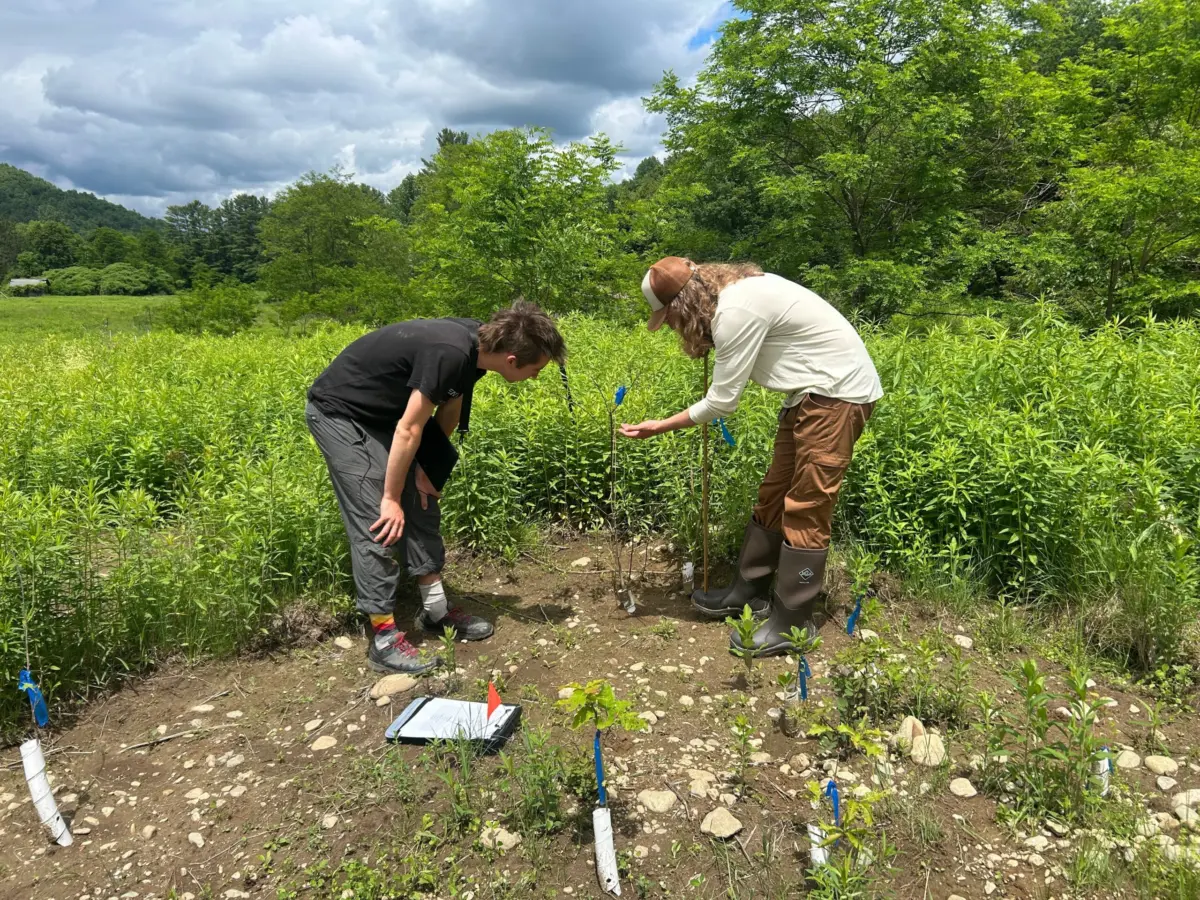
As the landscape transitioned from spring green to the lush expanse of early summer, the newly established plants faced their first major environmental tests. To evaluate how well the saplings were adapting to their new home, Audubon Vermont staff partnered with a University of Vermont Extension Intern for a comprehensive mid-season health assessment.
Equipped with a measuring stick slung over his shoulder and a digital survey tablet in hand, the UVM intern spearheaded the data collection process. Every single one of the 339 plants was individually evaluated against a standardized set of ecological metrics:
- Survivorship Status: Documenting live versus dead individuals to calculate baseline mortality rates.
- Vigor and Growth: Measuring annual leader growth, leaf coloration, and overall structural integrity.
- Threat Assessment: Identifying signs of browse damage, insect infestation, or disease.
- Microhabitat Conditions: Recording immediate soil moisture and canopy cover variations.
This intensive field audit provided conservationists with actionable data regarding which species were thriving in the riparian soil and which individuals required additional support or protective measures.
August: Strategic Vegetation Management and Habitat Tuning
By late summer, the success of the young trees was threatened not by drought, but by their own success stories: the surrounding meadow was experiencing an explosive growth of native and non-native herbaceous vegetation. Towering stalks of goldenrod (Solidango spp.), dense mats of grasses, and thick herbaceous undergrowth threatened to outcompete, shade out, and physically crush the young saplings.
To prevent the restoration plots from being swallowed by the meadow, Audubon staff executed a multi-tiered vegetation management strategy in August:
- Mechanical Knockdown: Using a tractor-mounted brush cutter and motorized weedwhackers, field technicians cleared the bulk of the thick goldenrod stalks and grass mats surrounding the planting clusters, drastically reducing immediate root and light competition.
- Precision Hand-Scything: To protect the delicate saplings while removing lingering weeds, staff utilized traditional hand scythes for precision clearance directly adjacent to the stems. Crucially, this selective clearing preserved beneficial, pollinator-friendly native species such as common milkweed (Asclepias syriaca).
- Pollinator Enhancement: In select plots cleared during the late-summer maintenance, staff scattered a specialized native wildflower seed mix. These seeds are intended to germinate in the spring, creating a diverse floral understory designed to attract and sustain native pollinator populations.
Supporting Context & Metrics: The Science of Riparian Restoration
The Ecological Significance of Riparian Buffers
Riparian zones—the interfaces between land and a river or stream—are among the most ecologically productive and dynamic habitats on Earth. Along the Huntington River, a healthy riparian buffer acts as a multi-functional ecological filter:
- Water Quality Improvement: Roots trap sediment, filter agricultural and residential runoff, and absorb excess nutrients before they can degrade aquatic ecosystems.
- Thermal Regulation: Overhanging canopy trees cast shade over the water, keeping river temperatures cool—a critical factor for native cold-water fish species such as brook trout.
- Erosion Control: Deep, interlocking root networks anchor riverbanks, mitigating the destructive impacts of seasonal ice jams and high-water flood events.
[Agricultural / Upland Runoff]
       │
       ▼
[Riparian Buffer Zone] ──(Filters Nutrients & Sediments)
       │
       ├─► [Shades & Cools Huntington River]
       ├─► [Stabilizes Riverbanks via Root Networks]
       └─► [Provides Food, Shelter & Breeding Habitat for Avian Fauna]
Avian Biodiversity Targets
The ultimate ecological benchmark for Audubon Vermont’s restoration initiative is the return and successful reproduction of target bird species dependent on early-successional shrubland habitats. Decades of land-use changes and forest maturation in New England have led to a sharp decline in shrubland birds. By engineering a dense, structurally diverse corridor of native trees and shrubs, project planners are directly targeting the recovery of four key indicator species:
- Field Sparrow (Spizella pusilla): Requiring patchy shrubby fields interspersed with herbaceous openings, this species will utilize the restored plots for ground-nesting and foraging on weed seeds and insects.
- Yellow Warbler (Setophaga petechia): A quintessential inhabitant of wet thickets and riparian corridors, Yellow Warblers depend on dense clusters of native shrubs for secure nest placement and high concentrations of insect prey.
- Common Yellowthroat (Geothlypis trichas): Thriving in low, dense vegetation near water, this warbler species will find the managed interface between the meadow and the tree clusters to be an ideal foraging habitat.
- Tree Swallow (Tachycineta bicolor): While primarily cavity nesters, Tree Swallows rely heavily on the open airspace above riparian buffers to hunt flying insects, benefiting indirectly from the overall biological productivity of the restored zone.
Official Statements and Stakeholder Perspectives
The success of the Huntington River restoration project is a direct testament to collaborative conservation, engaging academic institutions, youth leadership programs, and dedicated local volunteers.
Reflecting on the grueling conditions of the April planting day, project coordinators emphasized the extraordinary commitment of the community. "It somehow ended up being the exact day of the spring’s final slush-and-snow-and-freezing-rain storm," noted Audubon Vermont field staff in a retrospective review. "The event was a high-spirited success despite the bitter cold. A huge round of applause, again, to everyone who soldiered through!"
The involvement of the University of Vermont Extension Internship program underscores Audubon Vermont’s dual commitment to habitat restoration and workforce development. By integrating emerging scientists directly into active monitoring protocols, the project provides invaluable, hands-on field experience in applied conservation science. The UVM intern’s work with survey tablets and standardized metrics bridges the gap between academic theory and boots-on-the-ground ecological management.
Furthermore, leadership from the Youth Conservation Leadership Program highlights the generational continuity required in modern conservation. By engaging young leaders in heavy physical labor, plant identification, and habitat stewardship, Audubon Vermont is actively cultivating the next generation of environmental defenders equipped to tackle complex ecological challenges in the face of a changing climate.
Future Outlook: Preparing for Winter and Beyond
As September transitions into the deeper chill of autumn, the work at the Green Mountain Audubon Center is far from finished. The 339 surviving plants face a formidable obstacle course on their journey toward maturity, none more immediate than their upcoming encounter with their first full New England winter.
Winter Hardening and Defense Strategies
The primary threats to young woody plantings during the winter months are snow load, frost heaving, and, most notably, mammalian herbivory. Ravenous white-tailed deer (Odocoileus virginianus), facing food scarcity during winter, frequently target the tender bark and terminal buds of young restoration saplings.
To safeguard the investment made by staff and volunteers, Audubon Vermont is implementing proactive defensive measures:
- Fencing Reinforcement: Existing wildlife exclosures are currently undergoing structural audits, with damaged mesh repaired and secured.
- New Exclosure Installation: High-risk plots are receiving additional fencing barriers to prevent deer browsing during the high-stress winter season.
- Snow and Ice Management: Monitoring structural stress points where heavy wet snow could snap fragile leaders, allowing staff to make preventative adjustments.
Long-Term Monitoring and Adaptive Management
Looking ahead to the spring and summer of the coming year, Audubon Vermont’s conservation roadmap includes sustained data collection and adaptive management protocols:
- Survival Tracking: Conducting comprehensive spring emergence surveys to quantify winter mortality rates and assess overall root system resilience.
- Growth Benchmarking: Continuing the longitudinal tracking of height, canopy spread, and stem diameter initiated by the UVM intern.
- Adaptive Interventions: Deploying targeted weed management strategies as the restored meadow awakens, ensuring that invasive plant species do not outpace the native saplings.
Once fully established, these restored riparian plots will transcend their current status as fragile experimental patches, maturing into a robust, self-sustaining shrubland ecosystem. They will stand as a living testament to what can be achieved when scientific rigor, institutional partnership, and community dedication converge along a Vermont riverbank. Audubon Vermont will continue to publish regular updates on the trajectory of the Huntington River plantings, chronicling both the resilience of the ecosystem and the dedication of the people who nurture it.