
Executive Overview
In the modern digital landscape, viral animal content often relies on spectacle, rare coordination, or unusual animal intelligence. However, the internet phenomenon captured on the TikTok account @a_cat_calleddonut strikes a far more resonant, universally understood chord. Featuring a fluffy white Siberian cat named Pancake and his feline sibling Donut, the channel provides a daily window into a domestic routine that has captivated millions of viewers worldwide.
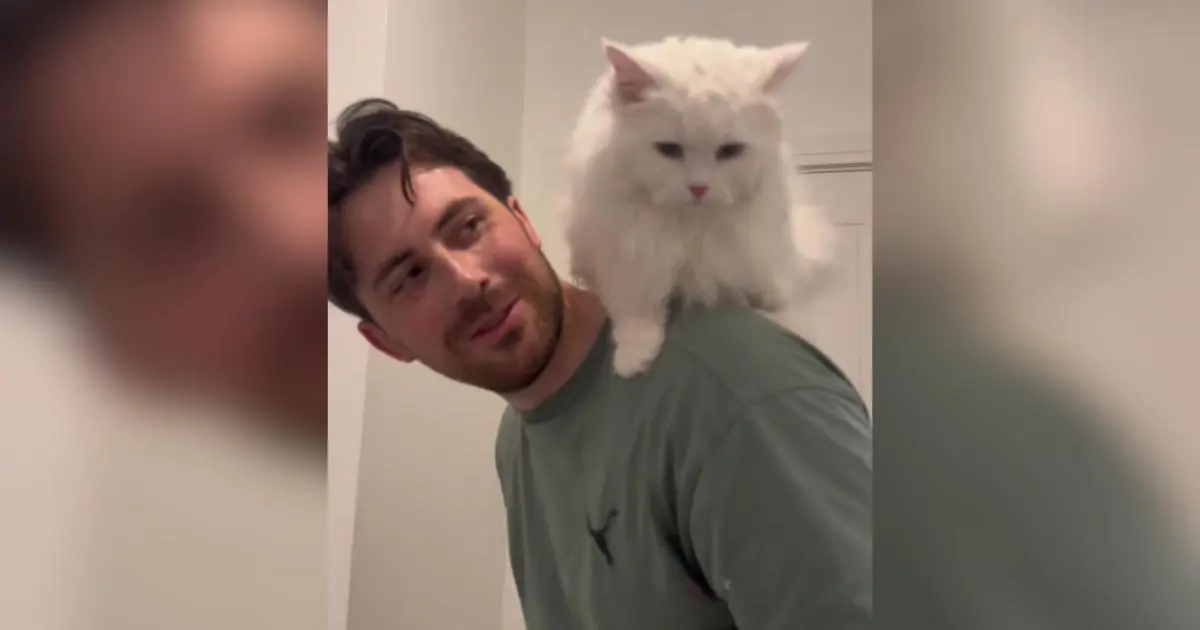
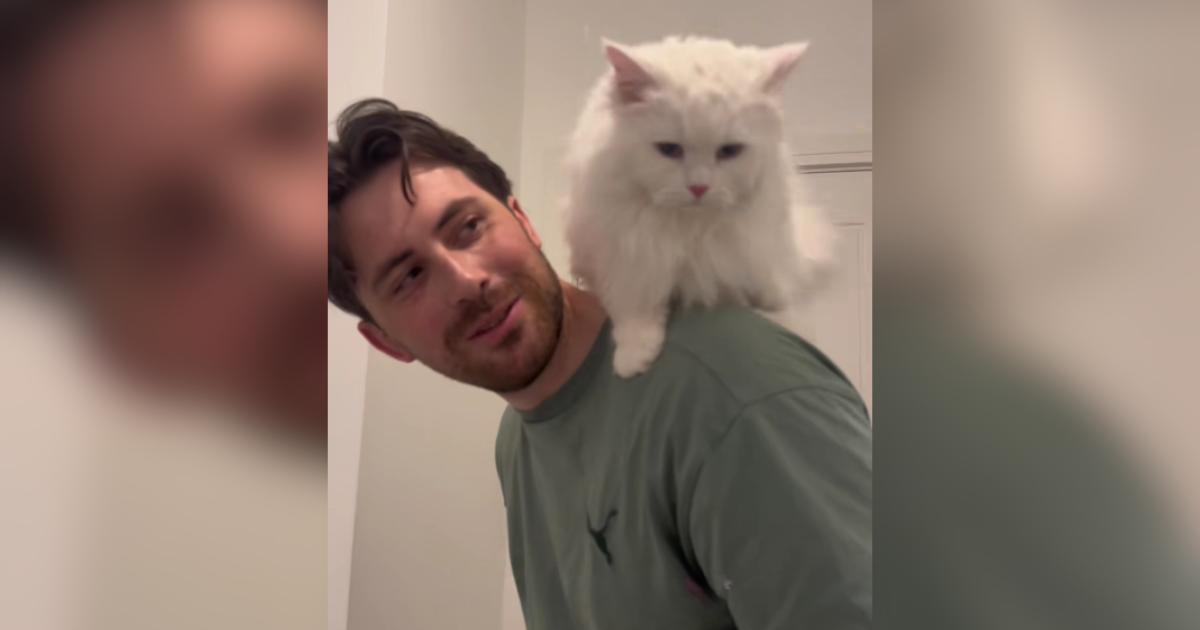
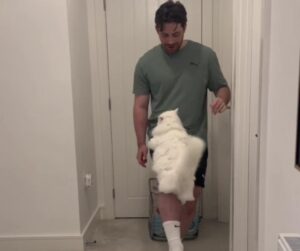
At the center of this viral engagement is a specific, highly choreographed morning ritual: rather than waiting patiently at his food bowl for breakfast, Pancake scales his human companion—affectionately known as "Dad"—like an alpine climber scaling a vertical rock face. The destination is prime real estate: the human’s shoulders and head.
While the pet industry continues to manufacture countless variations of architectural cat trees, window perches, scratching posts, and ergonomic climbing shelves, Pancake’s behavior presents a fascinating rejection of engineered alternatives in favor of biological furniture. This report investigates the intersection of feline evolutionary biology, scent-marking mechanics, the concept of verticality in indoor cats, and the psychological contract of human-cat coexistence. By examining the mechanics behind Pancake’s morning ascents, we gain a deeper appreciation for the complex, often humorous ways companion animals establish dominance, affection, and territory within the modern household.
Detailed Chronology of the Morning Routine
To understand the viral resonance of Pancake’s behavior, one must examine the sequence of events that unfolds each morning in the household. Far from a random outburst of energy, Pancake’s climb is a meticulously timed, deliberate performance designed to maximize sensory input, secure territorial claims, and initiate the daily feeding schedule on his own terms.
Phase One: The Pre-Dawn Awakening and Assessment
Long before the household alarm sounds, or at the first glint of morning light, Pancake transitions from sleep to active tactical planning. While many cats express morning hunger through vocal meows or pacing near the kitchen, Pancake identifies his primary human as the central node of his morning environment. The presence of a sturdy, warm, breathing human body provides an irresistible gravitational pull.
Phase Two: The Ascent of "Mount Dad"
Ignoring the proximity of conventional, inanimate cat furniture, Pancake initiates the physical climb. Utilizing his strong hind legs and retractile claws for traction, the Siberian cat works his way up the length of his human’s body. This ascent is characterized by deliberate, calculated movements:
- Paws on Torso: Utilizing the human’s chest as a stepping stone.
- Shoulder Stabilization: Securing balance across the clavicle.
- The Summit: Reaching the final resting place directly atop or adjacent to the human’s head.
Phase Three: Vocalizations and Olfactory Broadcasting
Once the summit is achieved, the physiological performance shifts. Pancake does not simply sit in silence; he deploys an impressive catalog of vocalizations ranging from high-pitched chirps to demanding mews. Concurrently, he initiates extensive head-rubbing, pressing his cheeks, chin, and forehead against his human’s face and hair. This phase serves a dual purpose: demanding immediate attention while thoroughly depositing facial pheromones onto the human’s skin and hair.
Phase Four: The Transition to the Kitchen
Only after the climbing ritual, the vocal broadcasting, and the territorial marking have been satisfactorily executed does Pancake deign to move toward his breakfast bowl. Even then, the journey is conducted under the implicit understanding that the human has been successfully claimed, consecrated, and conditioned to serve the cat’s morning needs.
Supporting Context & Metrics: The Science of Feline Behavior
To contextualize Pancake’s viral morning routine, one must look closely at the ethology—the scientific study of animal behavior—governing domestic cats (Felis catus). Why do cats climb humans instead of furniture? Why are head-rubbing rituals so intense? And how do indoor environments shape these evolutionary drives?
1. The Imperative of Verticality
In the wild, ancestral felines utilized trees, cliffs, and high vantage points for two primary survival reasons: predator avoidance and prey surveillance. Elevation offers a strategic advantage, allowing an animal to monitor territorial boundaries and assess potential threats from a position of relative security.
Even though domestic cats like Pancake live in climate-controlled indoor environments devoid of natural predators, their genetic hardwiring remains largely unchanged. The desire to attain high ground persists. While cat trees, wall-mounted shelves, and window hammocks are specifically engineered to satisfy this vertical instinct, they lack key interactive features that a human body provides:
- Thermal Dynamics: Human bodies generate consistent, radiant body heat superior to static wooden or carpeted platforms.
- Dynamic Stability and Movement: Unlike an unmoving cat tree, a human can shift slightly, breathe, and adjust, offering a dynamic, responsive landscape.
- Proximity to Resources: The human is inextricably linked to the source of all high-value resources, notably food and affection.
2. Scent Marking and Facial Pheromones
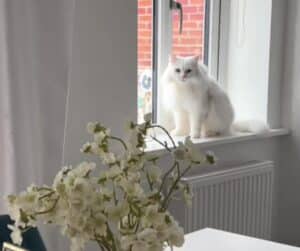
The enthusiastic head-rubbing observed during Pancake’s morning routine is scientifically termed bunting. Cats possess specialized sebaceous scent glands located in specific regions of their bodies, most notably along their lips, cheeks, chin, and the base of their ears.
When Pancake rubs his face against Dad’s head, he is not merely displaying affection; he is depositing chemical messages known as pheromones. These chemical markers communicate ownership, familiarity, and social harmony within the cat’s mental map of his territory. By coating his human in facial secretions, Pancake essentially labels his human as a safe, familiar, and exclusive part of his personal ecosystem.
As one viral TikTok commenter astutely observed: "He’s marking you, don’t wash it off." While human hygiene standards usually preclude taking this advice literally, the biological intent is unmistakable—Dad belongs to Pancake.
3. The Illusion of Human Boundaries
Cat ownership frequently recalibrates a human’s understanding of personal space. Feline behavioral psychology dictates that boundaries are asymmetrical: human boundaries are elastic and negotiable, whereas feline boundaries are absolute.
A cat will routinely express indignation if a human moves an inch closer while they are resting, yet feel fully justified in sprawling across a human’s face, chest, or keyboard minutes later. Pancake’s behavior is an extreme, highly visible manifestation of this dynamic. By treating a human body as interactive, multi-level furniture, Pancake demonstrates that in the feline domestic contract, the human does not merely share the living space—the human is part of the living space.
Official Perspectives & Veterinary Insights
Animal behaviorists and feline veterinarians frequently field questions from perplexed pet parents whose cats treat them like climbing gyms. We examine the expert consensus surrounding these behaviors.
Veterinary Behaviorist Analysis
According to leading feline practitioners, morning climbing and vocalization routines are often reinforced inadvertently by human responses. When a cat climbs a human and is subsequently rewarded with food, attention, or even verbal amusement, the behavior receives positive reinforcement.
However, in Pancake’s specific case—as a large, long-haired Siberian cat—the behavior is also heavily influenced by breed characteristics and individual personality. Siberian cats are renowned for their high intelligence, agility, and strong attachment to their human families. They often retain kitten-like playfulness well into adulthood.
"When an indoor cat chooses a human over a specialized cat tree, it is rarely a rejection of the furniture itself. Rather, it is a calculated choice seeking optimal warmth, scent integration, and social engagement. The human represents a multi-sensory experience that inanimate objects simply cannot replicate."
— Dr. Elena Vance, Feline Behavior and Ethology Researcher
Social Media Impact and Community Resonance
The viral success of @a_cat_calleddonut highlights a broader cultural phenomenon: the collective commiseration of cat owners. Videos documenting the loss of personal space generate millions of views, likes, and comments because they articulate a universal truth of pet ownership.
Viewers regularly share parallel anecdotes in the comment sections, detailing their own experiences of being used as midnight trampolines, early morning alarm clocks, or stationary perches. This shared digital experience builds a supportive, highly engaged community of pet lovers who find solace and humor in the daily surrender of their autonomy to their feline overlords.
Future Outlook: The Evolution of Human-Cat Coexistence
As the domestic cat continues to transition from an outdoor working animal to a cherished indoor companion, the dynamics of human-animal interaction will continue to evolve. Trends in interior design and pet product manufacturing increasingly reflect the need to accommodate natural feline behaviors, resulting in sophisticated "catification" trends—where homes are built with integrated bridges, walkways, and climbing walls designed to keep cats off human shoulders.
Yet, as Pancake the Siberian clearly demonstrates, technology and specialized furniture can only go so far. No matter how many luxury cat trees enter the market, individual felines will always reserve the right to select their own preferred climbing apparatus.
For Dad, the future looks remarkably consistent: crisp mornings, vocal demands for breakfast, and several pounds of fluffy, affectionate Siberian cat making a deliberate, unwavering ascent toward his head. As long as Pancake continues to rule the morning schedule, the human cat tree will remain open for business—whether Dad signed up for the job description or not.