
Executive Overview
Traveling with domesticated animals via commercial airlines has historically been a high-stress venture, particularly for pet owners whose companions exceed the standard small-dog parameters of under 10 pounds. While airlines generally accommodate tiny dogs and cats with straightforward rules, pet owners navigating the "grey area"—dogs weighing between 15 and 20 pounds or standing taller than 12 inches at the shoulder—frequently encounter rigid enforcement, inconsistent gate policies, and anxiety-inducing moments at security checkpoints.
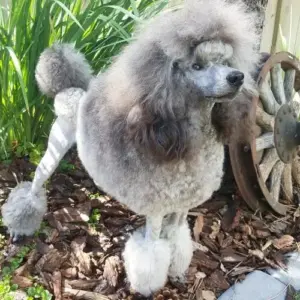
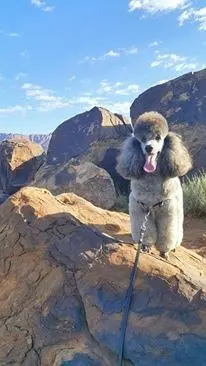
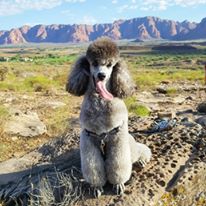
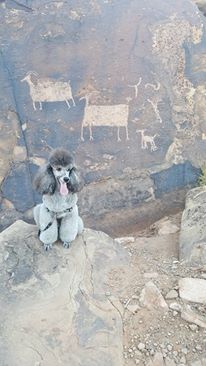
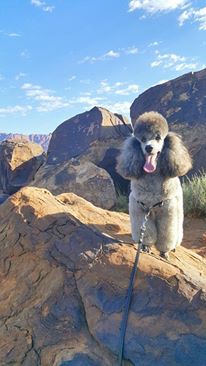
Enter the world of advanced pet travel hacks, where experienced owners move beyond basic manufacturer guidelines to engineer practical solutions. In a recent detailed travel report shared with Dog Jaunt, pet owner Amy outlined her successful journey from Providence, Rhode Island, to Las Vegas, Utah, and back, traveling with her 17-pound, 16-inch-tall Miniature Poodle named Calvin.
Using an extra-large (XL) SturdiBag outfitted with ingenious custom modifications, Amy navigated two major domestic carriers—Delta Air Lines and Southwest Airlines—without a single administrative hurdle regarding the size of the carrier. This case study explores the tactical decisions, structural modifications, airline communications, and logistical arrangements that allowed a larger-than-average dog to fly comfortably in the aircraft cabin.
Detailed Chronology: The Journey to Utah and Back
Phase 1: Planning and Booking with Delta Air Lines
The journey began with reservations booked through Delta Air Lines for a multi-leg itinerary from Providence, RI, to Las Vegas, NV. Given the stringent reputation Delta holds regarding pet container dimensions—typically requiring soft-sided carriers to compress easily beneath the seat in front of the passenger—Amy took a proactive approach during the booking phase.

Rather than trying to hide the dimensions of the XL SturdiBag, Amy contacted Delta’s reservation line directly. She explicitly informed the customer service representative that she would be traveling with a "large-small dog" inside a soft-sided carrier that exceeded standard rigid measurements. The response from Delta’s booking agent was refreshingly pragmatic: as long as the carrier possessed enough structural flexibility ("could smoosh") to fit underneath the aircraft seat during taxi, takeoff, and landing, it would be permitted.
To mitigate any unforeseen pushback at the gate from strict agents, Amy devised a clever backup strategy. She packed a standard large-sized SturdiBag, completely folded flat, inside her primary carry-on luggage. Furthermore, she preemptively modified the XL SturdiBag by swapping out its rigid bottom floorboard and matching soft interior pad with the smaller equivalents from her backup large-sized carrier. This calculated adjustment effectively reduced the interior footprint and compressed the bag’s overall length from 20 inches down to 18 inches, allowing it to conform more seamlessly to tight under-seat spatial constraints while remaining fully interchangeable.
Phase 2: Outbound Leg (Providence to Las Vegas via Atlanta)
On the morning of the flight, Calvin underwent a carefully planned routine. Amy ensured her Miniature Poodle enjoyed an extensive, energy-burning walk early in the morning and withheld his standard breakfast to minimize the risk of motion sickness or mid-flight digestive emergencies, though he was permitted a few select treats while airborne.
The first flight leg utilized a Delta MD-88 aircraft. Due to the fixed layout of the cabin, Amy found herself assigned to a middle seat, presenting a distinct logistical puzzle when sliding the pet carrier into place.
"Once it was between the seats it was fine, but actually getting it between the seat I’d be sitting in and the seat back in front of me was a squeeze," Amy noted.
Despite the initial tight fit, the modified XL SturdiBag compressed adequately to slide into the designated footwell. Cabin crew members did not challenge the carrier’s dimensions, and most staff members appeared entirely unobservant of the traveling canine.
During a layover at Hartsfield-Jackson Atlanta International Airport, Amy exited the secure terminal area to provide Calvin with a bathroom break. While the airport lacked an immediately obvious, dedicated indoor animal relief zone near their gate, Calvin successfully utilized a patch of decorative landscaping. Afterward, they cleared security seamlessly for their second flight—a Boeing 737-700 operating the route from Atlanta to Las Vegas—which landed without incident.
Phase 3: The Southwest Pivot and Return Journey
Following a computer system failure with Delta that resulted in severe flight delays on the return trip, Amy made a strategic pivot. Unwilling to risk prolonged delays with a dog in tow, she purchased a new ticket home utilizing Southwest Airlines.
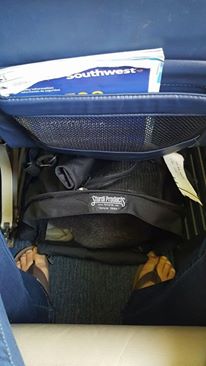
Boarding the Southwest flight, a gate agent stopped Amy to verify her documentation, specifically checking to ensure that a pet-in-cabin ticket fee had been properly registered and attached to Calvin’s carrier. Because Southwest operates an open-seating policy rather than assigned seat selections, Amy secured a middle seat on the first leg of her return trip, which was operated by a Boeing 737-700. Even with the middle-seat configuration, the XL SturdiBag fit comfortably beneath the seat, affording Calvin ample interior space to adjust his position during the flight.
The return itinerary featured a stopover at Chicago Midway International Airport. Midway offered a designated, fenced outdoor pet relief area just outside security. Although Amy noted that the concrete-heavy enclosure lacked natural, inviting aesthetics for a dog, the immediate vicinity featured abundant grass and trees, allowing Calvin to relieve himself comfortably.
Following a swift re-screening process at security checkpoints, Amy and Calvin boarded their final connecting flight back to Providence, Rhode Island. Notably, T.F. Green Airport in Providence features a modern indoor pet relief facility, providing a stress-free conclusion to the cross-country voyage.
Supporting Context & Metrics: Analyzing the "Size Paradox"
When selecting a pet carrier for commercial air travel, owners must balance conflicting priorities: airline regulations, structural stability, and the biological dimensions of the animal.
The Carrier Specifications
- Standard Large SturdiBag: Optimized for pets up to approximately 12 inches in shoulder height. Its factory dimensions are tailored to standard regional and mainline aircraft under-seat clearances.
- Extra-Large (XL) SturdiBag: Measures 20 inches in length, designed structurally for dogs exceeding normal cabin thresholds.
- The Modification Strategy: By substituting the floorboard and soft pad of the XL bag with components from the standard Large bag, Amy achieved a dual-purpose configuration:
- Shortened the internal rigid base length from 20 inches to 18 inches.
- Maintained cross-compatibility, allowing a rapid downshift to the backup Large bag if gate agents demanded strict compliance with manufacturer specs.
Canine Biometrics vs. Carrier Realities
Calvin’s physical measurements present an instructive case study in pet travel logistics:
- Shoulder Height: 16 to 16.5 inches (4 to 4.5 inches higher than the optimal threshold for a standard large carrier).
- Weight: Approximately 17 pounds.
- Anatomical Advantage: Much of Calvin’s height is concentrated in his leg length rather than a bulky torso. Because Poodles and similar athletic breeds possess high flexibility and easily curl into compact spheres when resting, his actual resting footprint inside the carrier was significantly smaller than his standing height suggested.
This operational reality highlights an essential rule for pet travel veterans: raw metrics (height and weight) offer a baseline, but the animal’s natural resting posture and frame morphology dictate whether an oversized carrier can successfully pass under an aircraft seat.
Official Industry Standards and Airline Policies
Navigating commercial air travel with animals requires strict adherence to federal and corporate guidelines. Major U.S. carriers maintain explicit, albeit variable, protocols for in-cabin pets:
- Carrier Flexibility: Soft-sided carriers are almost universally preferred by seasoned travelers because they possess the structural give required to compress by 1 to 2 inches when pushed into cramped under-seat spaces. Hard-sided plastic kennels lack this tolerance and are frequently rejected if they do not slide in effortlessly.
- Reservation Caps: Airlines limit the total number of pets allowed in the cabin per flight (typically between 4 and 6 animals depending on the aircraft type), making early booking and verbal confirmation essential.
- Documentation and Fees: A mandatory pet fee (ranging from $95 to $125 each way depending on the airline) must be paid at check-in, and the animal must remain inside its zipped container for the entirety of the flight, from boarding to deplaning.
- Relief Infrastructure: Per Department of Transportation (DOT) regulations, major commercial airports are required to provide accessible animal relief areas inside or immediately adjacent to terminal secure zones, facilitating long-haul journeys with larger dogs.
Future Outlook: Trends in Pet-Inclusive Air Travel
As domestic pet ownership surged over the past decade, the travel sector has experienced parallel growth in demand for pet-friendly infrastructure. Industry analysts point to several emerging trends that will shape the future of flying with animals:
- Standardized Terminal Amenities: Airports nationwide are aggressively upgrading their infrastructure, phasing out outdated concrete patches in favor of sophisticated indoor pet relief lounges complete with artificial turf, drainage systems, and sanitation stations.
- Design Innovations in Pet Gear: Manufacturers are increasingly focusing on modular pet luggage. Solutions like Amy’s interchangeable SturdiBag components point toward a future of customizable, multi-configuration travel gear designed specifically to outsmart rigid airline measurement boxes without compromising animal welfare.
- Policy Harmonization: While legacy carriers continue to maintain independent rules regarding container sizing, advocacy groups are pushing for clearer, universally recognized guidelines for soft-sided soft carriers, reducing the guesswork and anxiety for travelers flying with medium-sized breeds.
Conclusion
Amy and Calvin’s successful round-trip journey demonstrates that traveling with an oversized dog in an aircraft cabin is entirely feasible with meticulous preparation, strategic gear modifications, and calm confidence at the gate. By viewing airline regulations as dynamic parameters rather than impassable walls, pet owners can successfully open up the skies for animals who fall just outside the standard travel blueprint.