
Executive Overview
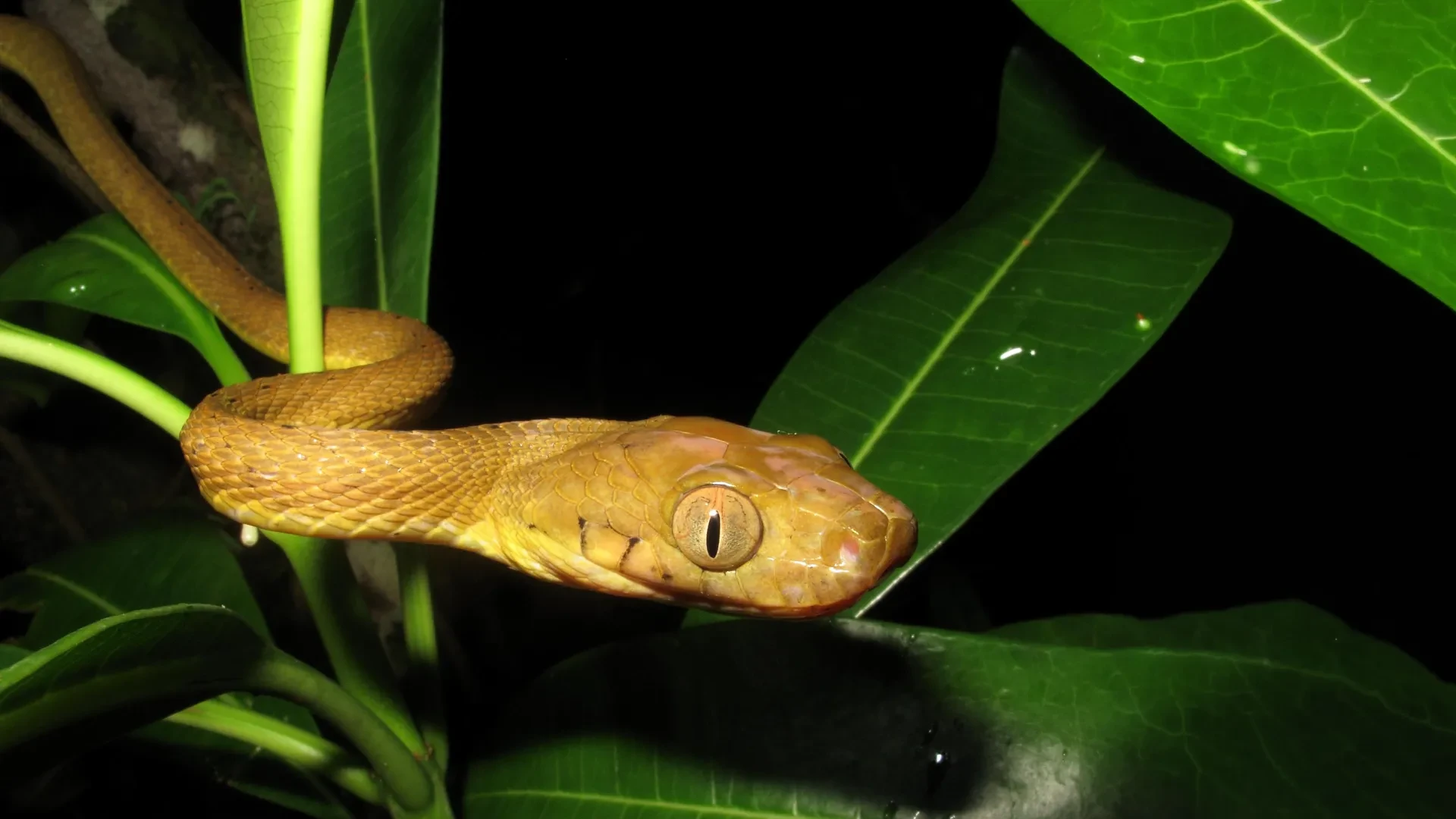
The brown tree snake (Boiga irregularis) stands as a grim textbook example of the catastrophic potential inherent in invasive species. Native to the coastal regions of Australia, Indonesia, and the Solomon Islands, this nocturnal predator likely hitched a ride on military cargo planes in the chaotic aftermath of World War II, landing on the unsuspecting island of Guam. In the decades since, it has systematically dismantled the island’s ecological framework. With population densities reaching an astonishing 30,000 snakes per square mile in certain pockets of the U.S. territory, the species has driven native forest birds to local extinction and wreaked havoc on human infrastructure by triggering hundreds of electrical power outages annually via encounters with utility poles.
For years, evolutionary biologists have grappled with a compelling paradox: how did an explosive, ecologically devastating population arise from what is believed to be a mere handful of founding individuals? According to standard evolutionary theory, such a narrow founding population should trigger a severe genetic bottleneck. Inbreeding depression—the reduction in biological fitness due to mating between closely related individuals—should normally deplete genetic diversity, leaving the population vulnerable to disease, environmental shifts, and evolutionary stagnation.
Yet, the brown tree snake defied these foundational expectations. A groundbreaking study published on July 24 in Science Advances, led by researchers at the University at Buffalo (UB) in collaboration with the U.S. Geological Survey (USGS), has finally cracked the case. Utilizing cutting-edge long-read sequencing technology, the research team uncovered a massive reservoir of hidden genetic diversity within the brown tree snake genome. Rather than lacking variation, these serpents harbor thousands of complex structural variants—large-scale DNA insertions, deletions, duplications, and rearrangements—concentrated heavily in genes governing immunity and olfaction.
This revelation not only rewrites our understanding of how invasive species adapt and thrive under extreme ecological pressures, but it also provides a sobering warning for wildlife management agencies trying to contain the population, while paradoxically offering a glimmer of hope for the conservation of endangered, highly inbred species worldwide.
Detailed Chronology: From Accidental Stowaway to Ecological Nightmare
The Post-War Arrival and Ecological Collapse
The timeline of Guam’s ecological collapse began in the mid-1940s. Following the conclusion of World War II, increased military logistics, cargo transport, and shipping movements inadvertently provided the brown tree snake with a passport across the Pacific Ocean. Devoid of natural predators, parasites, or diseases on the island, and met with an abundance of naive prey—including endemic bird species that had evolved in the absence of agile arboreal predators—the snakes found an ecological paradise.
By the 1960s, the consequences were unmistakable. Guam’s vibrant native bird populations began to vanish at an alarming rate. Today, 10 of Guam’s 12 native forest bird species have been driven to local extinction, causing a cascading ecological failure. Without seed-dispersing birds, the island’s forests face long-term regeneration problems. Furthermore, the web of ecological interactions unraveled as spider populations exploded in the absence of avian insectivores.
Beyond the forest canopy, the snakes turned their attention to human society. Seeking warmth and prey, brown tree snakes frequently scale electrical infrastructure. When they bridge high-voltage lines or crawl into transformers, they cause catastrophic short circuits. These incidents result in hundreds of power outages annually, costing millions of dollars in damages, disrupting commerce, and requiring constant vigilance from local utility providers.
The Evolutionary Puzzle
As the snake population swelled into the millions, evolutionary biologists grew increasingly perplexed. Standard genetic theory dictates that when a species is established by a tiny number of founders—a phenomenon known as a genetic bottleneck—its evolutionary potential plummets.
Inbreeding typically exposes deleterious recessive mutations, lowering reproductive success, reducing immune competence, and stifling environmental adaptation. For decades, scientists assumed that the brown tree snake population on Guam must either possess some anomalous tolerance to inbreeding or that the initial bottleneck was somehow wider than historical records suggested.
The Breakthrough: July 2024
The missing piece of the puzzle finally emerged with the July 24 publication in Science Advances. Spearheaded by UB corresponding author Dr. Trevor Krabbenhoft and first author Dr. Christopher Osborne, alongside USGS collaborators, the research team bypassed conventional genetic analysis methods. By applying advanced long-read genomic sequencing to DNA samples provided by the USGS Brown Tree Snake Rapid Response Team (RRT), the researchers peered deeper into the serpent’s genetic architecture than ever before, unmasking structural variations that conventional technologies had historically missed.
Supporting Context & Metrics: The Power of Long-Read Sequencing
To understand the magnitude of the UB-led discovery, one must examine the evolution of genetic sequencing itself.
The Limits of Traditional Sequencing
For decades, population genetics relied heavily on technologies designed to detect single nucleotide polymorphisms (SNPs)—minor alterations involving individual DNA base pairs, such as a cytosine (C) being replaced by a thymine (T). While SNPs are exceptionally useful for general population tracking, they offer a narrow, myopic view of genomic diversity.
Dr. Levi Gray, a postdoctoral researcher in Krabbenhoft’s lab and a former USGS researcher who worked directly on Guam’s snake crisis, offers a striking analogy:
"It’s like looking at portions of two books letter by letter with a magnifying glass and thinking they’re the same, but not realizing entire paragraphs have been moved around or duplicated. Older sequencing technology didn’t allow us to easily see that DNA in one individual might be in a completely different place on the chromosome than in another."
Long-Read Sequencing and Structural Variants
Long-read sequencing technology fundamentally changes this dynamic. By allowing researchers to sequence much larger, continuous fragments of a genome at once, it enables the detection of structural variants—genetic alterations affecting 50 or more base pairs.
When the research team analyzed the brown tree snake genome using this advanced framework, the scale of hidden variation became immediately apparent. They identified more than 19,000 structural variants across the genome. To put this in perspective, these large-scale insertions, deletions, and inversions alter nearly eight times more of the total genome than changes involving single base pairs alone.
Where the Variants Live: Immunity and Olfaction
Crucially, these 19,000 structural variants were not distributed randomly across the genome. Instead, they showed a pronounced concentration in two critical functional categories:
- Immune System Genes: Variations in immunity genes can provide a diversified defense against novel pathogens, a vital trait for an invasive species encountering new environments and high population densities.
- Olfactory (Smell) Genes: Brown tree snakes rely intensely on their sense of smell. By flicking their forked tongues, they gather chemical cues from the environment to navigate, track prey, and assess social conditions.
The extreme diversity found within the snakes’ olfactory genes sheds light on a long-standing behavioral mystery. While brown tree snakes readily cannibalize other snakes in their native Australian and South Pacific ranges, instances of cannibalism on Guam are remarkably rare, despite sky-high population densities and intense competition for food.
According to Dr. Gray, the heightened olfactory sensitivity driven by these structural variants likely enables the snakes to chemically recognize one another as close kin—functioning more like siblings than meals—thereby suppressing cannibalistic tendencies and stabilizing the population during its explosive growth phase.
Official Statements and Expert Perspectives
The implications of the Science Advances study stretch far beyond the jungles of Guam, carrying heavy weight for both invasive species eradication efforts and global conservation strategies.
The Invasive Species Perspective: Resilience Redefined
For government agencies, environmental ministries, and the USGS Brown Tree Snake Rapid Response Team—which works tirelessly to prevent the stowaways from establishing breeding populations in Hawaii, the Commonwealth of the Northern Mariana Islands, and the continental United States—the findings are sobering.
If brown tree snakes possess a deeper, more flexible genetic toolkit than previously recognized, eradication and containment operations face an adversary that is inherently more resilient to environmental stress and evolutionary bottlenecks than standard models predicted. This resilience underscores the urgency of biosecurity protocols at ports, airports, and cargo hubs throughout the Pacific.
The Conservation Perspective: Hope for Endangered Species
Paradoxically, the mechanisms enabling an invasive pest to thrive could hold the key to saving endangered species teetering on the brink of extinction. Many endangered animals—such as the black-footed ferret, the California condor, or isolated populations of big cats—suffer from severe inbreeding and restricted genetic diversity following population crashes.
Dr. Christopher Osborne, former UB PhD student and now an aquatic biologist at SUNY Oswego, highlights this dual-edged sword:
"It’s possible that endangered species may have more flexibility in their genes than we realize. We’re now getting a better understanding of unappreciated sources of genetic diversity that may explain how some inbred species can still respond to their environment."
Dr. Trevor Krabbenhoft echoes this sentiment, emphasizing that our historical underestimation of structural variants has clouded our conservation models:
"The brown tree snake is maybe not wildly diverse, but it has important sources of genetic diversity that have been underappreciated."
Future Outlook: Unanswered Questions and Next Steps
As the scientific community digests the implications of the UB-led study, several critical research questions remain on the horizon. Chief among them is the timeline of the genetic variation itself.
Did the Diversity Arise on Guam or Before Arrival?
Scientists are currently locked in debate over whether the 19,000 structural variants were already carried by the original founding snakes that boarded military aircraft post-WWII, or if they evolved rapidly after the invasion began.
While large genomic shifts typically accumulate over thousands of generations, emerging biological models suggest that severe population bottlenecks can sometimes act as evolutionary catalysts, accelerating the rate at which structural variants emerge as the genome reorganizes under extreme stress.
To resolve this mystery, researchers plan to conduct comprehensive genomic sequencing of brown tree snakes sampled directly from their native Australian and South Pacific ranges. Comparing the native genomes against the Guam populations will reveal whether the genetic diversity was pre-adapted or forged in the crucible of the island invasion.
Broadening the Genomic Lens
Beyond the brown tree snake, this study serves as a proof-of-concept for how modern genomics should approach wild populations. By demonstrating that single base-pair metrics drastically underestimate genomic flexibility, the research paves the way for re-evaluating other invasive pests and endangered taxa using long-read sequencing technologies.
As laboratories around the world begin to apply these advanced techniques to other species, our fundamental definitions of genetic health, population bottlenecks, and evolutionary resilience are undergoing a radical transformation. For Guam, the battle against the brown tree snake remains an uphill climb, but science has finally armed us with a clearer view of the formidable opponent we seek to manage.