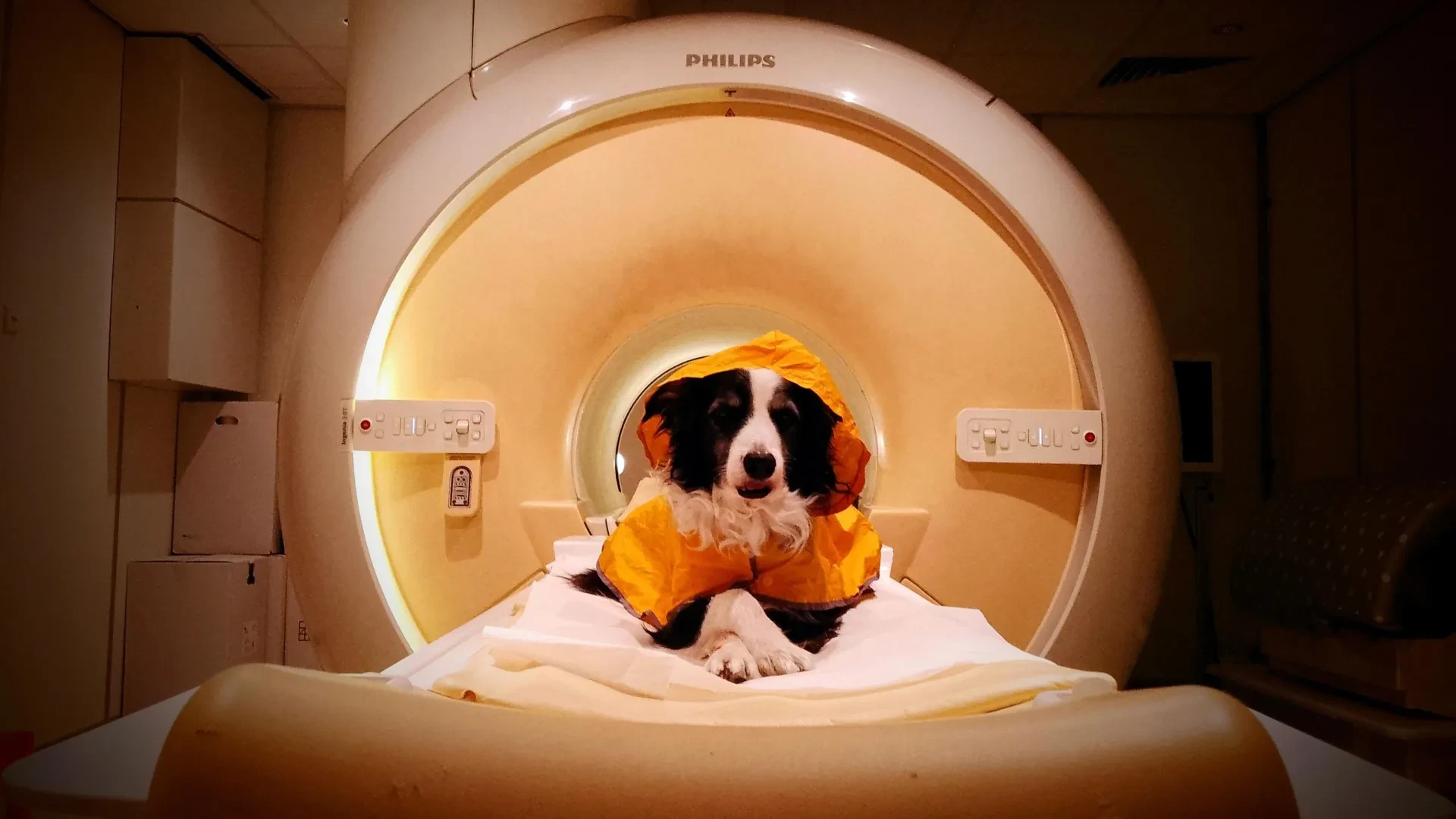

Executive Overview
For millennia, the relationship between humans and dogs (Canis lupus familiaris) has been defined by an unspoken, deeply intuitive bond. Owners frequently report that their canine companions can sense when they are feeling down, share in their joy, or retreat when anger flares. While anecdotal evidence has long suggested that dogs are preternaturally gifted at reading the human face—from a beaming smile to a sorrowful frown—the underlying biological and neurological mechanisms that govern this cross-species empathy have remained largely an evolutionary mystery.
Now, a pioneering neuroimaging study published on August 7 in the Cell Press journal iScience has blown wide open the black box of the canine mind. By peering directly into the active brains of dogs using advanced functional imaging and machine learning, researchers have mapped the specific neural signatures light up when our pets look at our faces.
The findings are profound. Not only do human smiles trigger distinct, high-level cognitive and reward-processing pathways in the canine brain, but the study also delivers the first empirical evidence that dogs can cognitively differentiate between distinct negative human emotions, including anger, fear, and sadness. They do not merely lump all bad moods into a generalized "threat" category; rather, their brains register subtle nuances in our facial expressions.
This revolutionary insight shifts our understanding of canine cognition, offering a window into how thousands of years of domestication have fundamentally rewired the wolf’s ancient descendants. Unlike primates, whose social processing abilities stem from a shared evolutionary tree, dogs have forged a unique, convergent path alongside human civilization. This article provides an in-depth exploration of the study, its rigorous methodology, its broader evolutionary implications, and what it means for the future of human-animal communication.
Detailed Chronology: Unraveling the Canine Mind
The journey to mapping the emotional processing centers of the dog brain was methodical, requiring a fusion of behavioral science, advanced neuroimaging, and cutting-edge computational analysis. Led by an international team of researchers primarily anchored at the University of Vienna, alongside collaborations spanning the National Autonomous University of Mexico and Eötvös Loránd University in Hungary, the project unfolded in distinct phases.
Phase 1: Investigating the Neural Signature of Happiness
To understand how dogs process human emotional expressions, the research team wisely chose to start with the most universally recognized positive signal: the human smile. Previous behavioral observations strongly indicated that positive human expressions hold profound emotional significance for domestic dogs, acting as social glues that reinforce the bond between pet and owner.
The team recruited a cohort of eight pet dogs, training them to remain completely still inside a functional neuroimaging environment without the use of physical restraints or chemical sedation. While the dogs lay calmly, they were shown a series of static images depicting unfamiliar humans displaying either happy, smiling expressions or neutral, expressionless faces.
The results were striking. When exposed to happy human faces, distinct neural activation surged in two primary regions of the canine brain:
- The Temporal Cortex: An area deeply involved in higher-level cognitive processing, visual perception, and the integration of complex sensory data.
- The Caudate Nucleus: A critical node in the brain’s reward and motivation circuitry, heavily associated with the anticipation of pleasure, positive reinforcement, and bonding.
"The activity in the caudate nucleus is particularly interesting," explains Laura Cuaya, a senior researcher on the project from the University of Vienna who initiated the research at the National Autonomous University of Mexico. "It suggests that happy human faces may have deep emotional significance for dogs, processing our joy not just as visual information, but as something fundamentally rewarding."
Phase 2: Expanding the Spectrum to Negative Emotions
Having established that smiles light up reward and cognitive centers, the research team faced a more complex question: How does the canine brain handle the darker side of the human emotional spectrum? Do dogs process all negative expressions identically—grouping anger, fear, and sadness into a single "danger or stress" bucket—or can their brains tell them apart?
To answer this, the researchers expanded their experimental cohort to 12 dogs. These subjects were exposed to a broader gallery of human facial expressions encompassing happiness, anger, fear, and sadness.
Because interpreting complex neural firing patterns across multiple emotional states is exceedingly difficult to do with the naked eye, the researchers turned to advanced machine learning models. They fed the spatial and temporal patterns of brain activity recorded during the scans into algorithms designed to classify and differentiate the neural responses.
Phase 3: The Breakthrough in Negative Discrimination
The machine learning analysis yielded results that shattered previous assumptions about canine social intelligence.
First, the algorithms easily separated the neural response to human smiles from all other expressions. The unique neural network involving the temporal cortex and the caudate nucleus fired in a way that was entirely distinct during the presentation of happy faces compared to any negative emotion.
More importantly, a whole-brain analysis revealed that the dogs’ brains exhibited fundamentally different patterns of neural activity when viewing a fearful face versus an angry or sad face. This provided the scientific community with its very first concrete proof that dogs possess the neurological hardware to distinguish between specific negative human expressions. They recognize that a grimace of fear is not the same as a scowl of anger or the downturned eyes of grief.
Supporting Context & Metrics: The Science and the Caveats
To fully appreciate the weight of these findings, one must examine the metrics of the study, the evolutionary framework surrounding it, and the physiological realities of how dogs navigate their sensory worlds.
Methodological Rigor and Sample Sizes
While cohorts of 8 and 12 dogs might sound modest to the layperson, neuroimaging studies involving awake, unrestrained animals require extraordinary levels of training and animal husbandry. Each dog underwent rigorous behavioral conditioning to ensure they were entirely stress-free, comfortable, and stationary during the fMRI scans. The application of machine learning to the resulting fMRI voxel data allowed researchers to extract statistically significant patterns from complex multidimensional datasets, ensuring that the findings were robust and repeatable.
The Limits of Still Images vs. Multisensory Reality
The researchers are careful to contextualize their findings within the limits of laboratory science. A still photograph of a human face captures only a microscopic slice of real-world communication. In everyday life, dogs do not rely on visual cues alone.
Canines are multisensory creatures that interpret human intent by synthesizing a symphony of simultaneous signals:
- Facial Expressions: Micro-movements of the brow, lips, and eyes.
- Body Language: Posture, shoulder tension, movement speed, and tail carriage.
- Vocalizations: Tone of voice, pitch, inflection, and volume.
- Olfactory Cues: The chemical and hormonal signatures (such as sweat and adrenaline) released by human bodies during emotional states.
Therefore, while the study proves that the brain can process and differentiate these expressions visually, the real-world experience of a dog reading its owner is likely far more holistic and immersive.
The Primate vs. Canine Evolutionary Divergence
One of the most profound theoretical takeaways of the study lies in evolutionary biology. When scientists study how primates (including humans and chimpanzees) process emotions, they are examining traits inherited from a common ancestor. The cognitive architecture for social recognition was present before our evolutionary lines split millions of years ago.
With dogs, however, the evolutionary story is entirely divergent. Wolves split from the lineage that led to modern dogs tens of thousands of years ago. Through the crucible of domestication—living alongside human hunter-gatherers, farmers, and modern suburbanites—dogs underwent rapid, convergent evolutionary pressures. They developed specialized social-cognitive skills specifically tailored to bridge the gap between two vastly different mammalian species. They became, by design and evolution, our ultimate interspecies partners.
Official Statements & Expert Insights
The research team behind the iScience study emphasizes that these findings should fundamentally alter how humans view and treat their canine companions.
"Humans are really good at picking up small details on the face, and so are dogs," notes first author Raúl Hernández-Pérez from the University of Vienna. "This makes dogs very interesting. By studying their brains, we can understand what adaptations have developed to support their remarkable social and emotional understanding of humans."
This highlights the rarity of the canine adaptation. While other animals—such as horses, cats, and even goats—can read certain human cues to varying degrees, the depth and precision of the dog-human emotional bridge remain peerless in the animal kingdom.
Senior author Laura Cuaya expands on the philosophical and practical implications of the work, noting a vital distinction regarding pet environments:
"All of the dogs in the study were pets living with families," Cuaya points out. "Free-ranging dogs, including those that live on the street, experience a very different social environment and may interpret human signals differently through their unique life experiences."
This distinction opens up fascinating avenues for future research, suggesting that domestication and close living quarters with humans play an active role in fine-tuning these neural pathways.
"I would like people to see dogs as emotional beings," Cuaya concludes passionately. "They have evolved with us to understand our expressions and cooperate with us, and recognizing that can change how we communicate with and care for them."
Future Outlook: The Next Frontier in Canine Cognition
As the ink dries on this foundational study, the scientific community is already looking toward the horizon. The publication of these findings marks not an endpoint, but a launching pad for a new era of behavioral neuroscience.
1. Multisensory Brain Imaging
Future studies are already slated to take a more holistic, dog-centered approach. Researchers plan to investigate how canine brains integrate simultaneous signals—such as matching an angry facial expression with an angry vocal tone or a fearful scent. Understanding how the brain synthesizes these multimodal inputs will provide a more accurate picture of how dogs experience our moods in real-world scenarios.
2. Comparative Cognitive Mapping
Another major goal for the University of Vienna research group is direct cross-species comparison. By mapping how dogs and humans process the exact same emotional stimuli under identical experimental conditions, scientists hope to pinpoint the exact functional overlaps and divergences in our shared cognitive landscape.
3. Implications for Animal Welfare and Training
Beyond pure science, these insights carry profound practical applications for veterinary medicine, animal shelter operations, and domestic pet training. Recognizing that dogs possess a nuanced neurological capacity to perceive our distress (sadness, fear) and our approval (smiles, joy) demands a higher standard of empathy from owners.
When a dog cowers or reacts defensively to an angry owner, it is not merely responding to a generalized hostile environment; its brain is actively registering the specific shape of human anger. Conversely, leveraging the reward circuitry of the caudate nucleus through positive reinforcement and affirming human expressions can accelerate training, reduce anxiety-related behavioral problems, and deepen the emotional security of shelter dogs transitioning into adoptive homes.
Ultimately, this landmark research confirms what dog lovers have known in their hearts for generations: when we look into the eyes of a dog, we are not looking into a simple, reactive biological machine. We are gazing into a finely tuned, highly evolved mind that has spent millennia learning how to read our faces, share our sorrows, and celebrate our joys.