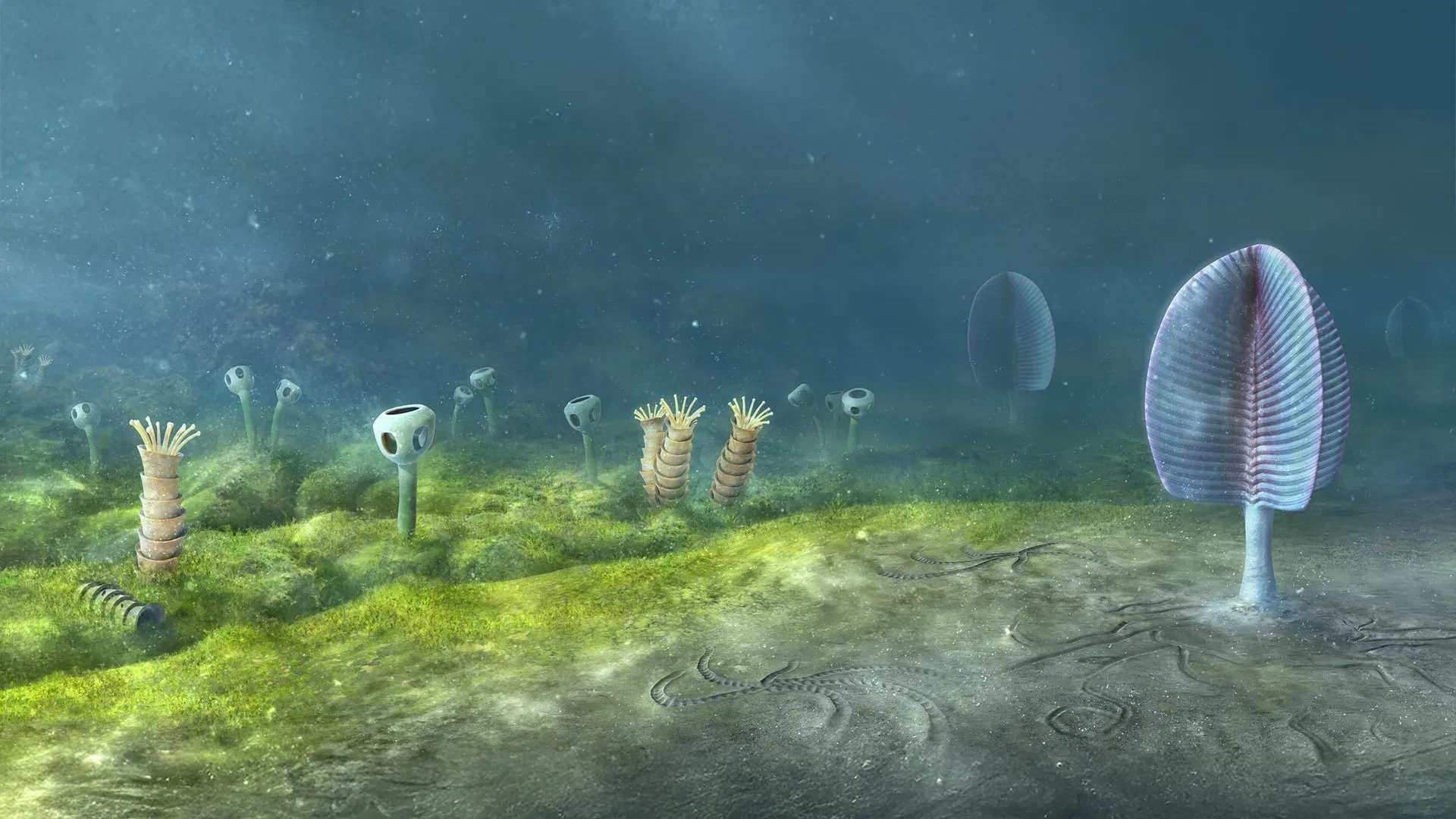

Executive Overview
For generations, evolutionary biologists have operated under a foundational timeline: that the animal kingdom burst onto the scene relatively abruptly shortly before the Cambrian Period, roughly 539 to 487 million years ago. While molecular clock estimates—which measure genetic divergences to track evolutionary milestones—have long hinted at a much deeper, more ancient origin for animal life, physical fossil evidence has stubbornly refused to cooperate.
Scientists attempting to establish a maximum age for the first animals have traditionally relied on exceptional, exquisitely preserved ancient fossil deposits. Chief among these is the Weng’an Biota in China, a 590-million-year-old Ediacaran assemblage containing microscopic organisms preserved down to the cellular level. Because the Weng’an Biota lacks any definitive animal remains despite its extraordinary preservation, paleontologists reasoned that animals simply could not have existed yet. If they had, surely these pristine rock layers would have captured them.
Now, a groundbreaking study led by the University of Oxford and published in Science Advances shatters this critical baseline assumption. By analyzing exceptionally preserved microfossils from the Kheseen Biota in Mongolia—a site roughly 40 to 50 million years younger than Weng’an—an international research team demonstrated that environments capable of preserving delicate microscopic life can completely fail to capture animals, even when we know unequivocally that animals were alive elsewhere on Earth at that time.
By breaking the long-standing "absence equals non-existence" dogma attached to sites like Weng’an, the new research paves the way for molecular clock analyses anchored to much older, pre-Ediacaran rock formations (dating between 850 and 730 million years ago). The resulting calculations push the hypothetical dawn of the animal kingdom backward by a staggering 200 million years. If correct, the earliest animals may have originated between 800 and 700 million years ago—potentially swimming through the primordial oceans before, or right alongside, the catastrophic global glaciations known as "Snowball Earth."
Detailed Chronology: From the Weng’an Dogma to the Mongolian Paradigm Shift
To understand the magnitude of the Oxford-led discovery, one must trace the historical methodology used by paleontologists to bound the origin of animal life. Without direct, undeniable body fossils of the very first multicellular creatures, scientists have relied on stratigraphic constraints—using rock layers of known ages to establish when certain groups must have already existed, and when they could not have existed yet.
The Weng’an Anchor and the Ediacaran Bottleneck
The Weng’an Biota, discovered in South China, has long served as a crown jewel for Precambrian microfossil research. Dating to approximately 590 million years ago during the Ediacaran Period, the deposit is famous for preserving delicate structures, including spherical clusters of cells that initially sparked intense debates over whether they represented early animal embryos.
However, rigorous consensus ultimately categorized these microstructures as non-animal protists or algae. Because the Weng’an deposits exhibit a rare "Konservat-Lagerstätte" style of preservation—where soft tissues and microscopic entities are mineralized in pristine detail—paleontologists leveraged its silence on true animals as a hard ceiling. The prevailing logic dictated that if metazoans (multicellular animals) had evolved by 590 million years ago, the exceptional taphonomic (fossilization) environment of Weng’an would have trapped them. Therefore, scientists argued, animals must have originated after Weng’an.
The Kheseen Biota: Putting the Assumption to the Test
To test whether a lack of animal fossils truly proves an absence of animals, an international team comprising researchers from the University of Oxford, the University of California Berkeley, ETH Zürich, and Yale University turned their attention to Central Asia.
They conducted an exhaustive investigation of the Kheseen Biota in Mongolia, a rock assemblage roughly 40 million years younger than Weng’an. Crucially, the historical moment represented by the Kheseen Biota is one where scientists already have definitive proof that animals existed globally, thanks to confirmed fossil evidence from contemporaneous deposits in places like Namibia and South China.
Using advanced scanning electron microscopy, the research team analyzed more than 140 rock samples, including materials gathered from previously unstudied field locations. They uncovered an array of exquisitely preserved microfossils, including diverse acritarchs—enigmatic, tiny spherical organisms adorned with intricate spines and branching projections—alongside complex, embryo-like microstructures preserving internal cellular divisions.
Despite this breathtaking level of preservation, not a single fossil within the Kheseen assemblage could be confidently identified as an animal.
This single realization dismantled the foundational logic of the Weng’an argument. As the researchers pointed out, if the Kheseen Biota can feature world-class preservation of microscopic life while entirely omitting animal remains—despite the indisputable fact that animals were roaming the Earth at that time—then the absence of animals at Weng’an tells us nothing about whether animals had evolved by 590 million years ago. They may have simply inhabited different ecological niches, or the localized chemical conditions required for fossilization at Weng’an and Kheseen were fundamentally incompatible with preserving early animal tissues.
Rewriting the Molecular Clock
With the Weng’an constraint nullified, the research team reopened the geological record to much older formations dating between 850 and 730 million years ago. These included:
- The Svanbergfjellet Formation in Svalbard, Norway.
- The Bitter Springs Group in the Amadeus Basin, Australia.
- The Chuar Group in the Grand Canyon, Arizona, USA.
All three are richly fossiliferous deposits capable of exceptional microfossil preservation, though none have yet yielded definitive animal fossils. Previously, these ancient sites were dismissed as too old to serve as baseline constraints for animal origins because of the strict timeline imposed by the younger Weng’an deposit.
By integrating these older geological boundaries into a sophisticated molecular clock analysis—which cross-references known genetic mutation rates among living species with fossil calibration points—the researchers generated a radically revised timeline. When anchored to the 850–730 million-year-old formations, the estimated emergence of the animal kingdom shifted backward by roughly 200 million years, placing the origin of animals neatly between 800 and 700 million years ago.
Supporting Context & Metrics
To appreciate the scale of this evolutionary shift, it is essential to examine the physical constraints, chemical markers, and geological milestones that frame the debate surrounding early animal life.
| Parameter / Milestone | Traditional View (Pre-2024) | Revised View (Science Advances Study) |
|---|---|---|
| Estimated Origin of Animals | ~600 to 550 million years ago (Ediacaran) | ~800 to 700 million years ago (Cryogenian / Tonian) |
| Primary Dating Constraint | Weng’an Biota (~590 million years ago) | Older formations (Svanbergfjellet, Bitter Springs, Chuar: 850–730 Ma) |
| Relationship to "Snowball Earth" | Post-dated major glaciations; animals evolved in response to melting ice. | Pre-dated or evolved during extreme global ice ages. |
| Fossilization Blind Spot | Assumed absence in pristine deposits meant non-existence. | Demonstrated that pristine preservation can completely miss soft-bodied animal taxa. |
The Biomarker Puzzle: Chemical Echoes of Ancient Life
Body fossils are not the only form of evidence scientists use to track evolutionary history. Organic geochemists study chemical fossils, or biomarkers—stable hydrocarbon molecules derived from biological lipids that survive in ancient sedimentary rocks for hundreds of millions of years.
Decades of biomarker research have repeatedly detected steroid molecules known as 24-isopropylcholestanes. These specific chemicals are synthesized predominantly by modern demosponges. When extracted from rocks dating back at least 650 million years, these biomarkers suggest that sponge-like animals were already thriving tens of millions of years before macroscopic, hard-part skeletal fossils appeared in the geological record.
The new Oxford study provides the theoretical bridge connecting these tantalizing chemical whispers to a coherent macro-evolutionary framework. If animals truly originated 800 million years ago, the presence of sponge biomarkers at 650 million years ago aligns seamlessly with a prolonged, hidden phase of early metazoan diversification.
The Anatomy of the Invisible
Why did it take so long for animals to leave a clear fossil record? The answer lies in their fragile biology.
The earliest animals were not trilobites with hard shells or vertebrates with mineralized bones. They were microscopic, soft-bodied, gelatinous organisms lacking any hard skeletal parts. When such creatures die, they typically decompose rapidly through bacterial action, scavenged long before sediment can bury and mineralize them.
For a soft-bodied organism to enter the fossil record, a vanishingly rare combination of variables must align perfectly:
- Rapid burial in fine-grained sediment to cut off oxygen and scavengers.
- Early diagenetic mineralization—such as phosphatization, silicification, or pyritization—where minerals replace organic tissues at the cellular level almost instantaneously upon death.
- Favorable local ocean chemistry that promotes micro-scale mineral precipitation.
Because these conditions are intensely localized, entire marine ecosystems can hum with animal life while leaving zero physical trace in the regional sedimentary strata.
Official Statements and Expert Perspectives
The profound implications of the study have drawn commentary from leading figures across international academic institutions, emphasizing both the caution required in interpreting absence and the exciting frontier ahead.
Associate Professor Ross Anderson, Senior Author of the study from the Oxford University Museum of Natural History, explained the core conceptual leap achieved by the team:
"The Kheseen Biota breaks the argument that the exceptional microfossils of Weng’an mean we would have seen animal fossils in the assemblage had they existed at the time. The Kheseen microfossils are just as well-preserved, yet animals continue to be absent—despite the fact we know at that point they existed."
Anderson further underscored the taphonomic reality exposed by the Mongolian samples:
"This suggests animals may have occupied environments different from those represented in the Kheseen deposits, or that the chemical conditions responsible for fossilization there were not suitable for preserving animal remains."
Orin Lole Durbin, first author of the study (who completed the research as an undergraduate at Oxford before beginning his PhD studies at Virginia Tech), maintained a balanced, rigorous scientific perspective on what the model does and does not prove:
"Pre-Ediacaran animal body fossils still elude us, and this analysis does not prove that animals existed 800 million years ago. However, our new fossil evidence from Mongolia undermines one of the main arguments for restricting animal origins to the Ediacaran interval. Meanwhile, our molecular-clock analyses show how much further back their evolutionary history could extend."
Future Outlook: Did Animals Conquer "Snowball Earth"?
Pushing the timeline of animal origins back to 800–700 million years ago opens up one of the most provocative questions in Earth science: How did the earliest animals interact with "Snowball Earth"?
The Cryogenian Icehouse
Around 720 million years ago, the Earth entered the Cryogenian Period, triggering some of the most severe and extensive ice ages in geological history. During episodes colloquially termed "Snowball Earth," continental ice sheets expanded toward the equator, and the global ocean may have been largely encased in thick sea ice.
For decades, scientists debated whether complex multicellular life could have survived such apocalyptic environmental stress, or if the melting of Snowball Earth served as the evolutionary trigger that sparked the creation of animals.
If the Oxford team’s revised molecular clock is accurate, the paradigm shifts entirely. Instead of evolving after the ice melted, animal life may have already been well-established before the glaciers advanced. Some evolutionary biologists even speculate that the extreme environmental pressures of Snowball Earth—such as massive nutrient fluxes from retreating ice, shifting oxygen gradients, and severe evolutionary bottlenecks—acted as the crucible that forged early animal diversification.
The Road Ahead for Paleontologists
Resolving the true birth date of the animal kingdom will require a coordinated, multi-disciplinary assault on the Precambrian rock record. The researchers outline several critical avenues for future investigation:
- Expanding Taphonomic Surveys: Paleontologists must sample a vastly wider array of microfossil-bearing formations globally, targeting diverse depositional environments—from deep-water marine basins to shallow lagoons—to map out where soft-bodied preservation occurs and where it fails.
- Integrated Multiproxy Search: The search for early animals cannot rely on body fossils alone. Future research must weave together three independent threads of evidence: rare body fossil discoveries, trace fossils (such as ancient bioturbation, burrows, or tracks), and continuous organic geochemical biomarker profiles.
- Refining Molecular Clocks: As genetic datasets from modern basal metazoans (like sponges, ctenophores, and placozoans) grow richer, and as geochronological dating of Precambrian ash beds becomes increasingly precise, molecular clock models will tighten their uncertainty margins.
Until a definitive, undisputed animal fossil is wrenched from Cryogenian-aged rock, the exact birth date of the animal kingdom will remain a tantalizing mystery. Yet, by dismantling the false security of the Weng’an bottleneck, the Oxford study has shattered the glass ceiling of Precambrian paleontology—inviting scientists to look deeper into Earth’s history, where a hidden world of ancient animal life may have quietly weathered the deep freeze of Snowball Earth.