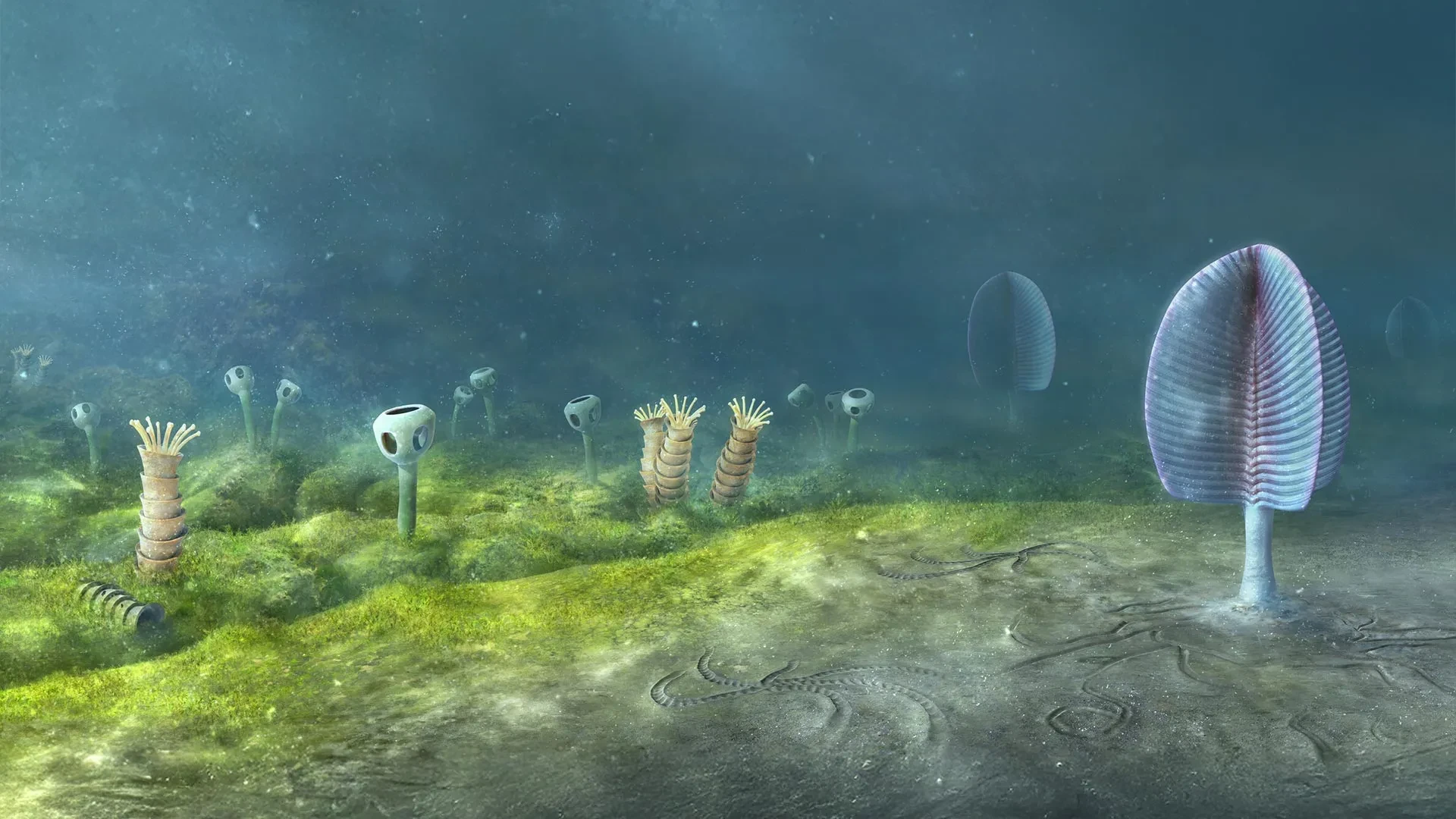

Executive Overview
For generations, evolutionary biologists and paleontologists have relied on a foundational assumption to map the timeline of complex life on Earth: if an unusually well-preserved fossil deposit lacks any trace of animal remains, animals must not have existed yet when those rocks formed.
This logical bedrock has long anchored scientific models, establishing strict chronological boundaries for when multicellular animal life—or Metazoa—first emerged. However, groundbreaking new research published on October 2 in Science Advances shatters this paradigm. Led by an international team of scientists from the University of Oxford, alongside collaborators from the University of California Berkeley, ETH Zürich, and Yale University, the study reveals that animals may have evolved up to 200 million years earlier than their earliest clear appearance in the traditional fossil record.
By examining exquisitely preserved microfossils from the Kheseen Biota in Mongolia, the research team dismantled the long-held "absence of evidence is evidence of absence" argument tied to older deposits like China’s famous Weng’an Biota. When researchers recalibrated their evolutionary timelines—known as molecular clocks—using older geological constraints rather than the Weng’an deposit, the estimated origin of the animal kingdom was pushed backward.
The revised models point to a possible emergence between 800 and 700 million years ago. This timeline places the genesis of animal life deep within the Neoproterozoic Era, thrusting the earliest creatures into a dramatic historical context: they may have predated, or even navigated, the catastrophic, planet-spanning glaciations known as "Snowball Earth."
While definitive body fossils from this deep-time window remain elusive, this study fundamentally reshapes our understanding of evolutionary biology, challenging how science interprets the silences of the fossil record.
Detailed Chronology
To understand the magnitude of the Oxford-led study, one must trace the timeline of early Earth history, the quirks of fossil preservation, and the decades-long scientific pursuit of the "first animal."
The Cambrian Illusion and the Ediacaran Gap
To the casual observer, the history of animal life on Earth appears to burst forth out of nowhere during the Cambrian Period, spanning roughly 539 to 487 million years ago. During this relatively brief geological window, the fossil record suddenly teems with complex, hard-shelled organisms, articulated arthropods, mollusks, and early chordates in an event frequently termed the "Cambrian Explosion."
However, evolutionary theorists have long known this sudden appearance was an illusion. Genetic data and molecular clock analyses consistently suggested that the lineages leading to these complex animals split from their single-celled ancestors hundreds of millions of years earlier. Yet, hunting for physical proof of these ancient forebears proved immensely frustrating.
The Weng’an Biota and the "Maximum Age" Anchor
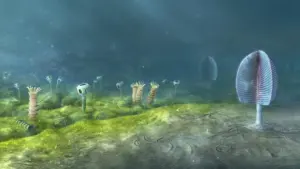
Enter the Ediacaran Period (stretching from 635 to 539 million years ago). Scientists scouring Ediacaran rocks discovered exceptional Lagerstätten—fossil sites exhibiting extraordinary preservation. Among the most prized of these is the Weng’an Biota in South China, a roughly 590-million-year-old deposit containing microscopic organisms preserved down to the cellular level.
Because Weng’an preserves delicate, microscopic life forms with breathtaking clarity, paleontologists historically reasoned that if multicellular animals had been swimming, crawling, or burrowing in the oceans 590 million years ago, the Weng’an environment would have captured them. Because zero undisputed animal fossils were ever found in Weng’an, scientists used the deposit as a chronological anchor: a maximum age boundary dictating that the animal kingdom must have originated after 590 million years ago.
The Kheseen Biota: Breaking the Mold
This assumption has now been thoroughly tested and overturned through the investigation of the Kheseen Biota in Mongolia.
The Kheseen Biota is a fossil assemblage roughly 40 million years younger than Weng’an (dating deeper into the Ediacaran, though subsequent to Weng’an’s formation). Crucially, by the time the Kheseen Biota formed, scientists already possess definitive proof from other global locations—such as Namibia and South China—that animals were actively populating Earth’s marine ecosystems.
An international team of researchers, employing advanced scanning electron microscopy, analyzed more than 140 rock samples from the Kheseen Biota, including materials gathered from previously undocumented locations. The analytical yield was astonishing: they discovered exquisitely preserved microfossil species, including intricate acritarchs (spherical microscopic organisms adorned with delicate spines and branching projections) and mysterious, embryo-like fossils complete with internal cell structures.
Yet, despite this phenomenal level of preservation—rivaling or exceeding that of Weng’an—not a single fossil within the Kheseen Biota could be definitively identified as an animal.
This discovery delivers a fatal blow to the foundational logic of the Weng’an argument. The Kheseen Biota proves that an environment can possess the exact chemical and geological conditions required to preserve microscopic, soft-tissue structures in microscopic detail, yet still completely fail to capture animal remains, even when we know animals existed globally at that time. Consequently, the absence of animal fossils in the 590-million-year-old Weng’an deposit no longer serves as proof that animals had yet to evolve.
Recalibrating the Molecular Clock
With the Weng’an constraint invalidated, the research team looked much further back in the geological column—specifically to rock formations dating from 850 to 730 million years ago. These included:
- The Svanbergfjellet Formation in Norway,
- The Bitter Springs Group in Australia, and
- The Chuar Group in Arizona, United States.
These ancient, fossil-rich formations possess the geological capability to preserve delicate organic remains, though no confirmed animal fossils have yet been extracted from them. Historically, scientists hesitated to use these formations as baseline constraints for animal evolution because doing so implied an ancient, hidden pedigree for animals that lacked fossil support.
By integrating these older geological constraints into sophisticated molecular clock analyses, the research team recalculated the evolutionary timeline. Molecular clocks operate by measuring the accumulation of genetic mutations over time in living species, combining this genetic distance with fossil calibration points and estimated evolutionary rates to project backward toward common ancestors.
When the researchers substituted the younger Weng’an constraint with these older 800-to-730-million-year-old formations, the mathematical models shifted dramatically. The estimated origin of the animal kingdom was pushed backward by approximately 200 million years, placing the dawn of animal life squarely between 800 and 700 million years ago.
Supporting Context & Metrics
To appreciate the gravity of a 200-million-year evolutionary shift, it is essential to examine the supporting evidence, the inherent limitations of the fossil record, and the dramatic planetary conditions that characterized the Neoproterozoic era.
The Chemical Witness: Biomarkers and Sponges
Long before scientists uncovered this latest molecular clock recalculation, indirect geochemical evidence hinted at a deeper pedigree for the animal kingdom.
In ancient rocks dating back at least 650 million years, researchers have detected specific chemical fossils, known as biomarkers. These molecular signatures—such as distinct lipid compounds synthesized by specific biological groups—are consistent with the presence of early demosponges. Sponges represent the basal branch of the animal family tree (Metazoa). Finding their chemical ghosts embedded in rocks tens of millions of years older than the oldest macroscopic body fossils strongly suggests that the structural fossil record is heavily biased.
Why Are Early Animals Missing?
The fundamental challenge of early paleontology is taphonomic bias: the physical realities governing what survives the fossilization process.
- Anatomy: The earliest animals were minuscule, morphologically simple, and entirely soft-bodied. Lacking mineralized shells, exoskeletons, spicules, or bones, their biological tissues decayed rapidly upon death.
- Environment: Early animal life was likely restricted to specific ecological niches—such as shallow-water microbial mats or deep-sea microhabitats—where fossilization conditions were rarely replicated.
- Geochemistry: Transforming a soft-bodied organism into a microfossil requires a hyper-specific sequence of rapid mineral replacement (such as phosphatization or silicification) before microbial decay obliterates cellular architecture.
Entering the Era of "Snowball Earth"
Pushing the origin of animals back to 800–700 million years ago forces a radical reevaluation of Earth history, intersecting directly with the Cryogenian Period, which began roughly 720 million years ago.
The Cryogenian is famous for episodes of extreme glaciation known colloquially as "Snowball Earth," during which continental ice sheets expanded from the poles to the tropics, locking the global ocean beneath thick sheets of ice.
If animals indeed originated between 800 and 700 million years ago, it means the animal kingdom either:
- Evolved before these catastrophic global freezings and managed to survive localized refugia (such as equatorial open-water patches or deep-sea hydrothermal vents), or
- Emerged during this period of intense environmental stress, with extreme climate fluctuations acting as an evolutionary catalyst that drove early multicellular diversification.
Official Statements
The researchers behind this landmark study have emphasized both the revolutionary nature of their findings and the humility required when investigating deep-time biology.
Associate Professor Ross Anderson, Senior Author of the study from the Oxford University Museum of Natural History, explained how the Mongolian discovery dismantles decades of paleontological dogma:
"The Kheseen Biota breaks the argument that the exceptional microfossils of Weng’an mean we would have seen animal fossils in the assemblage had they existed at the time. The Kheseen microfossils are just as well-preserved, yet animals continue to be absent—despite the fact we know at that point they existed."
Highlighting the reality that ancient animal bodies continue to elude discovery, Professor Anderson noted the ongoing mystery surrounding the exact birth date of the animal lineage:
"Until that evidence becomes available, the precise birth date of the animal kingdom remains uncertain."
Orin Lole Durbin, First Author of the study (who began the research as an Oxford undergraduate and is now a PhD student at Virginia Tech), underscored that while the study does not offer a smoking gun for 800-million-year-old animal fossils, it successfully dismantles the traditional barriers restricting animal evolution to the Ediacaran:
"Pre-Ediacaran animal body fossils still elude us, and this analysis does not prove that animals existed 800 million years ago. However, our new fossil evidence from Mongolia undermines one of the main arguments for restricting animal origins to the Ediacaran interval. Meanwhile, our molecular-clock analyses show how much further back their evolutionary history could extend."
Future Outlook
As the scientific community digests the implications of the Science Advances publication, researchers are charting a multidisciplinary path forward to solve one of Earth’s greatest biological mysteries.
1. Expanding the Geochemical and Paleontological Search
Paleontologists can no longer rely on a handful of celebrated Lagerstätten to anchor evolutionary timelines. Future field expeditions must cast a much wider net, examining microfossil and macrofossil deposits from a diverse array of geographic locations, paleolatitudes, and depositional environments. By studying formations with varying sedimentological and chemical preservation profiles, scientists can better understand where early animals lived and why their remains are so rarely preserved.
2. Synthesizing Multimodal Lines of Evidence
The future of pre-Cambrian paleontology relies heavily on data integration. Researchers emphasize that the hunt for the earliest animals cannot succeed through fossil morphology alone. Instead, future investigations must seamlessly weave together:
- Animal body fossils (wherever they may serendipitously appear),
- Trace fossils (such as ancient burrows, trackways, or biomats indicating complex behavioral motility), and
- Chemical biomarkers (preserving lipid and isotopic signatures of ancient organisms in molecular detail).
3. Refining Molecular Clock Models
As genetic databases of extant organisms expand and analytical techniques become more sophisticated, molecular clock methodologies will continue to sharpen. By constantly feeding newly discovered geological constraints and refined mutation rates into these models, computational biologists will narrow the uncertainty windows surrounding the evolutionary tree.
Summary Conclusion
The research led by Oxford University does not merely rewrite a textbook chapter; it recalibrates our conceptual framework of life’s resilience. By proving that the absence of animal fossils in prime deposits like Weng’an is a misleading artifact of preservation rather than proof of absence, the study opens a vast, hidden corridor in Earth’s history.
Whether the first animals crept through the shallow seas of a pre-glacial Eden or forged their multicellular complexity in the crucible of a frozen planet, science is now better equipped than ever to chase their ghosts across the deep expanse of geological time.