
Executive Overview
Deep within the hyper-arid sands of Peru’s northern coast, archaeologists have unearth-breaking physical evidence rewriting the history of one of South America’s most iconic and distinctive animal breeds. At the sprawling ancient administrative and burial complex of Castillo de Huarmey, researchers have discovered the oldest confirmed remains of Peruvian hairless dogs, dating back more than 1,200 years—centuries before the rise of the majestic Inca Empire.
Long immortalized in the ceramic pottery of pre-Hispanic Andean civilizations for their slender frames, erect ears, and distinct lack of fur, these animals had nevertheless eluded definitive physical identification in early archaeological strata until now. A landmark study published in the Journal of Anthropological Archaeology details the excavation of naturally mummified remains, unique skeletal anomalies, and chemical signatures that illuminate how these fascinating creatures lived, what they ate, and how they coexisted with the Wari Empire.
The findings offer a profound window into the complex, multifaceted relationship between humans and animals in the ancient world. Far from viewing dogs through a singular lens, Wari society displayed a fascinating dichotomy: hairless canines were treated with varying levels of reverence—ranging from solemn, elite interments alongside master craftspersons to more utilitarian existences—proving that human-animal dynamics a millennium ago were just as nuanced, contradictory, and deeply personal as they are today.
Detailed Chronology: Unearthing the Secrets of Castillo de Huarmey
To fully grasp the magnitude of the recent canine discoveries, one must understand the chronology and historical weight of Castillo de Huarmey itself. Situated approximately 190 miles north of Lima, this 110-acre monumental complex served as a vital administrative, religious, and funerary epicenter for the Wari Empire, which flourished between 600 and 1050 CE—predating the Incas by roughly 400 years.
The timeline of modern archaeological intervention at Castillo de Huarmey reads like a succession of monumental revelations:
- Pre-1970s: The deep stratigraphy of the burial complex remains undisturbed, preserving layers of Wari civilization safely beneath the desert surface.
- 1970: A powerful, high-magnitude earthquake strikes the region, causing architectural collapses at Castillo de Huarmey that inadvertently expose subterranean burial chambers containing valuable pottery and organic treasures.
- Post-Earthquake Era: The site suffers from extensive and destructive looting, which severely compromises the upper archaeological layers and mixes modern debris with ancient artifacts. Fortunately, the deepest cultural strata remain intact.
- 2010–2025: Comprehensive, long-term excavations led by international teams systematically peel back the layers of the complex, uncovering extensive South American camelid remains (domesticated llamas and alpacas), sacrificial contexts, and rich architectural spaces.
- 2012: Researchers uncover the first completely undisturbed elite Wari tomb. The chamber contains the staggering remains of 58 high-status noblewomen, six human sacrifices, and approximately 1,300 luxury artifacts crafted from gold, silver, bronze, wood, and textiles.
- 2022: Archaeologists unearth adjacent burials belonging to elite craftspersons, accompanied by pristine tools of precious metals that illuminate the sophisticated manufacturing economy of the Wari Empire.
- The Present Study: Advanced zooarchaeological, isotopic, and radiocarbon analyses focus on the site’s canine remains, culminating in the formal identification of the earliest physical specimens of Peruvian hairless dogs ever recorded at a Wari site.
Supporting Context & Metrics: Genetics, Isotopes, and Ancient Diets
The discovery of ancient dog remains in a looted and earthquake-damaged archaeological site presented immediate hurdles. Upper layers of the Castillo de Huarmey complex were heavily churned, making the exact dating and cultural attribution of animal bones challenging. However, a combination of biological science, chemical tracking, and osteological analysis unlocked the true identity of the specimens.
The Genetic Clue: Missing Teeth and Hairlessness
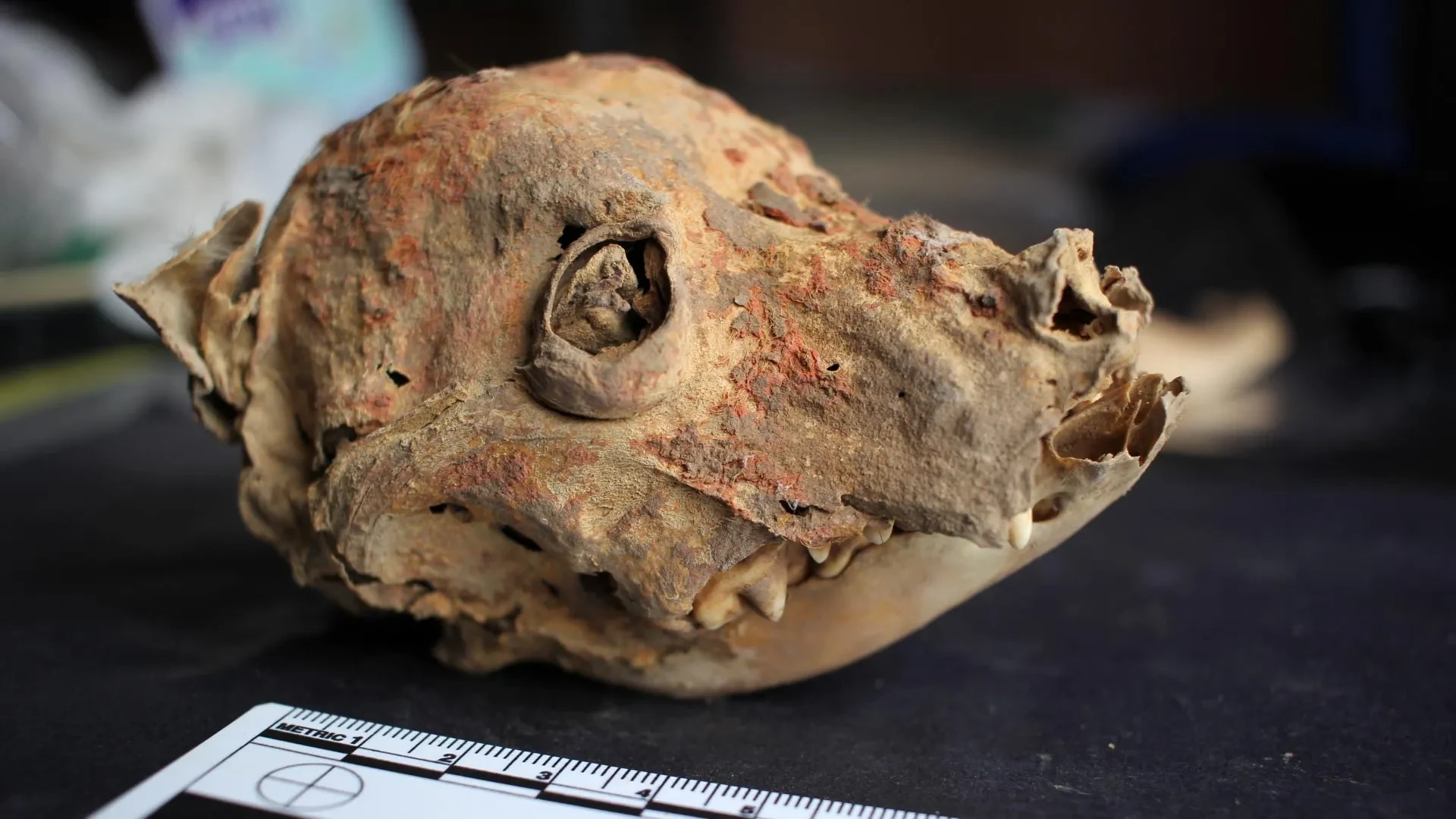
During excavations in the northern section of the main ceremonial area, researchers recovered 341 individual dog bone specimens representing at least 19 distinct animals, alongside a complete, naturally mummified male dog. Initially, the remarkably preserved state of the mummies caused researchers to question whether the animals were truly ancient, or perhaps the byproduct of more recent disturbances.
The definitive proof came from an unexpected anatomical feature: missing teeth.
- Unerupted Premolars: Lead researchers observed that several of the dog skulls lacked specific teeth—not due to extraction, disease, or old age, but because the first premolars and occasional last molars had simply never erupted.
- The Genetic Link: Cross-referencing veterinary and genetic literature revealed that the exact gene responsible for congenital hairlessness in dogs is directly linked to hypodontia (a reduced number of teeth). This biological marker confirmed beyond doubt that the mummified remains and skeletal fragments belonged to Peruvian hairless dogs.
Isotopic Analysis: Reconstructing Ancient Menus
To understand the lives of these ancient canines, the research team employed zooarchaeological techniques and advanced isotopic analysis. By extracting chemical signatures from bone collagen and tooth enamel, scientists can reconstruct an animal’s geographic origins and dietary habits over distinct life stages.
- Bone vs. Tooth: Tooth enamel captures the diet of an animal during its earliest puppyhood (as teeth form rapidly), while bone collagen reflects dietary intake over the final year of life.
- Maize Consumption: Isotopic ratios of carbon, nitrogen, oxygen, and strontium demonstrated that most of the Castillo de Huarmey dogs consumed significant amounts of maize (corn), aligning their diets closely with the staple foods of the human inhabitants.
- The Puppy Paradigm: Chemical signatures from hairless puppies revealed specialized dietary patterns during their earliest weeks of life that mirrored the diets of human children. As these animals matured, their diets diversified, pointing toward deliberate human management, targeted feeding, or highly organized breeding practices within the Wari community.
Elite Interments and Burial Contexts
The physical placement of the dogs within the Castillo de Huarmey complex further emphasizes their unique social standing:
- The Master Basketmaker: The skeletal remains of a tiny puppy, estimated to be just 6 to 8 weeks old, were discovered directly alongside an elite craftsperson renowned as the "Master Basketmaker."
- Palace Guards and Sacrifices: An adult dog was interred within the site’s primary palace architecture, while another puppy skeleton accompanied the remains of an adult male sacrifice designated as a potential tomb guardian.
- Radiocarbon Milestone: Radiocarbon dating confirmed that the complete mummified male dog is at least 1,200 years old, setting a new benchmark as the oldest radiocarbon-dated specimen recovered from the Castillo de Huarmey complex to date.
Official Statements and Academic Insights
The implications of this multidisciplinary study stretch far beyond zooarchaeology, offering a nuanced reflection on how human societies interact with the animal kingdom across the centuries.
"Our findings indicate that humans and dogs coexisted at this Wari site, but reconstructing their bond is challenging, as past emotions are difficult to capture through archaeological methods," explains Weronika Tomczyk, first author of the study, a research associate in Dartmouth’s Department of Anthropology, and a postdoctoral fellow in its Ecology, Evolution, Environment and Society Program.
Tomczyk emphasizes that the study transcends mere data collection, aiming to humanize the historical record by acknowledging the contradictions inherent in human-animal relationships:
"The goal of our study was to not only present data on Castillo de Huarmey’s dog burials, but also emphasize that people in the past had often contradictory relationships with the animals, just as they do today: a pet for one group of people could at the same time be considered a pest by their closest neighbors."
Elaborating on the biological markers that unlocked the mystery of the hairless dogs, Tomczyk notes:
"What I noticed is that some of the dog skeletons were missing teeth, and not that they lost them during their lifespan; some teeth, especially first premolars and sometimes last molars, had just never erupted. And then I found in the literature that the same gene which is responsible for hairlessness in dogs is responsible for a reduced number of teeth, indicating that these were Peruvian hairless dogs."
Addressing the dietary and behavioral clues uncovered via isotopic tracking, Tomczyk adds:
"We do not know if the dogs were intentionally fed maize or if perhaps, they were just eating leftovers or trash. Yet, the distinct dietary patterns of hairless puppies provide insights into what may have been organized breeding… While we will never know if any of the three dogs were pets or how people treated them, it is evident they received different treatment than other dogs."
The collaborative international study was co-authored by distinguished researchers Miłosz Giersz, Wiesław Więckowski, and Roberto Pimentel Nita of the University of Warsaw, alongside Claire Ebert of the University of Pittsburgh.
Future Outlook
The identification of 1,200-year-old Peruvian hairless dog mummies at Castillo de Huarmey opens exciting new avenues for Andean archaeology and evolutionary biology. As researchers continue to process the vast array of organic and inorganic materials preserved by the hyper-arid Peruvian desert, several key areas will command future scientific attention:
- Expanded Genetic Mapping: Future studies may utilize ancient DNA (aDNA) extraction to map the complete genetic lineage of the Castillo de Huarmey canines, comparing them to modern descendants of the Peruvian Inca Orchid and other indigenous American dog breeds.
- Broader Isotopic Mapping: By scaling strontium and oxygen isotope analyses across a larger sample of human, camelid, and canine remains, scientists hope to trace ancient migration routes, trade networks, and animal mobility throughout the Wari Empire.
- Comparative Wari Zooarchaeology: Researchers plan to cross-reference the Castillo de Huarmey findings with upcoming excavations at other peripheral Wari administrative centers, determining whether the specialized breeding and elite interment of hairless dogs was a widespread imperial practice or a localized coastal tradition.
Ultimately, these remarkably preserved desert mummies bridge a millennia-long gap between ancient iconography and biological reality. They remind us that the deep bond between humans and their canine companions is an ancient, enduring legacy—one written not just in monumental stone architecture and golden treasures, but in the silent, loyal paws of history.