
Executive Overview
For millennia, dogs have occupied a unique space in the human ecosystem. Evolving from ancient wolf-like ancestors into our most trusted domestic companions, they have bridged an interspecies divide through an uncanny, almost telepathic ability to understand human moods. Whether offering a comforting nudge after a difficult day or greeting us with unbridled joy upon our return, dogs appear to feel what we feel. While dog owners and animal behaviorists have long celebrated this profound emotional intelligence, the underlying neurological mechanisms have remained an enigma.
Now, a landmark study published on August 7 in the prestigious Cell Press journal iScience offers an unprecedented look into the canine mind. Conducted by an international team of researchers—primarily from the University of Vienna, alongside collaborators from the National Autonomous University of Mexico and Eötvös Loránd University in Hungary—the study uses advanced neuroimaging and machine learning to map precisely how a dog’s brain responds to various human facial expressions.
The findings confirm that human smiles spark distinct, measurable neurological activity within specific regions of the canine brain, illuminating why happiness resonates so deeply with our pets. More importantly, the research provides the first empirical evidence that dogs do not merely lump negative human emotions into a single, monolithic category of "stress" or "danger." Instead, canine brains generate distinct neural signatures for anger, fear, and sadness, demonstrating a sophisticated capacity to differentiate among a broad spectrum of human feelings.
This investigative report explores the chronological development of this pivotal research, details the neurological metrics that reshaped our understanding of canine cognition, contextualizes the evolutionary milestones of domestication, and examines how these insights will forever alter our communication and relationship with our pets.
Detailed Chronology of the Research
The path to decoding the canine brain was paved by years of behavioral observations, which eventually necessitated high-tech intervention to look beneath the surface.
Phase One: Recognizing the Behavioral Baseline
For decades, scientists understood that dogs could react to human faces. Behavioral studies showed that dogs look to human faces for cues when facing unsolvable problems, and they often mirror human yawns. However, behavioral observation can only reveal so much. It cannot explain why or how the brain processes these signals. Was the dog actually processing the emotional content of a smile, or merely responding to the visual geometry of an upturned mouth? To answer this, researchers needed to look inside the brain.
Phase Two: The First Wave of Brain Scans (Happiness vs. Neutral)
The research team initiated their neurological investigation by focusing on happiness, hypothesizing that positive human expressions hold profound evolutionary significance for pets.
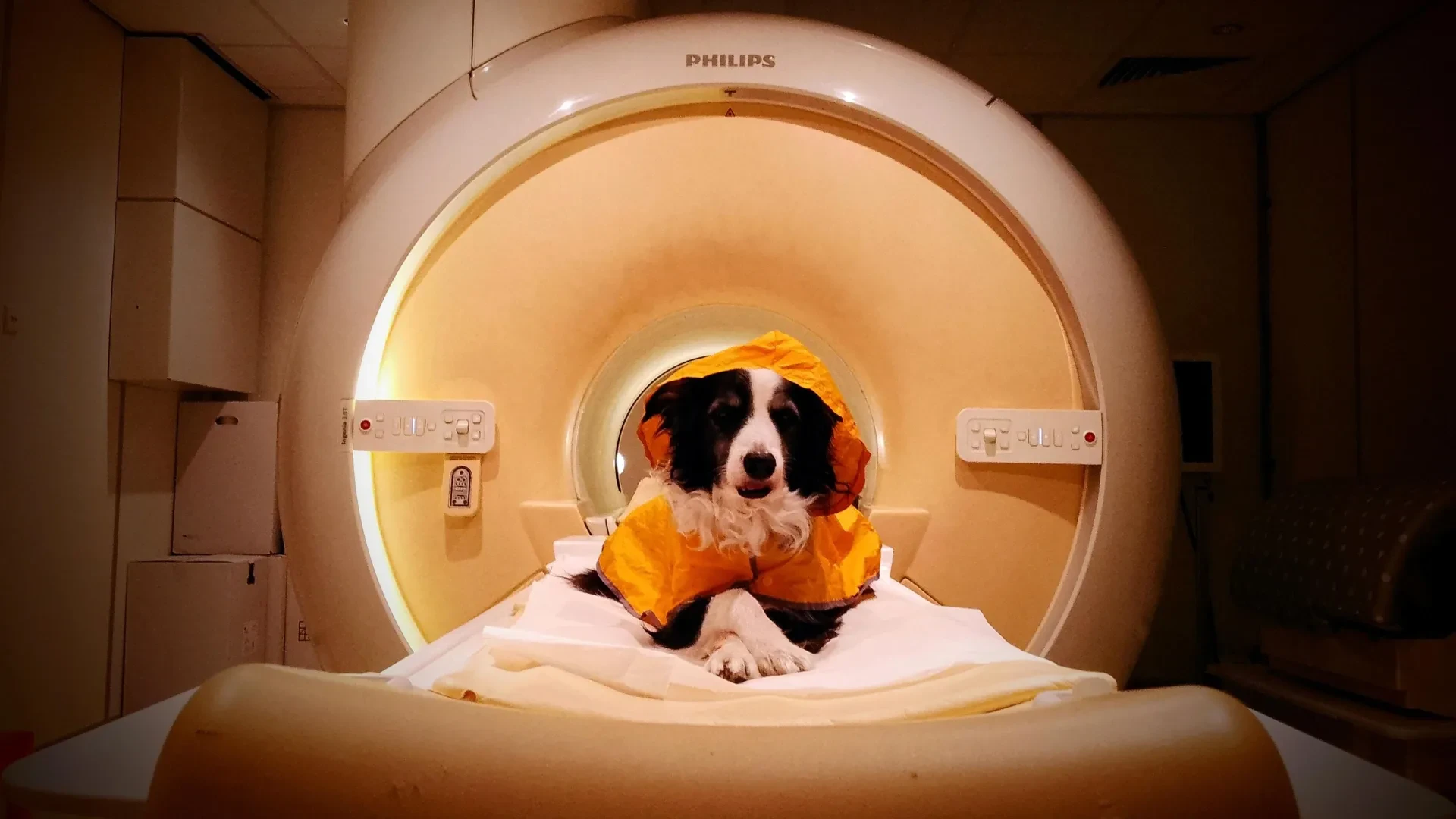
In the initial experiment, researchers scanned the brains of eight domestic dogs while the animals were exposed to images of unfamiliar humans displaying either happy or neutral expressions. By utilizing non-invasive functional imaging techniques, the team monitored real-time neurological activity. The results were immediate and striking: when exposed to happy faces, the dogs showed a sharp increase in neurological activity within two distinct brain regions—the temporal cortex and the caudate nucleus.
These areas are far from arbitrary. In both human and mammalian neurobiology, the temporal cortex is deeply involved in higher-level cognitive processing, visual perception, and categorization. Meanwhile, the caudate nucleus is universally recognized as a core component of the brain’s reward circuitry. This activation suggested that a human smile is not just seen by a dog; it is actively registered as a rewarding, positive stimulus.
Phase Three: Expanding the Emotional Spectrum
Having established how dogs process happiness, the research team sought to determine whether these same brain networks would react differently to a wider variety of emotions—specifically, negative ones.
In a subsequent and more complex phase of the study, the researchers expanded their cohort to 12 dogs. These animals were exposed to a comprehensive gallery of human expressions, including happiness, anger, fear, and sadness. To untangle the complex webs of data generated by the brain scans, the research team deployed advanced machine learning algorithms. These computational models were tasked with analyzing patterns of neural activity across the entire brain to see if the canine mind could successfully sort and categorize these varied emotional signals.
The results of this machine learning analysis shattered previous assumptions about canine emotional processing. Not only did the dogs react differently to positive versus negative expressions, but their brains also created unique, discernible neurological patterns for distinct negative emotions.
Supporting Context & Metrics: Inside the Canine Brain
To fully appreciate the magnitude of the iScience study, one must examine the specific neurological metrics and the experimental conditions that yielded these discoveries.
The Neurological Hardware of Empathy
The canine brain is remarkably adapted for social navigation, despite possessing a different evolutionary history than primates. Two primary regions emerged as the focal points of the study:
- The Temporal Cortex: Responsible for processing complex sensory inputs, this region allowed the dogs in the study to parse the visual architecture of human faces. When distinguishing between a smiling face and a frowning or fearful expression, the temporal cortex worked overtime to analyze minute spatial details, such as the tension around the eyes or the curve of the lips.
- The Caudate Nucleus: Often dubbed the "reward center" of the mammalian brain, the caudate lights up in anticipation of food, praise, or the presence of a beloved companion. Its activation in response to a human smile confirms that happiness is inherently reinforcing for dogs. They do not just recognize a smile; their brains treat it like a biological treat.
Machine Learning and Whole-Brain Analysis
One of the study’s greatest methodological triumphs was its use of whole-brain analysis combined with machine learning. Traditional neuroimaging studies often rely on predefined "regions of interest," potentially missing subtle, distributed patterns of activity across the wider brain.
By feeding scan data into machine learning classifiers, the researchers were able to test whether computer algorithms could reliably guess what emotion a dog was looking at based solely on the dog’s brain activity. The algorithm successfully separated responses to happy faces from all other emotions, thanks to the distinct activity within the temporal cortex and caudate nucleus network.
Furthermore, a deeper whole-brain analysis revealed that fear produced a fundamentally different pattern of neural activity compared to anger and sadness. While anger and sadness share overlapping qualities—both being low-valence, subdued or aggressive states—the canine brain treats fear as a unique category requiring distinct cognitive processing. This suggests a high degree of perceptual granularity in dogs, disproving the outdated theory that animals view the world in a simplistic binary of "safe" versus "dangerous."
The Controlled Variables
It is critical to note the precise parameters under which these metrics were gathered. All 12 dogs participating in the second phase of the study were domestic pets living closely with human families. Consequently, their brains had been shaped by years of daily exposure to human emotional displays, vocal tones, and behavioral feedback loops.
Furthermore, the stimuli used in the experiments consisted of still images of unfamiliar people. While this allowed researchers to control for variables like familiarity and body language, it also represented a stripped-down version of reality. In everyday life, dogs interpret humans through a multisensory tapestry encompassing facial expressions, posture, vocalizations, and scent. The fact that dogs could distinguish emotions from static images alone underscores just how hardwired they are to read human faces.
Official Statements and Expert Perspectives
The lead architects behind this groundbreaking research have offered profound insights into what these findings mean for the future of ethology, evolutionary biology, and human-animal relationships.
Raúl Hernández-Pérez, the study’s first author from the University of Vienna, emphasized the exceptional visual acuity of dogs compared to other domesticated species:
"Humans are really good at picking up small details on the face, and so are dogs. This makes dogs very interesting. By studying their brains, we can understand what adaptations have developed to support their remarkable social and emotional understanding of humans."
This sentiment is echoed by senior author Laura Cuaya, also of the University of Vienna, whose academic journey on this project spanned institutions in Mexico and Hungary. Cuaya highlighted the uniqueness of the canine evolutionary trajectory when contrasted with our closest primate relatives:
"When we compare humans with primates, we are looking at abilities that may have come from a common ancestor. With dogs, the story is totally different. They followed a very different evolutionary path, yet through domestication, they developed the social abilities needed to understand and cooperate with us."
Cuaya also stressed the philosophical and practical implications of the research for everyday pet owners. Rather than viewing dogs as simple-minded animals driven purely by basic instincts, we must recognize their capacity for emotional attunement:
"I would like people to see dogs as emotional beings. They have evolved with us to understand our expressions and cooperate with us, and recognizing that can change how we communicate with and care for them."
Future Outlook: The Next Frontier in Canine Cognition
While the iScience study marks a monumental leap forward in our understanding of animal psychology, it also opens the door to a myriad of new research questions. The scientific community is already looking toward the horizon to plan the next phase of investigations into the canine mind.
Expanding Beyond the Family Home
One of the primary caveats acknowledged by the research team is the demographic of their study participants: all were household pets. Free-ranging dogs, community street dogs, and working animals experience vastly different social environments. Future studies aim to compare the brain scans of family pets with those of free-ranging dogs to determine whether the ability to differentiate human micro-expressions is an innate byproduct of thousands of years of domestication, or a skill heavily honed by individual life experience living inside human homes.
Multisensory Integration and Ecological Validity
Because the recent study relied on still images, researchers are eager to explore how dogs process emotion when multiple sensory inputs are combined. Future experimental designs will likely incorporate dynamic video footage paired with vocalizations—such as happy laughter, angry shouting, or fearful gasps—to see how the canine brain integrates visual and auditory emotional signals in real time.
Cross-Species Comparative Studies
Another exciting avenue on the horizon involves direct comparative studies between humans and dogs. By examining how both species process identical emotional stimuli, scientists hope to gain a clearer picture of convergent evolution: how two entirely different species, separated by millions of years of evolutionary divergence, arrived at a shared neurological framework for cross-species empathy and cooperation.
Changing How We Live with Dogs
Ultimately, the future outlook of this research extends far beyond academic journals. As we decode the biological mechanisms that allow dogs to read our smiles, hear our pain, and recognize our fear, our responsibility toward them deepens.
Understanding that our pets are actively processing our emotional states means we must be more mindful of the emotional atmosphere we create in our homes. When we smile, our dogs genuinely share in the neurological warmth of that happiness. Conversely, when we project unmanaged anger, fear, or sadness, our pets register those distinct emotional tones, underscoring the deep empathy that defines the human-canine bond.