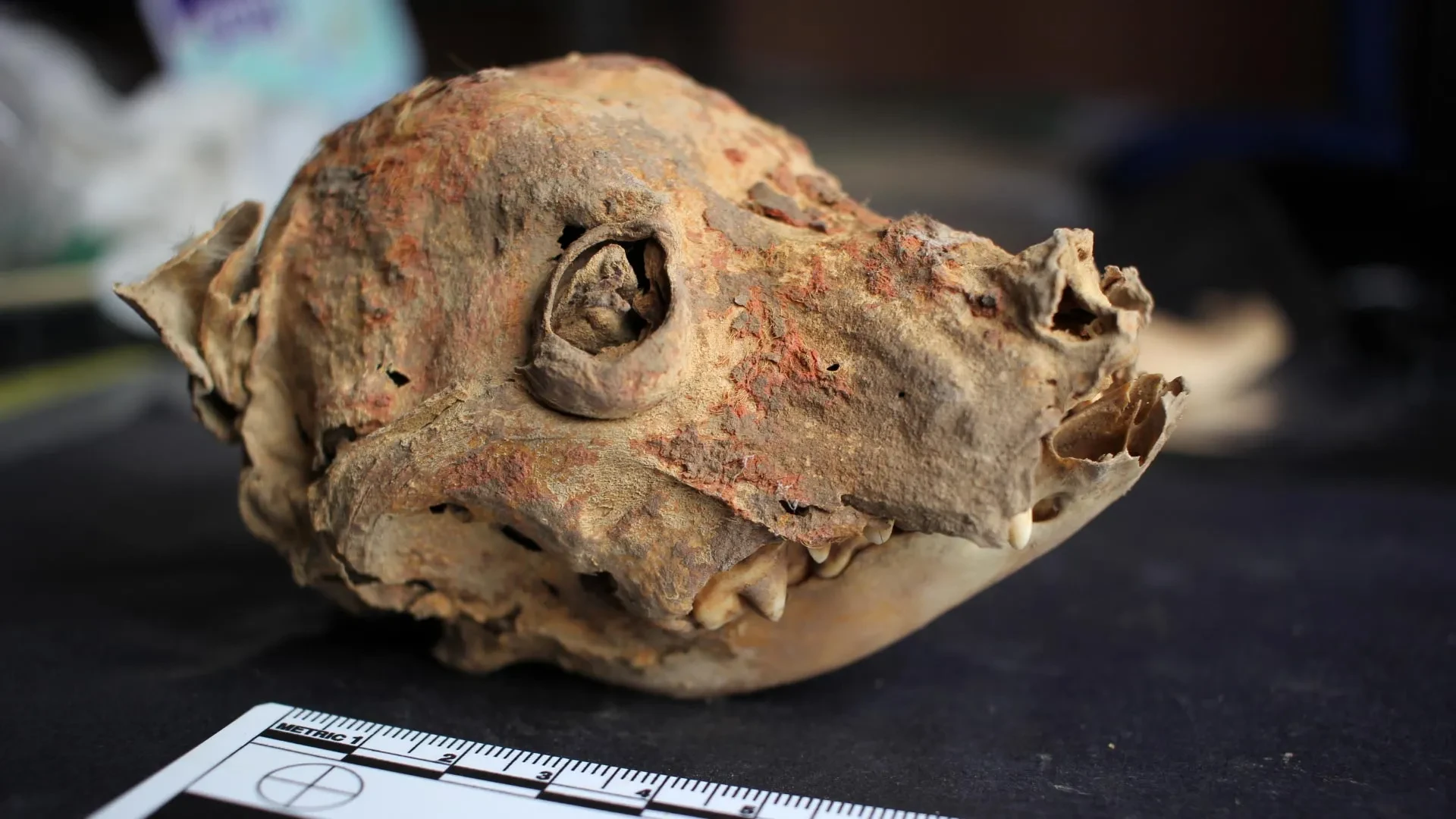

Deep within the hyper-arid expanse of Peru’s Pacific coast, a team of international archaeologists has unearthed a groundbreaking physical link to the ancient Andean past. Excavating the monumental Castillo de Huarmey—an expansive 110-acre administrative and ceremonial complex established by the pre-Inca Wari Empire—researchers have uncovered the earliest definitive physical evidence of Peruvian hairless dogs ever recorded. Dating back more than 1,200 years, these remarkable remains include naturally mummified specimens, distinct skeletal anomalies, and intricate chemical signatures that illuminate the complex, nuanced relationships shared between humans and canines long before the rise of the Inca Empire.
Published in the Journal of Anthropological Archaeology, the new study shifts our understanding of daily life, ritual practices, and animal husbandry within the Wari civilization, which flourished between 600 and 1050 CE. Led by first author Weronika Tomczyk, a research associate in Dartmouth’s Department of Anthropology and a postdoctoral fellow in its Ecology, Evolution, Environment and Society Program, the research underscores a compelling reality: ancient human-animal bonds were as multifaceted, contradictory, and deeply varied as they are in modern society. A creature revered as an elite companion in one household could simultaneously be regarded as a pest or outcast just a short distance away.
The discovery centers on an array of extraordinary artifacts and biological remains, including a remarkably preserved, naturally mummified male dog adorned with cinnabar pigment, juvenile skeletal remains interred alongside high-status craftspeople, and isotopic clues suggesting these hairless canines shared a diet closely aligned with that of their human masters. By combining advanced zooarchaeological techniques, radiocarbon dating, and multi-element isotopic analysis, the research team has opened a unique window into the biological and cultural ecosystem of a forgotten Andean superpower.
Detailed Chronology
The unfolding narrative of Castillo de Huarmey and its canine inhabitants spans centuries of construction, catastrophic natural disasters, modern looting, and meticulous scientific excavation. Understanding the historical weight of these discoveries requires tracing the timeline of the site and the multi-year investigative efforts that brought these ancient dogs to light.
Rise and Fall of the Wari Empire (600–1050 CE)
Occupying a sprawling landscape approximately 190 miles north of Lima, Castillo de Huarmey served as a vital administrative, economic, and religious hub for the Wari Empire along Peru’s northern coast. Flourishing centuries before the Inca Empire consolidated power across the Andes, the Wari constructed massive monumental architecture, organized complex trade routes, and maintained strict sociopolitical hierarchies. The site remained a bustling center of imperial control until its eventual abandonment around 1050 CE, leaving behind deeply stratified archaeological deposits that recorded generations of human activity.
Catastrophe and Modern Disturbance (1970–2010s)
For centuries, the deeper strata of Castillo de Huarmey remained sealed beneath the arid desert sands. However, the site was not immune to tragedy. In 1970, a powerful earthquake shook the region, causing a catastrophic collapse of portions of the ancient complex. This structural failure exposed burial chambers filled with valuable ceramics, textiles, and precious metals, inadvertently drawing a wave of illicit looters who extensively disturbed the upper archaeological layers. Despite this significant damage, the deepest, most secure archaeological contexts remained intact, preserving the foundational Wari layers for future academic investigation.
Breakthrough Discoveries (2012–2022)
Systematic, modern archaeological excavations at Castillo de Huarmey began yielding monumental insights in 2012, when researchers uncovered the first completely undisturbed elite Wari tomb. This remarkable find contained the remains of 58 high-status women, six human sacrificial victims, and approximately 1,300 luxury artifacts crafted from gold, silver, and precious stones. A decade later, in 2022, archaeologists identified adjacent burials belonging to elite craftspeople accompanied by specialized bronze, silver, and gold working tools. These discoveries provided a comprehensive framework for understanding how the Wari Empire governed, commemorated its dead, and centralized industrial production.
The Canine Investigation (2010–2025)
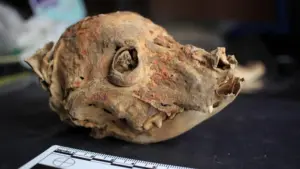
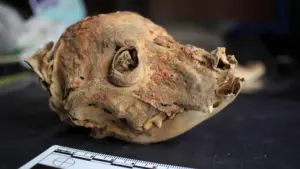
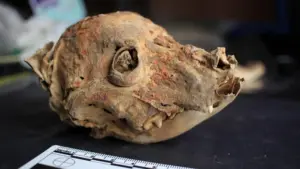
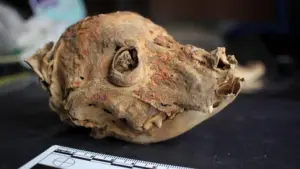
Alongside human burials and structural remains, excavations between 2010 and 2025 recovered vast quantities of faunal remains, including South American camelids (llamas and alpacas) and hundreds of dog bone specimens. While initial processing focused heavily on monumental architecture and elite human interments, a deeper zooarchaeological analysis of the upper, mixed layers in the northern ceremonial section revealed three standout sets of dog remains. Among them were a naturally mummified skull bearing traces of bright red cinnabar pigment, an almost complete male dog skeleton missing only its lower front limbs, and dental anomalies that would crack the case wide open regarding the animals’ true identity.
Supporting Context & Metrics
The identification of these ancient canines relied on a sophisticated intersection of biological anthropology, genetics, and analytical chemistry. The data gathered from the Castillo de Huarmey excavations provide concrete metrics regarding the population size, physical health, dietary habits, and mortuary treatment of these historical dogs.
Biological Identification Through Dental Anomalies
At first glance, the discovery of a well-preserved, hairless dog mummy in the upper archaeological layers sparked immediate skepticism among researchers, who initially wondered if the remains might represent a relatively recent animal buried decades prior during the era of looting. However, lead researcher Weronika Tomczyk identified two critical physiological markers: absolute hairlessness and a specific dental deficiency.
Upon closer inspection, the dog skeletons were missing their first premolars and, in some cases, their last molars—teeth that had never erupted during the animals’ lifespans rather than being lost to disease, trauma, or old age. Tapping into veterinary and genetic literature, Tomczyk recognized that the exact genetic mutation responsible for canine hairlessness is pleiotropic, meaning it simultaneously causes oligodontia (a reduced number of teeth). This crucial biological connection definitively linked the excavated remains to the Indigenous Peruvian hairless dog breed, ruling out other canine populations.
Quantitative Metrics of the Excavation
- Site Area: 110 acres (approximately 190 miles north of Lima).
- Occupational Timeline: 600 to 1050 CE (Wari Empire period).
- Total Dog Specimens Recovered: 341 individual bone specimens.
- Minimum Number of Dogs: At least 19 individual dogs, alongside a complete mummified male.
- Radiocarbon Milestone: The complete mummified male dog was scientifically dated to at least 1,200 years old, establishing it as the oldest radiocarbon-dated specimen recovered from the site to date.
Isotopic Analysis and Dietary Reconstruction
To uncover how these animals lived and what they consumed, the research team deployed multi-element isotopic analysis, measuring isotopes of carbon, nitrogen, oxygen, and strontium preserved within the dogs’ bones and teeth.
- Carbon and Nitrogen: Revealed that the diets of the dogs overlapped significantly with the human population, heavily featuring maize (corn), a staple crop of the pre-Hispanic Andes.
- Tooth vs. Bone Signatures: Tooth enamel captured the chemical signatures of the animals’ earliest developmental stages as puppies, while bone collagen reflected the dietary intake of their final year of life.
- Strontium Isotopes: Utilized local geological variations to trace the geographic origins and movement patterns of the animals, comparing canine data directly against human and camelid baselines from the site.
Official Statements
The implications of the Castillo de Huarmey study have resonated across the academic community, shedding light on the nuanced relationships binding humans and animals in antiquity. The primary investigators have emphasized the social complexity underlying these archaeological deposits.
"Our findings indicate that humans and dogs coexisted at this Wari site, but reconstructing their bond is challenging, as past emotions are difficult to capture through archaeological methods," noted lead author Weronika Tomczyk, a research associate in Dartmouth’s Department of Anthropology and a postdoctoral fellow in its Ecology, Evolution, Environment and Society Program.
Tomczyk further elaborated on the philosophical core of the research, stressing that historical human attitudes toward animals were rarely monolithic:
"The goal of our study was to not only present data on Castillo de Huarmey’s dog burials, but also emphasize that people in the past had often contradictory relationships with the animals, just as they do today: a pet for one group of people could at the same time be considered a pest by their closest neighbors."
Discussing the surprising dietary patterns observed among the hairless puppies—which mirrored the diets of human children before diversifying in adulthood—Tomczyk highlighted the potential implications for early animal husbandry:
"We do not know if the dogs were intentionally fed maize or if perhaps, they were just eating leftovers or trash. Yet, the distinct dietary patterns of hairless puppies provide insights into what may have been organized breeding."
Addressing the ultimate status of these animals within Wari society, Tomczyk concluded:
"While we will never know if any of the three dogs were pets or how people treated them, it is evident they received different treatment than other dogs."
Future Outlook
The groundbreaking identification of Peruvian hairless dogs at Castillo de Huarmey opens new avenues for Andean archaeology, prompting researchers to reevaluate faunal assemblages at other pre-Inca sites across South America. Moving forward, the research team aims to expand isotopic and ancient DNA (aDNA) analyses across a broader spectrum of Wari faunal remains to trace maternal lineages, geographic migration networks, and the selective breeding practices of ancient Andean populations.
Furthermore, these findings reinforce the vital importance of protecting and systematically analyzing mixed archaeological strata in regions vulnerable to natural disasters and modern looting. As analytical techniques in zooarchaeology and biomolecular science continue to advance, sites like Castillo de Huarmey will undoubtedly yield further secrets, bridging the gap between ancient biological remnants and the rich cultural tapestry of the Indigenous societies that shaped the pre-Columbian world.