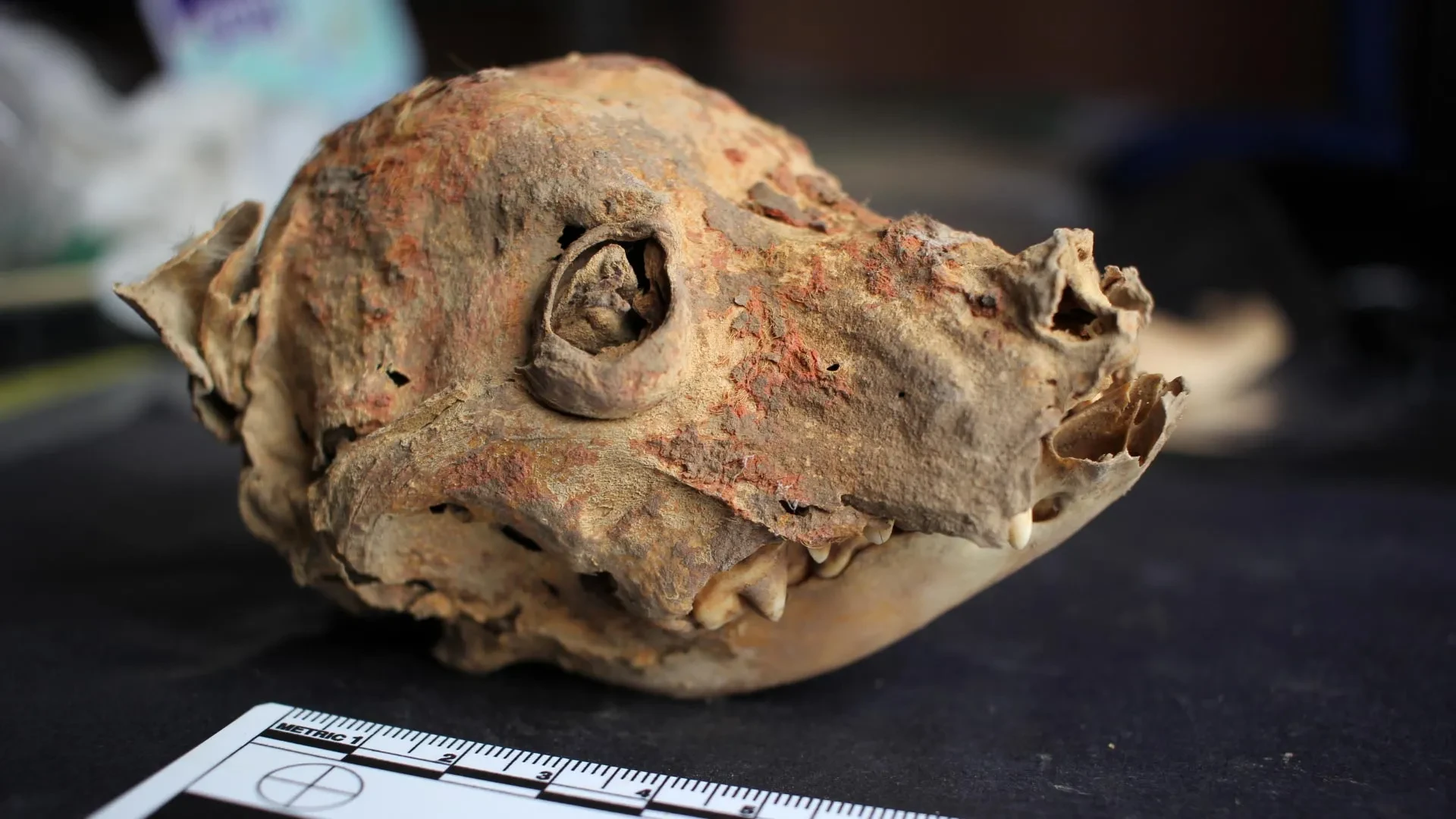

Deep within the hyper-arid coastal desert of northern Peru, a team of international archaeologists has unearthed unprecedented physical evidence of the ancient Andean world: the oldest confirmed remains of Peruvian hairless dogs ever radiocarbon-dated at a pre-Inca site.
Published in the Journal of Anthropological Archaeology, the groundbreaking study centers on Castillo de Huarmey—the sole verified administrative and ceremonial center of the Wari Empire discovered thus far on Peru’s northern coast. Located approximately 190 miles north of Lima, the expansive 110-acre complex flourished between 600 and 1050 CE, predating the rise of the iconic Inca Empire by roughly four centuries.
While the site has previously yielded extraordinary treasures, including undisturbed elite tombs filled with high-status women, gold, silver, and bronze tools, this latest discovery shifts the academic lens downward. By examining 341 individual dog bone specimens representing at least 19 animals—alongside naturally mummified remains—researchers have peeled back a millennium of dust to reveal complex, deeply nuanced relationships between humans and canines in the pre-Columbian Americas.
The findings establish that Peruvian hairless dogs—a distinctive, slender, pointed-eared breed celebrated today as a national cultural heritage symbol and recognized internationally as the Peruvian Inca Orchid—coexisted with the Wari people over 1,200 years ago. More intriguingly, the study reveals that these ancient canines shared an overlapping diet with humans, received variable burial treatments ranging from elite interments to trash disposal, and exhibited specific biological markers linked directly to the genetic mutation responsible for their famous lack of fur.
Detailed Chronology & Excavation History
The unearthing of these ancient dog remains is the culmination of more than a decade of meticulous excavation, layered with historical challenges, natural disasters, and scientific detective work.
The Site and Its Tumultuous Past
Castillo de Huarmey was strategically built by the Wari Empire to project power, manage trade networks, and organize administrative duties across its northern territories. However, the site’s preservation has not been straightforward. In 1970, a massive earthquake struck the region, causing critical structural collapses within the complex and exposing vulnerable burial chambers. In the wake of this natural disaster, illicit looters heavily disturbed large sections of the site, mixing archaeological layers and scattering upper-level materials.
Despite this devastation, deeper, well-protected stratigraphic layers remained pristine. Between 2010 and 2025, archaeologists systematically worked through these undisturbed zones, uncovering monumental architecture, South American camelid remains (domesticated llamas and alpacas), and an abundance of high-status artifacts.
A Breakthrough in the Northern Ceremonial Area
During excavations within the northern section of the main ceremonial area, researchers struck upon three sets of remarkably preserved dog remains that initially baffled the team.
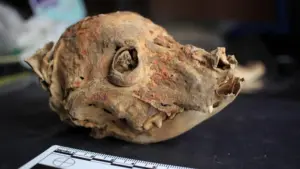
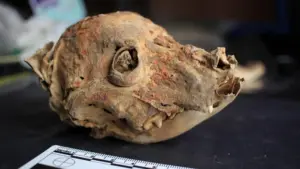
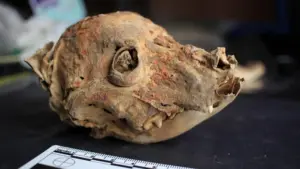
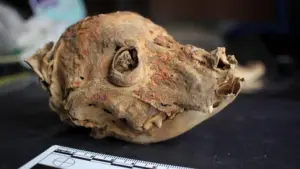
- The Cinnabar-Coated Skull: A naturally mummified skull that retained visible hairless skin and attached ears. Notably, the skull was coated with cinnabar, a toxic, bright red mineral pigment heavily utilized in sacred Andean funerary rites.
- The Complete Male Mummy: A second, larger dog skull accompanied by a naturally mummified male skeleton, buried in a shallow pit and remaining almost entirely intact save for the lower portions of its front limbs. Radiocarbon dating confirmed this specimen to be at least 1,200 years old, making it the oldest securely dated biological specimen recovered from Castillo de Huarmey to date.
Initially, field researchers wondered if these remarkably preserved bodies were modern intrusions—perhaps left behind by looters or local inhabitants within the last half-century. However, a closer anatomical examination by biological anthropologists dismantled this hypothesis.
The Genetic Marker: Missing Teeth
The key to unlocking the true antiquity of the dogs lay not in their surrounding soil, but inside their mouths. Lead author Weronika Tomczyk noticed a striking pattern: several of the dog skeletons were missing their first premolars and, in some instances, their last molars. Crucially, these teeth had never erupted during the animals’ lifespans; they were not lost due to trauma, disease, or old age.
Delving into veterinary and genetic literature, Tomczyk identified a direct biological correlation: the exact genetic mutation responsible for canine hairlessness is pleiotropic, meaning it simultaneously causes oligodontia (a reduced number of teeth). This rare phenotypic signature confirmed that the mummies and skeletal fragments belonged unquestionably to ancient Peruvian hairless dogs, anchoring the breed’s deep antiquity in the Wari horizon.
Supporting Context & Metrics
To decode the lives of these ancient canines, the research team deployed a suite of advanced zooarchaeological and chemical methodologies, yielding precise empirical data regarding diet, geography, and social status.
Quantitative Metrics of the Discovery
- Total Bone Specimens: 341 individual dog bone fragments recovered across the complex.
- Minimum Number of Individuals (MNI): At least 19 distinct dogs identified through osteological analysis.
- Chronological Horizon: Dated firmly between 600 and 1050 CE (Wari Empire period).
- Radiocarbon Benchmark: The complete mummified male dog stands as the oldest radiocarbon-dated canine specimen from Castillo de Huarmey.
- Geographical Span: Unearthed across diverse functional zones of a 110-acre administrative hub located 190 miles north of Lima.
Isotopic Analysis: Reconstructing Diet and Origins
To understand what the dogs ate and where they lived, researchers executed a rigorous stable isotope analysis on bone and tooth samples. By measuring variations of carbon, nitrogen, oxygen, and strontium isotopes, scientists gained a biochemical window into the animals’ lifespans.
- Tooth vs. Bone Signatures: Because canine teeth develop and erupt rapidly during puppyhood, isotope ratios extracted from teeth provided a chemical snapshot of the animals’ earliest weeks and months. Conversely, bone tissue—which undergoes continuous remodeling—reflected the dietary intake of the dog’s final year of life.
- Maize Consumption: The isotopic data revealed that the vast majority of the dogs consumed diets heavily reliant on maize (corn), a staple crop of the pre-Hispanic Andes. This directly mirrored the dietary habits of the human population living at Castillo de Huarmey.
- The Hairless Puppy Paradigm: An unexpected dietary pattern emerged among the suspected hairless puppies. During their earliest weeks of life, their isotopic signatures closely mirrored those of human children, suggesting they were fed specialized diets or table scraps directly associated with human provisioning. As they matured into adulthood, their diets diversified. This divergence implies that these specific hairless puppies may have been subjected to controlled rearing or selective breeding programs by human handlers.
Mortuary Contexts: Pets, Sacrifices, and Refuse
The spatial distribution of the dog remains across Castillo de Huarmey highlights a striking dichotomy in how these animals were perceived and treated:
- Elite Companionship: The bones of a puppy aged just 6 to 8 weeks old were discovered alongside an elite artisan known as the "Master Basketmaker," suggesting a deeply personal or symbolic bond in death.
- Palace Dwellers: Adult dog remains were recovered from within the structural confines of the site’s elite residential palace.
- Guardian Interments: Part of a puppy skeleton was found interred alongside an adult male human (designated as individual XY), who archaeological evidence indicates was sacrificed to serve as a perpetual tomb guardian.
- Secular and Waste Contexts: While some dogs received formal, respectful burials, others were discovered mixed among general refuse and discarded construction debris. Notably, only a minute fraction of the bones displayed butchery marks, proving that—unlike camelids—dogs were rarely slaughtered for human consumption at this site.
Official Statements & Expert Perspectives
The complexity of interpreting human-animal relationships in antiquity forms the core of the study’s conclusions. The researchers caution against projecting modern, sentimentalized notions of pet ownership onto an ancient empire, while simultaneously recognizing the undeniable special status afforded to select canines.
"Our findings indicate that humans and dogs coexisted at this Wari site, but reconstructing their bond is challenging, as past emotions are difficult to capture through archaeological methods," explains lead author Weronika Tomczyk, a research associate in Dartmouth’s Department of Anthropology and a postdoctoral fellow in its Ecology, Evolution, Environment and Society Program.
Tomczyk emphasizes that ancient societies were rarely monolithic in their treatment of animals, mirroring the contradictions found in modern neighborhoods:
"The goal of our study was to not only present data on Castillo de Huarmey’s dog burials, but also emphasize that people in the past had often contradictory relationships with the animals, just as they do today: a pet for one group of people could at the same time be considered a pest by their closest neighbors."
Commenting on the genetic and dental anomalies that unlocked the identity of the mummies, Tomczyk notes:
"What I noticed is that some of the dog skeletons were missing teeth, and not that they lost them during their lifespan; some teeth, especially first premolars and sometimes last molars, had just never erupted. And then I found in the literature that the same gene which is responsible for hairlessness in dogs is responsible for a reduced number of teeth, indicating that these were Peruvian hairless dogs."
Addressing the dietary revelations regarding the hairless puppies, Tomczyk adds:
"We do not know if the dogs were intentionally fed maize or if perhaps, they were just eating leftovers or trash. Yet, the distinct dietary patterns of hairless puppies provide insights into what may have been organized breeding."
Summarizing the overarching ambiguity of the mortuary evidence, she concludes:
"While we will never know if any of the three dogs were pets or how people treated them, it is evident they received different treatment than other dogs."
The collaborative study represents an international multidisciplinary effort, featuring co-authors Miłosz Giersz, Wiesław Więckowski, and Roberto Pimentel Nita of the University of Warsaw, alongside Claire Ebert of the University of Pittsburgh.
Future Outlook
The confirmation of Peruvian hairless dogs at Castillo de Huarmey opens vital new avenues for Andean archaeology and bioarchaeology. As researchers continue to process the vast assemblages recovered from the Wari administrative center, several key areas of future investigation have come to the forefront:
- Ancient DNA (aDNA) Extraction: While morphological and isotopic analyses have successfully linked the skeletal remains to the hairless breed, upcoming genetic sequencing aims to map the mitochondrial DNA of the mummified specimens. This will trace the phylogenetic lineage of the Peruvian hairless dog across millennia, tracking how genetic traits were preserved or altered from the Wari period through the Inca Empire and into modern times.
- Broader Regional Comparisons: Archaeologists plan to compare the isotopic and osteological profiles of the Castillo de Huarmey canines with contemporaneous dog remains recovered from other Wari administrative hubs in the Andean highlands and coastal valleys. This comparative framework will determine whether hairless dogs were bred exclusively in specific microclimates or traded across vast distances within the empire.
- Refining Pre-Inca Social Dynamics: By continuing to analyze the micro-stratigraphy of elite burials versus domestic refuse areas, researchers hope to gain sharper resolution on how social stratification influenced animal husbandry. Understanding who had access to these distinct hairless dogs will shed light on elite status signaling, ritual economy, and domestic life in pre-Columbian Peru.
Ultimately, the mummified sentinels of Castillo de Huarmey bridge a 1,200-year divide, reminding modern observers that our fascination with, affection for, and complex coexistence with our canine companions is an enduring, deeply human legacy.