
Archaeological excavations at the ancient Andean ceremonial and administrative complex of Castillo de Huarmey in Peru have yielded groundbreaking evidence regarding the historical coexistence of humans and specialized canine breeds. Published in the Journal of Anthropological Archaeology, a comprehensive multi-institutional study reports the recovery of the earliest definitive physical remains of Peruvian hairless dogs ever scientifically documented at a Wari Empire site. Dating back more than 1,200 years—roughly four centuries before the rise of the Inca Empire—the findings include naturally preserved mummies, unique skeletal anomalies, and complex isotopic signatures that illuminate the nuanced, and occasionally contradictory, relationships between ancient Andean societies and their domestic animals.
Led by a collaborative team of international researchers, including first author Weronika Tomczyk of Dartmouth College, the investigation leverages advanced zooarchaeological techniques, radiocarbon dating, and biochemical isotopic analysis. The discovery not only pushes back the established timeline for the presence of hairless canines in northern coastal Peru, but it also provides rare insights into ancient breeding practices, domestic animal diets, and diverse funerary treatments. These findings challenge monolithic historical interpretations of animal husbandry in pre-Columbian South America, revealing that human-canine interactions spanned a complex spectrum from revered companions to marginalized scavengers.
Detailed Chronology
To contextualize the discovery of these ancient canine remains, it is necessary to examine the historical timeline of Castillo de Huarmey and the successive archaeological milestones that have transformed our understanding of the Wari Empire.
The Wari Empire and Castillo de Huarmey
Situated roughly 190 miles north of Lima in an exceptionally arid coastal desert region, Castillo de Huarmey spans approximately 110 acres. Between 600 and 1050 CE, the complex served as a major administrative, religious, and burial hub for the Wari Empire, an expansive state that dominated the central Andean highlands and coastal regions long before the Incas consolidated power.
The hyper-arid environment of the Peruvian Pacific coast has long acted as a natural preservation chamber. Organic materials that typically decay in temperate climates—such as animal hair, skeletal collagen, textiles, leather, pigments, and unbaked clay—remain remarkably well-preserved beneath the desert sands.
Key Archaeological Milestones
- 1970: A powerful tectonic earthquake struck the region, causing structural collapses within parts of Castillo de Huarmey. The seismic event exposed ancient burial chambers containing valuable ceramics and precious metals, inadvertently drawing the attention of looters who subsequently disturbed large upper archaeological strata.
- 2012: Archaeologists achieved a major breakthrough by uncovering the first completely undisturbed elite Wari tomb at the site. The chamber contained the remains of 58 high-status noblewomen, six sacrificial human victims, and approximately 1,300 luxury artifacts crafted from gold, silver, bronze, and textiles.
- 2015–2020: Ongoing systematic excavations across the ceremonial sectors began recovering vast quantities of faunal remains, including South American camelid bones (likely domesticated llamas and alpacas) alongside fragmented and whole dog skeletons found in both primary and secondary archaeological deposits.
- 2022: Researchers identified specialized burial zones dedicated to elite craftspeople. These graves were accompanied by sophisticated metallurgy and weaving toolkits, further elucidating the socioeconomic stratification of the Wari state.
- 2010–2025: Intensive multidisciplinary laboratory analyses were conducted on 341 individual dog bone specimens representing at least 19 distinct canines, culminating in the formal identification of the Peruvian hairless dog lineage through genetic-osteological correlations.
Supporting Context & Metrics
The investigation into the Castillo de Huarmey canines relied on a sophisticated intersection of zooarchaeology, osteology, molecular biology, and geochemistry.
Osteological Indicators and Genetic Markers
Distinguishing the Peruvian hairless dog—recognized today by the American Kennel Club as the Peruvian Inca Orchid—from other ancient canine populations required careful morphological analysis. The breed is characterized by slender statures, erect pointed ears, and a complete lack of fur, traits historically documented in coastal Andean iconography, particularly in pre-Hispanic pottery.
During the excavation of the northern section of the main ceremonial area, researchers isolated three standout canine deposits:
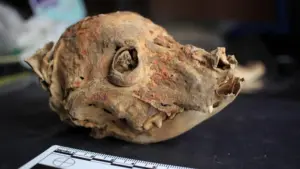
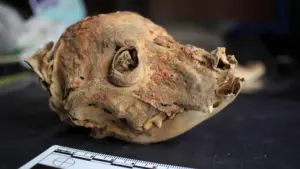
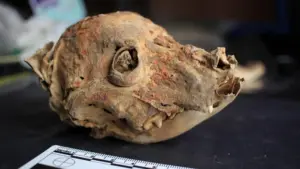
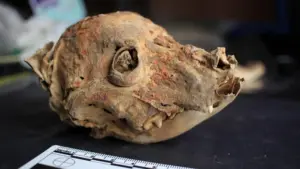
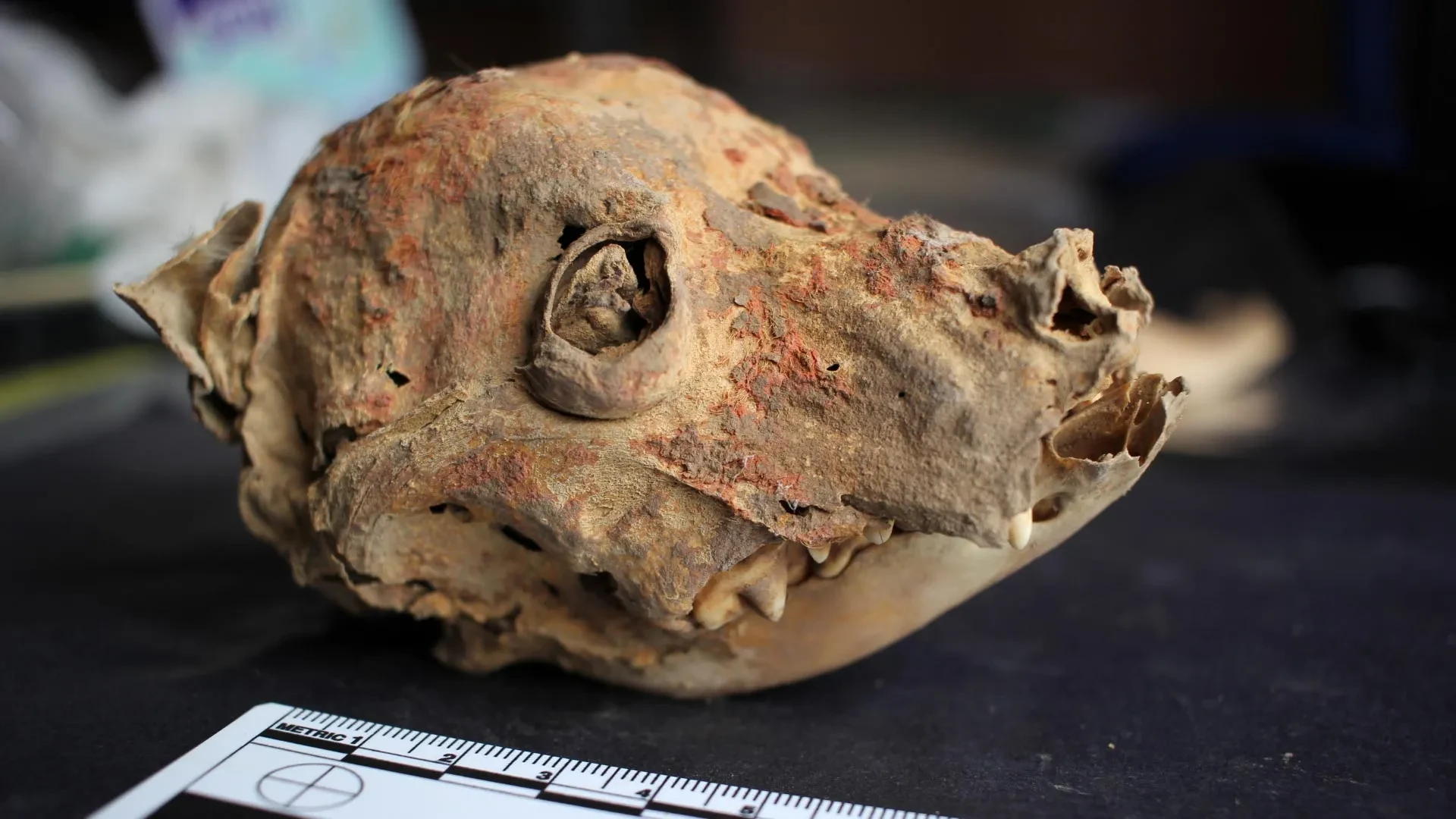
- A naturally mummified skull retaining visible hairless skin patches and intact ears, stained with cinnabar—a toxic mercuric sulfide pigment heavily utilized in elite Andean mortuary rituals.
- A larger, mature dog skull exhibiting distinct dental anomalies.
- A nearly complete, naturally mummified male dog skeleton recovered from a shallow pit, missing only the distal portions of its front limbs.
Upon examining the skeletal structures, Tomczyk identified a critical biological marker: several jaws displayed a congenital absence of teeth, specifically the first premolars and, in some cases, the last molars. Crucially, these teeth had never erupted during the animal’s lifetime rather than being lost due to pathology, trauma, or old age. Medical and veterinary literature confirms a direct genetic link: the specific gene responsible for mammalian hairlessness is pleiotropic, simultaneously causing oligodontia (a reduced number of teeth). This genetic correlation provided definitive physical proof that the specimens belonged to the ancient hairless lineage.
Biogeochemical and Isotopic Analyses
To reconstruct the life histories, geographic origins, and nutritional intake of the Wari canines, the research team executed targeted isotopic sampling across multiple skeletal elements.
- Bone Collagen vs. Tooth Enamel: Because canine teeth develop rapidly during puppyhood, chemical signatures trapped within dental enamel reflect the diet of the animal during its earliest weeks of life. Conversely, bone tissue undergoes continuous remodeling, providing an isotopic record representing approximately the final year of the animal’s life.
- Elemental Isotopes: Researchers measured isotopes of carbon, nitrogen, oxygen, and strontium. Strontium isotope ratios, which vary predictably depending on the underlying geology of a region, allowed scientists to evaluate whether the dogs were locally bred or imported from distant ecological zones, such as the Andean highlands.
The isotopic data revealed striking parallels between human and canine nutritional regimes at Castillo de Huarmey. The vast majority of the analyzed dogs exhibited elevated carbon isotope values consistent with a heavy reliance on maize (corn), a dietary staple across the pre-Hispanic Andes. Furthermore, hairless puppies displayed isotopic signatures closely mirroring those of human children, suggesting that young hairless dogs may have been selectively targeted for specialized feeding regimens or raised under highly controlled domestic conditions.
Mortuary Contexts and Quantitative Metrics
Out of 341 recovered bone specimens representing at least 19 individual dogs, the placement of the remains varied dramatically across social strata:
- Elite Associations: The skeletal remains of a puppy aged between 6 and 8 weeks were recovered directly alongside an elite artisan known as the "Master Basketmaker." Another puppy skeleton was interred with an adult male designated as "XY," interpreted as a sacrificial tomb guardian. An adult dog was discovered interred within the restricted perimeter of the site’s primary palace complex.
- Differential Treatment: While select specimens received deliberate, careful primary burials indicative of high cultural valuation, other remains were commingled with domestic refuse in upper stratigraphic layers churned by historic looters. Notably, only a negligible fraction of the bones displayed butchery marks, confirming that canine consumption for dietary purposes was rare or absent at Castillo de Huarmey.
- Absolute Chronology: Radiocarbon dating established that the complete mummified male dog is at least 1,200 years old, positioning it as the oldest radiocarbon-verified canine specimen recovered from the complex to date and establishing a crucial benchmark for the site’s chronological framework.
Official Statements
The implications of the Castillo de Huarmey discoveries extend far beyond zooarchaeology, challenging contemporary assumptions regarding human-animal bonds in antiquity.
Discussing the methodological challenges of interpreting emotional or social bonds across millennia, lead author Weronika Tomczyk noted:
"Our findings indicate that humans and dogs coexisted at this Wari site, but reconstructing their bond is challenging, as past emotions are difficult to capture through archaeological methods. The goal of our study was to not only present data on Castillo de Huarmey’s dog burials, but also emphasize that people in the past had often contradictory relationships with the animals, just as they do today: a pet for one group of people could at the same time be considered a pest by their closest neighbors."
Elaborating on the physiological identification of the breed via dental records, Tomczyk explained:
"What I noticed is that some of the dog skeletons were missing teeth, and not that they lost them during their lifespan; some teeth, especially first premolars and sometimes last molars, had just never erupted. And then I found in the literature that the same gene which is responsible for hairlessness in dogs is responsible for a reduced number of teeth, indicating that these were Peruvian hairless dogs."
Addressing the dietary patterns and the possibility of intentional animal husbandry, Tomczyk added:
"We do not know if the dogs were intentionally fed maize or if perhaps, they were just eating leftovers or trash. Yet, the distinct dietary patterns of hairless puppies provide insights into what may have been organized breeding. While we will never know if any of the three dogs were pets or how people treated them, it is evident they received different treatment than other dogs."
Future Outlook
The identification of authenticated Peruvian hairless dog remains at Castillo de Huarmey opens new avenues for Andean archaeology, bioarchaeology, and evolutionary biology. Future research phases will likely focus on several critical objectives:
- Ancient DNA (aDNA) Extraction: Researchers aim to retrieve mitochondrial and nuclear DNA from the mummified tissue samples. Successful sequencing would allow geneticists to trace the maternal and paternal lineages of the Wari hairless dogs, mapping their evolutionary divergence and genetic continuity with modern descendants, such as the Peruvian Inca Orchid.
- Expanded Isotopic Mapping: By broadening strontium and oxygen isotope baselines across contemporary human, camelid, and canine populations throughout the Andean coastal valleys and highlands, scientists hope to reconstruct ancient trade and animal-exchange networks utilized by the Wari Empire.
- Comparative Taponomic Studies: Additional excavations across unlooted lower strata at Castillo de Huarmey and contemporaneous Wari imperial centers will help clarify whether specialized breeding programs for hairless canines were centralized administrative operations or decentralized local practices.
Ultimately, the preservation of these 1,200-year-old canines bridges the gap between material culture and living heritage. By demonstrating that ancient humans maintained complex, highly differentiated relationships with specialized animal breeds, the Castillo de Huarmey study deepens our understanding of the social dynamics that shaped pre-Columbian Andean civilizations.