
Executive Overview
Deep within the hyper-arid coastal desert of Peru, roughly 190 miles north of Lima, archaeologists have unearthed a groundbreaking discovery that is reshaping our understanding of pre-Columbian human-animal relationships. At the ancient administrative and burial complex of Castillo de Huarmey—the sole known urban center of the Wari Empire on Peru’s northern coast—researchers have identified the oldest physical and genetic evidence of Peruvian hairless dogs ever documented.
Dating back more than 1,200 years, long before the rise of the expansive Inca Empire, these remarkable remains include naturally mummified specimens, distinct skeletal configurations, and intricate chemical signatures embedded in teeth and bone. The findings offer an unprecedented window into the lives of ancient quadrupeds, demonstrating that these slender, mystic canines occupied a specialized, albeit complex, role in Wari society.
Spearheaded by an international team of researchers—including lead author Weronika Tomczyk of Dartmouth College, alongside colleagues from the University of Warsaw and the University of Pittsburgh—the study was recently published in the Journal of Anthropological Archaeology. By combining zooarchaeological analysis, advanced radiocarbon dating, and multi-element isotopic profiling, the research team has not only verified the presence of the iconic Peruvian hairless breed during the Middle Horizon period but has also illuminated the nuanced, multifaceted ways ancient Andean societies interacted with domestic fauna.
Detailed Chronology of the Discoveries
The journey to uncovering these ancient canines spans decades of meticulous excavation, layered catastrophe, and forensic-level archaeological detective work at Castillo de Huarmey, a sprawling 110-acre complex occupied between 600 and 1050 CE.
1. The Wari Footprint: 2012–2022
Before the dogs took center stage, Castillo de Huarmey had already established its reputation as one of the most significant archaeological sites in South America. In 2012, excavation teams announced a monumental breakthrough: the discovery of the first undisturbed elite Wari tomb. Tucked away beneath the desert sands, the vault housed the remains of 58 high-status noblewomen, six sacrificial human victims, and roughly 1,300 luxury artifacts crafted from gold, silver, bronze, and precious textiles.
A decade later, in 2022, researchers struck history again nearby, unearthing the burials of elite craftspeople accompanied by specialized metalworking tools. These discoveries provided vital insights into how the Wari centralized power, administered regional territories, and integrated diverse populations. Yet, the daily reality of ordinary life—and the animals that populated these ancient streets—remained largely obscured until the detailed analysis of the faunal assemblages began.
2. The Excavations and the 1970 Catastrophe
Between 2010 and 2025, rigorous archaeological investigations across the site’s northern ceremonial sectors yielded hundreds of animal specimens, including South American camelids (llamas and alpacas) and domestic canids. However, piecing together the chronological integrity of these finds proved extraordinarily difficult due to severe historical disturbances.
In 1970, a catastrophic earthquake struck Peru, causing structural collapses across Castillo de Huarmey. The tremor fractured burial chambers, exposing valuable ceramics and skeletal remains to the surface. Unscrupulous looters quickly capitalized on the disaster, churning through the upper archaeological strata and mixing ancient artifacts with modern debris.
Fortunately, deep subterranean layers remained sealed in their pristine Wari contexts. It was within the upper, disturbed zones and transitional levels that the canine remains were primarily discovered—forcing researchers to rely on cutting-edge scientific methods to separate ancient history from modern confusion.
3. The 2025 Breakthrough: Mummies and Missing Teeth
Among the thousands of animal bones recovered, three distinct sets of canine remains captured the immediate attention of the research team during recent analyses:
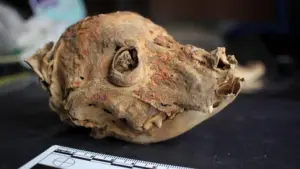
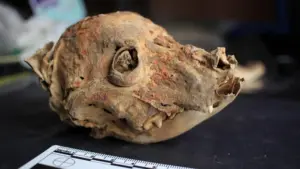
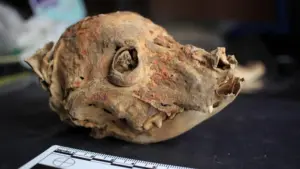
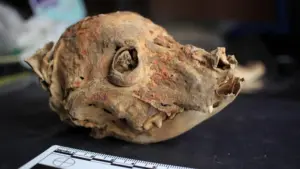
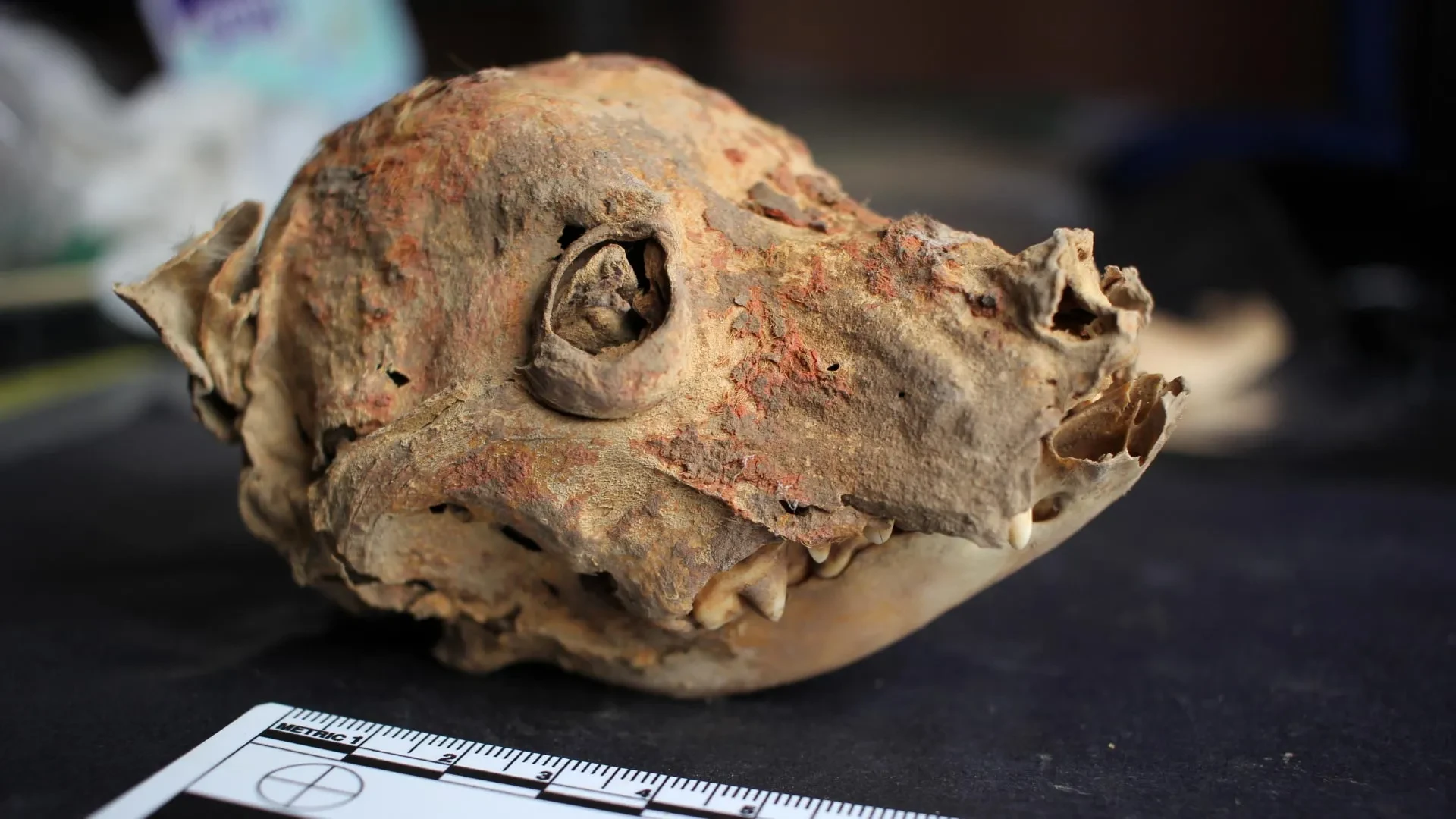
- The Pigmented Skull: A naturally mummified dog skull retaining patches of hairless skin, intact ears, and a heavy coating of cinnabar—a toxic, bright red mercuric sulfide pigment heavily integrated into elite Andean mortuary rituals.
- The Male Mummy: A nearly complete, naturally mummified male dog buried in a shallow floor pit, missing only the lower portions of its front limbs.
- The Genetic Key: Initially, researchers suspected these specimens might be modern intruders, perhaps deposited by looters decades prior. However, closer inspection revealed a crucial biological anomaly: the dogs were entirely hairless and lacked their first premolars and occasional last molars.
This dental anomaly served as the smoking gun. As Tomczyk and her team verified through genetic and morphological literature, the specific gene responsible for hairlessness in canines is intrinsically linked to congenital tooth agenesis (the failure of teeth to form and erupt). This genetic signature definitively tied the remains to the indigenous Peruvian hairless dog, a lineage immortalized in Andean coastal pottery and recognized today by the American Kennel Club as the Peruvian Inca Orchid.
Supporting Context & Metrics
To extract maximum data from the 341 dog bone specimens representing at least 19 individual canines, the research team deployed a robust multidisciplinary scientific framework.
The Scientific Toolkit: Zooarchaeology and Isotopic Tracing
Researchers subjected the remains to standard zooarchaeological analysis to determine age profiles, sex, and pathological conditions. To reconstruct the diets and geographical origins of the dogs, the team executed sophisticated isotopic assays, measuring ratios of carbon, nitrogen, oxygen, and strontium isotopes preserved in the animal’s bone collagen and tooth enamel.
- Carbon and Nitrogen: These isotopes reveal dietary staples. The analysis proved that Wari dogs heavily consumed maize (corn)—a primary caloric staple for the human population across the pre-Hispanic Andes. Interestingly, isotopic signatures in the teeth (which form during puppyhood) indicated that young hairless dogs maintained diets strikingly similar to human children, transitioning to a more generalized diet as they aged.
- Strontium: Strontium isotope variations reflect local geological foundations, allowing scientists to track whether an animal was locally raised or imported from distant ecological zones.
Statistical Breakdown of the Finds
- Site Dimensions: 110 acres (administrative and ceremonial complex).
- Geographical Location: 190 miles north of Lima, Peru (coastal desert ecosystem).
- Chronological Span: 600 to 1050 CE (Middle Horizon period).
- Canine Assemblage: 341 bone specimens representing a minimum of 19 individual dogs.
- Radiocarbon Dating Milestone: The mummified male dog was radiocarbon-dated to over 1,200 years old, setting a new chronological baseline for canine presence at the site.
- Burial Stratigraphy: Ranged from elite interments (e.g., a 6-to-8-week-old puppy buried alongside an elite craftsperson known as the "Master Basketmaker") to palace-floor deposits and sacrificial guardian burials.
Official Statements and Expert Analysis
The complexity of human-canine relations in the ancient Andes is a central theme emphasized by the study’s authors. Far from viewing dogs through a singular lens, Wari society appears to have maintained a multifaceted, sometimes contradictory, perspective on these animals.
"Our findings indicate that humans and dogs coexisted at this Wari site, but reconstructing their bond is challenging, as past emotions are difficult to capture through archaeological methods," notes lead author Weronika Tomczyk, a research associate in Dartmouth’s Department of Anthropology and postdoctoral fellow in its Ecology, Evolution, Environment and Society Program.
Tomczyk further highlights the sociological parallels between antiquity and modernity regarding animal stewardship:
"The goal of our study was to not only present data on Castillo de Huarmey’s dog burials, but also emphasize that people in the past had often contradictory relationships with the animals, just as they do today: a pet for one group of people could at the same time be considered a pest by their closest neighbors."
Discussing the dental and dietary indicators pointing toward specialized animal husbandry, Tomczyk adds:
"What I noticed is that some of the dog skeletons were missing teeth, and not that they lost them during their lifespan; some teeth, especially first premolars and sometimes last molars, had just never erupted… We do not know if the dogs were intentionally fed maize or if perhaps, they were just eating leftovers or trash. Yet, the distinct dietary patterns of hairless puppies provide insights into what may have been organized breeding."
Reflecting on the stark contrasts in mortuary treatment—ranging from reverent burials with elite craftspeople to discarded remains in rubbish zones—Tomczyk concludes:
"While we will never know if any of the three dogs were pets or how people treated them, it is evident they received different treatment than other dogs."
The collaborative study unites international experts, featuring co-authors Miłosz Giersz, Wiesław Więckowski, and Roberto Pimentel Nita from the University of Warsaw, alongside Claire Ebert of the University of Pittsburgh.
Future Outlook and Ongoing Archaeological Horizons
The discovery of these 1,200-year-old mummified hairless dogs at Castillo de Huarmey opens up compelling new avenues for Andean zooarchaeology and genetic research. As excavations continue along Peru’s northern coast, researchers are shifting focus toward several critical objectives:
- Ancient DNA (aDNA) Extraction: Future studies aim to successfully isolate and sequence mitochondrial and nuclear DNA from the mummified hairless specimens. This genetic mapping will allow scientists to trace the evolutionary lineage, population bottlenecks, and genetic divergence of hairless dogs from pre-Inca times through the Spanish colonial era to the modern day.
- Broader Regional Comparisons: Archaeologists plan to compare the isotopic and skeletal data from Castillo de Huarmey with canine remains recovered from other contemporary Wari administrative nodes, as well as highland centers such as Huari (Ayacucho). This will reveal whether hairless dogs were bred exclusively on the arid coast or traded across diverse ecological niches within the empire.
- Refining Mortuary Micro-Contexts: Advanced micro-stratigraphic and residue analyses will continue to evaluate the exact nature of human-animal burials. By analyzing organic residues on associated grave goods, researchers hope to determine whether these hairless canines served therapeutic, spiritual, or symbolic functions in Wari mortuary ritual.
Ultimately, the revelation of these ancient desert mummies bridges a millennia-old gap in our historical consciousness. They remind us that the deep affection, complex utility, and varied social roles we assign to our four-legged companions today are traditions rooted deep within the ancient civilizations of South America—cementing the Peruvian hairless dog not merely as a modern cultural symbol, but as an enduring ancient participant in the human story.