
Executive Overview
Automatic pet feeders have surged in popularity, promising convenience, precise portion control, and a peaceful night’s sleep for pet owners worldwide. However, extensive hands-on testing of 22 different models out of 42 considered reveals a more nuanced reality. Performance varies wildly across the market, and even top-tier machines require managed expectations.
Whether you are looking to manage a cat’s complex dietary needs, prevent a 3:00 a.m. wake-up call from an insistent dog, or schedule consistent meals while you are away at work, an automatic feeder can be a valuable tool. Yet, experts universally agree: an automated machine is a supplement to responsible pet care, never a substitute for a human sitter.
This comprehensive report dives into the rigorous testing methodologies behind the top-performing dry, wet, and budget-friendly automatic pet feeders, examines the pitfalls of human portioning, highlights the industry’s current landscape, and helps you decide which model fits your household.
Detailed Chronology & Testing Methodology
To understand how these machines perform in real-world environments, testers evaluated an array of programmable hopper models and rotating tray designs over multiple weeks. The testing framework was built around rigorous scientific and physical criteria to separate gimmicky tech from genuinely reliable hardware.

1. The Testing Process
- Dry Food and Hopper Testing: Seventeen dry-food and hopper-style feeders were loaded with two distinct kibble sizes: small (5×5 millimeters) for cats and average-size (14×9.5 millimeters) for dogs. Each unit was pushed to its specified operational limits regarding maximum and minimum kibble dimensions.
- Wet Food and Tray Testing: Five rotating tray feeders were evaluated using two styles of canned cat food—pâté and chunks in gravy—to assess how well they handled moisture, seal security, and thermal regulation.
- Portion Accuracy Trials: Hopper feeders underwent more than a dozen trials each, resulting in over 260 individual portion tests. Testers weighed multiple dispensed portions on a precise kitchen scale, comparing actual weight against the machine’s stated targets. Any model whose output deviated by more than 25% was disqualified.
- Thermal Stress and Safety Tests: For refrigerated wet-food feeders, meat thermometers tracked food temperatures over six-hour spans across multiple test rounds, while interior sensors measured performance over continuous 72-hour periods.
- Physical Security Audits: Testers actively simulated clever, food-motivated pets. Using fingers and narrow, paw-like spoons, they attempted to extract kibble from dispenser holes, shook and batted units to test stability, and attacked lids to check for vulnerability.
- Software and Power Reliability: Apps were reviewed for intuitive design, scheduling ease, and interface clarity. Testers also simulated Wi-Fi outages and unplugged units from wall outlets to test backup battery continuity and software logging.
Supporting Context & Metrics: Why You Might Need an Automatic Feeder
While human intuition suggests we are good at scooping pet food, empirical evidence says otherwise.
The Human Margin of Error in Portioning
According to veterinary nutritionist Lisa Weeth, humans have a staggering margin of error of about 25% above or below a standard cup when attempting to scoop dry kibble. Food density, shape shifts, and container condensation all confuse the human eye.
Furthermore, veterinary professor Amy Nichelason notes that standard volume measurements (like cups and tablespoons) fail to account for the true density of modern pet diets. Both Weeth and Nichelason agree that weighing meals on a kitchen scale is the gold standard for accuracy—making scale-integrated feeders exceptionally valuable for pets requiring strict weight management.
Behavioral and Lifestyle Benefits
- Multi-Meal Consistency: Cats are opportunistic hunters by nature, thriving on several small meals a day rather than one or two large portions. Automatic feeders provide this natural pacing even when owners are stuck at work.
- Breaking the Human-Food Association: Persistent pets often wake owners at dawn because they associate humans directly with food. Automating the process can sever this mental link, potentially leading to undisturbed sleep.
- Preventing Food Theft: In multi-household environments, dominant pets often steal from slower eaters. While RFID and microchip-enabled models (like the SureFeed) offer advanced solutions, basic automated schedules help distribute meals evenly without human intervention.
Official Recommendations: Top Picks on
the Market

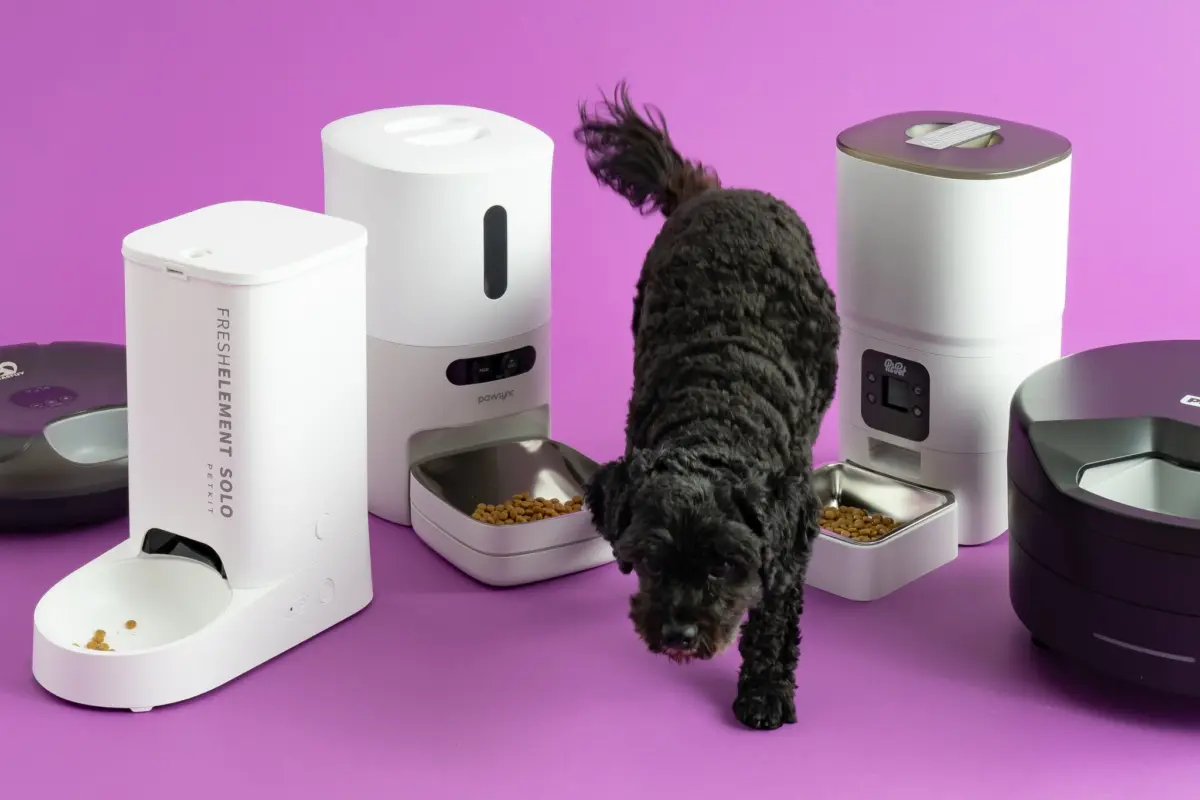
Top Pick for Dry Food: Pawsync Smart Pet Feeder
The Pawsync Smart Pet Feeder stands out by incorporating an integrated scale directly beneath its stainless steel bowl, weighing each portion after it is dispensed rather than relying purely on volume estimations.
- Key Strengths: It calculates portions in ounces or grams, automatically recalibrates when switching kibble types, and features an optional Smart Mode that subtracts leftover food from the next scheduled meal. In testing, it achieved an impressive average deviation of just 2% for small kibble and 4% for large kibble.
- Minor Flaws: The app interface has a slight learning curve, and during a power outage, the unit switches to its three D-cell backup batteries while dropping Wi-Fi connection to preserve power—meaning it dispenses on schedule but fails to log the event digitally.
Top Pick for Wet Food: PetSafe FreshFeed Refrigerated Pet Feeder
For owners of cats or small dogs requiring wet food, the PetSafe FreshFeed is a standout choice due to its true refrigeration capabilities.
- Key Strengths: Unlike passive ice-pack models, the FreshFeed actively chills food to an average internal temperature of 38°F—matching a standard kitchen refrigerator. It features six serving slots (five of which are actively refrigerated) and pauses cooling five minutes before feeding to gently warm the food for optimal texture.
- Minor Flaws: It carries a premium price tag, lacks a battery backup (meaning a power outage stops both cooling and feeding), and emits a constant white-noise fan sound from its cooling vents.
Best for Cordless Portability: Casfuy F13 Automatic Feeder
The Casfuy F13 is a rotating tray feeder equipped with a built-in rechargeable battery, allowing it to be placed anywhere in the home without being tethered to an electrical outlet.
- Key Strengths: It operates completely wirelessly, includes multiple reusable ice packs for temporary wet-food cooling, features a semi-transparent lid for quick visual checks, and relies on straightforward onboard programming without requiring a mobile app.
- Minor Flaws: The ice packs have a limited lifespan, requiring daily swaps if used for wet food, and the unit limits users to five programmable meals due to its exposed tray architecture.
Budget Picks: Petkit Fresh Element Solo & PitPet Smart Feeder
- Petkit Fresh Element Solo: An app-controlled hopper feeder that offers reliable scheduling, a tight lid seal, and easy disassembly at an affordable price point. Its primary drawback is that it ships without a power adapter or backup batteries.
- PitPet Smart Automatic Pet Feeder: A low-risk, no-frills starter model for owners testing out automation for the first time. While it lacks advanced app connectivity or lid seals, its physical control panel is remarkably intuitive, and its portion accuracy outperforms many competitors in the same price bracket.
Future Outlook: What’s Next in Pet Tech
The automatic pet feeder market is rapidly evolving. Future industry developments point toward several key innovations:

- Advanced Multi-Pet Microchip Integration: Brands are increasingly focusing on RFID and microchip-reading technology (such as the SureFeed and upcoming Petlibro systems) to guarantee that multi-pet households can strictly police diet stealing without manual supervision.
- Next-Generation Wet-Food Systems: Emerging pre-launch models like the Sphynx and Symba promise better thermal dynamics and automated preservation for raw and wet diets, addressing a historically underserved market segment.
- App Reliability and Security: As recent server outages from major manufacturers have demonstrated (such as Petlibro’s August 2026 outage), consumers are growing wary of cloud-dependent smart home devices. Future models will need to place a heavier emphasis on robust offline local scheduling to ensure pets never go unfed during internet disruptions.
Conclusion
Automatic pet feeders are powerful tools for weight management, schedule flexibility, and reclaiming your early-morning sleep. However, they are not entirely foolproof. When shopping for a feeder, carefully evaluate your pet’s diet (dry vs. wet), your need for strict portion accuracy versus general scheduling, and your home’s Wi-Fi reliability. By pairing smart technology with attentive human oversight, you can ensure your pets are well-fed, healthy, and happy.