
By Don Vaughan
Special to Veterinary Practice News
Executive Overview
In the quiet corridors behind the public habitats of the world’s leading zoological institutions, a quiet medical revolution is unfolding. Advanced physical rehabilitation—a therapeutic modality once reserved almost exclusively for high-performing equine athletes or beloved household pets—has firmly established itself as a cornerstone of modern zoological medicine.
As exceptional standards of nutrition, preventive medicine, and husbandry continue to extend the lifespans of exotic animals under managed care, veterinarians are increasingly confronting the chronic diseases of aging. Chief among these is osteoarthritis and its associated musculoskeletal decline. To combat these conditions, zoo veterinarians are adapting canine and feline physical rehabilitation techniques, deploying everything from specialized obstacle courses and balance boards to radioactive isotopes and acupuncture.
The implications of this movement extend far beyond the perimeter fences of institutions like the San Diego Zoo Wildlife Alliance, Brookfield Zoo Chicago, and the Smithsonian’s National Zoo. By demonstrating that sophisticated physical therapy can be successfully executed across a breathtaking taxonomic spectrum—from five-year-old tamanduas and geriatric gorillas to aardvarks, Galapagos tortoises, and even Komodo dragons—zoological medicine is offering a translational roadmap for general veterinary practitioners treating domestic animals, while deepening our fundamental understanding of mammalian and reptilian physiology alike.
Detailed Chronology: The Case of Mani the Tamandua
The trajectory of physical rehabilitation in modern zoos is best illustrated through individual patient journeys. Consider Mani, a five-year-old male tamandua residing at the San Diego Zoo Wildlife Alliance. Though categorized as only middle-aged for his species, Mani’s keepers noticed a distressing decline in his physical prowess. Once an agile arboreal mammal, Mani was beginning to slow down significantly.
Mani’s clinical presentation included:
- Trouble navigating vertical climbing structures.
- Limb stiffness and an inability to smoothly pull his body upward from a tail hang.
- Marked deceleration when descending sloped perches.
- Several concerning falls within his habitat.
Recognizing these safety hazards, the veterinary team moved quickly. A comprehensive diagnostic workup, anchored by a computed tomography (CT) scan, revealed a sobering picture.
"A CT scan revealed Mani had caudal lumbar spondylosis deformans and spondylosis in his cervical and thoracic spine as well," says senior veterinarian Deena Brenner, DVM, DACZM. Following the imaging, Dr. Brenner performed a rigorous mobility assessment. "I saw [Mani] had moderate stiffness in his rear legs; mild kyphosis at the thoracolumbar junction; and stiffness in his hips with decreased extension, especially when standing. He was also slow and deliberate in how he used his tail."
As one of the zoo’s most visible and beloved ambassador animals, Mani was promptly referred to the institution’s physical rehabilitation service with a clear mandate: improve his strength, functional movement, and overall mobility.
Dr. Brenner and her team devised a targeted, multi-modal physical therapy regimen tailored specifically to the biomechanics of a tamandua. The therapeutic protocol included:
- The Vertical Weave: A series of vertical poles Mani was required to negotiate carefully to improve lateral flexibility and coordination.
- Cavalletti Rails: Raised ground obstacles designed to encourage deliberate limb elevation and joint flexion.
- Specialized Tunnel Navigation: A controlled space deployed specifically to promote spinal extension.
- Balance Boards and Incline Ramps: Core-strengthening equipment adapted to challenge his equilibrium and build hind-limb muscular endurance.
The intervention required patience, consistency, and close collaboration between veterinary staff and wildlife care specialists. After seven months of sustained physical therapy, the transformation was remarkable.
"The wildlife care staff reports he’s doing very well," says Dr. Brenner, who holds a specialty certification in veterinary physical rehabilitation. "He is moving more comfortably with a stronger rear-limb posture, he’s not slipping, and he hasn’t had any falls. They really feel that physical rehabilitation has particularly helped Mani."
Supporting Context & Metrics: Translating Canine Care to Exotic Species
Mani’s successful recovery is not an isolated miracle; it is part of a broader, systemic shift in how zoological institutions manage geriatric populations. Because zoo animals receive exceptional, round-the-clock nutritional, environmental, and medical care, they frequently outlive their wild counterparts. However, this longevity comes with biological costs, chief among them being degenerative joint disease.
According to James Steeil, DVM, DACZM, a supervisory veterinarian with the Smithsonian’s National Zoo and Conservation Biology Institute in Washington, D.C., the parallels between domestic and exotic veterinary rehabilitation are striking.
"I can have the same conversation about the treatment of arthritis in my cat and in a tiger at the zoo," Dr. Steeil explains. "The outcomes might be slightly different because of limitations based mostly on safety, but what we provide is eerily similar to what the general practitioner is doing in terms of diagnostics, treatments, and collaboration with specialists."
This cross-species applicability relies on the fundamental conservation of mammalian and vertebrate biology. "What is always amazing to me is how translatable many canine rehabilitation techniques are across zoological species," adds Dr. Brenner. "They just need to be adapted to the body of the patient. We know bodies age similarly, and the care for those is similar, such as analgesics, exercise, and range-of-motion activities."
Common Indications for Zoo Rehabilitation
- Osteoarthritis: Most prevalent in the spine, hips, stifles, and elbows.
- Post-Traumatic Recovery: Rehabilitation following accidental falls, territorial disputes, or physical trauma.
- Post-Surgical Conditioning: Restoring muscle mass and joint mobility after orthopedic or soft-tissue surgeries.
- Congenital Deformities: Managing structural anomalies that impact gait, elimination, or quality of life.
Official Statements and Inter-Species Protocols
The success of physical rehabilitation in a zoological setting depends entirely on a tripartite alliance: veterinarians, rehabilitation specialists, and animal care professionals. Because zoo animals cannot be handled or forced into compliance like domestic pets, therapy relies heavily on trust, voluntary participation, and positive reinforcement.
"Animal care specialists have a really good eye as a result of their relationship with the animals under their care," says Jennifer McGee, director of Wildlife Experiences at Brookfield Zoo Chicago. "These animals are our colleagues. Many times, we work with them throughout their entire lives, which builds deep, respectful relationships."
Animal care specialists dedicate countless hours to operant conditioning, training animals to voluntarily present specific body parts for physical examinations, thermography, or targeted therapy. Behaviors are systematically broken down into minute, stress-free increments. When an animal successfully executes a requested behavior, it is immediately reinforced with preferred foods, novel enrichment toys, or tactile praise.
"Because welfare is our top priority, it’s important an animal have a choice in their participation, and it’s a positive experience for them," McGee emphasizes. "It’s all about making learning fun."
This philosophy was critical in the case of Mandara, a 44-year-old female gorilla at the Smithsonian’s National Zoo. When animal care specialists observed that Mandara was slowing down and shuffling her feet, her prior conditioning—specifically, training to present her feet on request—proved invaluable. It allowed veterinarians to swiftly diagnose ankle arthritis and initiate a targeted physical therapy plan without inflicting psychological distress or requiring dangerous chemical immobilizations.
Expanding Horizons: Beyond Mammals
While rehabilitation was once thought to be exclusively useful for mammals, modern zoological medicine has successfully expanded these modalities into avian and reptilian classes, proving that even shelled or cold-blooded species benefit from targeted care:
- Aardvarks: At the San Diego Zoo, a young female aardvark named Zola—who sustained a severe neck injury early in life—undergoes twice-weekly therapeutic exercises, supported by analgesics, acupuncture, and manual therapy.
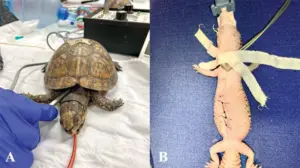
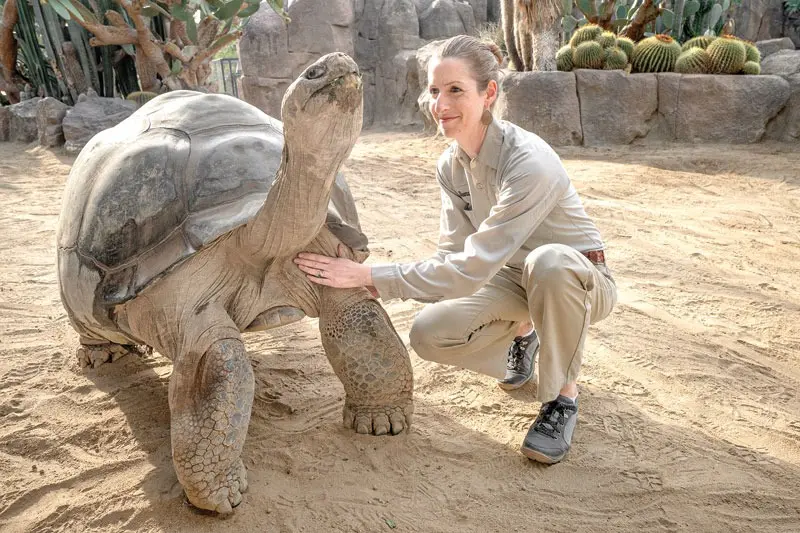
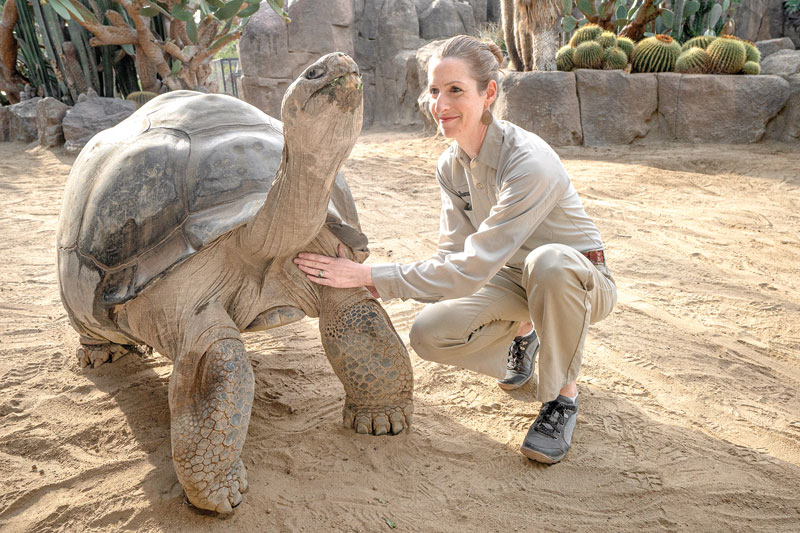
- Galapagos Tortoises: Three geriatric tortoises at the San Diego Zoo receive weekly manual therapy for osteoarthritis. Clinicians utilize the shell much like the ribs and spine of a mammal, manipulating the body across different planes while applying specialized manual massage to the limbs.
- Leopard Tortoises: At Brookfield Zoo Chicago, a female leopard tortoise named Kaya has undergone frequent rehabilitation sessions to manage a spinal deformity that impaired hind-limb strength and defecation. Kaya’s regimen includes core stabilization on a balance ball (with direct physical support from care specialists), a specialized obstacle course requiring leg-lift clearance, and incline walking for strength development.
- Komodo Dragons: In one of the most innovative interdisciplinary collaborations in modern zoo history, Dr. Steeil partnered with Matt Brunke, DVM, DACVSMR (Canine), CCAT—a specialist in canine sports medicine and rehabilitation—to treat Murphy, a popular male Komodo dragon suffering from severe joint arthritis.
To combat Murphy’s joint inflammation, Dr. Brunke and the veterinary team utilized Synovetin OA, a radioactive tin-117m isotope originally developed for dogs, injecting it directly into the dragon’s joints.
"We had established a rubric to evaluate Murphy’s mobility, gait, and joint flexion, which showed that he gained improvement in his comfort level as a result of the therapy," Dr. Brunke notes. Although Murphy’s advanced age eventually caught up with him—leading to the difficult decision to humanely euthanize him in December 2024—the case pushed the boundaries of what is medically possible in reptilian care.
Future Outlook: The Translational Ripple Effect
The therapeutic arsenal deployed by modern zoos now rivals that of advanced human and small-animal sports medicine clinics. Beyond traditional exercise protocols, contemporary zoos regularly utilize:
- Epidural steroid injections.
- Cold laser therapy (photobiomodulation).
- Extracorporeal shockwave therapy.
- Advanced diagnostics, including high-resolution radiography, CT, goniometry, and precise muscle girth measurements.
As zoological institutions continuously refine these techniques, their findings are aggressively disseminated through peer-reviewed medical journals, veterinary conferences, and public outreach media. This knowledge transfer is having a profound "trickle-down" effect on general veterinary practice.
When the Smithsonian’s National Zoo produced a short, engaging video documenting Murphy the Komodo dragon’s arthritis treatments titled "How Do You Help a Komodo Dragon with Arthritis?" the public response was immediate and overwhelming.
"Within a month of the video going live, I received four specific consults from people who wanted to discuss Murphy’s therapy for their pets," Dr. Brunke reports. "Many of them also asked, ‘Is this approach available for me, because my knee hurts.’ I had to tell them, no, but there are other things you can do."
This public fascination serves a greater educational and clinical purpose. By showcasing the dignity and complexity of geriatric care in exotic species, zoos are shifting public expectations regarding animal welfare.
"We tell a lot of stories like these at the San Diego Zoo, and I think they inspire people to think about how to treat their own animals," notes Dr. Brenner. "There are a lot more physical rehabilitation opportunities for small animals than there were just five years ago, and I think community veterinarians will be asked for rehabilitation therapy more as a standard of care moving forward."
Ultimately, the integration of physical rehabilitation into zoological medicine underscores a profound philosophical evolution. As zoos transition from mere exhibition spaces to world-class conservation and welfare centers, the commitment to easing the physical burdens of aging—whether in a tamandua, a gorilla, a tortoise, or a dragon—demonstrates that the boundaries of compassion in veterinary medicine are limitless.