
Executive Overview
For millennia, dogs have occupied a unique space in human society. Often referred to as "man’s best friend," they share our homes, our beds, and our daily routines with an uncanny ability to tune into our psychological states. From a comforting nudge when we weep to tail-wagging jubilation when we smile, canines appear to read our facial expressions with startling accuracy. While pet owners and behavioral scientists have long acknowledged this empathetic phenomenon, the actual neurological and biological mechanisms driving it have remained largely shrouded in mystery.
How does a species separated from us by millions of years of divergent evolution develop such an exquisite capacity to interpret human moods?
A pivotal new study published on August 7 in the Cell Press journal iScience offers unprecedented insight into this interspecies bond. By peering directly into the canine mind through advanced neuroimaging, researchers have mapped the specific neural pathways activated when dogs process human facial expressions. The findings confirm not only that canine brains react distinctively to human smiles, but also that dogs possess the capacity to neurologically differentiate between a spectrum of negative human emotions, including anger, fear, and sadness.
This research transcends simple academic curiosity. By understanding how domestication has rewired the canine brain to serve as a mirror for human emotion, scientists are unlocking profound truths about co-evolution, social adaptation, and the neurobiology of empathy. This article provides an in-depth examination of the study’s methodologies, its core findings, the evolutionary implications of domestication, and what this means for the future of human-animal interaction.
Detailed Chronology
To fully understand how researchers unraveled the inner workings of the dog brain, it is necessary to examine the chronological progression of this pioneering research project. The path from initial hypothesis to breakthrough publication involved rigorous experimental design, advanced machine learning applications, and international academic collaboration.
Phase I: Establishing the Foundation – The Mystery of the Smile
The journey began with a fundamental premise: happiness, expressed through human smiles, holds a distinct evolutionary and communicative value for domesticated dogs. Previous behavioral observations suggested that positive human expressions act as powerful social cues, potentially functioning as natural rewards for canines.
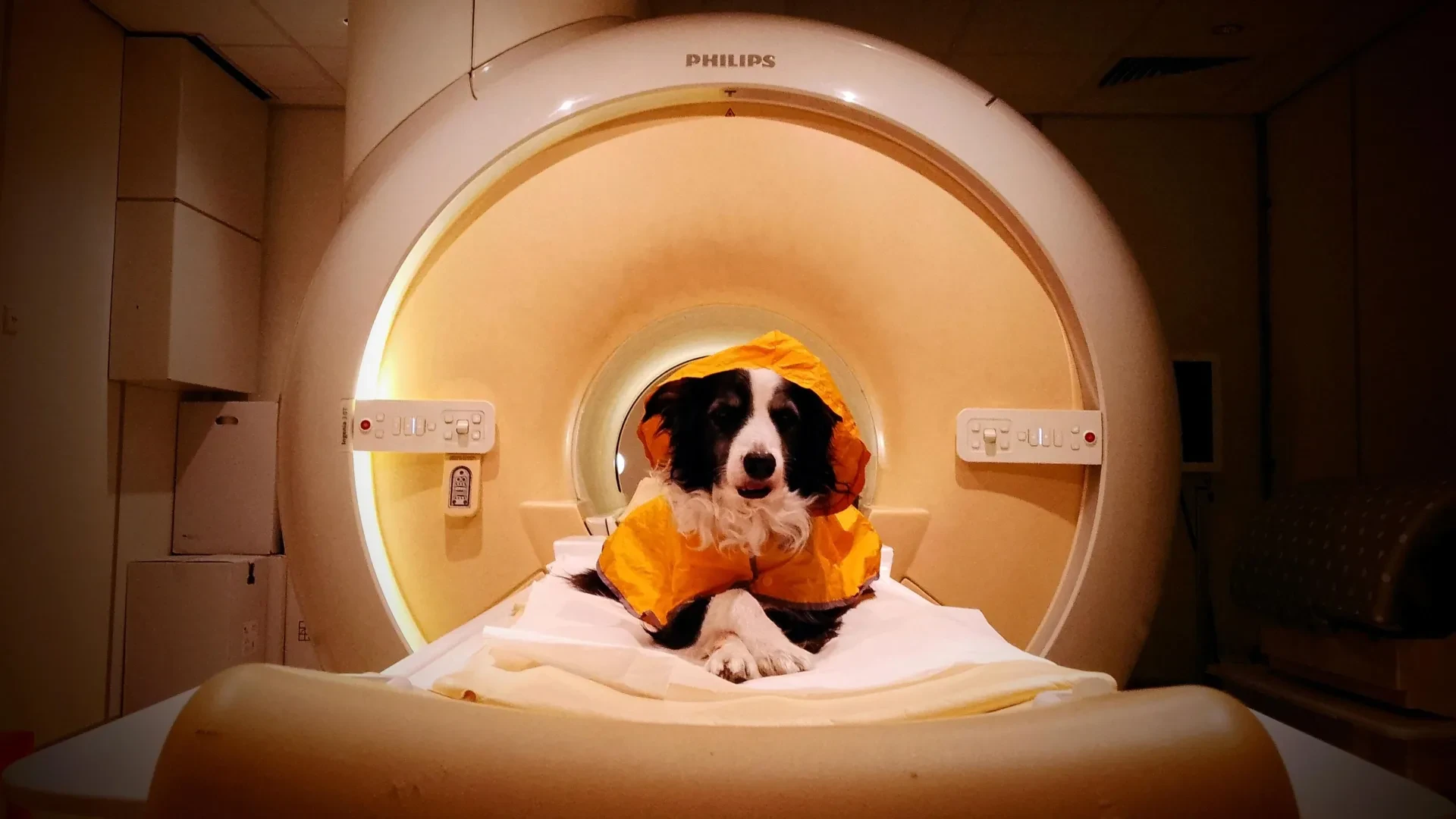
To test this hypothesis, the research team—spearheaded by scientists from the University of Vienna, working in collaboration with the National Autonomous University of Mexico and Eötvös Loránd University in Hungary—recruited a cohort of eight pet dogs. These animals were trained to remain still during functional magnetic resonance imaging (fMRI) scans without the use of physical restraints or sedatives, ensuring that their brain activity reflected natural, stress-free states.
During the initial scans, the dogs were presented with static images of unfamiliar humans displaying either happy (smiling) or neutral expressions. Upon analyzing the neural data, the researchers observed a pronounced surge in brain activity whenever the dogs laid eyes on the smiling faces. Specifically, activation spiked in two key regions: the temporal cortex, which is heavily involved in higher-level cognitive processing and visual interpretation, and the caudate nucleus, a core component of the brain’s reward circuitry.
Phase II: Expanding the Spectrum – Incorporating Negative Emotions
Having established that human smiles trigger specific neural responses associated with cognition and reward, the researchers sought to determine whether these same brain networks reacted uniformly to negative emotions, or if the canine brain made finer distinctions.
For this second phase of the experiment, the cohort was expanded to twelve dogs. The subjects were exposed to a wider array of human facial expressions, encompassing happiness, anger, fear, and sadness. Because complex emotional responses generate overlapping patterns of brain activity that are difficult to parse with traditional analytical methods, the researchers deployed advanced machine learning algorithms. These computational tools were tasked with sorting the neuroimaging data to identify whether the canine brain processed each negative emotion distinctly or lumped them into a single "negative" category.
Phase III: Machine Learning and Whole-Brain Analysis
The application of machine learning yielded breakthrough results. The computational models successfully separated the brain activity triggered by happy faces from the responses generated by anger, fear, and sadness, largely due to the unique activation signatures in the temporal cortex and caudate network.
However, the most startling discovery emerged from a subsequent whole-brain analysis. The data revealed that the dogs were not merely categorizing expressions into binary "positive" and "negative" buckets. Instead, the algorithms detected distinctly different patterns of neural activity when the dogs viewed fearful expressions compared to angry or sad ones. This milestone marked the first empirical, neurobiological evidence that dogs can cognitively differentiate between specific negative human emotional expressions.
Supporting Context & Metrics
To contextualize the significance of these findings, it is helpful to examine the experimental metrics, the evolutionary backdrop of interspecies communication, and the physiological structures involved in canine neuroprocessing.
Experimental Metrics and Cohort Breakdown
- Publication Venue: iScience (Cell Press), published August 7.
- Initial Cohort: 8 family-owned pet dogs utilized for the primary smiling-versus-neutral facial expression experiment.
- Expanded Cohort: 12 family-owned pet dogs utilized for the multi-emotion (happiness, anger, fear, sadness) machine learning analysis.
- Core Brain Regions Implicated:
- Caudate Nucleus: Associated with the brain’s reward system, reinforcing the idea that human smiles have inherent positive valence for dogs.
- Temporal Cortex: Responsible for higher-level visual and cognitive processing, allowing dogs to decode minute details in human facial geometry.
The Evolutionary Anomaly: Primates vs. Canines
When evolutionary biologists study social and emotional processing, they typically look at closely related species. For instance, comparing human emotional recognition to that of chimpanzees or macaques yields predictable similarities stemming from a shared common ancestor.
Dogs, however, represent a radical departure from this rule. Canines diverged from the common ancestor they share with felines and bears tens of millions of years ago, and their evolutionary lineage shares virtually no ancestral primate traits related to face-to-face social negotiation. Yet, through the crucible of domestication—a process that began anywhere from 15,000 to over 30,000 years ago—dogs underwent profound evolutionary changes. They adapted their cognitive architectures to fit seamlessly into human social structures, evolving specialized skills that outstrip even those of our closest primate relatives when it comes to reading human communicative intent.
Official Statements and Expert Analysis
The implications of this study are best understood through the perspectives of the researchers who spearheaded the investigation. Their insights illuminate the transition from behavioral observation to hard neurobiological fact.
Lead author Raúl Hernández-Pérez of the University of Vienna emphasizes the meticulous nature of human and canine facial perception:
"Humans are really good at picking up small details on the face, and so are dogs. This makes dogs very interesting. By studying their brains, we can understand what adaptations have developed to support their remarkable social and emotional understanding of humans."
Dr. Laura Cuaya, senior author of the study, who initiated the research at the National Autonomous University of Mexico before expanding it through collaborations at Eötvös Loránd University and the University of Vienna, highlights the profound nature of the caudate nucleus activation:
"The activity in the caudate nucleus is particularly interesting. It suggests that happy human faces may have emotional significance for dogs."
Addressing the broader implications of how dogs perceive humanity, Cuaya reflects on the unique evolutionary bridge built between the two species:
"When we compare humans with primates, we are looking at abilities that may have come from a common ancestor. With dogs, the story is totally different. They followed a very different evolutionary path, yet through domestication, they developed the social abilities needed to understand and cooperate with us."
Furthermore, Cuaya urges a fundamental shift in how society views and treats domestic animals:
"I would like people to see dogs as emotional beings. They have evolved with us to understand our expressions and cooperate with us, and recognizing that can change how we communicate with and care for them."
Future Outlook and Methodological Frontiers
While the iScience study marks a monumental leap forward in canine cognitive neuroscience, the researchers are quick to point out that it represents only the beginning of a much larger scientific inquiry. Several critical variables and future research directions remain on the horizon.
1. The Variable of Environment: Pet Dogs vs. Free-Ranging Canines
All subjects in the recent study were domestic family pets. These animals live in continuous, intimate contact with human beings, soaking up hundreds of hours of facial cues, vocal tones, and behavioral feedback every week.
Future studies aim to examine free-ranging or street dogs—populations that share a different relationship with humanity. By comparing the neuroimaging data of domestic pets with that of feral or semi-feral canines, scientists can untangle the exact contributions of individual life experience versus broad genetic domestication in shaping emotional recognition.
2. Multi-Modal Communication
A static photograph on a computer screen, while invaluable for controlled fMRI experimentation, captures only a fraction of real-world communication. In daily life, dogs interpret humans through a rich, multi-sensory tapestry that combines facial expressions, body language, tone of voice, and olfactory signals.
Subsequent research initiatives will adopt a more holistic, dog-centered approach. Scientists plan to investigate how canine brains integrate simultaneous signals—such as matching an angry facial expression with an aggressive vocalization or a fearful expression with a stress-related scent.
3. Cross-Species Processing Parallels
Another exciting frontier involves direct comparisons between how human and canine brains process identical emotional datasets. By putting both species through parallel neuroimaging paradigms, researchers hope to map the convergent evolutionary strategies that allow two radically different biological organisms to share a deeply intertwined emotional language.
Conclusion
The research published in iScience closes a long-standing gap between subjective pet-owner intuition and objective neurobiological reality. We now know that when a dog looks at a smiling face, its reward centers light up, and when it encounters expressions of fear, anger, or sadness, its brain processes those negative cues as distinct emotional states.
As science continues to peel back the layers of the canine mind, one inescapable conclusion emerges: dogs are not merely reacting to us out of conditioned habit or opportunistic survival. They are active, emotionally attuned participants in a shared evolutionary journey, wired to read our expressions, understand our moods, and navigate the complex emotional landscape of human life alongside us.