
Executive Overview
Few agricultural commodities are as deceptively fragile as the potato. Renowned for their susceptibility to bruising, potatoes suffer from mishandling at nearly every stage of the supply chain—starting from the moment they are unearthed by heavy machinery. Across the globe, millions of dollars in potential revenue are literally bruised away annually, resulting in downgraded crops, processor rejections, and substantial food waste long before the tubers ever reach a processing plant or supermarket shelf.
To combat this persistent agricultural bottleneck, consumer packaged goods (CPG) giant PepsiCo and agricultural machinery manufacturer Grimme have forged a high-tech alliance. Eschewing traditional hardware-only upgrades, the partners are tackling supply chain loss at its root by focusing on an element frequently neglected in modern farming: operator training and workforce upskilling.
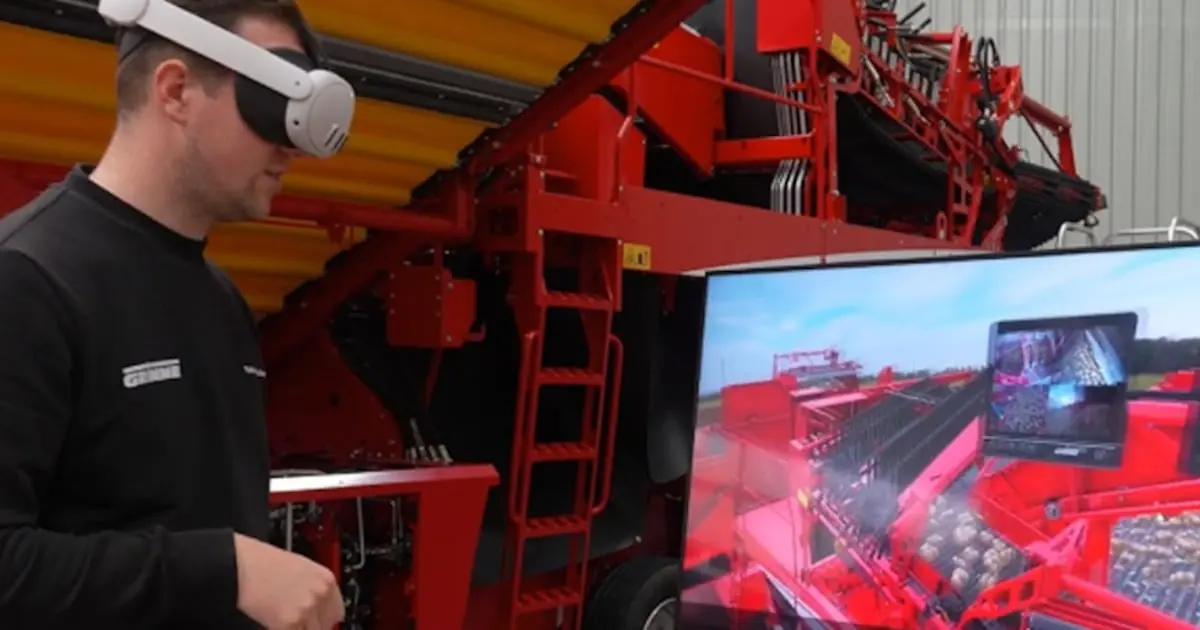
Through a collaborative initiative supported by immersive learning technology provider Altoura, PepsiCo and Grimme have developed photorealistic digital replicas—commonly known as digital twins—of Grimme’s flagship EVO and SE series potato harvesters. Powered primarily by virtual reality (VR) headsets, this cutting-edge training platform allows farm operators, agronomists, and seasonal workers to interact with complex machinery in a risk-free virtual environment. Trainees can deconstruct components, remove inspection panels, learn calibration techniques, and understand how machinery settings directly impact crop integrity—all without stepping foot in a muddy field or risking expensive equipment damage.
Early pilot data from international trials in Brazil, Mexico, Poland, and Romania reveals staggering results: participating farms recorded an 87% increase in bruise-free potatoes, alongside a 1.7-fold reduction in severe bruising.
As agriculture faces mounting pressures from labor shortages, climate volatility, and razor-thin profit margins, the PepsiCo-Grimme initiative offers a compelling glimpse into the future of farming. By blending industrial simulation software typically reserved for advanced manufacturing with accessible mobile and desktop deployment, this project is proving that immersive technology can democratize expertise, preserve crop quality on a massive scale, and redefine upskilling for the 21st-century agricultural workforce.
Detailed Chronology of the Partnership and Technological Rollout
The genesis of the PepsiCo-Grimme digital twin project did not happen overnight. It represents a carefully orchestrated convergence of agricultural necessity, industrial simulation expertise, and cross-industry technology transfer.
Phase 1: Identifying the Mechanical Root Cause
For decades, agricultural engineers recognized that potato bruising is predominantly mechanical. Adjustments to harvester web speeds, share angles, and drop heights can make the difference between a pristine harvest and a bruised crop. However, teaching seasonal or geographically dispersed workforces how to continuously fine-tune these heavy machinery variables has always been a logistical nightmare. Traditional manuals are often unread, and on-the-job training leads to costly mistakes during peak harvest windows when time is of the essence.
Recognizing that minor operational errors compound into massive financial and agricultural losses, PepsiCo’s global agriculture division began exploring innovative ways to bridge the knowledge gap.
Phase 2: Building the Digital Twin Ecosystem
To build a realistic simulation, PepsiCo partnered with Grimme—a global leader in potato harvesting technology—and Altoura, a recognized specialist in immersive learning and spatial computing. The objective was to create exact digital twins of Grimme’s EVO and SE series potato harvesters.
Unlike simple 3D animations, these digital twins mirror the exact physics, mechanics, and operational nuances of the physical machines. Trainees using VR headsets can virtually walk around the harvester, peer into internal mechanisms, practice maintenance procedures, and simulate harvesting under various soil and moisture conditions. Crucially, recognizing that not all farms have access to high-end VR hardware or reliable internet connections, the application was engineered to be hardware-agnostic. It runs seamlessly on VR headsets, tablets, smartphones, and desktop computers. Furthermore, once the Altoura application is downloaded, users do not require Wi-Fi or active mobile service—a vital feature for remote agricultural fields.
Phase 3: Global Pilot Testing (Brazil, Mexico, Poland, and Romania)
With the platform developed, the partners initiated real-world field tests last year. The rollout was deliberately international, targeting key agricultural regions in Brazil and Mexico before expanding into European markets in Poland and Romania.
During these pilots, local farmers and equipment operators were introduced to the digital training platform prior to the harvest season. The results were immediate and quantifiable, demonstrating that virtual preparation translated directly into superior field execution and reduced crop trauma.
Phase 4: Public Showcase and Global Scaling
Following successful validation in the pilot markets, PepsiCo and Grimme officially debuted the technology to a broader agricultural audience at PepsiCo’s Global Agro University in Germany. This showcase marked the transition from an experimental pilot to a scalable, repeatable framework designed for global deployment. Rather than imposing a one-size-fits-all model, the companies have focused on localization—translating software interfaces, adapting training scenarios to regional farming practices, and ensuring that the technology addresses the unique operational realities of diverse agricultural communities worldwide.
Supporting Context, Metrics, and Economic Impact
To fully appreciate the significance of the PepsiCo-Grimme collaboration, one must examine the broader economic and operational realities of industrial potato farming.
The True Cost of Potato Bruising
Potatoes are roughly 80% water, making them remarkably sensitive to impact forces. When a harvester digs tubers out of the earth, they are subjected to shaking webs, separation rollers, and transfer drops. If harvester settings are miscalibrated—often due to operator inexperience or fatigue—the tubers sustain internal and external bruising.
- External Bruising: Scuffs and skin breaks that invite bacterial and fungal rot during storage.
- Internal Bruising: Discoloration beneath the skin that manifests hours or days later. Processors like PepsiCo (which utilizes massive quantities of potatoes for its snack brands, such as Lay’s) reject truckloads failing quality thresholds, or heavily discount bruised yields.
The financial fallout is staggering. Across the global supply chain, potato bruising translates to millions of dollars in lost annual revenues. For independent growers, a single poorly calibrated harvest can wipe out net profit margins for the entire season.
Quantitative Breakthroughs from the Pilot Program
The metrics released by PepsiCo validate the investment in immersive learning technology:
- 87% Increase in Bruise-Free Potatoes: Farms utilizing the digital twin training platform experienced a dramatic surge in top-grade, undamaged yields.
- 1.7x Reduction in Severe Bruising: Catastrophic crop damage was nearly cut in half, significantly reducing food waste and post-harvest rejections.
Overcoming Infrastructure and Adoption Barriers
Introducing high-tech solutions into agriculture often encounters resistance due to cost, complexity, and connectivity issues. PepsiCo and Grimme deliberately engineered their platform to dismantle these barriers:
- Low Barrier to Entry: By supporting tablets, smartphones, and desktops alongside VR headsets, farms do not need to invest heavily in specialized hardware to benefit from the training.
- Offline Functionality: Recognizing that rural farming communities frequently lack dependable broadband connectivity, the Altoura application operates entirely offline once installed.
- Cost vs. Risk Economics: As Rob Meyers, VP of Global Agriculture at PepsiCo, pointed out, the cost of implementing VR and digital twin training is only a fraction of the severe financial risk posed by crop bruising. The technology effectively pays for itself after avoiding the loss of just a few truckloads of potatoes.
Official Perspectives and Industry Insights
The intersection of agriculture and immersive technology offers a fascinating lens through which to view modern corporate innovation. Key leaders behind the initiative have shared valuable insights regarding its development, philosophy, and future trajectory.
Translating Manufacturing Innovation to the Fields
The inspiration for applying digital twins to agriculture did not emerge from a vacuum. It was born out of cross-pollination within PepsiCo’s vast corporate ecosystem. Earlier, PepsiCo made headlines by announcing an industry-first artificial intelligence and digital twin collaboration with industrial giants Siemens and Nvidia, aimed at optimizing manufacturing and industrial simulation.
Rob Meyers, Vice President of Global Agriculture at PepsiCo, noted how witnessing these industrial applications sparked an agricultural epiphany:
"We had seen some of the work that our wider PepsiCo business was doing around using digital twins to improve operator training in the manufacturing space and felt there was a lot of applicability that could help us on the farming side."
The Challenge of Labor and Regional Customization
Agriculture faces a chronic labor shortage, compounded by high turnover rates, seasonal workforces, and linguistic barriers. Meyers emphasized that the digital twin platform was built specifically to address these human capital challenges:
"One of agriculture’s biggest challenges is delivering consistent, high-quality training to operators who may be seasonal, geographically dispersed or working in different languages and markets. The opportunity with digital tools is their ability to make expert training more accessible and scalable."
Furthermore, Meyers stressed the importance of grassroots adaptation over rigid technological imposition. Scalability, he noted, depends entirely on local relevance:
"Adapting to local realities is often more important to driving adoption at scale. As we expand into new markets, we’re continuing to refine the experience, including language support and training content. The goal isn’t to introduce complexity. It’s to make proven expertise available to more operators, in more places, before they enter the field."
Future Outlook: Can VR and Digital Twins Solve Ag’s Workforce Crisis?
As the agricultural sector braces for the demands of feeding a growing global population under increasingly unpredictable climatic conditions, the success of the PepsiCo-Grimme initiative signals a broader paradigm shift.
The Convergence of AgTech and Immersive Learning
For decades, "AgTech" was synonymous with automated tractors, drone crop-dusting, and IoT soil sensors. The human element—the operator sitting in the cab—was often treated as the variable least amenable to technological intervention. The digital twin revolution turns this assumption on its head. By treating the operator as a critical node in the supply chain optimization process, companies like PepsiCo and Grimme are unlocking unprecedented operational efficiencies.
We are likely to witness the expansion of immersive learning technologies across other high-value crops—such as apples, citrus fruits, and wine grapes—where mechanical harvesting and handling inflict similar bruising and quality degradation.
Bridging the Generational and Skills Gap
As veteran farmers retire and rural communities experience a brain drain, agriculture faces a widening skills gap. Immersive technologies like VR and digital twins possess a distinct cultural advantage: they resonate strongly with younger, digitally native generations. By gamifying machine maintenance and operational calibration, farming can be repositioned as a high-tech career path, attracting tech-savvy talent back to the agricultural sector.
The Path Forward: Scaling for Global Resilience
The roadmap for PepsiCo and Grimme involves deeper integration across additional international markets, continuous refinement of artificial intelligence integrations, and expansion into multi-language and localized training modules.
Ultimately, the digital potato harvester represents much more than a clever corporate training exercise. It is a blueprint for sustainable agriculture in the 21st century—demonstrating that by empowering workers with virtual expertise, the agricultural industry can dramatically reduce waste, protect grower profitability, and secure the global food supply chain one bruise-free harvest at a time.