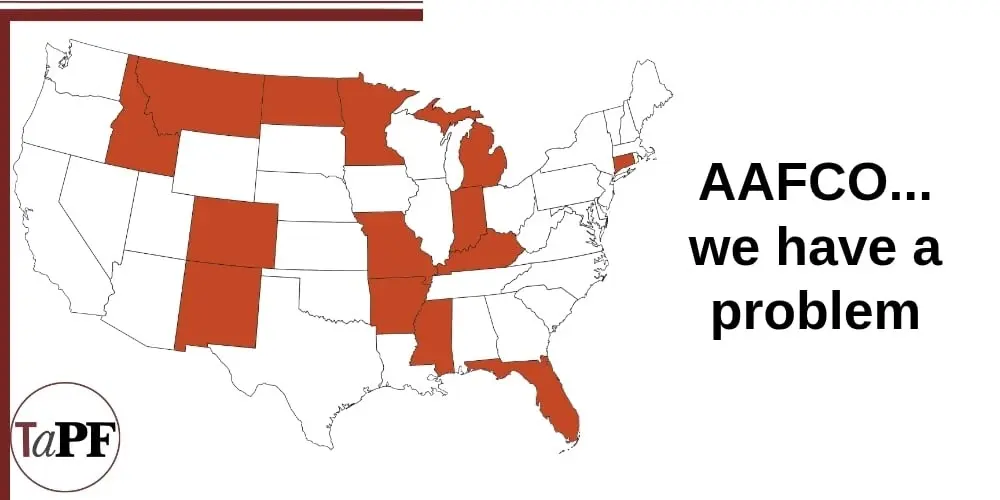
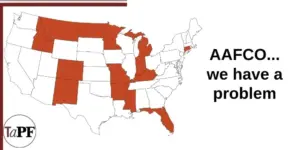
A legal discrepancy at the intersection of state statutory law and pet food regulatory standards has created a systemic risk for the American pet food industry. An analysis of state commercial feed codes reveals that statutory laws across fourteen U.S. states directly conflict with official ingredient definitions promulgated by the Association of American Feed Control Officials (AAFCO).
At the center of this legal challenge is a fundamental contradiction regarding animal sourcing. While laws in states such as Missouri, Minnesota, and Florida strictly prohibit commercial animal feed from containing diseased animals or livestock that died by means other than slaughter, standard AAFCO definitions for widely used rendered ingredients—including poultry by-product meal, meat meal, and animal digest—omit these explicit statutory protections. Instead, AAFCO relies on broader definitions that allow federal and state administrative "discretion," effectively permitting non-slaughtered or diseased animal tissue into the pet food supply chain.
Under established legal principles across the affected jurisdictions, administrative rules that conflict with state legislative statutes are inherently invalid. If challenged in court, key AAFCO ingredient definitions could be struck down, leaving commonly used ingredients legally undefined in fourteen states. Such a ruling would render pet foods containing these ingredients unmarketable and legally adulterated in those jurisdictions, posing severe supply chain disruptions for manufacturers, retailers, and regulatory agencies.
+-----------------------------------------------------------------------------------+
|                            THE REGULATORY CONFLICT                                |
+-----------------------------------------------------------------------------------+
|  STATE STATUTORY LAW (e.g., MO Rev. Stat. § 266.180)                              |
|  • Expressly deems feed "adulterated" if sourced from non-slaughtered or          |
|    diseased animals, or if containing filthy/decomposed material.                 |
+-----------------------------------------------------------------------------------+
                                          VS
+-----------------------------------------------------------------------------------+
|  AAFCO INGREDIENT DEFINITIONS (Adopted in Model Bill)                             |
|  • Omits requirements for slaughter or disease-free sourcing.                     |
|  • Relies on "suitable for use" clauses, accommodating FDA administrative          |
|    enforcement discretion.                                                        |
+-----------------------------------------------------------------------------------+
                                          ||
                                          /
+-----------------------------------------------------------------------------------+
|  STATUTORY RESULT (e.g., MO Rev. Stat. § 536.014)                                 |
|  • Administrative rules in conflict with state statute are void and invalid.      |
|  • Risk: Ingredients become legally undefined; products face state bans.           |
+-----------------------------------------------------------------------------------+
Detailed Chronology of the Regulatory Conflict
The current oversight stems from decades of administrative practice where non-binding enforcement policies overshadowed statutory state law.
The Historic Role of AAFCO and State Adoption
Founded in 1909, AAFCO is a voluntary, non-governmental organization composed of state and federal feed control officials. While AAFCO itself possesses no independent statutory or regulatory authority, its annual Official Publication (OP) serves as the industry standard. Most U.S. states incorporate AAFCO ingredient definitions into their state feed regulations either by direct statutory reference or administrative adoption.
The Rise of FDA Compliance Policy Guidelines
For decades, the U.S. Food and Drug Administration (FDA) maintained Compliance Policy Guidelines (CPGs)—specifically CPG Sec. 675.400—which permitted the rendering of "4-D" animals (dead, dying, diseased, or disabled) into animal feed, despite federal statutory prohibitions under Section 402(a)(5) of the Federal Food, Drug, and Cosmetic Act (FD&C Act). State regulatory agencies largely followed this federal enforcement discretion, incorporating AAFCO’s flexible definitions into daily oversight without reconciling them against their own enacted state codes.
The 2024 Legal Discovery and Analysis
Following years of scrutiny regarding rendered ingredients, legal researchers and consumer advocacy groups, led by Susan Thixton of TruthaboutPetFood.com and the Association for Truth in Pet Food (ATPF), initiated a comparative analysis between individual state commercial feed statutes and AAFCO’s official ingredient definitions.
Formal Filing of Regulatory Notice
In late 2024, the ATPF formally submitted an administrative notification to AAFCO’s Board of Directors, the Pet Food Committee, and the Ingredient Definitions Committee. The notice identified fourteen state codes where legislative definitions of "adulteration" directly conflict with AAFCO’s ingredient standards, demanding immediate harmonization to prevent legal challenges.
Deep-Dive Analysis: The Statutory and Regulatory Friction
The tension between state statutory mandates and administrative standards centers on statutory authority. Administrative bodies cannot issue rules, definitions, or policies that undermine or conflict with statutes enacted by state legislatures.
The Legal Precedent: Missouri Statute as a Benchmark Case
Missouri’s commercial feed laws illustrate this conflict. Under the Missouri Revised Statutes, Section 266.180, commercial feed is legally deemed adulterated:
"(i) If it is, in whole or in part, the product of a diseased animal or of an animal which dies other than by slaughter which is unsafe within the meaning of section 402(a)(5) of the Federal Food, Drug, and Cosmetic Act…"
Additionally, the statute classifies feed as adulterated:
"…If it consists in whole or in part of any filthy, putrid, or decomposed substance, or if it is otherwise unfit for feed."
Concurrently, Missouri Revised Statutes Section 536.014 establishes a strict standard for administrative rulemaking:
"No department, agency, commission or board rule shall be valid in the event that: (2) The rule is in conflict with state law."
Because AAFCO ingredient definitions are codified as administrative rules by state departments of agriculture, any AAFCO definition that permits non-slaughtered, diseased, decomposed, or filthy materials directly violates Section 266.180. Consequently, under Section 536.014, those administrative rules are legally void ab initio (from the beginning).
+------------------------------------------------------------------------------------+
|                       COMPARATIVE ANALYSIS OF LEGAL CONFLICTS                      |
+------------------------------+-----------------------------------------------------+
| Statutory Requirement        | AAFCO Regulatory Definition                         |
| (State Legislation)          | (Standard Model Language)                           |
+------------------------------+-----------------------------------------------------+
| Must be derived exclusively  | Lacks explicit slaughter requirement. Contains      |
| from slaughtered livestock.  | broad phrase: "suitable for use in animal food."    |
+------------------------------+-----------------------------------------------------+
| Prohibits tissue from        | Accommodates regulatory "permissions" or "enforcement |
| diseased or 4-D animals.     | discretion" permitting diseased tissue.             |
+------------------------------+-----------------------------------------------------+
| Strictly bars filthy or      | Standard definition contains no legal requirement   |
| decomposed substances.       | guaranteeing freedom from decomposition or filth.   |
+------------------------------+-----------------------------------------------------+
Affected Ingredients and Industry Reliance
The regulatory disconnect impacts primary protein and digest components widely used in standard pet food formulations. These ingredients include:
Poultry By-Product Meal: Consists of the ground, rendered, clean parts of the carcass of slaughtered poultry, such as necks, feet, undeveloped eggs, and intestines. However, AAFCO’s official definition lacks mandatory enforcement mechanics requiring 100% derivation from healthy, slaughtered birds.
Poultry By-Products: Non-rendered clean parts produced from slaughtered poultry, facing identical legal oversight gaps regarding health status.
Meat Meal: The rendered product from mammal tissues, exclusive of added blood, hair, hoof, horn, hide trimmings, manure, stomach, and rumen contents. Crucially, the definition does not specify that the source mammals must be humanely slaughtered or disease-free.
Meat and Bone Meal: Rendered mammalian tissue including bone, lacking statutory slaughter guarantees.
Animal By-Product Meal: Rendered animal tissues that fail to meet specific single-species definitions, historically vulnerable to multi-species and 4-D animal blending.
Animal Digest: Material resulting from chemical or enzymatic hydrolysis of clean, undecomposed animal tissue.
These ingredients account for millions of tons of material processed annually by the rendering industry and distributed across domestic pet food supply lines.
The 14-State Matrix and Regulatory Governance
The fourteen states identified with conflicting statutory provisions represent a major cross-section of the U.S. pet food market:
Arkansas
Colorado
Connecticut
Florida
Idaho
Indiana
Kentucky
Michigan
Minnesota
Mississippi
Missouri
Montana
New Mexico
North Dakota
A notable concern highlighted by industry observers is regulatory oversight within these jurisdictions. State Feed Control Officials (FCOs) from several of these fourteen states sit on AAFCO’s Board of Directors, the Pet Food Committee, and the Ingredient Definitions Committee. These officials routinely vote to approve or modify ingredient definitions that violate the enacted statutes of their home states.
              14 STATES WITH DIRECT STATUTORY CONFLICTS
======================================================================
  [AR] Arkansas        [CO] Colorado        [CT] Connecticut
  [FL] Florida         [ID] Idaho           [IN] Indiana
  [KY] Kentucky        [MI] Michigan        [MN] Minnesota
  [MS] Mississippi     [MO] Missouri        [MT] Montana
  [NM] New Mexico      [ND] North Dakota
======================================================================
  Impact: Millions of pet food units sold across these states rely on
  ingredient definitions vulnerable to judicial invalidation.
Official Statements and Advocacy Demands
In her formal petition sent to AAFCO leadership, pet food consumer advocate Susan Thixton outlined the legal exposure facing both state regulators and commercial manufacturers.
Excerpt from the Official Communication to AAFCO Leadership:
"Fourteen US states have state laws that conflict with AAFCO ingredient definitions commonly used in pet food… If challenged, a Missouri court could easily rule that many AAFCO ingredient definitions are ‘in conflict with state law’ and would be ruled as invalid.
All 14 states have similar laws. If challenged in any of the 14 states, courts would more than likely rule many AAFCO ingredient definitions conflict with state law and would invalidate the definitions.
It is concerning that many individuals from these 14 states voted to approve these ingredient definitions, participated on the Pet Food and Ingredient Definitions committees and even held high positions within AAFCO knowing their state laws conflicted with the AAFCO definitions—yet no one ever spoke up.
We are asking AAFCO to immediately address this issue, before a serious problem for pet food consumers and industry occurs. AAFCO’s Animal Product ingredient definitions SHOULD be aligned with state laws. At the very least, the Animal Product ingredient definitions for the states Arkansas, Colorado, Connecticut, Florida, Idaho, Indiana, Kentucky, Michigan, Minnesota, Mississippi, Missouri, Montana, New Mexico, and North Dakota must be revised to fully align with state laws; include the requirements to be sourced from a slaughtered animal, a disease-free animal, and free from filth and decomposition."
The Association for Truth in Pet Food (ATPF) confirmed that it is awaiting a formal response from AAFCO’s legal counsel and executive committee. The organization stated that if AAFCO fails to act, the correspondence will be integrated into public records provided to state attorneys general and consumer protection agencies.
Future Outlook and Market Implications
The identification of this regulatory flaw introduces significant operational, legal, and economic uncertainties for the pet food supply chain.
Judicial Risk and Consumer Class Action Litigation
If a pet owner, consumer protection group, or state attorney general files a declaratory judgment action in any of the fourteen states, courts will be required to compare administrative definitions against state statutory language. Given explicit statutory mandates (such as Missouri § 536.014), courts would likely declare the administrative definitions of "Meat Meal" or "Poultry By-Product Meal" invalid.
Such a ruling would have immediate legal consequences:
Loss of Defined Status: Ingredients would lose their legal definition within that state’s administrative code.
Immediate Reclassification as Adulterated: Products containing undefined rendered animal tissues could be deemed adulterated under state law, exposing manufacturers to immediate wood-block stop-sale orders.
Class-Action Vulnerability: Pet food brands marketing products in those states could face major consumer class-action lawsuits alleging deceptive trade practices, statutory fraud, and breach of implied warranty.
                       SCENARIO MATRIX: LEGAL JUDGMENT IMPACT
+------------------------------+-------------------------------------------------------+
| Trigger Event                | Legal & Commercial Outcome                            |
+------------------------------+-------------------------------------------------------+
| Declaratory Judgment Filed   | State Court reviews administrative definitions against |
| in State Court               | statutory adulteration mandates.                      |
+------------------------------+-------------------------------------------------------+
| Administrative Rules         | Ingredients (e.g., Meat Meal) lose legal recognition  |
| Struck Down                  | in the jurisdiction.                                  |
+------------------------------+-------------------------------------------------------+
| Enforcement Phase            | Departments of Agriculture issue stop-sale orders;    |
|                              | retailers forced to pull non-compliant inventory.     |
+------------------------------+-------------------------------------------------------+
| Civil Litigation             | Mass tort and consumer class-action claims filed      |
|                              | alleging statutory adulteration and deceptive labeling.|
+------------------------------+-------------------------------------------------------+
Supply Chain Disruptions and Economic Impact
A systemic disruption in these fourteen states would force manufacturers to bifurcate their supply chain operations or reformulate product lines. To maintain market access across these jurisdictions, brands would need to:
Guarantee that 100% of rendered animal proteins are derived exclusively from inspected, slaughtered livestock.
Transition formulations away from generic rendered meals toward whole human-grade meats or verified single-origin ingredients.
Establish clear, auditable supply-chain tracing from slaughterhouse to final processing plant to satisfy state agricultural inspectors.
Systemic Reform Pathways
To resolve this legal conflict, regulatory bodies face two potential pathways:
State Statutory Amendments: Legislatures in all fourteen states would need to amend their feed laws to explicitly allow non-slaughtered, 4-D, or diseased animal tissue into the feed supply. However, passing legislation that dilutes feed safety standards presents severe political challenges.
AAFCO Ingredient Revisions: AAFCO could update its Animal Product definitions by inserting mandatory language requiring raw materials to be derived exclusively from inspected, slaughtered animals, free from disease, filth, and decomposition.
As legal scrutiny intensifies, pet food manufacturers, ingredient suppliers, and state regulators are under pressure to resolve this statutory conflict before judicial challenges force systemic disruptions across the domestic pet food market.