
Fact-checked by Kenn Kaufman, Field Editor, Audubon Magazine
Executive Overview
When bird enthusiasts conceptualize the avian biodiversity of North America, a vibrant spectrum of blues, yellows, and earthy browns typically dominates the imagination. True pink plumage is surprisingly scarce across the continent. Even when applying a generous definition that incorporates rare vagrants, peripheral species, and minimal feather accents, North America plays host to fewer than a dozen distinct birds featuring shades of pink.
Yet, what this palette lacks in sheer volume, it makes up for in ecological and visual impact. Among this select group are some of the most striking animals on the continent, ranging from legendary coastal waders to elusive high-altitude finches and shimmering hummingbirds.
The mechanisms behind these hues are as diverse as the species themselves. For large waders like the American Flamingo (Phoenicopterus ruber) and the Roseate Spoonbill (Platalea ajaja), pigmentation is fundamentally exogenous, driven by carotenoid-rich diets. Conversely, hummingbirds owe their electric flashes of pink to the microscopic physical structures of their feathers, which refract light via structural coloration. Meanwhile, various finch species display reddish-pink plumage rooted deeply at the genomic level.
This comprehensive report examines the biology, distribution, conservation status, and observational strategies for North America’s elite roster of pink-feathered birds, offering field ornithologists and backyard birders a definitive guide to locating and understanding these remarkable creatures.
Detailed Chronology & Biological Taxonomy of North American Pink Birds
Understanding how pink manifests across disparate avian families requires categorizing these birds by morphology, habitat, and the biological source of their coloration. Ornithologists divide North America’s pink avifauna into primary waders, high-flying hummingbirds, common backyard finches, and high-elevation alpine specialists.
I. The Large Waders: Icons of the Wetlands
American Flamingo (Phoenicopterus ruber)
- Morphology & Identification: Standing apart with an entirely pink body and a distinctively heavy, black-tipped, downward-curved beak, the American Flamingo is one of North America’s two long-legged pink waders. Its specialized bill is engineered for inverted foraging, filtering microscopic organisms out of brackish water.
- Historical & Ecological Context: Popular culture frequently mischaracterizes flamingos as commonplace Florida residents. Historically, scientists debated whether the state ever maintained a stable, self-sustaining breeding population. However, modern shifting climate patterns and hurricane-driven vagrancy have transformed this narrative. Wild birds blown northward by tropical storms have increasingly taken up year-round residence, raising legitimate ecological prospects of a restored breeding presence in the Sunshine State.
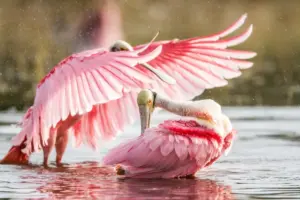
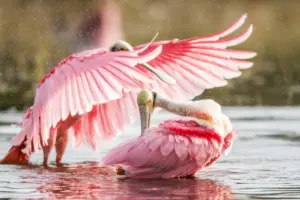
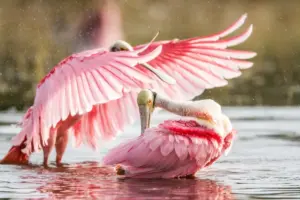
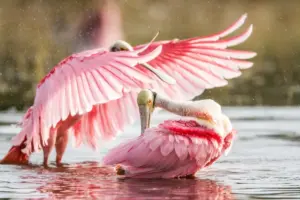
Roseate Spoonbill (Platalea ajaja)
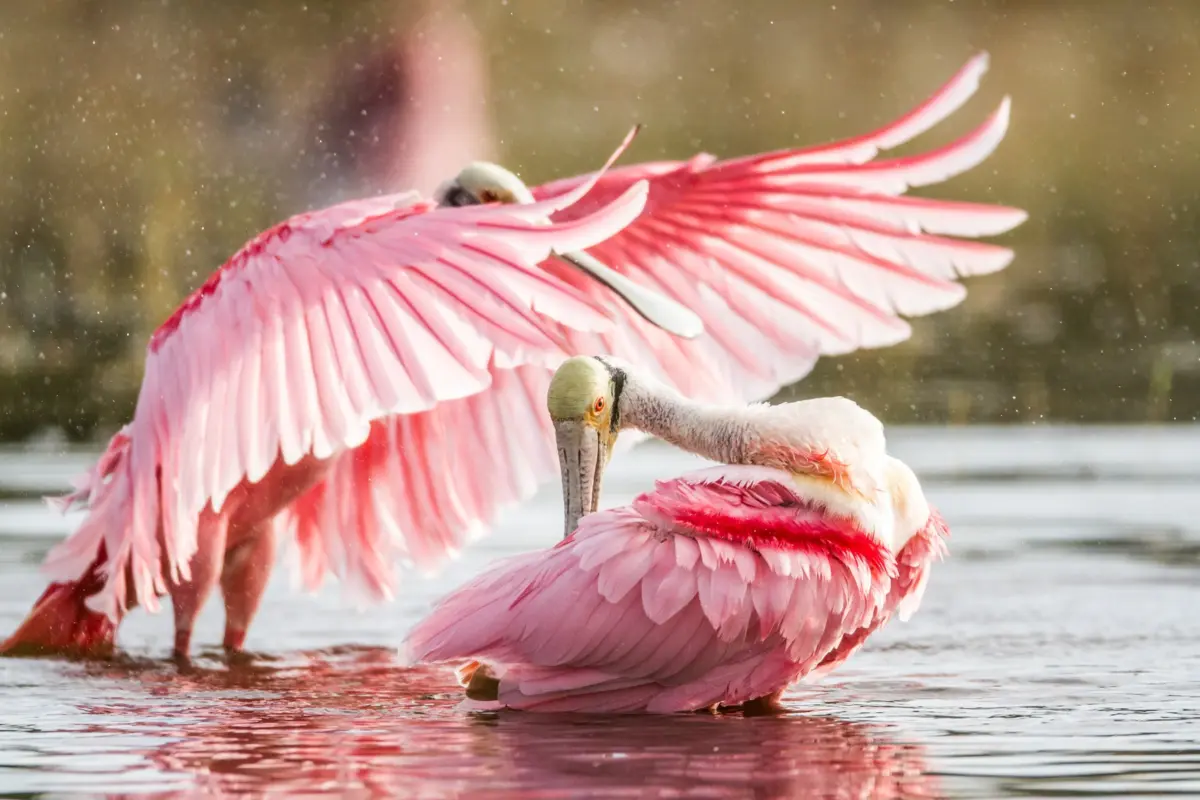
- Morphology & Identification: While sharing a superficial resemblance to flamingos from a distance, the Roseate Spoonbill is instantly distinguished by its bizarre, spatula-shaped bill. Featuring a white neck and a greenish, unfeathered head, the spoonbill sweeps its sensor-rimmed bill laterally through coastal shallows and estuarine muck to detect small fish and crustaceans.
- Geographic Expansion: More common than the flamingo, the spoonbill maintains healthy year-round populations along the Gulf Coast and southern Florida. In recent decades, observational data confirms that the species has steadily expanded its breeding range northward, serving as a biological indicator of changing wetland ecosystems in the Everglades and beyond.
II. The Iridescent Jewels: North American Hummingbirds
Unlike waders that acquire pink via diet, hummingbirds manipulate light through physics. Microscopic "pancake-like" structures within their feather barbules create brilliant iridescent flashes.
- Anna’s Hummingbird (Calypte anna): When the head of a male Anna’s Hummingbird encounters direct sunlight, its crown and gorget (throat feathers) gleam an intense, electric pink. Originally native to scrub habitats of Baja California and southern California, this species has expanded its year-round range up the Pacific Coast and into southern Arizona, adapting seamlessly to urban gardens and suburban feeders.
- Calliope Hummingbird (Selasphorus calliope): Holding the title of North America’s smallest breeding bird, the male Calliope sports a patchy, flaring gorget flashing shades from soft pink to vibrant magenta. During summer, these tiny migrants inhabit Northern California, the Intermountain West, the Pacific Northwest, and western Canada.
- Broad-tailed Hummingbird (Selasphorus platycercus): Familiar to hikers and residents across the Mountain West and southwestern states, male Broad-tailed Hummingbirds feature a rose-pink gorget. Preferring high-elevation forests and subalpine meadows, they are equally recognizable by the distinct, metallic humming buzz emitted by their wings during flight.
III. The Familiar Foragers: Finches of Forest and Feeder
Reddish-pink pigmentation in North American finches is genetically encoded, driven by dietary carotenoids metabolized into plumage coloration during molting cycles.
- Purple Finch (Haemorhous purpureus): Despite its common name, the male Purple Finch displays a wash of color ranging from deep maroon to bright raspberry-pink. While breeding heavily in Canada’s boreal forests, they overwinter widely across the eastern United States. They are celebrated feeder favorites, particularly during "irruption years" when food shortages push northern populations deep south.
- Cassin’s Finch (Haemorhous cassinii): A western counterpart to the Purple Finch, the male Cassin’s Finch features a soft pink breast and face coupled with a brilliant red, spiky cap. Nomadic foragers of high-elevation coniferous forests, they frequently sing resonant, warbling notes from the very tops of mature evergreens.
IV. The High-Altitude Specialists: The Rosy-Finches
Among the rarest and most localized pink birds in North America are the three species of rosy-finches, which inhabit the harshest, highest-elevation environments on the continent.
- Black Rosy-Finch (Leucosticte atrata): A year-round resident of the Great Basin’s highest peaks, this endangered western finch pairs a charcoal-black, brown, and gray body with bold, striking pink highlights slashed across its wings and belly. Its isolation makes it a "holy grail" species for serious listers.
- Brown-capped Rosy-Finch (Leucosticte australis): Displaying a more subdued palette than its black counterpart, this species features rich brown head plumage and a softer pastel pink wash. Its range is exceptionally restricted, breeding exclusively above timberline in the Rocky Mountains from Wyoming down to New Mexico.
- Gray-crowned Rosy-Finch (Leucosticte tephrocotis): The most widespread of the three rosy-finches, this bird nests from western Alaska south to alpine zones in California and northern Montana, descending into the Intermountain West during winter. It features extensive gray on the crown with subdued pink wing panels.
Supporting Context & Metrics
To contextualize the distribution and population dynamics of these species, field researchers rely on systematic metrics, tracking parameters, and ecological indicators:
- Species Count Threshold: Fewer than 12 species out of the roughly 1,000 birds recorded in North America exhibit genuine pink plumage or notable pink highlights.
- Geographic Concentration: Over 70% of North America’s specialized pink species (rosy-finches and specific hummingbirds) are restricted to western montane and Pacific coastal ecosystems.
- Nutritional Dependence: Carotenoid pigmentation in flamingos and spoonbills relies entirely on crustacean and algal ingestion; captive specimens deprived of these dietary components naturally fade to a dull, chalky white or pale gray.
- Migration Distances: Calliope and Broad-tailed Hummingbirds travel up to 5,000 miles round-trip annually between their North American breeding grounds and Central American wintering territories.
Official Statements and Expert Insight
To maintain rigorous ornithological accuracy, insights from premier field editors provide essential context regarding bird distribution and identification:
"We don’t have a lot of pink birds in North America. In fact, even if we get generous with the definition of pink and count rare species or those with minimal pink plumage, we have fewer than a dozen. Fortunately, two of them are among the most remarkable birds you can see in the United States: the Roseate Spoonbill and the American Flamingo."
— Kenn Kaufman, Field Editor, Audubon Magazine
Regarding the changing status of marsh waders, ornithological surveys emphasize that the resurgence of wild flamingos in the Florida Everglades is not merely an observational anomaly, but a direct indicator of regional environmental restoration efforts. Conservation biologists monitoring the Comprehensive Everglades Restoration Plan (CERP) note that returning hydrological flows have successfully restored the micro-crustacean and small fish densities necessary to sustain long-legged wading species year-round.
Future Outlook: Conservation and Observation Strategies
For birders hoping to observe North America’s pink avifauna, targeted field strategies and dedicated conservation support are vital.
Where to Find Them
- Wetlands & Coastal Refuges: For Roseate Spoonbills, prime viewing locations include Florida’s J.N. "Ding" Darling National Wildlife Refuge and Texas’s Smith Oaks Rookery. American Flamingos are increasingly reliable within Everglades National Park, Biscayne Bay, and the Florida Keys.
- Backyard Feeders: Attracting Purple and Cassin’s Finches requires stocking specialized feeders with black-oil sunflower seeds and safflower. Hummingbird enthusiasts can successfully draw Anna’s, Calliope, and Broad-tailed species using standard sucrose-water nectar feeders (4 parts water to 1 part refined white sugar, avoiding artificial dyes).
- Alpine Expeditions: For the elusive rosy-finches, birders must scale high-elevation passes. Notably, Sandia Crest, New Mexico, remains the only location in North America where patient observers can log all three rosy-finch species frequenting established feeding stations during winter months.
Conservation Outlook
While backyard hummingbirds and finches maintain stable populations, alpine and wetland specialists face distinct anthropogenic threats. Climate change threatens to compress the alpine tundra zones required by rosy-finches, while coastal development continually threatens the estuarine foraging grounds of Roseate Spoonbills and American Flamingos. By supporting native plant initiatives, wetland restoration projects, and citizen-science platforms like eBird, bird conservationists can ensure these dazzling splashes of pink remain a permanent fixture of the North American landscape.