
Executive Overview
True pink birds are an ecological rarity across the North American continent. Even when ornithologists cast a wide net—incorporating rare vagrants, species with minimal pink plumage, and variants featuring subtle roseate hues—fewer than a dozen distinct species inhabit or regularly visit the region.
Yet, what this palette lacks in volume, it makes up for in sheer visual spectacle. From the iconic, long-legged waders of the coastal wetlands to high-elevation montane specialists and iridescent backyard hummingbirds, North America’s pink birds represent a fascinating convergence of evolutionary adaptation, specialized diets, microscopic physics, and genomic chemistry.
While everyday bird watchers are accustomed to the ubiquitous yellows of goldfinches or the brilliant blues of bluebirds, encountering a pink-hued avian species often requires targeted observation, specialized habitats, or a keen eye for subtle seasonal shifts. This report provides an authoritative, field-tested guide to identifying, understanding, and attracting North America’s rare pink and rose-colored birds, complete with insights into the biological mechanisms that paint their feathers.
The Biological Spectrum: How North America’s Birds Get Their Pink
To understand North America’s pink avifauna, one must first look at the science of color. The mechanisms responsible for these striking hues vary wildly across taxonomic families, operating via three distinct pathways: diet, microstructures, and genetics.
+-----------------------------------------------------------------+
|               BIOLOGICAL MECHANISMS OF PINK PLUMAGE             |
+---------------------+-------------------------------------------+
| Dietary Pigmentation| Carotenoids from algae, shrimp, and       |
|                     | crustaceans (Flamingos, Spoonbills)       |
+---------------------+-------------------------------------------+
| Structural Color    | Light refraction via microscopic pancake  |
|                     | structures in feathers (Hummingbirds)     |
+---------------------+-------------------------------------------+
| Genomic Chemistry   | Intrinsic pigment expression at the DNA   |
|                     | level (Finches, Rosy-Finches)             |
+---------------------+-------------------------------------------+
1. Dietary Carotenoids: The Waders
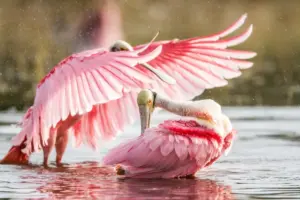
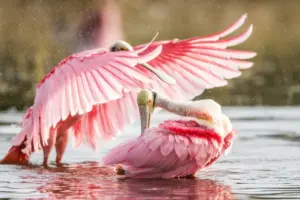
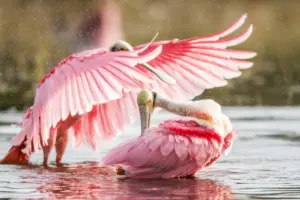
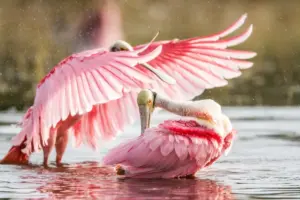
For species like the American Flamingo (Phoenicopterus ruber) and the Roseate Spoonbill (Platalea ajaja), pink is not an intrinsic genetic trait but a badge earned through consumption. These birds feed on aquatic organisms—such as brine shrimp, crabs, crayfish, and small fish—that ingest microalgae packed with carotenoids. These natural red, orange, and yellow pigments are broken down during digestion and deposited into the growing feathers. Consequently, a flamingo or spoonbill kept in captivity on a carotenoid-deficient diet will gradually fade to a stark, chalky white.
2. Structural Iridescence: The Hummingbirds
Hummingbirds do not possess pink pigments in their feathers at all. Instead, males of species like Anna’s, Calliope, and Broad-tailed hummingbirds owe their electric pink gorgets and crowns to microscopic, air-filled platelet structures within the barbules of their feathers. When light strikes these microscopic "pancake" structures, it refracts constructive light waves, producing a brilliant, iridescent flash that changes depending on the viewing angle.
3. Genomic Expression: The Finches
For North America’s finches—including the Purple Finch, Cassin’s Finch, and the rare Rosy-Finches—red and pink plumage is determined at the genomic level. These birds metabolize dietary pigments differently, converting them into chemical compounds that deposit red and pink tones directly into their keratin structures as their feathers grow during the annual molt.
Iconic Giants: Flamingos and Spoonbills
North America boasts two large, long-legged waders that immediately command attention. Though they share ecological niches in southern wetlands, distinguishing between them is straightforward once key anatomical features are observed.
+------------------+-----------------------------+-----------------------------+
| Feature          | American Flamingo           | Roseate Spoonbill           |
+------------------+-----------------------------+-----------------------------+
| Body Color       | Entirely pink               | Pink body, white neck,      |
|                  |                             | greenish head               |
+------------------+-----------------------------+-----------------------------+
| Bill Morphology  | Heavily curved, black tip;  | Long, flat, spatulate tip;  |
|                  | inverted foraging           | tactile sweep foraging      |
+------------------+-----------------------------+-----------------------------+
| Geographic Range | Historically vagrant;       | Year-round Gulf Coast &     |
|                  | establishing in Florida     | southern Florida            |
+------------------+-----------------------------+-----------------------------+
The American Flamingo (Phoenicopterus ruber)
Popular perception often casts the American Flamingo as a common Florida resident, but historical data paints a more complex picture. Scientists have long debated whether Florida ever hosted a stable, self-sustaining breeding population prior to human intervention. However, this paradigm is shifting. Wild vagrant birds, frequently displaced and blown northward by tropical storm systems and hurricanes, have increasingly taken up year-round residence in the Sunshine State, raising the prospect of newly established wild breeding colonies.
The flamingo is easily identified by its entirely pink plumage, long serpentine neck, and heavily specialized bill. This black-tipped, sharply curved mandible is engineered for inverted foraging, allowing the bird to scoop up muddy water and filter out microscopic food items while keeping its head upside down.
The Roseate Spoonbill (Platalea ajaja)
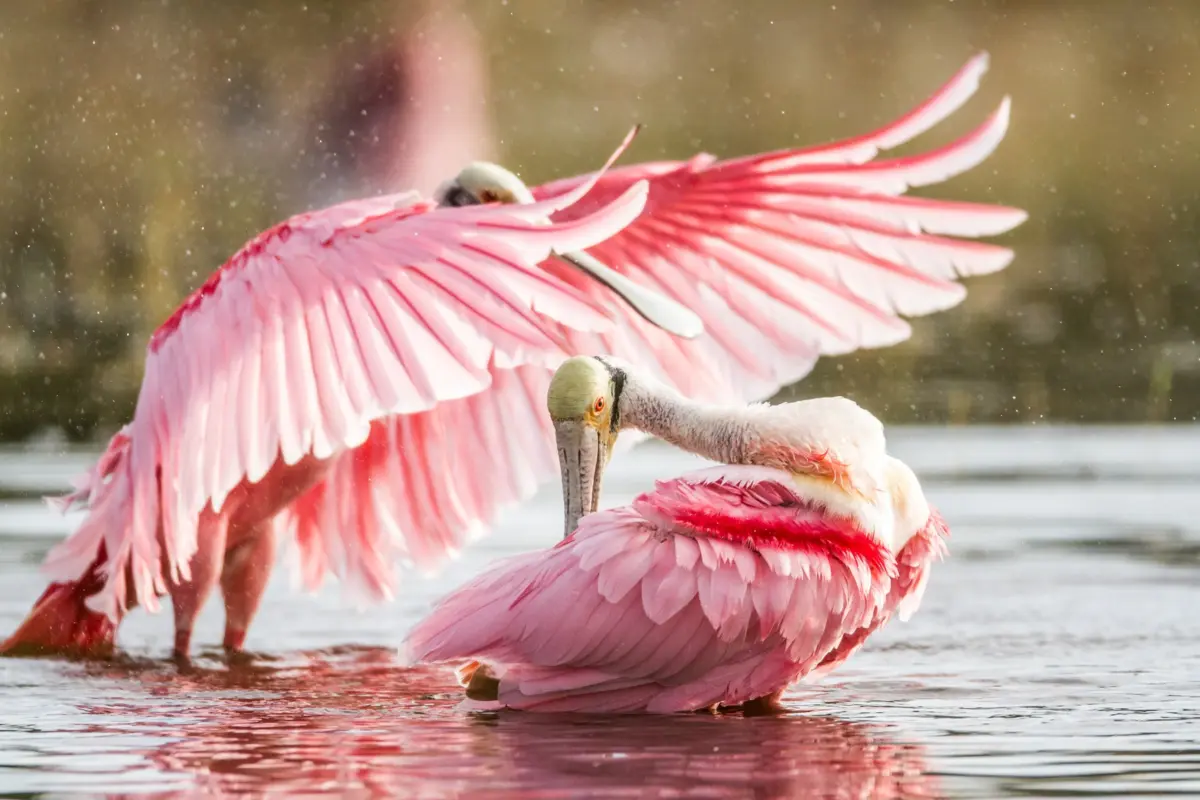
While far from abundant, the Roseate Spoonbill is a much more familiar sight to birders along the Gulf Coast and southern Florida, where healthy populations reside year-round. From a distance, a flying spoonbill’s rosy silhouette can mimic a flamingo, but its distinct anatomical architecture quickly gives it away.
Foraging in coastal shallows, tidal estuaries, and brackish wetlands, the spoonbill sweeps its long, spatula-tipped bill rhythmically from side to side. The bill is lined with sensitive nerve endings, allowing the bird to detect small fish, aquatic insects, and crustaceans by touch in murky water. Unlike the monochrome flamingo, the spoonbill features a clean white neck and a bare, greenish head. Recent ecological surveys indicate that the species is expanding its range northward, adapting to changing wetlands.
Backyard Gems: Common Pink Birds of the United States
For birders hoping to catch a glimpse of pink without mounting an expedition into remote backcountry or deep wetlands, backyard feeders and western gardens offer steady opportunities.
Anna’s Hummingbird (Calypte anna)
When the crown and gorget of a male Anna’s Hummingbird catch the direct sun, they flare into an unmistakable electric pink. Unlike many hummingbird species that display iridescent throat patches only when viewed from specific angles, male Anna’s boast iridescent feathers across both their crown and throat. A frequent visitor to suburban gardens and nectar feeders, this resilient species is established year-round along the entire West Coast and extends eastward into southern Arizona.
Calliope Hummingbird (Stellula calliope)
Sizing up as the smallest breeding bird in North America, the male Calliope sports a unique, patchy gorget that fans outward around its neck, gleaming in shades from soft pink to vibrant magenta. During the breeding season, these diminutive travelers inhabit the Intermountain West, Northern California, the Pacific Northwest, and parts of western Canada.
Broad-tailed Hummingbird (Selasphorus platycercus)
A fixture of the mountain West and southwestern states, male Broad-tailed Hummingbirds wear a rose-pink gorget that shines against a white breast. Preferring high-elevation forests and alpine meadows, they readily visit backyard feeders within their range. In flight, the male’s wings generate a sharp, metallic buzzing sound that acts as an auditory signature.
Purple Finch (Haemorhous purpureus)
Despite its misleading moniker, the male Purple Finch is washed in deep crimson, rose, and light pink hues that often look as though the bird has been dipped in raspberry juice. Found year-round in the Northeast, around the Great Lakes, and along the West Coast, many Purple Finches breed in Canada’s vast boreal forests before migrating to overwinter across the eastern United States. They are regular visitors to platform and tube feeders, particularly during years when northern food shortages trigger massive southward migrations, known as "irruption years."
Cassin’s Finch (Haemorhous cassinii)
Closely resembling its cousin the Purple Finch, the male Cassin’s Finch features pinkish-red plumage that varies from soft rose on the breast and face to a brighter crimson on its spiky cap. A nomadic forager of the high western mountains, Cassin’s Finches prefer coniferous forests and frequently broadcast their rolling warbles from the topmost branches of tall trees.
The Holy Grails: Less Common and Rare Pink Rosy-Finches
For dedicated birders seeking a challenge, the North American continent houses three high-altitude specialists belonging to the genus Leucosticte. These rosy-finches are prized additions to any life list.
+------------------------+---------------------------------+---------------------------------+
| Species                | Primary Plumage Characteristics | Geographic Stronghold           |
+------------------------+---------------------------------+---------------------------------+
| Black Rosy-Finch       | Black/brown body, bold pink     | High elevations of the          |
|                        | wing and belly highlights       | Great Basin                     |
+------------------------+---------------------------------+---------------------------------+
| Brown-capped Rosy-Finch| Subdued brown body, lighter     | Highest peaks of the Rocky      |
|                        | pink highlights                 | Mountains (Wyoming to NM)       |
+------------------------+---------------------------------+---------------------------------+
| Gray-crowned Rosy-Finch| Extensive gray head, reduced    | Alaska south to California      |
|                        | black and pink                  | and northern Montana            |
+------------------------+---------------------------------+---------------------------------+
Black Rosy-Finch (Leucosticte atrata)
As a year-round resident of the most rugged, inaccessible elevations of the Great Basin, the Black Rosy-Finch is both rare and vulnerable. The male’s stark combination of deep black, rich brown, and gray body feathers offset by brilliant, shocking-pink highlights on the wings and belly creates a striking contrast. Its remote habitat makes it a prized target for intrepid listers.
Brown-capped Rosy-Finch (Leucosticte australis)
A close relative of the Black Rosy-Finch, the Brown-capped features a more subdued color profile. Its body leans heavily into warm brown tones rather than black or gray, and its pink highlights are softer. Its geographic range is among the most restricted of any North American bird, confined strictly to the windswept alpine zones of the Rocky Mountains from Wyoming down to New Mexico.
Gray-crowned Rosy-Finch (Leucosticte tephrocotis)
Morphologically similar to its black-feathered counterpart, the Gray-crowned Rosy-Finch is distinguished by extensive gray on the cheeks and crown, accompanied by less extensive black and pink on the body. As the most widespread of the three rosy-finches, this species nests across western Alaska and the high peaks of California and Montana, descending into the Intermountain West during the winter months.
Field Guide: Where and How to Locate North America’s Pink Avifauna
Because true pink birds are thinly distributed across North American ecosystems, successful observation requires targeted fieldcraft and geographic precision.
- Coastal Waders: To observe Roseate Spoonbills with consistency, travel to designated sanctuaries along the Gulf Coast, such as Florida’s J.N. "Ding" National Wildlife Refuge or Texas’s Smith Oaks Rookery. For American Flamingos, historical vagrancy zones in the Florida Everglades, Biscayne Bay, and the Florida Keys offer the highest probability of sightings.
- Hummingbird Habitats: Mountain trails throughout the West during late spring and summer provide ideal settings for spotting Calliope and Broad-tailed hummingbirds. Along the Pacific Coast, Anna’s Hummingbirds can be located in nearly any urban park, garden, or residential neighborhood.
- The Rosy-Finch Summit: Birders hoping to check off all three rosy-finches in a single excursion must venture to high-altitude outposts. The ultimate destination is Sandia Crest, New Mexico, widely recognized as the only location in North America where all three rosy-finch species regularly congregate at winter feeders.
Habitat Management: Attracting Pink Birds to Your Property
While establishing a coastal salt marsh in a suburban backyard is impractical, homeowners outside of Florida and the Gulf Coast can successfully attract several pink species by tailoring their landscaping and feeding stations.
+------------------------+----------------------------------+----------------------------------+
| Target Species         | Preferred Food Source            | Feed / Plant Recommendation      |
+------------------------+----------------------------------+----------------------------------+
| Anna's, Calliope, &    | High-sucrose floral nectar       | Commercial nectar feeders with   |
| Broad-tailed Hummers   | and artificial sugar solutions   | a 4:1 water-to-sugar ratio       |
+------------------------+----------------------------------+----------------------------------+
| Purple & Cassin's      | High-oil seeds and grains        | Black oil sunflower seeds,       |
| Finches                |                                  | safflower, and millet mixes      |
+------------------------+----------------------------------+----------------------------------+
Attracting Hummingbirds
To draw Anna’s, Calliope, and Broad-tailed hummingbirds to a residential garden, deploy standard nectar feeders filled with a clean, un-dyed sugar water solution (standardized at a 4-to-1 ratio of water to refined white sugar). Avoid commercial red dyes, which are unnecessary and potentially harmful to avian metabolisms. Supplement feeders by planting native, tubular flowering perennials such as sage (Salvia), penstemon, and trumpet creeper.
Attracting Finches
Purple and Cassin’s finches can be drawn to residential yards by stocking platform or tube feeders with high-oil seeds. Black oil sunflower seeds are the universal favorite, supplemented by safflower and nyjer seed. Maintaining a reliable fresh water source, such as a heated bird bath during colder months, will further increase backyard traffic.
Frequently Asked Questions (FAQ)
Q: What is the single most common pink bird in North America?
A: Among birds displaying true pink plumage, the Broad-tailed Hummingbird and Anna’s Hummingbird are the most widespread and abundant across western regions. Simultaneously, Cassin’s and Purple Finches are common and widespread across their respective woodland ranges, though their coloration leans more heavily toward rose and crimson.
Q: Why do flamingos and spoonbills lose their color in captivity?
A: Captive flamingos and spoonbills require specialized diets enriched with carotenoid pigments (derived from specific algae, crustaceans, and specialized feed additives). Without these dietary precursors, their newly grown feathers emerge white during the annual molt.
Q: How do the foraging bills of flamingos and spoonbills differ?
A: The American Flamingo utilizes a short, heavily hooked bill designed for filtering microscopic organisms while feeding upside down in shallow water. In contrast, the Roseate Spoonbill employs a long, flat, spatula-tipped bill equipped with dense networks of sensitive nerve endings, sweeping back and forth through soft mud to detect hidden aquatic prey by touch.
Q: Are rosy-finches considered endangered?
A: While not globally extinct, populations of Black, Brown-capped, and Gray-crowned rosy-finches face localized pressures from habitat loss, changing climate dynamics at high alpine zones, and warming temperatures. Their specialized reliance on extreme high-elevation microclimates makes them subjects of ongoing ornithological study and conservation monitoring.